Executive Snapshot
- Client type: Boutique financial advisory and wealth-planning firm
- Industry: Wealth management / financial advisory
- Core problem: Advisors spent too much time turning client conversations, emails, portfolio notes, and recommendation logic into complete compliance records.
- Why agentic AI: The workflow required evidence gathering, structured drafting, source linking, gap detection, and human approval rather than a single chatbot response or fixed automation script.
- Deployment stage: Prototype-to-pilot design
- Primary result: The firm shifted from memory-heavy manual documentation to a governed evidence-to-draft-to-review workflow, reducing advisor admin effort while improving review consistency.
1. Business Context
The client was a small independent financial advisory firm serving affluent professionals, retirees, family business owners, and conservative investors. Advisors held recurring review meetings, handled portfolio update requests, and documented suitability assessments, risk profiles, investment rationales, client objections, disclosures, and follow-up actions. The work occurred after nearly every client interaction and drew from meeting notes, email threads, CRM records, product sheets, risk questionnaires, and portfolio summaries. Delays mattered because a missing rationale or vague risk note could turn an otherwise reasonable advisory decision into a weak compliance record. The firm did not lack advisory expertise; it lacked a repeatable way to convert advisory work into audit-ready evidence.
2. Why Simpler Automation Was Not Enough
A fixed script could not solve this workflow because the inputs were messy and the decision path changed from case to case. One meeting might involve a retirement-income review; another might involve a client rejecting a lower-risk product; a third might require an escalation because the requested investment no longer matched the recorded risk profile. A basic chatbot could summarize a transcript, but it would not reliably identify missing evidence, preserve source links, separate advisor judgment from AI-generated draft language, or route uncertain cases back to the right human reviewer. The analytical point from the agentic AI literature is that the value comes from governed delegation: bounded agents perform evidence intake, drafting, mapping, and checking, while humans retain authority over judgment, approval, and exceptions.123
3. Pre-Agent Workflow
Before the agent was introduced, the firm operated through a human-coordination-heavy process:
- Advisor conducts the client meeting or receives advisory communication. The primary record begins as a conversation, email thread, handwritten note, or portfolio discussion.
- Advisor manually gathers source materials. Relevant emails, risk questionnaires, prior notes, product sheets, and portfolio files are pulled from different locations.
- Advisor drafts the record from memory and raw notes. The advisor writes the meeting summary, risk profile update, suitability assessment, and recommendation rationale.
- Operations or the advisor uploads the record. Notes are saved into the CRM or compliance folder, often with uneven formatting and incomplete source references.
- Compliance reviewer checks the file. The reviewer looks for missing fields, weak rationales, unsupported statements, and policy mismatches.
- Advisor revises after comments. The file may return to the advisor for clarification, creating delay and context loss.
- Final record is archived. The approved file becomes the compliance record, but the quality depends heavily on the advisor’s writing discipline and memory.
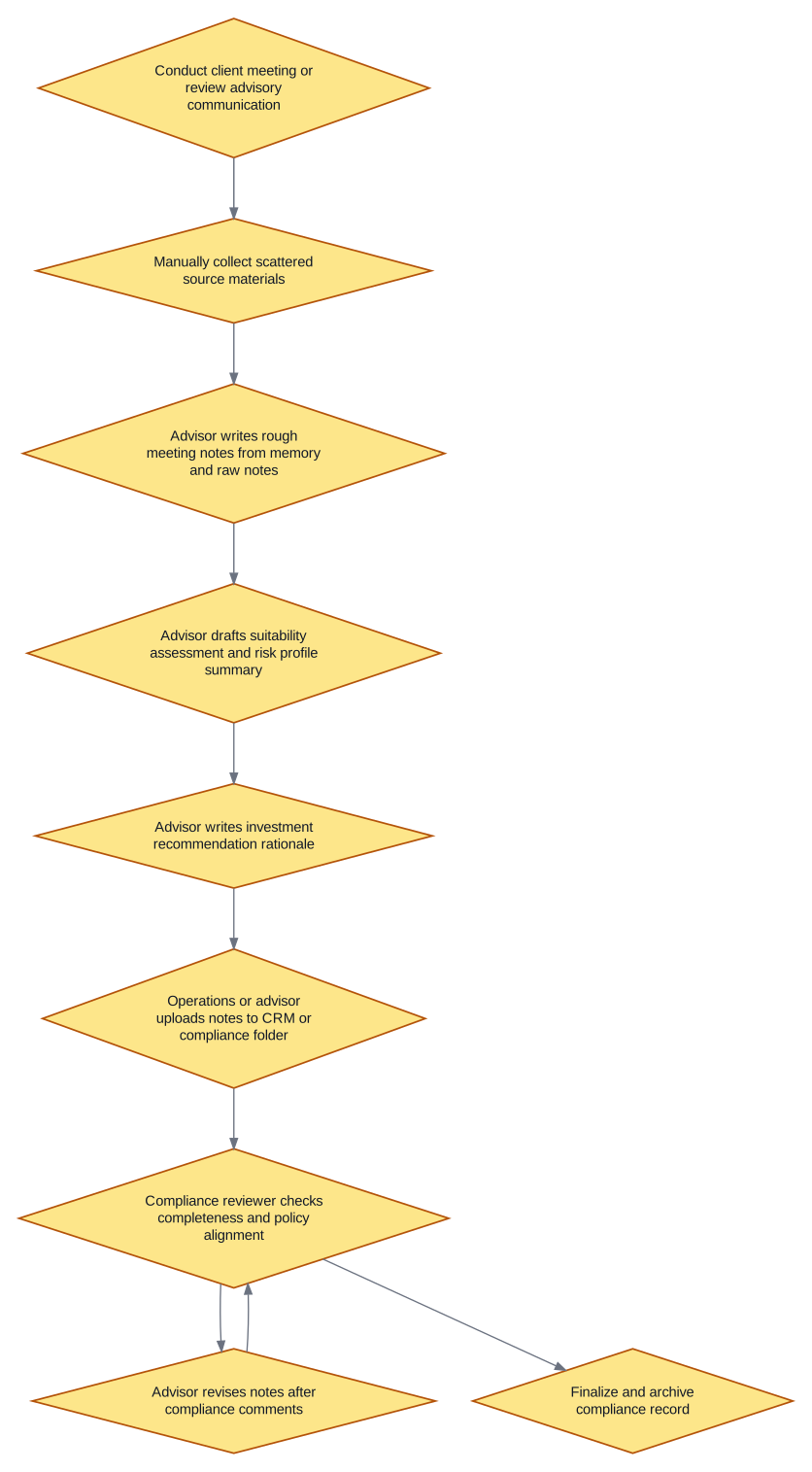
Key pain points:
- Advisor time was absorbed by writing and reconstruction rather than client service.
- Compliance review often focused on missing information instead of substantive risk.
- Suitability rationales varied across advisors, making review standards harder to apply.
- Evidence trails were fragmented across CRM notes, emails, transcripts, and portfolio files.
- The review loop was slow because questions often appeared days after the original meeting.
4. Agent Design and Guardrails
The AI Compliance Documentation Agent was designed as a documentation system, not an autonomous financial advisor. Its job was to transform authorized raw materials into structured, source-linked drafts for human review.
- Inputs: meeting transcripts, advisor notes, client emails, CRM records, portfolio summaries, risk questionnaires, approved product factsheets, and internal compliance templates.
- Understanding: evidence intake, entity extraction, source mapping, client-goal tagging, risk-signal extraction, and unresolved-issue identification.
- Reasoning: template selection, suitability-support drafting, missing-field detection, source-consistency checks, and escalation-rule application.
- Actions: draft meeting summaries, draft suitability notes, prepare investment-rationale records, generate compliance checklists, flag missing evidence, and create advisor follow-up tasks.
- Memory/state: client profile version, previous meeting record, open compliance questions, reviewer comments, and final approval status.
- Human review points: advisor review before submission, compliance review before archive, advisor correction after reviewer comments, and workflow-owner monitoring of system quality.
- Out-of-scope actions: final investment recommendations, client-facing advice without approval, product selection, risk-profile override, or final compliance sign-off.
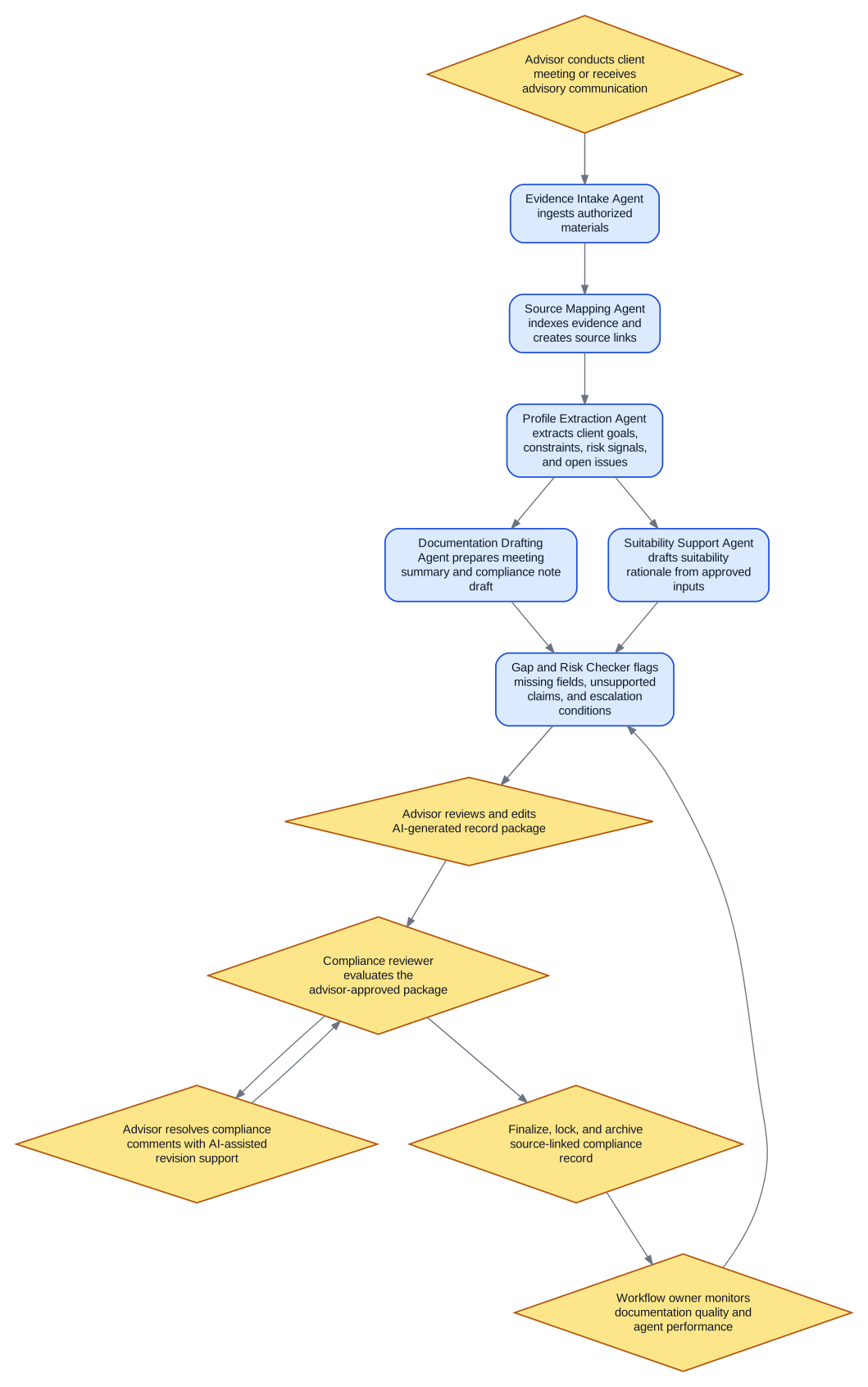
The system used a modular agent design: an Evidence Intake Agent collected approved materials; a Source Mapping Agent created traceable references; a Profile Extraction Agent identified goals, constraints, risk signals, and open issues; a Documentation Drafting Agent produced the meeting note; a Suitability Support Agent drafted the rationale; and a Gap and Risk Checker flagged missing documentation or escalation conditions. This decomposition follows the same principle found in financial compliance and financial-services agentic systems: separate agents should have bounded roles, explicit handoffs, traceable outputs, and auditable logs.345
5. Post-Agent Workflow
After the agent was introduced, the workflow changed from “advisor writes everything manually” to “agent prepares a reviewable evidence package.”
- Advisor conducts the meeting or receives client communication. The human advisory interaction remains the trigger.
- Evidence Intake Agent ingests authorized materials. Transcripts, emails, CRM notes, risk questionnaires, and portfolio files are collected under access-control rules.
- Source Mapping Agent links evidence. Important claims are tied back to source documents, timestamps, or prior records.
- Profile Extraction Agent identifies advisory facts. Client goals, constraints, investment horizon, liquidity needs, risk signals, preferences, and unresolved questions are extracted.
- Documentation Drafting Agent prepares the record package. The system drafts the meeting summary, risk-profile update, suitability note, investment rationale, and follow-up list.
- Gap and Risk Checker reviews the draft. Missing fields, unsupported statements, stale risk profiles, and escalation conditions are flagged before human review.
- Advisor reviews and edits. The advisor confirms factual accuracy, clarifies judgment, removes unsupported language, and approves the package for compliance review.
- Compliance reviewer evaluates the advisor-approved package. The reviewer focuses on policy alignment, suitability logic, exceptions, and evidence quality.
- Advisor resolves compliance comments with AI-assisted revision support. The agent helps revise language and locate missing evidence, but the advisor remains accountable.
- Final record is locked and archived. The approved record is stored with source links, reviewer identity, timestamps, and version history.
- Workflow owner monitors quality. The firm tracks error patterns, review comments, missing-field rates, and agent output quality.
6. One Workflow Walkthrough
A long-term client requested a portfolio shift toward higher-yield income products during a quarterly review. The advisor discussed the client’s retirement cash-flow goal, discomfort with short-term volatility, and preference for familiar products. After the meeting, the Evidence Intake Agent ingested the transcript, the latest risk questionnaire, the prior portfolio review note, and the approved product factsheet. The Profile Extraction Agent identified an important tension: the client wanted higher income but had a moderate risk profile and limited tolerance for drawdowns. The Suitability Support Agent drafted a rationale explaining why the recommended allocation was partial rather than aggressive. The Gap and Risk Checker flagged that the client’s liquidity requirement was mentioned in the meeting but not present in the latest profile form. The advisor added clarification and approved the revised package. Compliance then reviewed the suitability logic, requested one wording change, and approved the final source-linked record for archive.
7. Results
- Baseline period: Four-week pre-pilot workflow review
- Evaluation period: Six-week prototype pilot
- Workflow scope/sample: Recurring client review meetings, portfolio adjustment discussions, and recommendation update notes
- Process change: Advisor documentation time was estimated to fall from 45–60 minutes per meeting to 12–18 minutes for standard cases. Same-day record completion improved because the first draft was generated while context was still fresh.
- Decision/model change: Compliance comments shifted from basic missing-field corrections toward substantive review of suitability logic, exception handling, and source quality.
- Business effect: For a five-advisor team, the workflow could release roughly 20–25 advisor hours per month from administrative drafting and rework, while improving consistency in meeting summaries and rationale structure.
- Evidence status: Prototype/pilot estimate. These figures should be validated through a controlled time-and-motion study before being reported as production results.
The most important result was not that the AI wrote faster. It was that the firm changed the review object. Compliance no longer received a loose narrative assembled from memory; it received a structured record package with source links, missing-evidence flags, advisor edits, and review history.
8. What Failed First and What Changed
The first version of the agent overproduced polished language. In several cases, the draft sounded complete even when the underlying evidence was incomplete. That created a dangerous failure mode: fluent documentation could hide weak support. The design was changed so that source mapping and gap detection came before final drafting. Any unsupported claim had to be marked as “needs advisor confirmation,” and the agent was required to separate confirmed evidence from inferred or missing information. The remaining limitation is that the agent cannot know whether a recommendation is truly suitable when the client profile itself is outdated or incomplete. Those cases must escalate to the advisor and compliance reviewer.
9. Transferable Lesson
- Automate evidence preparation before automating prose. In regulated workflows, a polished paragraph is less valuable than a source-linked record.
- Keep judgment and accountability human-owned. The agent can draft, check, and route, but advisors and compliance reviewers must approve the final record.
- Design for exception handling from day one. The workflow should assume missing data, conflicting notes, stale client profiles, and ambiguous suitability logic.
This case shows that agentic AI works best in regulated operations when it converts fragmented human work into structured, reviewable evidence without pretending to replace professional responsibility.
References
-
Chaojia Yu, Zihan Cheng, Hanwen Cui, Yishuo Gao, Zexu Luo, Yijin Wang, Hangbin Zheng, and Yong Zhao, “A Survey on Agent Workflow – Status and Future,” arXiv:2508.01186, https://arxiv.org/abs/2508.01186. ↩︎
-
Adem Ait, Javier Luis Cánovas Izquierdo, and Jordi Cabot, “Towards Modeling Human-Agentic Collaborative Workflows: A BPMN Extension,” arXiv:2412.05958, https://arxiv.org/abs/2412.05958. ↩︎
-
Henrik Axelsen, Valdemar Licht, and Jan Damsgaard, “Agentic AI for Financial Crime Compliance,” arXiv:2509.13137, https://arxiv.org/abs/2509.13137. ↩︎ ↩︎
-
“Co-Investigator AI: The Rise of Agentic AI for Smarter, Trustworthy AML Compliance Narratives,” arXiv:2509.08380, https://arxiv.org/abs/2509.08380. ↩︎
-
Izunna Okpala, Ashkan Golgoon, and Arjun Ravi Kannan, “Agentic AI Systems Applied to tasks in Financial Services: Modeling and model risk management crews,” arXiv:2502.05439, https://arxiv.org/abs/2502.05439. ↩︎