Executive Snapshot
- Client type: Mid-sized private outpatient clinic
- Industry: Healthcare / outpatient clinical services
- Core problem: Front-desk staff were overloaded by patient inquiries, while doctors received incomplete and poorly structured pre-consultation notes.
- Why agentic AI: The workflow required multi-step information collection, missing-field follow-up, red-flag escalation, appointment matching, insurance pre-checking, and doctor-facing summarization.
- Deployment stage: Prototype / pilot design
- Primary result: The clinic moved from a human-coordination-heavy workflow to a governed intake pipeline where AI agents prepare structured records and humans retain control over clinical judgment, appointment confirmation, emergency escalation, and final documentation.
1. Business Context
The clinic receives patient inquiries through phone calls, WhatsApp messages, email, website forms, and walk-ins. A small front-desk team handles identity collection, symptom questions, doctor availability, insurance or HMO information, appointment confirmation, and post-visit administrative cleanup. This workflow happens many times each day and is especially fragile during morning peaks, after weekends, and when visiting specialists have limited slots. The clinic already has basic calendars, message threads, and registration records, but much of the intake context remains scattered across chat histories, call notes, and staff memory. Delays matter because patients may abandon the booking, urgent cases may be treated like routine requests, and doctors may start consultations with only a vague note such as “stomach pain, wants appointment today.”
The analytical lens for this case is simple: the AI system should not replace clinical judgment; it should create a reliable workflow state between messy patient communication and human medical decision-making. Recent arXiv work on conversational triage, patient-message urgency ranking, and clinical documentation shows the same pattern: LLM systems are most useful when they elicit missing information, preserve context, rank or route cases, and produce reviewable summaries, but they require safety checks, bias monitoring, and clinician oversight before clinical action.12345
2. Why Simpler Automation Was Not Enough
A fixed chatbot could collect a form, but it would fail when patients describe symptoms vaguely, mix insurance questions with clinical concerns, send partial information, or change appointment preferences mid-conversation. A scheduling script could show available slots, but it could not decide whether the patient needs a general consultation, specialist visit, urgent same-day review, nurse callback, or emergency escalation. A dashboard could display pending inquiries, but it would not convert raw messages into a structured doctor briefing. The workflow needed stateful coordination: remember what had already been collected, ask targeted follow-up questions, apply red-flag rules, route uncertainty to staff, prepare insurance pre-checks, and update templates after doctor review.
The design principle is therefore agentic coordination under clinical guardrails, not autonomous diagnosis.
3. Pre-Agent Workflow
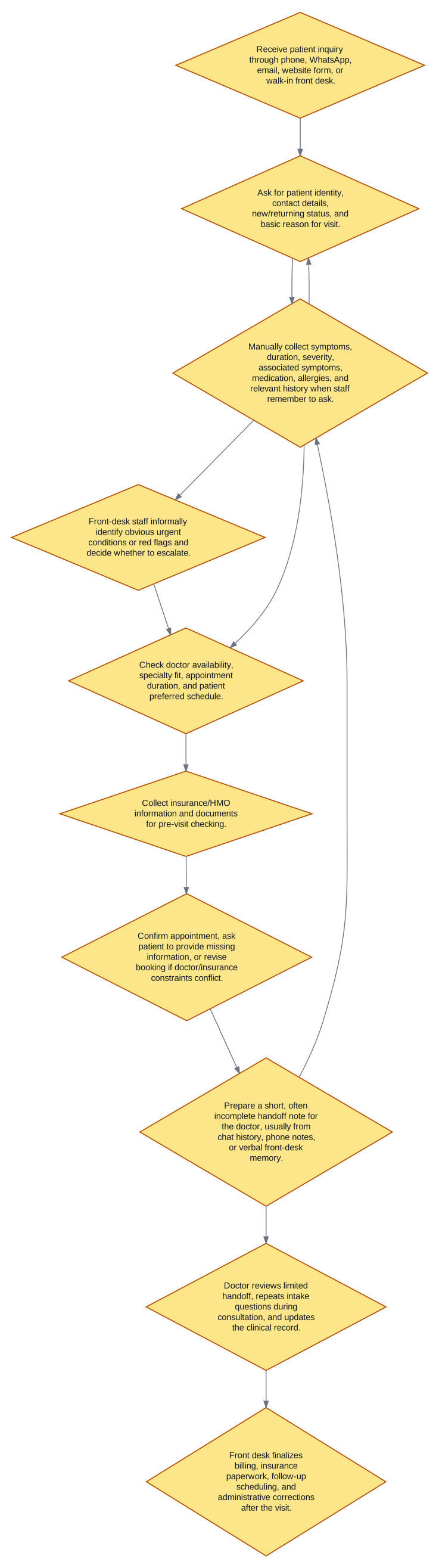
Before the agent system, the clinic’s intake process depended on front-desk staff manually coordinating every step:
- Patient inquiry arrives. A patient contacts the clinic by phone, WhatsApp, email, website form, or walk-in request.
- Staff collect basic identity and reason for visit. The front desk asks for name, age, contact details, new or returning patient status, and the basic complaint.
- Symptoms are collected inconsistently. Staff may ask about symptom duration, severity, associated symptoms, medication, allergies, and relevant history, but the exact questions vary by staff member, time pressure, and communication channel.
- Urgency is judged informally. Staff look for obvious warning signs and decide whether to escalate, but red-flag recognition depends on memory and experience.
- Scheduling and insurance are checked manually. Staff compare doctor availability, patient preference, appointment type, and insurance or HMO details.
- Doctor handoff is short and uneven. The doctor often receives a brief note assembled from chat history, phone memory, or a registration field.
- The doctor repeats intake during consultation. Because the handoff is incomplete, the doctor must reconstruct the history before clinical assessment.
- Admin cleanup happens after the visit. Billing, claim paperwork, follow-up scheduling, and corrections are handled after the consultation.
Key pain points:
- Incomplete intake records: Symptoms, medication, allergies, duration, and severity were often missing.
- Unclear escalation discipline: Urgent-sounding cases were not always separated from routine booking requests early enough.
- Doctor time leakage: Doctors spent consultation time rebuilding information that could have been collected before the visit.
- Staff overload: Front-desk staff had to switch between channels, calendars, insurance checks, and patient reassurance.
- Weak management visibility: Clinic leaders could not easily see where inquiries stalled, what fields were commonly missing, or which staff decisions required rework.
4. Agent Design and Guardrails
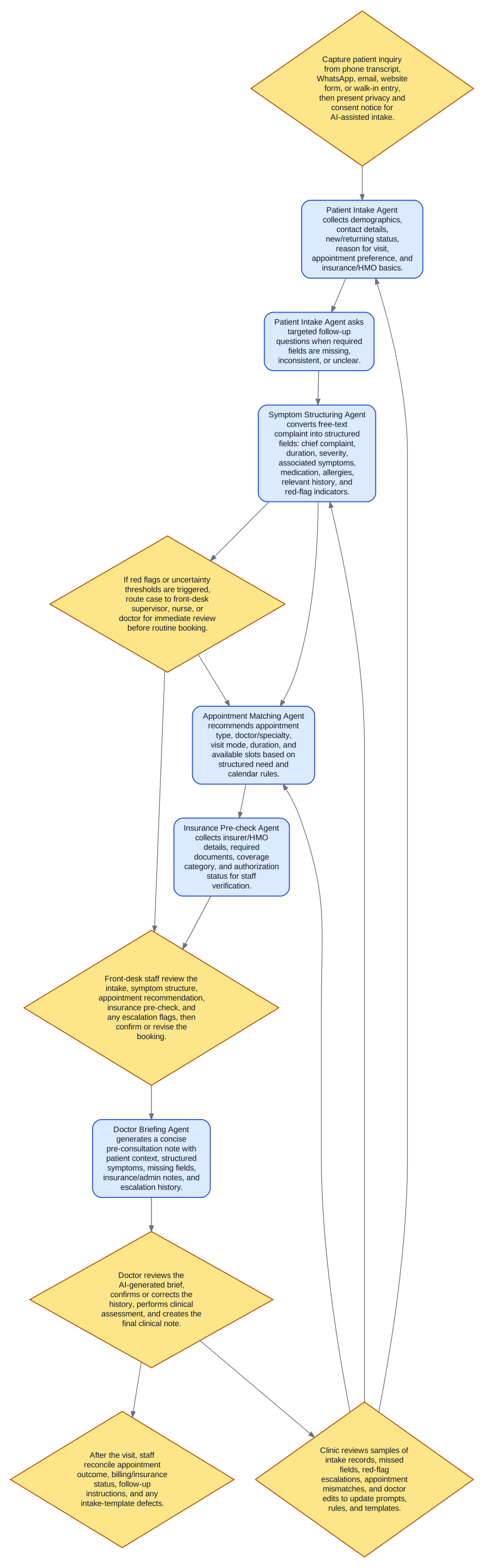
The post-agent workflow introduces five specialized agents: Patient Intake Agent, Symptom Structuring Agent, Appointment Matching Agent, Insurance Pre-check Agent, and Doctor Briefing Agent. They do not operate as a free-form medical chatbot. They operate as a controlled workflow layer.
- Inputs: Phone transcripts, WhatsApp messages, email, website forms, walk-in entries, patient registration records, doctor calendars, clinic scheduling rules, insurance/HMO requirements, and clinic-approved red-flag rules.
- Understanding: The system extracts identity, visit reason, symptom descriptions, duration, severity, associated symptoms, medication, allergies, patient preference, and insurance details.
- Reasoning: The agents check missing fields, apply non-diagnostic red-flag rules, recommend appointment type, match doctor availability, and prepare insurance verification tasks.
- Actions: The system asks targeted follow-up questions, prepares structured intake records, generates staff review queues, drafts doctor briefing notes, and logs escalation history.
- Memory/state: Each inquiry has a workflow state: missing fields, red-flag status, insurance status, appointment recommendation, staff confirmation, doctor review, and post-visit reconciliation.
- Human review points: Humans confirm identity and consent, review red-flag cases, approve or revise appointment recommendations, verify insurance, and finalize clinical documentation.
- Out-of-scope actions: The system does not diagnose, prescribe medication, promise insurance approval, make final emergency decisions, or replace the doctor’s medical record.
The most important guardrail is language control. The system describes symptoms as patient-reported information, not medical conclusions. For example, it can write “patient reports intermittent abdominal pain since yesterday evening,” but it should not write “likely gastritis.” This distinction preserves the AI’s role as intake infrastructure rather than medical authority.
5. Post-Agent Workflow
After implementation, the same patient inquiry becomes a structured, reviewable workflow:
- Inquiry capture and consent notice. The system captures the patient’s message or call transcript and presents a privacy and consent notice for AI-assisted intake.
- Patient Intake Agent collects required fields. It gathers identity, contact details, new or returning status, reason for visit, appointment preference, and basic insurance/HMO information.
- Missing-information loop runs automatically. If key fields are absent, the agent asks targeted follow-up questions instead of forcing staff to manually chase the patient.
- Symptom Structuring Agent creates a non-diagnostic summary. Free-text complaints are converted into chief complaint, duration, severity, associated symptoms, medication, allergies, relevant history, and possible red-flag indicators.
- Red-flag cases go to a human checkpoint. If urgency or uncertainty thresholds are triggered, the case is routed to front-desk supervisor, nurse, or doctor before routine booking.
- Appointment Matching Agent recommends a slot. It proposes appointment type, doctor or specialty, visit mode, duration, and available slots based on structured need and calendar rules.
- Insurance Pre-check Agent prepares verification. It collects payer details, required documents, coverage category, and possible authorization needs, without guaranteeing approval.
- Front desk confirms or revises the plan. Staff review the intake, escalation flags, appointment recommendation, and insurance status before confirming with the patient.
- Doctor Briefing Agent prepares a pre-consult note. The doctor receives a concise briefing with reported symptoms, missing fields, relevant admin notes, and escalation history.
- Doctor reviews and completes the consultation. The doctor confirms or corrects the history, performs clinical assessment, and creates the final clinical note.
- Management reviews quality. The clinic samples intake records, red-flag escalations, appointment mismatches, and doctor edits to improve rules and templates.
- Post-visit reconciliation closes the loop. Staff reconcile billing, insurance status, follow-up instructions, and any intake-template defects.
The new workflow does not remove people. It removes unstructured handoffs.
6. One Workflow Walkthrough
A parent sends a WhatsApp message at 8:15 a.m.: “My child has fever and rash. Can we see a pediatrician today? We have HMO.” The Patient Intake Agent asks for the child’s age, symptom duration, temperature range, breathing difficulty, medication already taken, allergies, and preferred time window. The Symptom Structuring Agent organizes the complaint into a non-diagnostic intake summary and marks two missing fields: exact temperature and allergy status. No emergency red-flag threshold is triggered, but the case is tagged as same-day pediatric priority because of age and symptom pattern. The Appointment Matching Agent finds an available pediatric slot and the Insurance Pre-check Agent requests the HMO card and authorization details. Front-desk staff review the summary, confirm the slot, and mark insurance as “pending verification.” Before consultation, the Doctor Briefing Agent sends the pediatrician a short note separating parent-reported symptoms from staff-verified information. The doctor confirms the history, updates the clinical note, and any corrections are logged for template improvement.
If the parent had reported difficulty breathing, severe lethargy, or rapidly worsening symptoms, the workflow would have stopped routine booking and routed the case to human escalation first.
7. Results
Because this case is at prototype / pilot design stage, the results below should be treated as a pilot measurement plan and expected operational impact, not production evidence.
- Baseline period: Two-week workflow discovery across normal clinic days and peak inquiry periods.
- Evaluation period: Proposed four-week pilot after front-desk training and doctor briefing-template approval.
- Workflow scope/sample: Phone, WhatsApp, email, website form, and walk-in inquiries that result in appointment requests, follow-up questions, insurance checks, or doctor handoff notes.
- Process change: Target 70–80% of booked appointments to have complete structured intake fields before staff confirmation; target 30–50% reduction in repetitive front-desk follow-up questions.
- Decision/model change: Red-flag cases should be routed to a human checkpoint before routine booking; doctor briefings should clearly separate patient-reported information from verified clinical conclusions.
- Business effect: Expected benefits include faster inquiry-to-booking cycles, fewer missed details, better doctor preparation, less front-desk interruption, and clearer management visibility into intake bottlenecks.
- Evidence status: Estimated / planned pilot. Production claims should not be made until the clinic measures completion rate, escalation accuracy, doctor-edit rate, patient satisfaction, and staff time savings.
The strongest near-term KPI is not “AI accuracy.” It is intake completeness before human confirmation. In this workflow, the agent’s job is to make the next human decision easier, safer, and faster.
8. What Failed First and What Changed
The first design risk was over-questioning. A generic medical chatbot can easily ask too many symptom questions, sound like it is diagnosing, or make patients anxious. The revised design uses shorter clinic-approved question sets, stops when required fields are complete, and escalates red flags instead of continuing conversation. Another early weakness was mixing administrative and clinical language. The fix was to separate every output into patient-reported symptoms, staff-verified information, insurance/admin status, and doctor-only clinical judgment. A limitation remains: the system still depends on clinic-approved red-flag rules, staff discipline, and doctor feedback. Without regular review, the workflow can drift back into inconsistent handoffs.
9. Transferable Lesson
- Do not start with diagnosis. Start with workflow state. The first value of AI in outpatient intake is knowing what information is missing, who must review it, and what action is safe next.
- Make escalation explicit. Red flags, insurance uncertainty, unclear identity, and conflicting appointment constraints should create human review tasks, not silent AI decisions.
- Use doctor edits as governance data. If doctors repeatedly correct the same briefing fields, the clinic should update intake prompts, templates, and rules rather than blaming the model.
This case shows that agentic AI works best in healthcare when it turns fragmented communication into governed, reviewable handoffs while keeping medical authority with humans.
Cognaptus: Automate the Present, Incubate the Future
References
-
Qi Shi, Qiwei Han, and Cláudia Soares, “C-PATH: Conversational Patient Assistance and Triage in Healthcare System,” arXiv:2506.06737, 2025. https://arxiv.org/abs/2506.06737 ↩︎
-
Sina Rashidian et al., “AI Agents for Conversational Patient Triage: Preliminary Simulation-Based Evaluation with Real-World EHR Data,” arXiv:2506.04032, 2025. https://arxiv.org/abs/2506.04032 ↩︎
-
Joseph Lee et al., “Investigating LLMs in Clinical Triage: Promising Capabilities, Persistent Intersectional Biases,” arXiv:2504.16273, 2025. https://arxiv.org/abs/2504.16273 ↩︎
-
Joseph Gatto et al., “Medical Triage as Pairwise Ranking: A Benchmark for Urgency in Patient Portal Messages,” arXiv:2601.13178, 2026. https://arxiv.org/abs/2601.13178 ↩︎
-
Kristina L. Kupferschmidt, Kieran O’Doherty, and Joshua A. Skorburg, “Write on Paper, Wrong in Practice: Why LLMs Still Struggle with Writing Clinical Notes,” arXiv:2509.04340, 2025. https://arxiv.org/abs/2509.04340 ↩︎