Executive Snapshot
- Client type: Small-to-mid-sized property management company managing roughly 80–300 residential rental units.
- Industry: Residential rental operations and property management services.
- Core problem: Tenant requests, repairs, rent reminders, lease renewals, contractor coordination, and owner reports were handled through fragmented human follow-ups across multiple channels.
- Why agentic AI: The workflow required intake, classification, context retrieval, task routing, communication drafting, exception escalation, and operational memory rather than a single chatbot response.
- Deployment stage: Prototype / controlled pilot design.
- Primary result: The operating model shifted from staff-memory-driven coordination to a governed AI-assisted workflow where humans focus on exceptions, approvals, and relationship-sensitive decisions.
1. Business Context
The company manages dozens or hundreds of rental units across apartment buildings, townhouses, and landlord-owned individual units. Its daily operation depends on fast coordination among tenants, property owners, contractors, leasing staff, and internal administrators. Requests arrive through email, phone calls, messaging apps, SMS, property portals, and direct conversations. A normal week may include leaking pipes, air-conditioning failures, noise complaints, late rent, lease-renewal questions, access issues, contractor invoices, and owner requests for updates. Delays matter because a missed repair follow-up can become a tenant complaint, an untracked lease expiry can become vacancy risk, and a vague owner report can weaken trust in the management company.
2. Why Simpler Automation Was Not Enough
The analytical point from the selected literature is that agentic AI creates operational value when it moves work from isolated assistance to framed autonomy: agents sense the current process state, retrieve context, decide the next bounded action, and escalate at commitment boundaries. Agentic BPM research distinguishes single-task automation from end-to-end process orchestration, while organizational-transition studies emphasize that high-value use cases are manual, repetitive, decision-intensive, and spread across systems or stakeholders.123 In rental operations, this matters because the same incoming message may require a routine acknowledgment, missing-information request, emergency repair escalation, owner approval, payment reminder, lease-sensitive response, or formal human review. A script or dashboard can remind staff what exists. A chatbot can draft a reply. But neither reliably manages the case state, evidence, next action, risk flag, approval rule, and learning loop across the whole rental workflow.
3. Pre-Agent Workflow
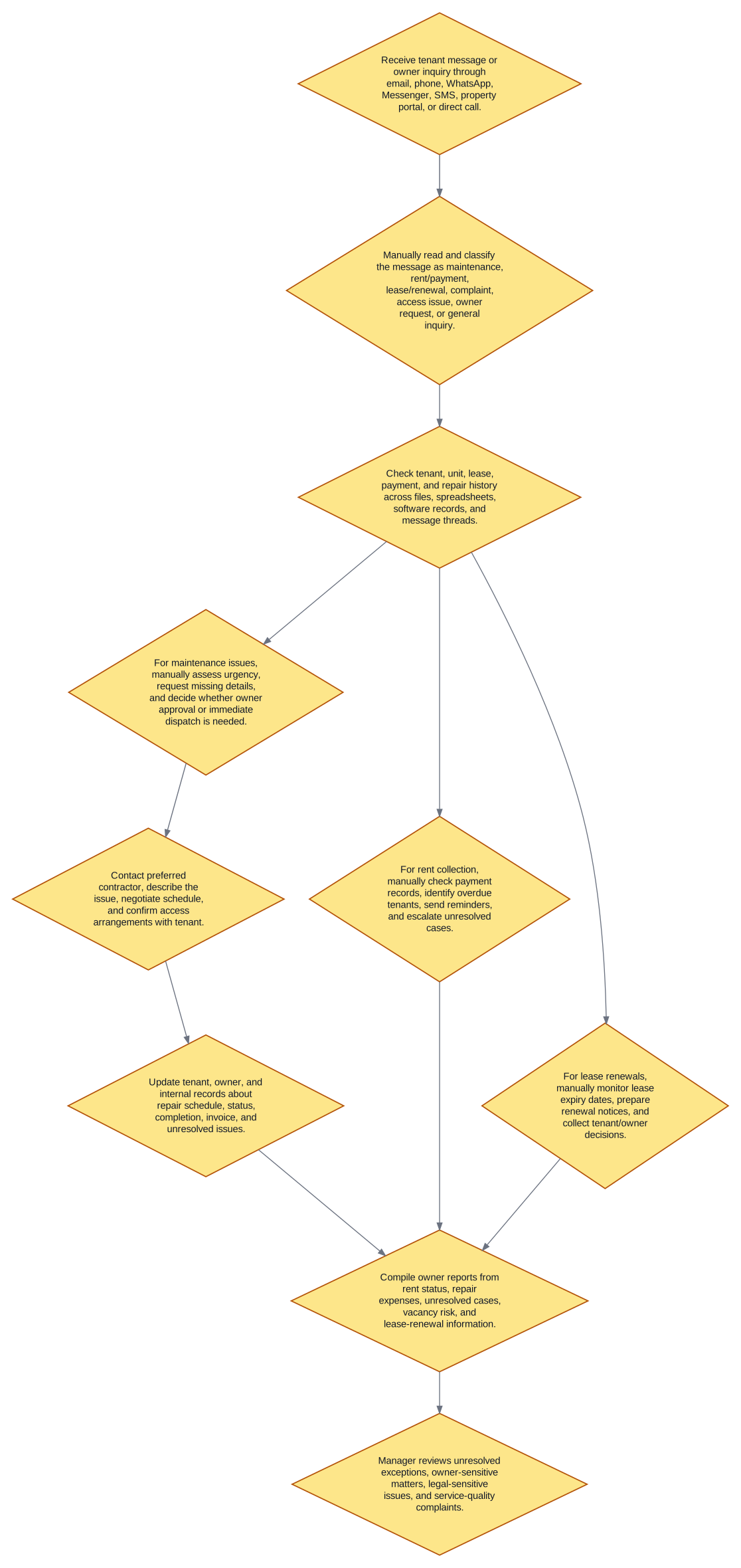
Before the redesign, rental operations were handled as a chain of manual coordination tasks.
- A tenant, owner, contractor, or staff member sent a message through email, phone, WhatsApp, Messenger, SMS, a property portal, or direct call.
- An admin or property manager manually read the message and classified it as maintenance, rent/payment, lease renewal, complaint, access issue, owner request, or general inquiry.
- The manager checked tenant, unit, lease, payment, repair, and owner records across spreadsheets, software tools, shared folders, and message threads.
- For maintenance cases, staff assessed urgency, requested missing details, contacted a contractor, confirmed tenant access, checked whether owner approval was needed, and updated the tenant manually.
- For rent, lease, and owner-reporting cases, staff checked ledgers or calendars, sent reminders, escalated unresolved items, and compiled reports from scattered records.
Key pain points:
- The workflow depended on individual memory. Staff had to remember open repairs, promised contractor visits, overdue rent follow-ups, lease-expiry dates, and owner preferences.
- Context reconstruction consumed management time. Before acting, employees had to search across ledgers, repair notes, leases, chat histories, and property records.
- Urgency and escalation were inconsistent. Emergency repairs, legal-sensitive messages, high-cost repairs, and formal notices relied on individual judgment rather than an explicit exception queue.
- Owner reporting was backward-looking and manual. Reports were assembled after the fact instead of being generated from live case state, repair status, and payment records.
- Learning was weak. Contractor reliability, repeated unit problems, tenant communication patterns, and human overrides were rarely converted into structured operational memory.
4. Agent Design and Guardrails
The redesigned system treated rental operations as a stateful process, not a collection of message drafts.
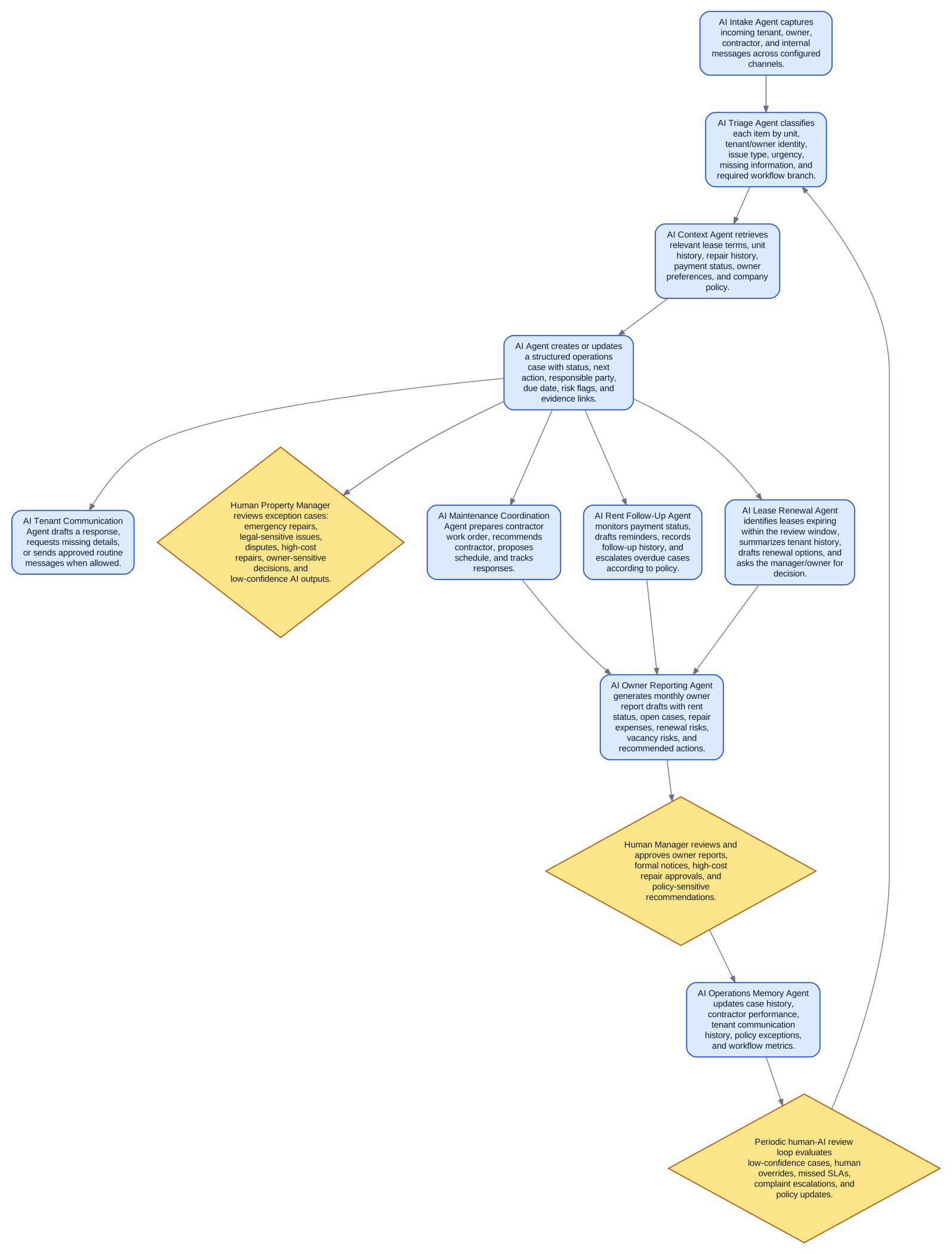
- Inputs: Tenant messages, owner inquiries, contractor replies, lease records, rent ledgers, unit repair histories, owner preferences, company SOPs, contractor lists, approval thresholds, and monthly reporting requirements.
- Understanding: The AI Intake Agent captures messages from authorized channels. The AI Triage Agent extracts unit identity, party role, issue type, urgency, missing fields, cost risk, lease sensitivity, and required workflow branch.
- Reasoning: The AI Context Agent retrieves relevant lease terms, payment status, repair history, unit history, owner instructions, and company policy. The system then creates or updates a structured operations case with status, next action, responsible party, due date, evidence links, and risk flags.
- Actions: The agent drafts tenant replies, creates repair work orders, recommends contractors from an approved list, tracks contractor responses, prepares rent reminders, surfaces lease renewals, and drafts owner reports.
- Memory/state: Each case preserves original message references, status, next-action date, assigned party, missing information, repair schedule, payment follow-up stage, renewal status, owner approval status, contractor response, and closure notes.
- Human review points: A human property manager reviews emergency repairs, legal-sensitive issues, disputes, high-cost repairs, owner-sensitive recommendations, formal notices, low-confidence classifications, and external reports.
- Out-of-scope actions: The agent cannot approve high-cost repairs, change lease terms, issue formal legal notices, terminate leases, approve compensation, select unapproved vendors, override owner instructions, or send high-risk escalation messages without human approval.
The guardrail design follows the same logic found in governance-oriented agent frameworks: information should be gathered before commitment, approval boundaries should be explicit, and human corrections should feed future policies, templates, and stop hooks.45
5. One Workflow Walkthrough
When a tenant reported that an air-conditioning unit had stopped working during a weekend, the system first captured the message and created an intake record linked to the tenant, unit, and original communication channel. The AI Triage Agent classified the issue as maintenance, marked it as comfort-sensitive but not automatically life-safety-critical, and detected missing details: appliance model, error signs, photos, and preferred access times. The AI Context Agent retrieved the unit’s repair history and found two prior AC service tickets within the past year. Because repeated repairs could imply a higher-cost replacement decision, the case was routed to the manager review queue after a routine missing-information reply was drafted. Once the tenant supplied details, the Maintenance Coordination Agent prepared a work order, recommended an approved HVAC contractor, proposed schedule windows, and attached the unit history. The manager approved the contractor dispatch but reserved any replacement decision for owner approval. The final case was logged with status, follow-up date, contractor response, and owner-reporting note.
6. Results
- Baseline period: Pre-pilot diagnostic of manual rental operations, using recent maintenance tickets, rent reminders, lease-renewal records, and owner-reporting cycles as the comparison base.
- Evaluation period: Controlled pilot design covering the first 6–8 weeks of AI-assisted operations before any full production rollout.
- Workflow scope/sample: Tenant complaints, routine and urgent repairs, contractor scheduling, rent follow-up, lease-renewal monitoring, and monthly owner-report drafting.
- Process change: Intake, classification, context retrieval, case creation, next-action assignment, and routine drafting moved from manual reconstruction to structured AI-assisted workflow execution.
- Decision/model change: The system no longer optimized only for faster replies. It optimized for operational completeness: issue category, unit context, urgency, missing information, approval requirement, next-action owner, and escalation path.
- Business effect: Expected benefits include shorter first-response time, fewer unassigned open cases, faster repair scheduling, more consistent rent follow-up, earlier lease-renewal outreach, and less manual time spent preparing owner reports.
- Evidence status: Prototype / controlled pilot design. Production metrics such as average first response time, time to schedule repair, overdue follow-up completion rate, renewal notice lead time, owner report preparation time, and human override rate should be measured during deployment.
The practical result is not simply that messages become more polished. The more important change is that each rental issue becomes a managed case: what happened, what evidence exists, what policy applies, who must act next, and when a human must approve the next step.
7. What Failed First and What Changed
The first version would likely fail if it were designed only as a tenant-message chatbot or email drafter. That design would answer faster but still leave the company dependent on human staff to search records, identify urgency, chase contractors, remember owner preferences, track overdue rent, and prepare reports. The redesign changed the sequence: intake and evidence assembly happen before drafting; case status is created before communication; human review is triggered by rule-based and confidence-based boundaries; and case memory is updated after completion. The remaining limitation is integration quality. The agent is only as reliable as the lease, ledger, repair, contractor, and communication data it can access.
8. Transferable Lesson
- Start with the operating loop, not the message. Rental operations improve when AI manages intake, context, state, routing, and follow-up—not merely when it writes better replies.
- Put humans at the commitment boundary. AI can prepare repair actions, reminders, reports, and recommendations, but humans should approve decisions involving legal exposure, cost thresholds, lease rights, compensation, owner relationships, and disputes.
- Make memory operational. Contractor performance, repeated unit issues, late-payment follow-up, tenant complaints, and owner decisions should become structured workflow memory rather than scattered notes.
This case shows that agentic AI works best where organizations need to convert fragmented operational signals into structured, reviewable, and accountable action.
References
-
“Agentic Business Process Management: The Past 30 Years And Practitioners’ Future Perspectives”, arXiv:2504.03693, https://arxiv.org/html/2504.03693v1 ↩︎
-
“Agentic Business Process Management Systems”, arXiv:2601.18833, https://arxiv.org/html/2601.18833v1 ↩︎
-
“A Practical Guide to Agentic AI Transition in Organizations”, arXiv:2602.10122, https://arxiv.org/html/2602.10122v1 ↩︎
-
“GAIA: A General Agency Interaction Architecture for LLM-Human B2B Negotiation & Screening”, arXiv:2511.06262, https://arxiv.org/html/2511.06262v1 ↩︎
-
“DoubleAgents: Human-Agent Alignment in a Socially Embedded Workflow”, arXiv:2509.12626, https://arxiv.org/html/2509.12626v3 ↩︎