Executive Snapshot
- Client type: Mid-sized e-commerce operator with outsourced manufacturing and third-party logistics.
- Industry: Online retail and consumer-goods supply chain operations.
- Core problem: Supplier and logistics outreach was treated as an email-writing task, so messages were polite but operationally weak.
- Why agentic AI: The workflow required evidence gathering, risk diagnosis, supplier accountability, logistics reasoning, sustainability checks, and human approval before external action.
- Deployment stage: Prototype / controlled pilot design.
- Primary result: The agent shifted outreach from generic communication support to structured supply-chain decision support.
1. Business Context
The company sells SKU-heavy consumer products through online marketplaces and its own direct-to-consumer channel. Its supply chain depends on manufacturers, freight partners, warehouses, and last-mile providers. The outreach workflow occurred whenever an operational exception appeared: a supplier delay, inventory shortage, quality issue, logistics handover problem, cost increase, or missing compliance document. Staff typically worked from order records, inventory sheets, email threads, shipment updates, and supplier notes. Errors mattered because a vague message could delay recovery by another day, and one day could be enough to create stockout risk, marketplace penalties, refund pressure, or customer-service escalation.
2. Why Simpler Automation Was Not Enough
The first version automated only the surface layer of the workflow: writing a supplier email. That was useful but insufficient. Supply-chain outreach is not a single text-generation task. It branches by issue type, supplier history, inventory exposure, logistics milestone, contract leverage, and compliance sensitivity. A fixed script could not reliably decide whether the message should request a revised production date, a partial shipment, a carrier handover proof, a commercial concession, or a sustainability certificate. The analytical point from the reference literature is simple: agentic AI creates value when specialized agents compress coordination costs by turning messy operational inputs into governed handoffs, typed decisions, and reviewable outputs—not when it merely adds more personas to drafting.12345
3. Pre-Agent Workflow
Before the redesign, the workflow looked like a communication loop rather than an operational-control loop.
- An operations employee noticed a supply-chain issue, usually from an order update, shipment delay, inventory gap, or supplier email.
- A human manager manually reconstructed the context from fragmented systems and wrote a short instruction for the AI assistant.
- A basic summarizer converted the instruction into a simple email objective.
- The Email Drafter produced a polite supplier or logistics-partner message.
- A message reviewer checked grammar, tone, and formatting.
- A human employee edited the email, sent it externally, interpreted the reply, and manually decided whether to escalate.
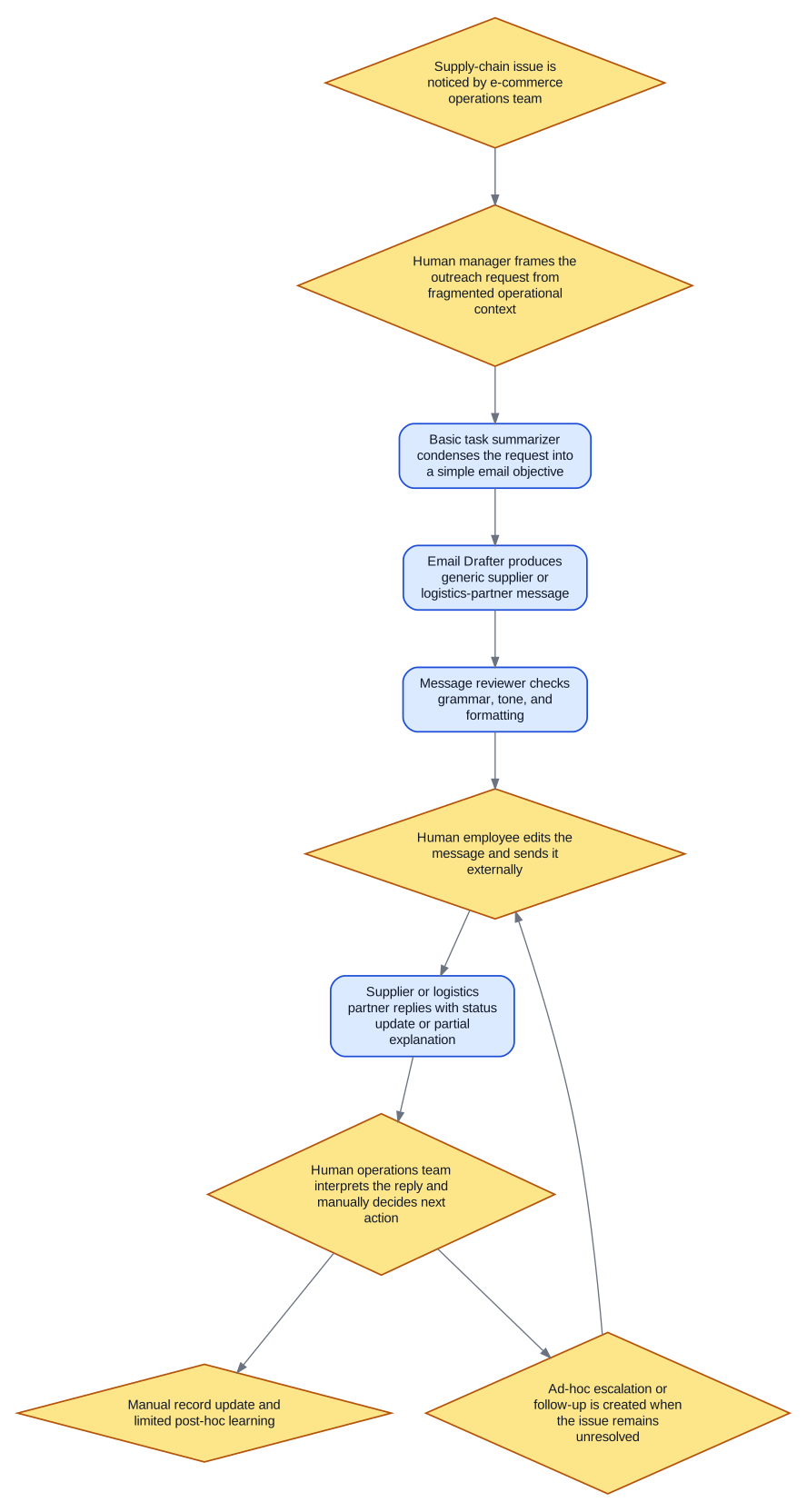
Key pain points:
- The agent had no operational memory. It did not retain supplier response quality, issue history, promised recovery dates, or unresolved evidence gaps.
- The workflow depended on human reconstruction. The manager had to decide what mattered before the system could help.
- The draft lacked business pressure. Messages often asked for an “update” instead of a specific commitment tied to inventory risk, shipment milestone, or commercial consequence.
- Escalation was ad hoc. Follow-ups depended on individual judgment rather than stockout thresholds, SLA breaches, or incomplete supplier replies.
- Learning was weak. Supplier performance notes and post-case lessons were updated manually, if at all.
4. Agent Design and Guardrails
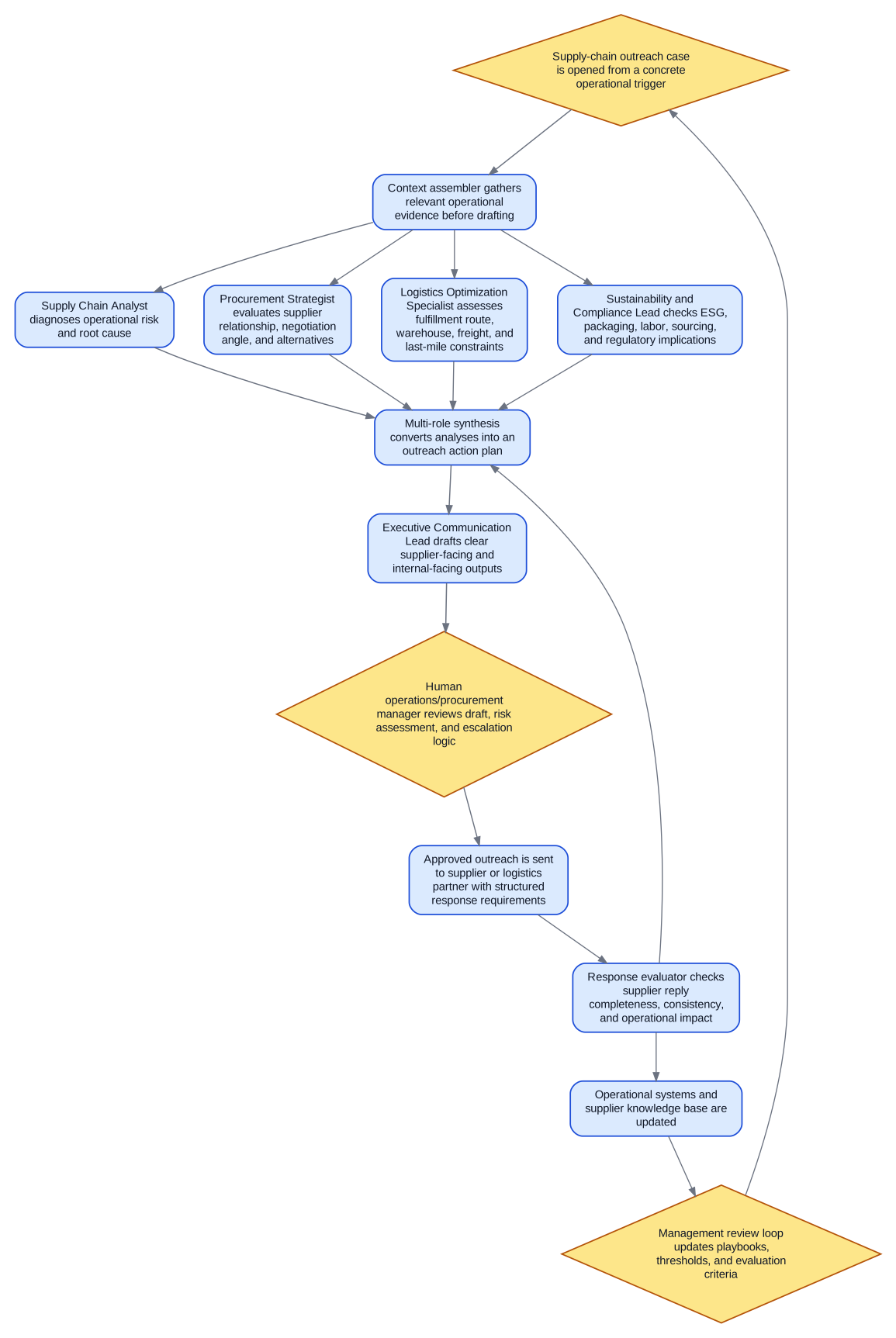
The redesigned system treated outreach as a structured supply-chain case, not a writing request.
- Inputs: SKU, supplier, purchase order, affected marketplace, current inventory, daily sales velocity, promised delivery date, shipment status, supplier history, contract or SLA notes, and any relevant sustainability or compliance documents.
- Understanding: The system assembled operational evidence before drafting. Missing fields were flagged rather than silently ignored.
- Reasoning: Five specialized roles contributed to the case. The Supply Chain Analyst diagnosed operational risk and likely root cause. The Procurement Strategist assessed supplier leverage, negotiation angle, and alternative sourcing options. The Logistics Optimization Specialist reviewed fulfillment route, warehouse, freight, and last-mile constraints. The Sustainability and Compliance Lead checked ESG, packaging, labor, sourcing, and regulatory implications. The Executive Communication Lead converted the analysis into supplier-facing and internal-facing outputs.
- Actions: The system produced a structured outreach plan, supplier email draft, internal management note, response checklist, and follow-up classification.
- Memory/state: Each case preserved issue type, evidence fields, supplier commitments, missing data, response quality, revised ETA, recovery option, and final resolution status.
- Human review points: A manager reviewed external messages involving price negotiation, supplier accountability, sustainability claims, contractual commitments, or high stockout risk.
- Out-of-scope actions: The agent could not autonomously impose penalties, change supplier contracts, approve substitute suppliers, modify purchase orders, or send high-risk escalation messages without human approval.
This guardrail design matters because supply-chain outreach mixes soft communication with hard operational consequences. The agent may draft the message, but the organization still owns supplier relationships, contractual exposure, and customer-impact decisions.
5. One Workflow Walkthrough
When a fast-moving SKU showed seven days of remaining inventory and a supplier shipment was three days late, the system opened a supply-chain outreach case. It first gathered the purchase order, promised completion date, current inventory, daily sales velocity, prior supplier delay history, and carrier handover status. The Supply Chain Analyst estimated stockout risk and identified the missing evidence: the supplier had not confirmed whether production was complete. The Logistics Optimization Specialist checked whether partial shipment or expedited freight could reduce the risk. The Procurement Strategist noted that the supplier had missed two prior recovery dates, so the message should request a specific recovery plan rather than a general update. Because the case involved potential stockout and supplier accountability, the human manager reviewed the draft before sending. The final outreach requested three structured fields: revised production completion date, shipment handover date, and partial-shipment feasibility. The reply was then checked for completeness and logged for future supplier performance review.
6. Results
- Baseline period: Original outreach-agent prototype using basic summarization, drafting, and tone review.
- Evaluation period: Revised prototype using the multi-role supply-chain workflow on the same categories of outreach cases.
- Workflow scope/sample: Supplier delay, inventory shortage, logistics escalation, cost-change negotiation, and sustainability-document request.
- Process change: The main work moved from manual context reconstruction after a vague trigger to structured evidence assembly before any draft was produced.
- Decision/model change: The agent no longer optimized only for email quality. It optimized for operational clarity: risk diagnosis, requested commitment, escalation path, and response completeness.
- Business effect: Expected benefits include fewer vague follow-ups, faster supplier clarification, stronger internal visibility, better escalation discipline, and more consistent supplier-performance learning.
- Evidence status: Prototype / controlled pilot design. The case supports directional workflow improvement, while hard production metrics such as stockout reduction, supplier response time, and recovery-cost savings should be measured after deployment.
The most important result was not that the email became more polished. The real improvement was that the organization could see why the message was being sent, what evidence supported it, what answer was required, and when the case should be escalated.
7. What Failed First and What Changed
The first version failed because it confused communication assistance with supply-chain coordination. It could turn a user instruction into a decent email, but it could not decide whether the issue was primarily an inventory risk, logistics bottleneck, commercial dispute, or compliance gap. The redesign added specialized roles and changed the workflow sequence. Evidence gathering came before drafting. Domain analysis came before communication. Human approval became a governed checkpoint rather than a last-minute manual edit. The remaining limitation is integration: the agent becomes much more valuable when connected to reliable inventory, supplier, order, logistics, and compliance data sources.
8. Transferable Lesson
- Start from the workflow, not the prompt. If the old process requires diagnosis, escalation, and accountability, the AI system should model those steps directly.
- Specialized agents need governed handoffs. More roles only help when each role has a clear input, output, boundary, and review condition.
- Keep humans at the commitment boundary. AI can prepare supplier-facing action, but humans should approve messages that create contractual, commercial, compliance, or relationship consequences.
This case shows that agentic AI works best when the organization needs to convert fragmented operational signals into structured, reviewable, and accountable action.
References
-
“Flowr — Scaling Up Retail Supply Chain Operations Through Agentic AI in Large Scale Supermarket Chains”, arXiv:2604.05987, https://arxiv.org/html/2604.05987 ↩︎
-
“Leveraging LLM-Based Agents for Intelligent Supply Chain Planning”, arXiv:2509.03811, https://arxiv.org/html/2509.03811 ↩︎
-
“Automating Supply Chain Disruption Monitoring via an Agentic AI Approach”, arXiv:2601.09680, https://arxiv.org/html/2601.09680 ↩︎
-
“Agentic AI Sustainability Assessment for Supply Chain Document Insights”, arXiv:2511.07097, https://arxiv.org/html/2511.07097 ↩︎
-
“Constrained Process Maps for Multi-Agent Generative AI Workflows”, arXiv:2602.02034, https://arxiv.org/abs/2602.02034 ↩︎