Executive Snapshot
- Client type: Mid-sized biotech / pharma R&D organization
- Industry: Drug discovery and translational research
- Core problem: A generic AI research assistant produced plausible scientific summaries, but missed qualitative decision criteria that mattered to R&D, regulatory, business-development, and executive stakeholders.
- Why agentic AI: The workflow required role-specific judgment, evidence provenance, regulatory checks, competitive review, and revision loops that could not be handled by a single prompt or static dashboard.
- Deployment stage: Pilot design / controlled internal review workflow
- Primary result: The workflow shifted from human-coordination-heavy rework to a governed, specialist-agent review process with explicit checkpoints and auditable decision logic.
1. Business Context
The organization evaluated early-stage drug discovery opportunities across target identification, candidate prioritization, translational plausibility, competitive positioning, and regulatory readiness. Before the redesign, teams used a generic AI research assistant to retrieve literature, summarize target biology, and rank candidate targets or molecules. The workflow occurred whenever a program team prepared a target-review memo or screened a new disease-area opportunity. Inputs included scientific papers, target lists, pathway evidence, compound notes, pipeline intelligence, regulatory guidance, and internal portfolio priorities. Errors mattered because a weak recommendation could push scarce experimental resources toward a target that looked computationally attractive but was crowded, weakly translatable, poorly differentiated, or hard to defend in later regulatory discussions.
The central analytical point from the selected literature is that drug discovery agents should not be designed as unconstrained autonomous answer generators. Their value is strongest when they decompose complex discovery work into specialist roles, use tools and evidence retrieval, keep auditable state, and place human review at points of high uncertainty or high consequence.12345
2. Why Simpler Automation Was Not Enough
A script could collect papers. A dashboard could show target scores. A chatbot could answer one-off questions. None of these solved the real workflow problem: the decision was multi-objective and stakeholder-dependent. A target could score well on druggability while failing on biomarker readiness. A compound could look promising in docking while showing weak developability. A disease area could look attractive scientifically but be commercially crowded. The workflow also branched whenever evidence was weak, assumptions conflicted, or reviewers requested a deeper explanation. This made a stateful, role-aware agentic design more suitable than a single model call. The goal was not to replace scientists or regulatory leaders, but to reduce missed criteria before human review.
3. Pre-Agent Workflow
Before the redesign, the organization operated through a generic AI-assisted review process.
- R&D lead defines the discovery question. A program scientist frames the disease area, target family, or candidate molecule set and asks the generic AI assistant to gather evidence.
- Generic AI assistant retrieves and summarizes literature. The assistant produces summaries of papers, pathway evidence, disease relevance, and preliminary target or compound rankings.
- R&D scientist reviews the ranking. The scientist checks whether the output is scientifically plausible and edits it into a technical discovery memo.
- Senior stakeholders identify missing qualitative criteria. During review, regulatory, clinical, business, or executive reviewers often notice gaps: weak biomarker logic, unclear human translation, pipeline crowding, poor differentiation, or insufficient evidence quality.
- Ad hoc revisions slow the decision. The team sends the memo back for additional checks, often without a standardized review path. The final go / no-go / monitor decision is made with unresolved uncertainty.
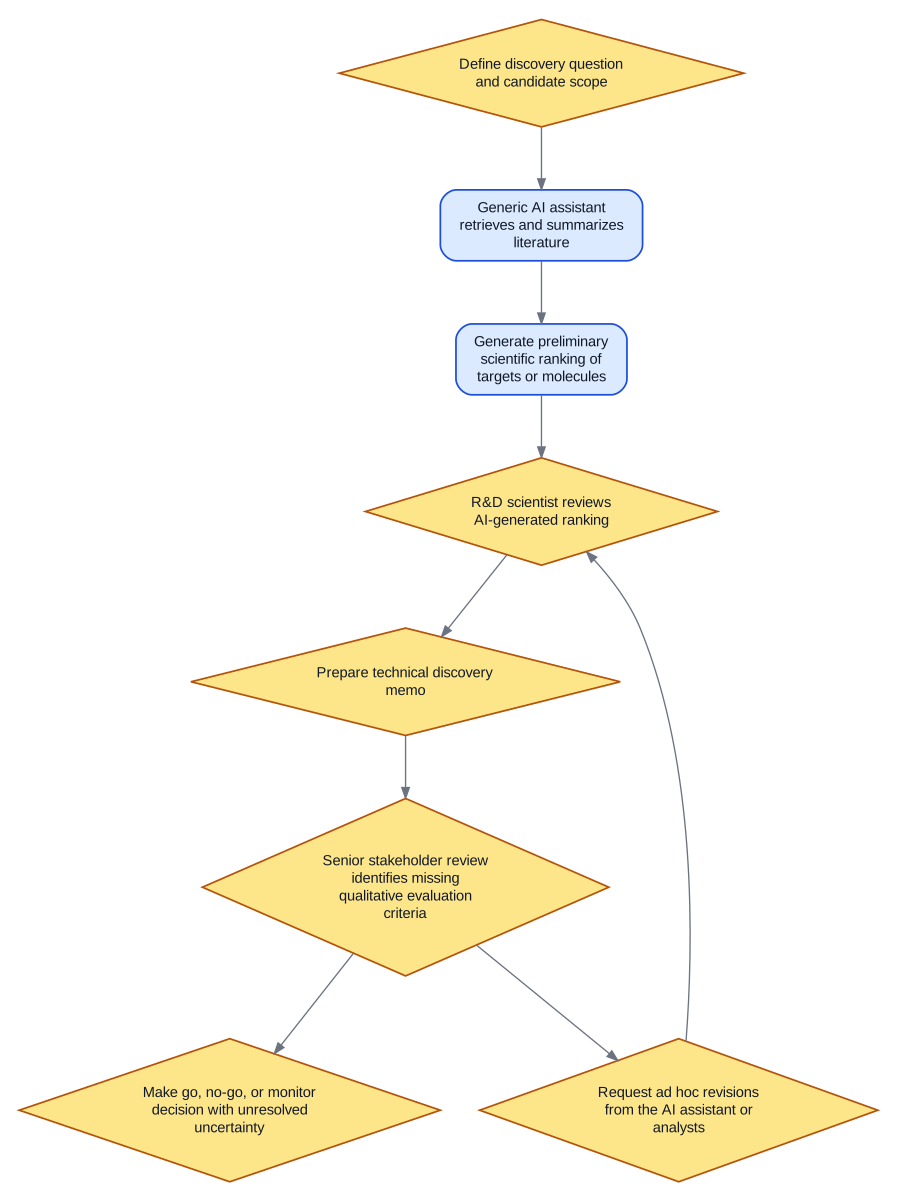
Key pain points:
- The AI assistant optimized for scientific plausibility, not stakeholder decision usefulness.
- Qualitative criteria were discovered late, during senior review, instead of being built into the workflow.
- Revisions were ad hoc, causing repeated handoffs between scientists, reviewers, and analysts.
- Evidence provenance, confidence levels, and assumptions were not consistently logged.
- The final memo could appear technically strong while remaining strategically weak.
4. Agent Design and Guardrails
The redesigned workflow introduced a governed multi-agent system. Its purpose was to produce a stakeholder-aligned drug discovery opportunity assessment, not an autonomous development decision.
- Inputs: discovery question, candidate targets or molecules, disease-area context, internal portfolio priorities, scientific literature, competitive pipeline notes, clinical translation criteria, and relevant regulatory expectations.
- Understanding: retrieval, evidence tagging, source provenance logging, target-mechanism extraction, clinical-translation mapping, competitive-intelligence extraction, and regulatory-relevance classification.
- Reasoning: a planner decomposes the task into specialist workstreams. Specialist agents evaluate scientific plausibility, industry trend fit, translational readiness, regulatory credibility, competitive differentiation, business fit, and evidence quality. A synthesis step converts specialist outputs into a scorecard.
- Actions: create a draft opportunity scorecard, flag low-confidence claims, generate reviewer-specific notes, prepare the decision memo, and log the reasoning trail.
- Memory/state: case state includes the decision question, candidate list, evidence sources, specialist assessments, assumptions, unresolved risks, revision history, and human-review notes.
- Human review points: humans define the decision question, approve governance boundaries, review the synthesized scorecard, resolve objections, approve final recommendations, and decide whether to continue, stop, or monitor the opportunity.
- Out-of-scope actions: the system cannot trigger wet-lab work, submit regulatory materials, commit budget, contact partners, or make final portfolio decisions without human approval.
The guardrail logic follows a simple principle: agents may investigate, structure, compare, score, and draft, but humans retain authority over high-impact scientific, regulatory, and business decisions. This is especially important in drug discovery because long-horizon workflows depend on artifact validity, reproducibility, and role-based permission boundaries.34
5. Post-Agent Workflow
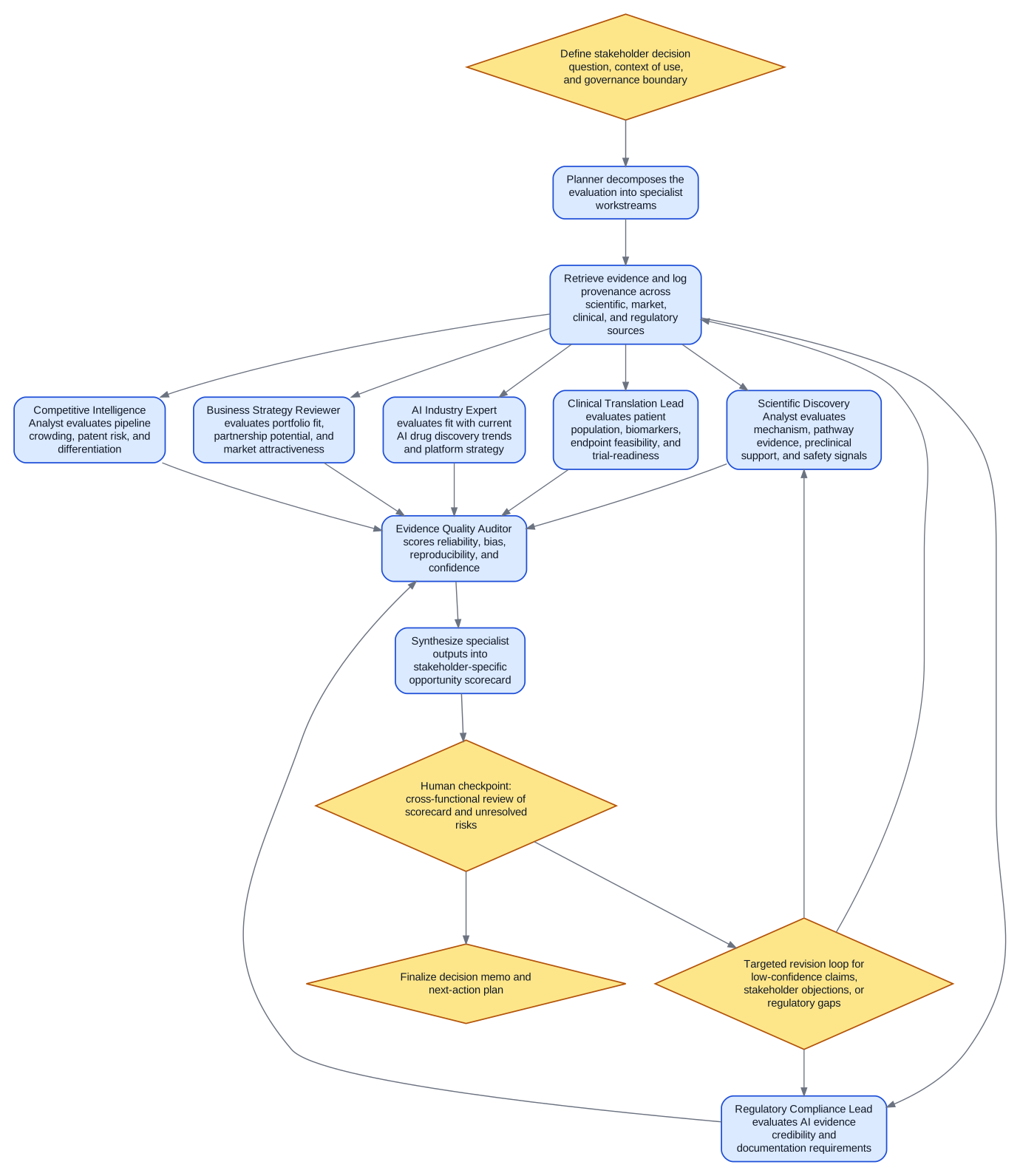
After the redesign, the workflow became a specialist-agent review process.
- Human sponsor defines the decision question and governance boundary. The sponsor specifies whether the task is target review, compound prioritization, or portfolio monitoring, and confirms what the system may and may not do.
- Planner decomposes the review. The planner assigns workstreams to specialist agents: Scientific Discovery Analyst, AI Industry Expert, Clinical Translation Lead, Regulatory Compliance Lead, Competitive Intelligence Analyst, Business Strategy Reviewer, and Evidence Quality Auditor.
- Evidence is retrieved and logged. The system gathers scientific, clinical, regulatory, and market evidence while recording provenance and confidence.
- Specialist agents produce parallel assessments. Each agent evaluates the opportunity through its own lens, using explicit criteria rather than a generic summary.
- Evidence Quality Auditor checks the claims. The auditor reviews source reliability, reproducibility, bias risk, and confidence level before the synthesis stage.
- Synthesis agent creates the opportunity scorecard. The system produces stakeholder-specific outputs: scientific rationale, translation risk, regulatory risk, competitive position, business fit, and recommended next action.
- Cross-functional humans review unresolved risks. If reviewers object or confidence is low, the workflow routes the case into a targeted revision loop.
- Final decision memo is approved. The final output is a human-approved memo with next experiments, open questions, and audit trail.
6. One Workflow Walkthrough
A program team wanted to evaluate a target in an inflammatory disease area. In the old workflow, the generic AI assistant ranked the target highly because publication activity, pathway relevance, and computational druggability looked strong. Under the new workflow, the planner decomposed the same case into specialist reviews. The Scientific Discovery Analyst confirmed plausible biology, but the Clinical Translation Lead flagged weak biomarker readiness. The Competitive Intelligence Analyst found that larger companies were already active in adjacent mechanisms. The Regulatory Compliance Lead noted that the AI-derived evidence would need clearer documentation before being used in a formal decision package. Because three dimensions showed unresolved risk, the system routed the case into a revision loop rather than producing a simple “high-priority” recommendation. A cross-functional human reviewer approved the final conclusion: monitor the target, run a focused biomarker-evidence review, and avoid immediate resource escalation.
7. Results
- Baseline period: Pre-redesign workflow reconstructed from the generic AI-assisted review process.
- Evaluation period: Controlled pilot design for internal target-review and candidate-prioritization memos.
- Workflow scope/sample: Early-stage opportunity assessments where scientific evidence, competitive context, translational feasibility, and regulatory credibility must be reviewed together.
- Process change: The workflow moved missing-criteria detection from late senior review into the agentic analysis stage.
- Decision/model change: Rankings were no longer based mainly on scientific plausibility. The new scorecard separated mechanism strength, translation risk, regulatory credibility, competitive crowding, business fit, and evidence quality.
- Business effect: Expected benefits include fewer late-stage memo revisions, clearer decision records, better cross-functional alignment, and earlier detection of opportunities that are scientifically interesting but strategically weak.
- Evidence status: Estimated / planned. The case describes a workflow-grounded transformation design, not a production deployment with audited live metrics.
The most important improvement is not speed alone. The redesign changes what the organization is able to see before making a decision. A generic assistant makes the review faster; a governed specialist-agent workflow makes the review harder to fool.
8. What Failed First and What Changed
The first version failed because it treated discovery evaluation as an information-summarization task. It could retrieve papers and produce a confident ranking, but it did not understand that senior stakeholders judge opportunities through different lenses. Scientific novelty, translation feasibility, regulatory defensibility, competitive positioning, and portfolio fit are not secondary details; they are the decision. The revised system changed the workflow by making those lenses explicit specialist roles. The remaining limitation is that the system still depends on the quality of available evidence and on human reviewers to resolve strategic trade-offs. It improves decision preparation, but it does not remove scientific uncertainty.
9. Management Responsibilities
The redesigned workflow also changes management responsibility.
- R&D leadership owns the decision question, biological assumptions, and final scientific recommendation.
- Regulatory leadership owns the interpretation of compliance risk and documentation expectations.
- Clinical translation leadership owns biomarker, endpoint, and patient-population plausibility.
- Business development or strategy leadership owns partnership relevance, market fit, and competitive interpretation.
- AI/product leadership owns retrieval quality, agent permissions, traceability, logging, and model-performance monitoring.
- Governance committee owns escalation rules for low-confidence claims, conflicting assessments, or high-impact decisions.
This division prevents the agent from becoming an unaccountable recommender. It also prevents humans from receiving an attractive AI-generated memo without knowing which assumptions were checked and which ones remain unresolved.
10. Transferable Lesson
- Build roles before building autonomy. In high-stakes workflows, the key design question is not “Can the agent answer?” but “Whose judgment does the workflow need to represent?”
- Move review criteria upstream. If senior stakeholders always ask about regulation, translation, competition, and business fit, those criteria should be embedded before the first memo reaches them.
- Treat uncertainty as a routing signal. Low confidence should not be hidden inside polished prose. It should trigger revision, escalation, or a narrower evidence task.
This case shows that agentic AI works best when it restructures the workflow around decision quality, not when it merely accelerates the production of plausible analysis.
References
-
Andres M. Bran, Sam Cox, Oliver Schilter, Carlo Baldassari, Andrew D. White, and Philippe Schwaller, “ChemCrow: Augmenting large-language models with chemistry tools,” arXiv:2304.05376, 2023. https://arxiv.org/abs/2304.05376 ↩︎
-
“Beyond SMILES: Evaluating Agentic Systems for Drug Discovery,” arXiv:2602.10163, 2026. https://arxiv.org/html/2602.10163v1 ↩︎
-
“An Auditable Agent Platform for Automated Molecular Optimisation,” arXiv:2508.03444, 2025. https://arxiv.org/html/2508.03444v1 ↩︎ ↩︎
-
“Mozi Governed Autonomy for Drug Discovery LLM Agents,” arXiv:2603.03655, 2026. https://arxiv.org/html/2603.03655v1 ↩︎ ↩︎
-
“RegGuard: AI-Powered Retrieval-Enhanced Assistant for Pharmaceutical Regulatory Compliance,” arXiv:2601.17826, 2026. https://arxiv.org/html/2601.17826v1 ↩︎