TL;DR for operators
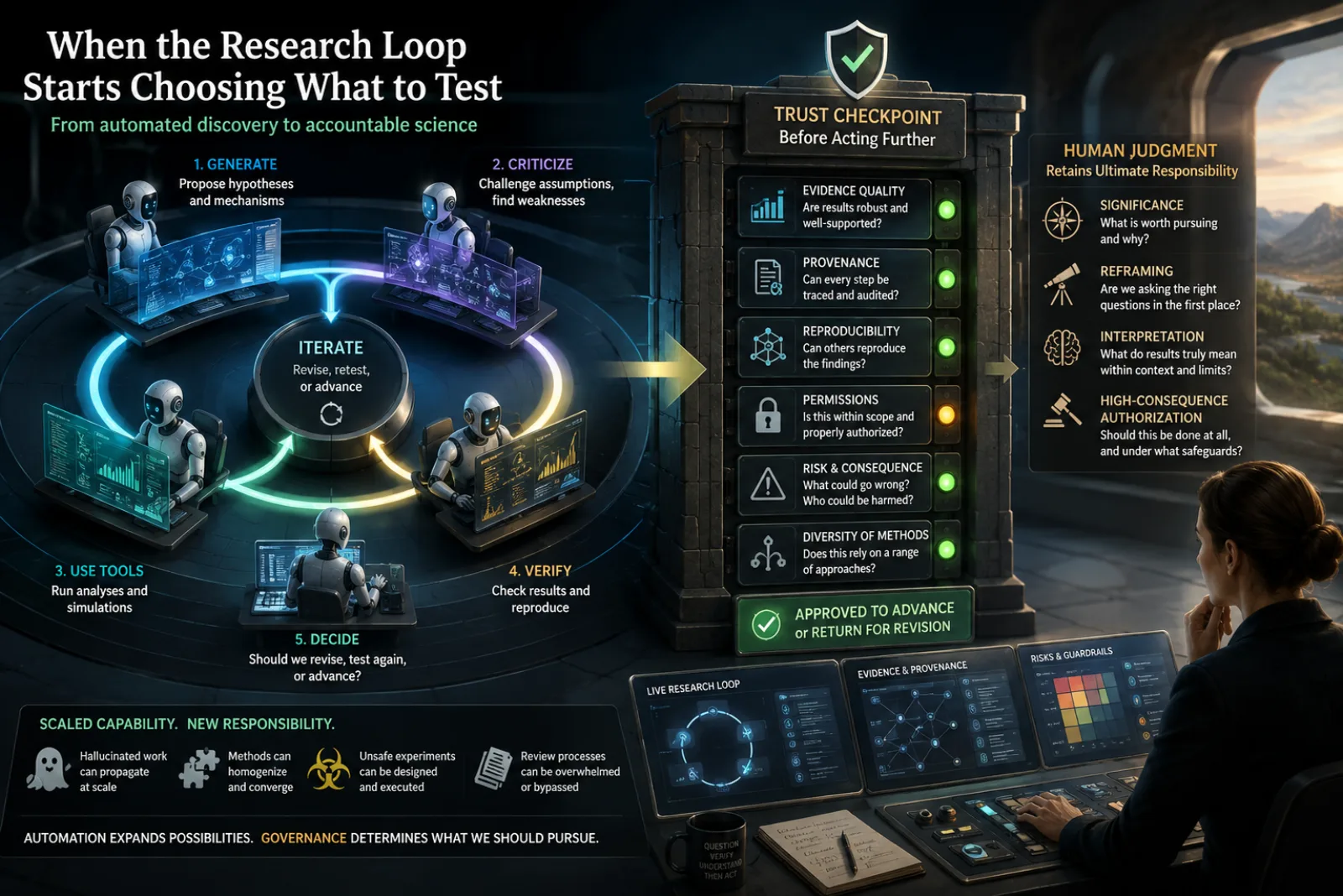
A research assistant answers a question you give it. A more autonomous scientific system can propose a hypothesis, criticize it, run analyses, compare outcomes, and decide whether another iteration is warranted. Once these functions are coordinated, the operational unit is no longer a model call. It is a discovery loop.
The perspective by Raul Jimenez and colleagues argues that multi-agent systems could become participants in scientific reasoning by expanding the number of hypotheses that can be generated, tested, criticized, and revised.1 The paper does not present a new benchmark proving that current systems are already reliable autonomous scientists. Denario, its main concrete example, is illustrative evidence from prior work.
For R&D leaders, the decision therefore shifts from whether to adopt AI research tools to how much scientific authority to delegate. The paper points toward machine-readable provenance, reproducible execution, automated verification, explicit approval for high-consequence actions, and protection of methodological diversity. Cognaptus reads these as controls worth testing now, not as experimentally validated operating standards.
The unit of automation is becoming the discovery loop
Consider a normal R&D sequence. One researcher proposes a hypothesis. Another looks for contradictions. Someone runs code or an experiment. The group decides whether to revise, test again, or advance the result.
The paper argues that specialized agents can coordinate those functions computationally. Generation agents propose models or interpretations; critic agents identify inconsistencies; verification agents test predictions against evidence; controller components coordinate tools and intermediate results. The result is an iterative cycle of proposal, challenge, test, and revision.
That is a larger unit of automation than isolated language-model assistance. Denario illustrates the architecture by combining literature work, code execution, data analysis, and iterative hypothesis testing. The paper also refers to a previously reported Denario demonstration involving hidden symmetries in modified-gravity theories. Because this perspective does not newly evaluate Denario, the example supports plausibility rather than a comparative performance claim.
For an R&D organization, authority accumulates across this loop. A system that only drafts code creates a local execution risk. A system that proposes hypotheses, chooses tools, evaluates results, and determines the next experiment can shape the direction of inquiry.
Scale moves the bottleneck from generation to judgment
If the discovery loop can run repeatedly at machine speed, generating candidates is no longer necessarily the scarce capability. The scarce capability becomes deciding which outputs deserve belief, resources, or permission to affect the physical world.
The authors describe AI as especially suited to exploring the “adjacent possible”: possibilities reached by extending, recombining, and testing what is already latent in existing knowledge. In operational terms, the system can search a much larger neighborhood of candidate explanations than a human team could inspect manually.
The paper does not quantify how much better the resulting science becomes. Its claim is conceptual: machine-scale systems may compress several stages of discovery at once. The same scale can also propagate hallucinated results, overwhelm review channels, concentrate methods, enable unsafe experimentation, and accelerate dual-use or self-modifying systems.
That makes throughput a poor proxy for scientific value. More hypotheses, reports, or experiments do not establish that an organization is learning more about nature. Verification and decision quality have to scale with production.
Decision rights matter more than a generic “human in the loop”
The paper assigns machines and humans different responsibilities rather than treating human oversight as one final check.
| Scientific decision | Machine role | Human responsibility | Control implied |
|---|---|---|---|
| Generate candidate explanations | Explore many alternatives rapidly | Decide which questions and frames matter | Preserve agenda-setting and significance judgments |
| Execute analyses | Run tools and test predictions | Judge whether evidence supports the conclusion | Reproducible pipelines and verification |
| Initiate physical or irreversible actions | Propose or prepare actions | Authorize intervention | Explicit, logged approval |
| Expand or self-modify agent capability | Explore technical changes | Decide whether release is acceptable | Capability gating and authorization |
| Allocate research effort | Search many nearby possibilities | Protect conceptual novelty and plurality | Diversity and incentive controls |
The clearest proposal is that AI-initiated physical experiments, irreversible interventions, and releases of self-modifying agents should require explicit and logged human authorization. That is stronger than placing a natural-language instruction in an agent prompt.
Cognaptus infers a concrete design rule for autonomous laboratories and scientific platforms: approval should be a system permission with an auditable event record, not a behavioral preference the model is expected to remember. The paper does not test which interface, threshold, or escalation policy works best.
Provenance and verification become part of the research stack
The paper argues that voluntary disclosure of AI use is inadequate when agents participate across an extended workflow. It proposes structured provenance and executable research pipelines so that others can reconstruct what happened.
For a research-platform team, the affected user is not only the scientist receiving an answer. It is also the reviewer, auditor, or collaborator deciding whether the result is trustworthy. The workflow therefore needs persistent records of agent-generated hypotheses, tool calls, code execution, data transformations, intermediate results, and revisions.
Automated review could handle mechanically checkable tasks such as code execution, data-integrity checks, statistical consistency, and citation validation. Human reviewers would remain responsible for conceptual evaluation and scientific significance. The paper explicitly leaves the trustworthiness of automated scientific-review tools unresolved and calls for open benchmarking.
This is a useful separation for system design: workflow integrity can be partly machine-checked, while scientific meaning still requires accountable judgment.
Human judgment is not a residual task
The paper does not argue that scientists become unnecessary as agents improve. Its division of labor is more specific.
Machines may become increasingly effective at searching within an existing possibility space: extending known ideas, testing variants, applying constraints, and ranking alternatives. Humans remain responsible for recognizing when the frame itself is inadequate, creating a different way to pose the problem, interpreting what a discovery means, judging significance, and accepting responsibility for the direction of inquiry.
The authors also warn that machine-scale research could narrow the ecosystem itself. If many agents use similar methods, incentives, and source material, productivity can rise while methodological diversity and human expertise weaken. The paper labels one part of this risk “knowledge collapse.” It therefore recommends protecting reproducibility, depth, interpretive insight, independent reimplementation, adversarial replication, and heterodox approaches.
For R&D portfolio managers, Cognaptus infers that counting independent agents is not enough. Apparent parallelism may still be methodologically concentrated. A portfolio control should therefore track whether teams, models, tools, and evaluation criteria are actually producing independent ways of testing a claim.
These are governance design principles, not proven controls
The evidence is appropriate for a perspective but limited for prescribing operations. The paper synthesizes prior AI-scientist work, institutional examples, governance concerns, and philosophical arguments. It does not experimentally compare alternative authorization systems, provenance formats, verification tools, or incentive structures.
That boundary matters because the recommendations are actionable without being validated standards. Organizations can implement traceable execution, reproducible workflows, approval gates, and capability controls, but they should measure whether those mechanisms actually catch errors, preserve accountability, reduce unsafe actions, and avoid slowing legitimate research in ways that defeat their purpose.
The paper also treats its own categories as provisional in a rapidly changing landscape. Even the philosophical suggestion that sustained scientific success by language-grounded systems might challenge assumptions about explicit human-like world models is conditional, not an empirical result established here.
Institutional architecture becomes part of the scientific system
The paper’s institutional argument follows from its technical framing. If an AI system participates across the discovery loop, governance cannot remain a policy document attached after deployment. Provenance, reproducibility, verification, authorization, accountability, and methodological diversity become part of the architecture that determines whether machine-scale science remains inspectable and scientifically useful.
The operating question is therefore not whether humans must remain present everywhere. It is which decisions a machine may take, what evidence it must leave behind, what can be verified automatically, and where accountable human judgment must still control the next step.
Cognaptus: Automate the Present, Incubate the Future.
-
Raul Jimenez and Boris Bolliet and Francisco Villaescusa-Navarro and Rabih Zbib and Benjamin Wandelt and David N. Spergel and Thomas Meier and Jessica Montgomery and Hana Aliee and Licia Verde (2026). AI Scientists as Engines of Discovery: A Case for Development within Reformed Institutions. arXiv:2606.22859. https://arxiv.org/abs/2606.22859 ↩︎