TL;DR for operators
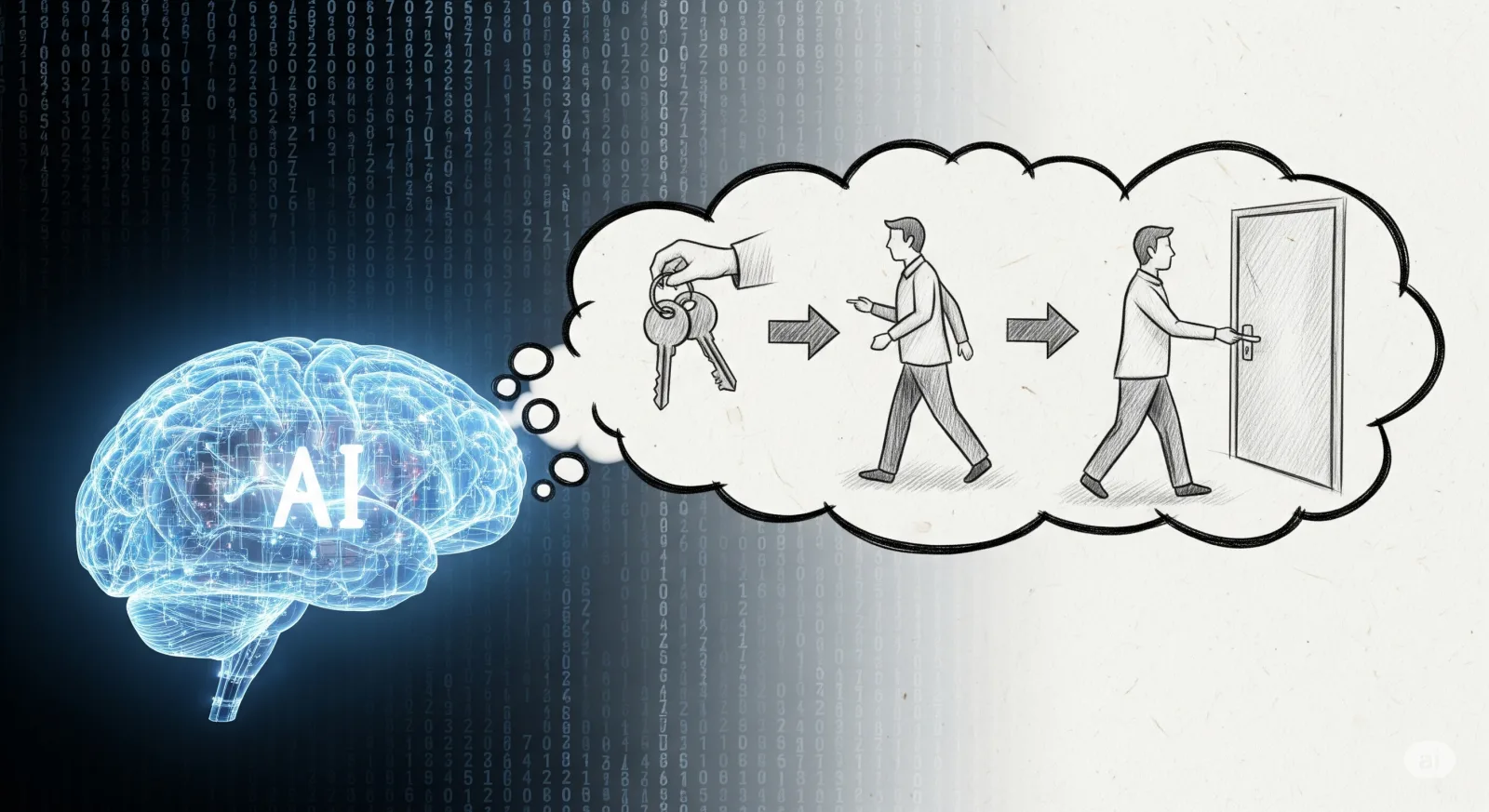
A robot sees a desk. A camera detects a laptop, papers, a bottle of water, and keys. A goal says: “I need the keys to open the door and go out.” A conventional system can match the goal to the object and generate an action. The paper asks for something more ambitious: can the machine then imagine the action sequence as internal sketches, inspect those imagined scenes, and adjust its next steps?
That is the useful part of Slimane Larabi’s paper, “Can Mental Imagery Improve the Thinking Capabilities of AI Systems?”1 It does not prove that mental imagery makes AI systems better thinkers in a benchmarked, statistically convincing sense. There are no broad evaluations, no ablation study showing “with imagery beats without imagery,” and no deployment evidence. The demonstrations are small and deliberately simple.
The contribution is architectural. The paper proposes a machine-thinking framework with four parts: a Cognitive Thinking Unit, a Needs Unit, an Input Data Unit, and a Mental Imagery Unit. The Cognitive Thinking Unit acts as the coordinator. The Needs Unit stores internal goals and scheduled actions. The Input Data Unit converts sensory inputs into natural-language descriptions. The Mental Imagery Unit generates visual sketches of possible action sequences.
For business use, the message is not “buy some Stable Diffusion and your agent can reason.” That would be convenient, therefore suspicious. The more practical reading is that enterprise agents may need explicit internal structure: goals should be represented separately from observations; observations should be grounded in sensory or system data; planning should generate candidate actions; simulation should test those candidates before the system acts.
The paper is best read as a design sketch for future autonomous agents. Fittingly, it literally uses sketches.
A machine that waits for prompts is not really autonomous
Most current AI systems are excellent at responding. They are much weaker at initiating.
This distinction sounds philosophical until it becomes operational. A customer support copilot waits for a ticket. A warehouse robot waits for a command. A finance assistant waits for a query. Even when these systems appear proactive, the “proactivity” is often a scheduled trigger, a rule, or a workflow automation wearing a nicer jacket.
The paper starts from this gap. Existing AI models can process language, recognize objects, generate images, and produce plausible plans. But those capabilities are usually assembled around external requests. The user asks; the system responds. The environment changes; the system reacts. A workflow hits a condition; the system calls a tool.
Larabi’s proposal is different: machine thinking should begin from internal needs as well as external input. A system may have a scheduled obligation, a goal, a prior action plan, or a problem to resolve. That internal pressure should trigger reasoning even before a human asks a question.
This is where the paper’s “Needs Unit” matters. It is not decorative terminology. It changes the direction of control. Instead of treating reasoning as a response to a prompt, the framework treats reasoning as a process initiated by a mismatch between what the system needs and what it perceives.
In business language, this is the difference between a dashboard and an operator. A dashboard displays state. An operator notices state, compares it with goals, simulates options, and chooses an action. The paper is trying to describe the second thing.
It does not fully build it. But the distinction is the point.
The framework is a loop, not a bigger prompt
The proposed architecture has four main components:
| Component | What it does | Operational interpretation |
|---|---|---|
| Cognitive Thinking Unit | Integrates inputs, needs, and imagined scenarios to infer actions or generate informative content | The agent’s reasoning coordinator |
| Needs Unit | Stores goals, scheduled actions, and internally generated obligations | The agent’s internal demand signal |
| Input Data Unit | Converts sensory inputs such as images, audio, or touch into natural-language descriptions | The perception-to-symbol layer |
| Mental Imagery Unit | Generates imagined images or sketches from Cognitive Thinking Unit stimuli | The simulation layer |
The key mechanism is not any single model. It is the loop among these units.
The Input Data Unit supplies descriptions of the world. In the paper’s implementation, camera images are processed using object detection and captioning. The Needs Unit supplies a goal, such as needing keys to open a door. The Cognitive Thinking Unit matches the goal to the relevant context, generates an action, and can then request mental images of the action sequence. The Mental Imagery Unit generates sketch-like scenes corresponding to those actions. Those scenes can be inspected or used to trigger further reasoning.
A crude version of the loop looks like this:
Need
  ↓
Context from sensory input
  ↓
Cognitive Thinking Unit
  ↓
Candidate action
  ↓
Mental image sequence
  ↓
Inspection, revision, or scheduling
This is why a mechanism-first reading is better than a feature summary. If we list the ingredients — Faster R-CNN, BLIP, sentence transformers, a language model, Stable Diffusion — the paper sounds like a shopping basket of familiar AI components. That undersells the idea and oversells the implementation at the same time.
The architectural claim is that “thinking” requires coordination among internal motivation, perception, inference, and simulation. The models are replaceable. The control loop is the actual proposal.
The Needs Unit gives the agent something to think about
The Needs Unit is the least glamorous part of the paper and probably the most important.
In the framework, needs include scheduled actions, goals, and knowledge-derived obligations. The examples are deliberately ordinary: being at a desk at 8:00 AM, attending a meeting at 10:00 AM, taking stairs to reach another building, using a bike to go somewhere. These are not profound moments of machine consciousness. Good. Profundity is usually where engineering papers go to die.
A need matters because it defines relevance. Without a need, a scene description is just a pile of facts. With a need, the same scene becomes actionable.
Consider the paper’s simple example. The Input Data Unit may generate multiple sentences from an image:
| Scene description | Relevance without a need | Relevance with “I need keys to open the door” |
|---|---|---|
| A laptop computer sitting on a wooden desk | Low | Low |
| A computer mouse and a mouse pad | Low | Low |
| A pile of papers on a table | Low | Low |
| A laptop computer with a bunch of keys on it | Medium | High |
The need changes the ranking of the scene. This is a small example, but it captures a large design principle for agents: perception without priority is noise.
Enterprise systems face the same issue. A procurement agent may have access to inventory data, supplier messages, shipment delays, pricing changes, compliance rules, and contract terms. None of those inputs is useful in isolation. They become useful only when evaluated against an internal objective: prevent a stockout, reduce cost, avoid non-compliant suppliers, or escalate a delayed shipment.
The paper’s Needs Unit is a primitive version of that objective layer. It is not yet a mature goal-management system. It does not learn priorities, resolve conflicts, price trade-offs, or handle ambiguous instructions. But it correctly places goals outside the prompt and inside the architecture.
That matters.
The Input Data Unit turns perception into sentences, with all the usual compromises
The paper’s Input Data Unit converts sensory data into natural-language sentences. In the experiments, the sensory channel is limited to camera images. The implementation uses Faster R-CNN for object detection and BLIP for image captioning. Detected objects are cropped, then captioned, producing descriptions such as “a red car is parked in a parking” or “a laptop computer with a bunch of keys on it.”
This is an implementation detail, but an important one. The framework depends on a translation step from raw sensory data into symbolic descriptions that the Cognitive Thinking Unit can use. In practical systems, this would be where logs become incident summaries, documents become extracted claims, call audio becomes structured notes, or sensor readings become operational events.
The strength of this move is interoperability. Once perception is expressed as language-like units, it can be matched with goals, passed into language models, stored as memory, and used for planning.
The weakness is compression. Captions throw away information. Object detection can miss objects. Captions can describe the wrong relation. A crop can isolate an object while losing the surrounding context that makes it meaningful. If the generated sentence says the keys are “on the laptop” when they are actually beside it, the downstream reasoning layer inherits that mistake with a straight face.
This is not a criticism unique to this paper. It is the tax paid by any architecture that converts rich multimodal input into simplified symbolic form. The tax may be worth paying, but it should appear on the invoice.
For business readers, the equivalent warning is simple: an agent’s reasoning quality is bounded by the quality of its state representation. If the input layer turns messy reality into misleading summaries, the planning layer will become confidently tidy and operationally wrong. Everyone enjoys tidy until the warehouse door does not open.
The Cognitive Thinking Unit is doing routing, matching, and action generation
The Cognitive Thinking Unit is the central coordinator. In the paper, it performs two main tasks in the toy implementation.
First, it matches a need to relevant context sentences. The paper uses the sentence-transformers library with the all-MiniLM-L6-v2 model to encode the need and each context sentence into embeddings. It then computes cosine similarity and selects the sentence with the highest score.
For the need “need the keys to open the door and go out,” the context sentence “a laptop computer with a bunch of keys on it” receives the highest similarity score, 0.4531. Other scene descriptions score much lower, including “a bottle of water sitting on a table” at 0.0395 and “a pile of papers on a table” at 0.0662.
This is main illustrative evidence for the matching part of the framework. It shows that a lightweight semantic-matching layer can connect internal needs to perceived context. It does not show robust reasoning. It does not show generalization across environments. It does not show that the system understands keys, doors, ownership, permission, or physical access. It shows that the pipeline can retrieve the most semantically relevant caption in a controlled example.
Second, the Cognitive Thinking Unit uses a language model to infer actions from context and need. Given context sentences including “a laptop computer with a bunch of keys on it” and the need to open the door, the system generates actions such as picking up the keys, unlocking the door, and going out. Given the need to drink water, it generates “Take a sip of water from the bottle on the table.”
Again, useful. Also modest.
This part of the paper is not a benchmark of planning intelligence. It is an implementation demonstration: if the system can represent needs and context as language, then an LLM-style generator can produce plausible next actions. That is enough to support the architectural story, but not enough to claim autonomous reasoning in the strong sense.
The distinction matters because many readers will instinctively upgrade “the system generated a plausible action” into “the system reasoned.” That upgrade is doing a lot of unpaid labour.
Mental imagery is introduced as simulation, not illustration
The Mental Imagery Unit is the paper’s distinctive element. It receives a stimulus from the Cognitive Thinking Unit and generates images representing possible scenarios. The paper frames this as analogous to human mental imagery: not merely seeing a picture, but simulating a possible event.
This is where the architecture becomes interesting. A language-only agent can state: “Pick up the keys, walk to the door, open the door.” A mental-imagery-enabled agent can generate a visual sequence corresponding to that action plan. The proposed value is that these images can then become objects of inspection. The system could ask: Is the scenario feasible? Are required objects present? What happens if the key does not work? What new action follows?
The paper describes thinking as exploring possible ways to achieve an event by generating a time series of mental images. That time dimension is important. A single image is a state. A sequence of images is a crude simulation.
The implementation uses Stable Diffusion to generate images from action descriptions, then applies a sketch transformation pipeline to convert generated images into grayscale, pencil-like sketches. The action sequence is simple:
- A man takes the keys on the desk.
- The man goes toward the door.
- The man opens the door.
The paper then introduces a contingency: what if the key does not open the door? The Cognitive Thinking Unit proposes new actions or states, such as the person becoming nervous, breaking down the door, or calling firefighters. New mental images are generated from those prompts.
This is exploratory evidence for the imagery loop. It shows that text-to-image models can be placed inside a reasoning architecture as a visual simulation module. It does not show that the generated images improve decisions. The paper does not compare action quality with and without imagery. It does not measure error detection, plan repair, or task success. It demonstrates the possibility of the loop, not its performance advantage.
That boundary is not a minor footnote. It is the difference between a research prototype and a claim about cognition.
Why sketches are a reasonable abstraction
The paper’s choice to convert generated images into sketches is more than a visual style decision. It reflects a claim about what mental imagery is for.
Photorealistic detail can be distracting. For planning, the system may not need wood grain, lighting, facial realism, or decorative background objects. It may need spatial relations: where the keys are, where the door is, whether the person can reach the object, whether the sequence of actions is plausible.
A sketch strips a scene down to structure. That makes it a natural candidate for internal simulation. The paper connects this idea to research suggesting that imagery-based representations can sometimes allow direct inspection of relationships in a scene rather than relying only on symbolic chains of propositions.
For operators, the equivalent principle is familiar: use the representation that matches the decision. A logistics team does not need a photorealistic render of a warehouse to route forklifts; it needs a map of paths, constraints, zones, and bottlenecks. A facilities agent does not need a cinematic image of a broken pump; it needs the fault location, surrounding dependencies, and safe access path.
The mental sketch is valuable if it preserves the features needed for reasoning while dropping the rest.
There is a catch. Current generative image models are not guaranteed to preserve physical consistency, object permanence, geometry, or causal continuity across frames. A sketch can simplify irrelevant detail, but it can also launder hallucination into something that looks cognitively clean. A bad simulation in pencil is still a bad simulation. It merely has better branding.
The experiments support feasibility, not superiority
The paper’s experiments are best read as staged implementation tests. Each one exercises part of the proposed architecture.
| Paper component tested | Likely purpose | What it supports | What it does not prove |
|---|---|---|---|
| Camera image detection and captioning using Faster R-CNN and BLIP | Implementation detail for the Input Data Unit | Raw images can be converted into usable context sentences | That the perception layer is robust in open-world settings |
| Need-context matching using sentence-transformer embeddings | Main illustrative evidence for CTU relevance matching | A stated need can select the most relevant caption in a controlled scene | Deep understanding of goals, causality, or physical affordances |
| LLM-generated action from context and need | Main illustrative evidence for action inference | The CTU can produce plausible action text from selected context | Reliable planning, safety, or task execution |
| Stable Diffusion sketches from action sequences | Exploratory extension for the Mental Imagery Unit | Action descriptions can be transformed into visual scenario sequences | That imagery improves reasoning quality |
| New sketches after a failed-key contingency | Exploratory illustration of iterative simulation | The loop can generate revised imagined scenarios from new prompts | Robust replanning, grounded counterfactual reasoning, or autonomous agency |
This table is the practical heart of the paper. It prevents two bad readings.
The first bad reading is dismissal: “This is just object detection plus captions plus an image generator.” Technically, the implementation does use familiar tools. But the architecture asks a legitimate question about how those tools should be arranged if we want agents that initiate, simulate, and revise action.
The second bad reading is inflation: “The paper shows that mental imagery unlocks autonomous machine reasoning.” It does not. It proposes a mechanism and demonstrates a toy path through that mechanism.
The correct reading sits between those extremes. The paper is a design hypothesis with working illustrations.
What this means for enterprise agent design
The immediate business relevance is not visual imagination in the artistic sense. It is internal simulation.
Enterprise agents are being asked to do more than answer questions. They are expected to monitor workflows, detect problems, recommend actions, execute tool calls, and sometimes operate with limited human supervision. That raises a design question: how should an agent represent the gap between current state and intended outcome?
Larabi’s framework suggests one answer: separate the system into explicit functional units.
| Agent design question | Framework answer | Business translation |
|---|---|---|
| What does the system want or need to do? | Needs Unit | Represent goals, obligations, schedules, and unresolved tasks explicitly |
| What does the system know about the environment? | Input Data Unit | Convert sensory, document, database, or operational data into structured context |
| How does the system decide what matters? | Cognitive Thinking Unit | Match goals against context, infer next actions, and coordinate reasoning |
| How does the system test possible futures? | Mental Imagery Unit | Simulate candidate action sequences before acting |
This structure is useful because many current agent deployments blur these layers. A single prompt contains the goal, the context, the constraints, the tool instructions, the memory, and the reasoning request. Then the system is expected to behave like a disciplined operator. Sometimes it does. Sometimes it behaves like an intern holding five whiteboards in a wind tunnel.
A more modular architecture could help teams diagnose failures. If an agent makes a bad decision, was the need badly specified? Was the input state wrong? Did the matching layer retrieve irrelevant context? Did the planner generate a poor action? Did the simulation fail to expose the problem? Modular design turns “the AI failed” into a more useful post-mortem.
That diagnostic value may be the near-term ROI. Not magical autonomous reasoning. Cheaper debugging.
The strongest business use cases are physical, spatial, and procedural
Mental imagery is not equally useful everywhere. For many enterprise tasks, text or structured data is enough. Generating images for every decision would be expensive, slow, and occasionally absurd. Nobody needs a sketch of an invoice approval unless the invoice has started moving suspiciously across the floor.
The framework becomes more relevant when tasks are physical, spatial, procedural, or safety-sensitive.
Robotics is the obvious case. A robot operating in a warehouse, hospital, hotel, or construction site needs to connect internal goals with visual context and action sequences. Before moving, lifting, opening, or navigating, simulation can help detect missing preconditions.
Field service is another candidate. A maintenance assistant could convert technician photos into structured context, match them against repair goals, and simulate disassembly or access steps. In this setting, imagery could support planning because the work itself is spatial.
Training and procedural support are also plausible. A system that turns an action plan into a sketch sequence could help workers understand steps before execution. The imagery layer would function less as machine cognition and more as human-facing operational rehearsal.
Autonomous workflow agents are a more speculative case. The “mental image” need not literally be visual. It could be a simulated process state: ticket moves from pending to approved, shipment moves from delayed to rerouted, account moves from flagged to reviewed. The paper uses sketches because it focuses on imagery, but the broader principle is internal scenario representation.
That is Cognaptus’ practical inference, not something the paper directly validates. The paper’s demonstrations are visual and toy-scale. Extending the idea to enterprise workflow simulation requires additional design work.
What the paper directly shows, and what it invites us to infer
It is useful to separate the evidence from the interpretation.
| Category | Statement |
|---|---|
| Directly shown by the paper | A modular framework can connect needs, visual input captions, semantic matching, action generation, and sketch generation in a simple scenario. |
| Directly shown by the paper | Faster R-CNN and BLIP can generate context descriptions from images for the Input Data Unit. |
| Directly shown by the paper | Sentence-transformer similarity can select a context sentence relevant to a stated need in the key-and-door example. |
| Directly shown by the paper | A language model can generate plausible actions from context and need statements. |
| Directly shown by the paper | Stable Diffusion can generate sketch-style images corresponding to simple action prompts and revised contingencies. |
| Cognaptus inference | Separating needs, perception, planning, and simulation may make autonomous agents easier to control and diagnose. |
| Cognaptus inference | Visual or structured simulation could be useful in physical, spatial, and procedural enterprise settings. |
| Still uncertain | Whether mental imagery improves task success, reasoning accuracy, safety, or robustness compared with non-imagery baselines. |
| Still uncertain | Whether generated images can remain grounded enough for high-stakes planning. |
| Still uncertain | How the framework scales beyond hand-picked examples and predefined action sequences. |
This separation prevents the article from becoming either fan mail or a takedown. The paper deserves neither. It deserves a careful reading.
Its strongest idea is that agentic reasoning may require internal representational machinery beyond prompt-response language generation. Its weakest point is that it gestures toward “machine thinking” while offering only preliminary demonstrations of each mechanism.
That is acceptable for a framework paper, provided readers do not confuse a framework with a result.
The missing ablation is the one everyone will want
The obvious experiment would compare performance with and without the Mental Imagery Unit.
For example:
- Give two systems the same need and scene.
- Let one generate actions using text-only context.
- Let the other generate actions plus mental image sequences.
- Measure whether imagery improves precondition detection, plan repair, physical feasibility, or downstream task success.
The paper does not do this. There is no ablation showing that mental imagery contributes independent value beyond language-based action generation. There is also no robustness test across noisy images, ambiguous goals, misleading captions, physically impossible prompts, or multi-step tasks with hidden constraints.
That absence shapes interpretation. The Mental Imagery Unit is plausible, interesting, and under-tested. It is the star of the paper, but currently more concept actor than box-office evidence.
This is especially important because image generators can produce visually plausible nonsense. If an imagined scene is used for reasoning, the system needs a way to verify whether the scene is consistent with the real environment, physical laws, and task constraints. Otherwise, the imagery loop can become a hallucination amplifier. The agent imagines a world in which the plan works, then confidently acts in a world where it does not. Very human, admittedly. Not ideal.
A production version would need grounding checks, temporal consistency, uncertainty estimates, and probably a non-visual state model running alongside the sketches.
The architecture points toward better agent governance
There is a governance angle hidden inside the mechanism.
A monolithic agent is hard to audit. When it fails, the explanation often collapses into “the model decided.” That is not an explanation. It is a shrug with GPU costs.
A modular cognitive architecture gives auditors more handles. The Needs Unit can be inspected: what goal was active? The Input Data Unit can be checked: what did the system think it saw? The Cognitive Thinking Unit can be reviewed: what context did it select and what action did it generate? The Mental Imagery Unit can be evaluated: what scenario did it simulate before acting?
This does not solve AI governance. It makes governance less theatrical.
For enterprise deployment, traceability matters. A warehouse robot, procurement agent, or field-service assistant must be able to show why it acted. A sketch sequence may become part of that explanation: not because it proves the model was “thinking,” but because it records the intermediate scenario the system used to evaluate action.
That could support debugging, training, compliance review, and human override. It could also expose failure modes earlier. If the imagined sketch places the keys on the desk when the camera view never supported that conclusion, the system has created a visible inconsistency. Visible errors are easier to challenge than hidden embeddings.
The paper does not develop this governance implication directly. But it follows naturally from the architecture.
The boundary: this is not machine consciousness, and thank goodness
The phrase “machine thinking” invites philosophical inflation. The paper occasionally leans into human cognition analogies: needs, mental imagery, reasoning, internal simulation. Those analogies are useful as design inspiration. They become dangerous when treated as equivalence.
The proposed system does not have desires. It has represented needs. It does not have imagination in the human phenomenological sense. It has generated images conditioned on prompts. It does not understand the world as a person does. It processes descriptions, similarities, and generated scenarios through a designed pipeline.
That is not a weakness. It is a relief. Business systems do not need inner lives. They need reliable state tracking, action selection, simulation, and correction.
The better term for practical readers may be “simulation-mediated agent architecture.” Less poetic, less likely to raise investor eyebrows, and much closer to what the paper actually demonstrates.
The word “imagery” is still useful because it identifies a specific representational strategy: use simplified visual scenes as intermediate reasoning objects. But the value lies in what those representations help the system do, not in whether they resemble human experience.
What builders should take from the paper
The paper offers four useful design lessons.
First, do not treat goals as disposable prompt text. Goals need persistence, priority, and a place in the architecture. A serious agent should know what it is trying to resolve before it starts admiring its own reasoning trace.
Second, perception should be transformed into decision-relevant state, not just stored as raw input. The Input Data Unit’s caption pipeline is simple, but the pattern generalizes. Enterprise agents need clean state representations from documents, sensors, databases, messages, and tools.
Third, planning should include some form of simulation. That simulation may be visual, symbolic, procedural, probabilistic, or hybrid. The paper’s sketch sequence is one version. The broader principle is that agents should test candidate actions against imagined consequences before execution.
Fourth, modularity is not bureaucracy. It is how complex agents become debuggable. If a system has separate units for needs, inputs, reasoning, and simulation, failures can be localized. That is not glamorous, but neither is incident response.
The paper does not hand builders a finished blueprint. It gives them a useful diagram and a small proof that the diagram can be wired together with existing models.
Conclusion: a sketch is not a mind, but it may be a useful working surface
The paper’s central idea is easy to caricature: give AI a sketchpad and maybe it will think. That is not quite fair, though it is a good way to sell a conference coffee break.
A better reading is this: autonomous agents need internal working surfaces. They need somewhere to combine goals, perceived context, candidate actions, and possible futures. Language is one such surface. Structured state is another. Mental imagery — especially simplified, sketch-like imagery — could be a third.
Larabi’s framework places that imagery inside a loop: Needs Unit, Input Data Unit, Cognitive Thinking Unit, Mental Imagery Unit, then back into reasoning. The experiments show that the loop can be illustrated using current components: object detection, captioning, sentence embeddings, language-model action generation, and diffusion-generated sketches.
They do not show that the loop improves reasoning at scale. That is the next test, and it is the one that matters.
For now, the paper is valuable because it shifts the conversation from “Can a model answer?” to “What internal machinery would an agent need before it acts?” That is a more serious question. Also a less comfortable one, which is usually a sign that we are getting warmer.
A sketch is not a thought. But it might become a place where a machine can rehearse one.
Cognaptus: Automate the Present, Incubate the Future.
-
Slimane Larabi, “Can Mental Imagery Improve the Thinking Capabilities of AI Systems?”, arXiv:2507.12555, 2025, https://arxiv.org/abs/2507.12555. ↩︎