Executive Snapshot
- Client type: Composite municipal permit services office serving a city of approximately 450,000 residents
- Industry: Local government and regulatory administration
- Core problem: Incomplete applications triggered repeated clarification cycles, fragmented regulatory searches, manual departmental routing, scheduling delays, and weak end-to-end case visibility
- Why agentic AI: The work required multiple specialized actions over a persistent case state, with branching review paths and mandatory human checkpoints
- Deployment stage: Prototype with a planned controlled pilot
- Primary result: A workflow design that transfers evidence preparation and coordination to agents while keeping interpretation, inspection findings, exemptions, decisions, and appeals under human control
1. Business Context
The municipality processes about 25,000 business licences, renovation permits, signage applications, event permissions, occupancy requests, and land-use cases each year. Submissions arrive through a portal, email, service counters, and paper forms, then enter a legacy permit-management system that remains the official record. The actual work extends across departmental checklists, websites, zoning maps, policy manuals, shared drives, email threads, spreadsheets, telephone calls, and separate inspection calendars. A simple licence renewal may remain within one team; a commercial renovation may require planning, building, fire, public works, environmental health, inspection, legal, and management input. Delays matter because applicants cannot open premises, begin construction, erect signage, or hold events until the municipality reaches a defensible decision.
2. Why Simpler Automation Was Not Enough
A form validator could detect blank fields, but it could not determine whether a change of use required fire review, whether a proposed sign triggered a location-specific restriction, or whether revised drawings reopened a previously completed departmental task. A dashboard could display status codes without explaining why a file was waiting. A chatbot could answer general questions but could not safely reconstruct a live case from conflicting notes and document versions. The process needed stateful coordination: retrieve the applicable rule, route work according to several case attributes, pause for applicant evidence, reopen only affected branches, and escalate ambiguity rather than manufacture a conclusion. Research on reasoning-and-action systems, legal retrieval, graph-organized agent collaboration, human action guards, and public-sector oversight supports this separation of routine workflow agency from consequential decision authority.12345
3. Pre-Agent Workflow
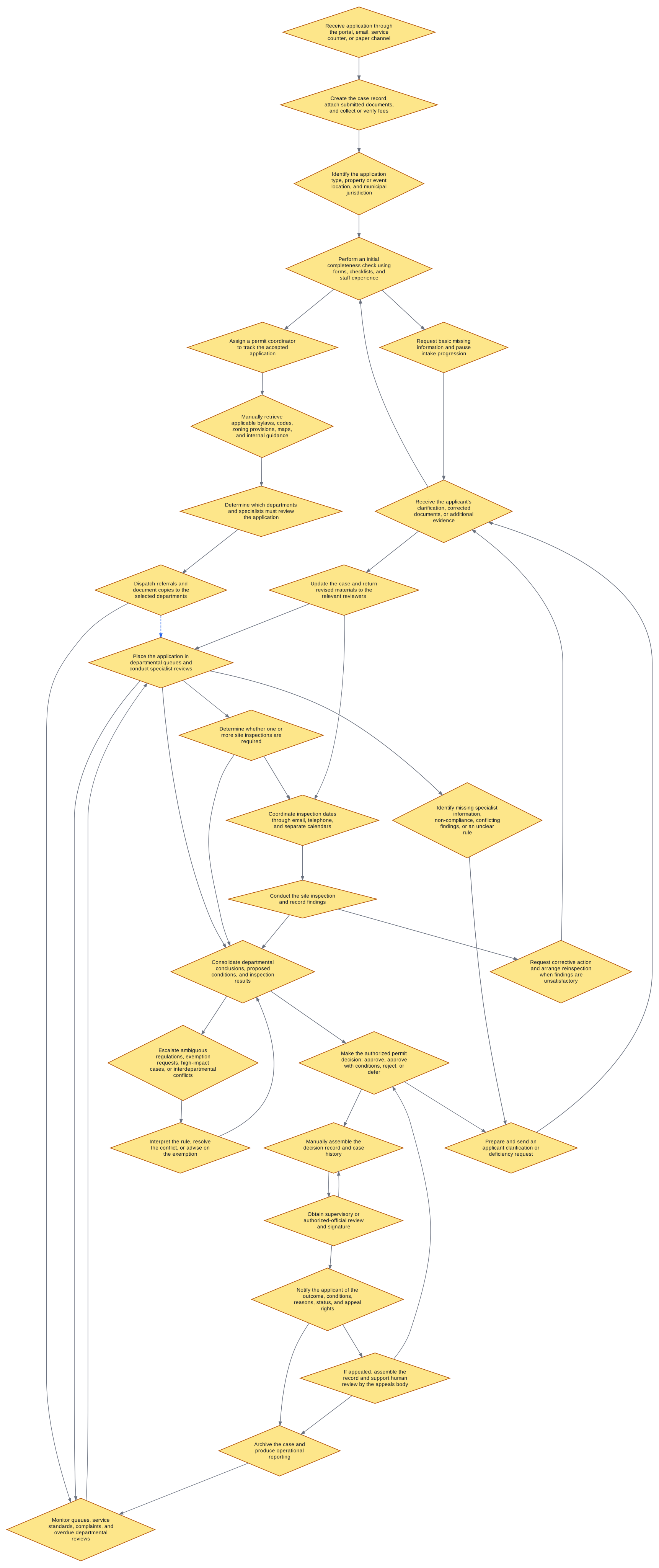
- Intake created the file. Staff received mixed-format submissions, keyed application data into the permit system, attached documents, verified fees, classified the request, and performed a basic completeness check using forms, local checklists, and experience.
- Coordinators reconstructed the route. Once accepted, a permit coordinator searched websites, shared drives, maps, manuals, and previous files to identify applicable provisions and decide which departments should review the case.
- Specialists discovered late deficiencies. Planning, building, fire, public works, health, or other reviewers worked from their own queues. Missing measurements, authorizations, plans, or safety evidence often emerged only after substantive review had begun.
- The file entered clarification loops. Reviewers sent comments to the coordinator; the coordinator rewrote them for the applicant; new documents arrived through mixed channels; staff matched them to the case and resent them to affected departments. Similar requests could be issued separately because departments completed reviews at different times.
- Staff manually closed the record. Inspection appointments were arranged by email and telephone. The coordinator reconciled departmental findings, inspection results, conditions, email history, and unresolved conflicts. Ambiguous regulations and exemptions went to senior reviewers or legal staff. An authorized official made the decision, after which staff assembled the decision record, prepared the notice, answered status questions, and—if challenged—rebuilt the case again for the appeals body.
Key pain points:
- Incomplete files were accepted before specialist requirements were visible, creating repeated applicant–coordinator–reviewer cycles.
- Routing and regulatory retrieval depended on individual knowledge, so identical cases could be handled differently.
- Management could see that a case was delayed but often had to ask staff which department, missing document, or unresolved interpretation was responsible.
4. Agent Design and Guardrails
Analytical point: automate the handoffs, not the authority. The strongest design is not an autonomous permit adjudicator. It is a governed dependency graph in which agents prepare evidence and move work between accountable human roles.
- Inputs: Application fields, uploaded files, parcel and address data, fee status, document versions, departmental findings, inspection records, calendars, and authoritative bylaws, codes, zoning provisions, and guidance.
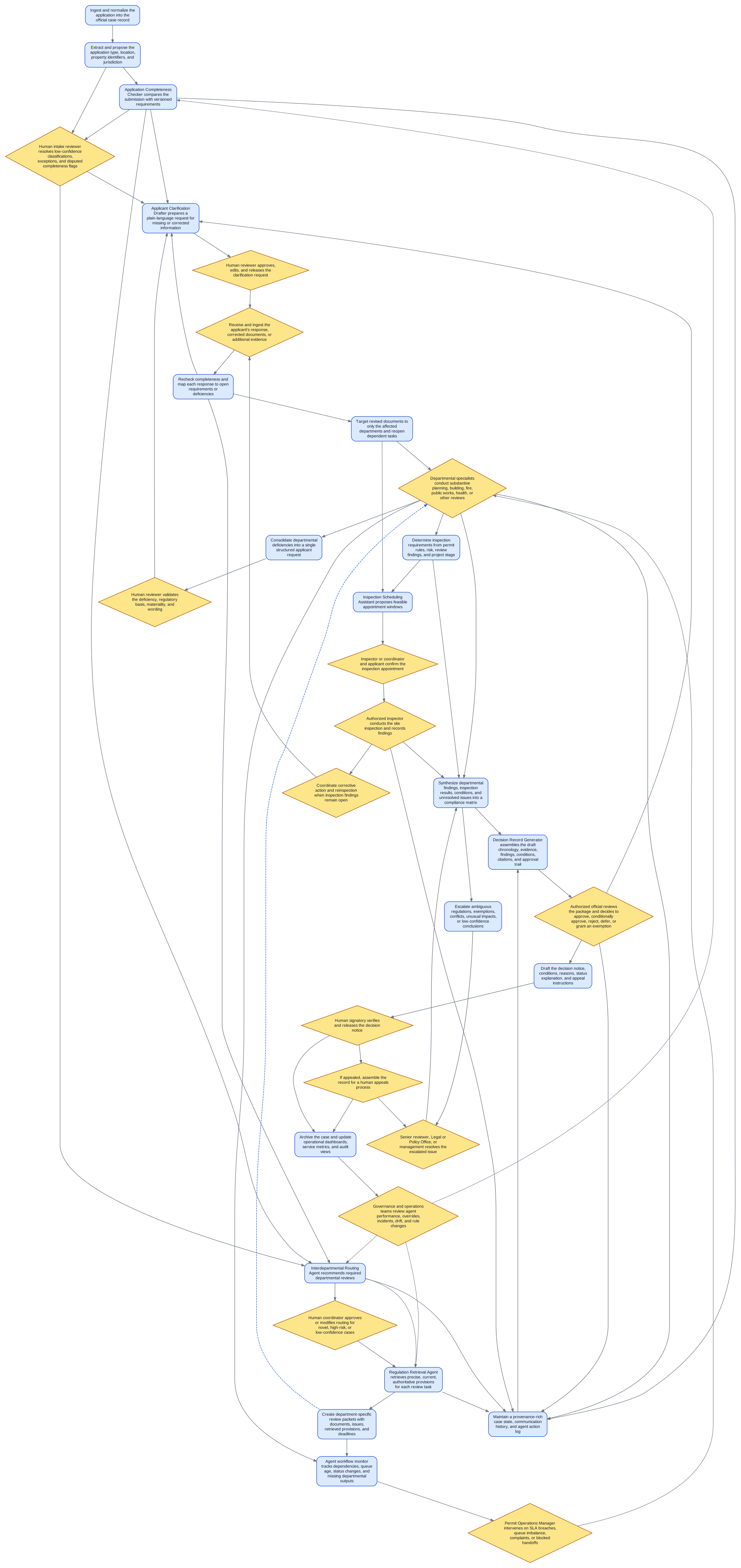
- Understanding: The Application Completeness Checker maps submitted evidence to versioned requirements. The Regulation Retrieval Agent returns precise passages, effective dates, and source anchors rather than broad document dumps.2
- Reasoning: The Interdepartmental Routing Agent applies approved triggers using application type, location, proposed activity, building characteristics, and risk. The six agents operate as a dependency graph so downstream work begins only when prerequisites are satisfied.3 Revised evidence reopens affected branches rather than restarting every review.
- Actions: The Applicant Clarification Drafter consolidates deficiencies into one plain-language draft. The Inspection Scheduling Assistant proposes qualified, feasible slots. The Decision Record Generator assembles chronology, evidence, citations, findings, conditions, overrides, and approvals.
- Memory/state: One shared case state tracks open requirements, current document versions, responsible units, deadlines, agent actions, human edits, and escalation history. Interleaving retrieval, action, observation, and replanning allows the workflow to react when new evidence changes the case.1
- Human review points: Staff resolve uncertain classifications and completeness flags, approve novel or high-risk routing, validate all deficiency requests, perform specialist and physical inspections, interpret ambiguous rules, decide exemptions, resolve conflicts, authorize outcomes, release notices, and hear appeals. Action guards interrupt the workflow at these consequential points.4
- Out-of-scope actions: Agents cannot approve or reject a permit, declare an inspection passed, grant an exemption, settle a disputed interpretation, alter a specialist finding, or decide an appeal.
Every retrieval, recommendation, draft, override, and approval is logged. The Permit Operations Manager receives queue-age, blocked-handoff, complaint, and service-standard views but cannot use the dashboard to alter professional findings. Governance teams review retrieval errors, routing overrides, incidents, prompt or rule changes, and autonomy thresholds as an ongoing operational function rather than a one-time approval exercise.5
5. One Workflow Walkthrough
A restaurant owner submits a renovation and signage application through the portal. The Completeness Checker identifies a missing owner authorization, inconsistent floor-area figures, and a sign drawing without dimensions. It maps each issue to the current application requirements and sends a consolidated draft to an intake officer, who removes an irrelevant item and releases the request. When corrected documents arrive, the system closes the three open items and the Routing Agent recommends building, fire, planning, environmental health, and signage review because the proposal changes occupancy, includes food preparation, and alters the exterior.
Each reviewer receives the current plans, a bounded review question, and precise regulatory passages. Fire review identifies an ambiguous occupancy issue, so the workflow stops that branch and sends an evidence packet to a senior fire officer rather than allowing the agent to resolve it. After the officer records the interpretation, the Scheduling Assistant proposes inspection windows. An inspector confirms the appointment, conducts the visit, and enters findings. The Decision Record Generator then assembles the full chronology and conditions. A delegated official reviews the package, approves the application with conditions, signs the notice, and leaves a traceable human rationale in the record.
6. Results
- Baseline period: A proposed 12-month historical sample from the legacy permit system and departmental records
- Evaluation period: A planned 90-day pilot, followed by a controlled comparison with matched historical permit categories
- Workflow scope/sample: Begin with business licences and signage or lower-complexity renovation cases; exclude appeals and discretionary land-use exemptions from automated progression
- Process change: Replace broad manual follow-up with requirement-level completeness checks, consolidated clarification requests, selective rerouting, and visible waiting states
- Decision/model change: Measure retrieval precision, unsupported citations, routing overrides, missed departments, human edits, and decision-record corrections—not only task completion
- Business effect: The scenario baseline assumes roughly 40% of applications need additional information and coordinators spend about one-third of their time on status enquiries and document follow-up. The pilot should test whether first-pass completeness improves, clarification cycles decline, coordinator touch time falls, and decision records require fewer corrections.
- Evidence status: Planned; no production savings or cycle-time reduction is claimed
The evaluation should separate municipal processing time from time waiting for the applicant. It should also report performance by permit type and applicant group so an aggregate improvement does not conceal worse service for one-time applicants, small businesses, or paper-channel users.
7. What Failed First and What Changed
The first prototype design treated application category as the main routing signal. It over-routed ordinary cases and missed triggers that depended on location, occupancy, building characteristics, or the proposed activity. Its retrieval component also returned long regulatory sections that slowed verification and increased the chance that an irrelevant clause would enter a draft. The design was changed to require multi-attribute routing evidence, precise passage retrieval, effective-date checks, and human approval for novel or low-confidence routes. A remaining limitation is that local guidance and informal departmental practice may be inconsistent or poorly versioned; the agent cannot make that source problem disappear, so unresolved provenance must become an escalation rather than a confident answer.
8. Transferable Lesson
- Model the organization as dependencies, not as a chatbot. The useful unit of automation is the handoff between completeness, retrieval, routing, review, clarification, inspection, and record preparation.
- Make provenance part of the workflow state. A permit decision is defensible only when the municipality can reconstruct the rule, evidence, reviewer, edit, override, and approval behind it.
- Place humans where authority and ambiguity intersect. Human review should not be attached to every low-risk action, but it must guard interpretation, external communications with procedural consequences, professional findings, exemptions, final decisions, and appeals.
This case shows that agentic AI works best in public administration when it reduces coordination friction around judgment rather than pretending to remove judgment from the institution.
-
Shunyu Yao et al., “ReAct: Synergizing Reasoning and Acting in Language Models,” arXiv:2210.03629, 2022. https://arxiv.org/abs/2210.03629 ↩︎ ↩︎
-
Nicholas Pipitone and Ghita Houir Alami, “LegalBench-RAG: A Benchmark for Retrieval-Augmented Generation in the Legal Domain,” arXiv:2408.10343, 2024. https://arxiv.org/abs/2408.10343 ↩︎ ↩︎
-
Chen Qian et al., “Scaling Large Language Model-based Multi-Agent Collaboration,” arXiv:2406.07155, 2024. https://arxiv.org/abs/2406.07155 ↩︎ ↩︎
-
Hussein Mozannar et al., “Magentic-UI: Towards Human-in-the-loop Agentic Systems,” arXiv:2507.22358, 2025. https://arxiv.org/abs/2507.22358 ↩︎ ↩︎
-
Chris Schmitz, Jonathan Rystrøm, and Jan Batzner, “Oversight Structures for Agentic AI in Public-Sector Organizations,” arXiv:2506.04836, 2025. https://arxiv.org/abs/2506.04836 ↩︎ ↩︎