Executive Snapshot
- Client type: Composite 300 mm specialty semiconductor fabrication facility
- Industry: Semiconductor manufacturing
- Core problem: Yield excursions took hours or days to investigate because lot, equipment, process, inspection, maintenance, and incident evidence was distributed across specialist systems.
- Why agentic AI: The investigation required several bounded specialists to retrieve evidence, compare affected and control lots, maintain hypotheses, and loop back when evidence was incomplete.
- Deployment stage: Prototype and shadow-pilot design
- Primary result: A governed target workflow that replaces serial human data chasing with parallel agent-assisted evidence assembly while preserving all consequential production decisions as human approvals.
1. Business Context
The fab runs continuous, high-mix production across lithography, deposition, etch, implant, thermal processing, CMP, metrology, inspection, and electrical test. Yield investigations occur whenever engineers see declining electrical yield, abnormal wafer maps, process-control violations, equipment alarms, unusual metrology, or customer-quality signals. The evidence needed to explain an excursion sits in the manufacturing execution system, equipment and FDC logs, recipe management, SPC, inspection repositories, maintenance records, test systems, incident reports, spreadsheets, and shift notes. Delay matters twice: affected material may continue moving before containment is complete, while an unnecessarily stopped chamber or held product can disrupt cycle time and customer delivery.
2. Why Simpler Automation Was Not Enough
A dashboard could show that yield had fallen, and a script could export one tool’s alarm history, but neither could manage the branching investigation. The relevant cohort changed as engineers learned more. Tool events had to be aligned with actual wafer processing intervals. A recipe deviation could be harmless for most products but consequential for one failure signature. Historical incidents were useful only when route, chamber, maintenance state, and defect pattern were genuinely comparable.
The five selected papers point to one analytical conclusion: agentic AI contributes here by compressing the evidence-and-review loop, not by automating the final engineering decision. Semiconductor anomaly detection can reduce manual screening even when abnormal examples are scarce.1 Cross-process attribution work shows why diagnosis must preserve sequential wafer histories rather than rely on isolated correlations.2 ReAct-style systems add value by alternating reasoning with targeted retrieval and revising the plan when observations are incomplete.3 Multi-agent frameworks support specialized roles and configurable human participation.4 Provenance research explains why every claim, tool result, memory item, and action recommendation must remain traceable.5
3. Pre-Agent Workflow
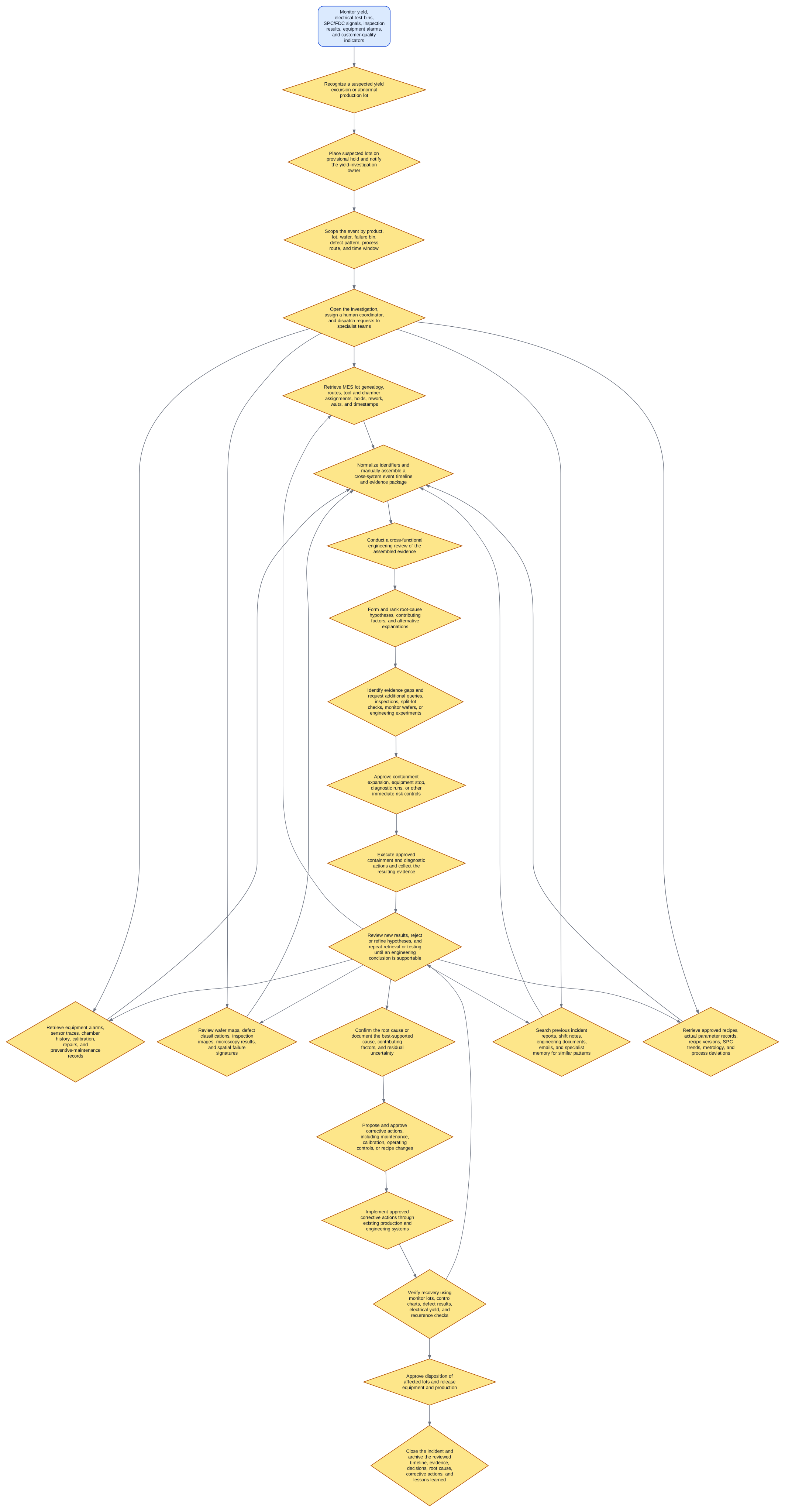
Before the agent system, a yield excursion became a human-coordination problem.
- A yield, product, process, manufacturing, or quality engineer recognized an abnormal signal, opened an investigation, and—when exposure justified it—requested a provisional lot hold.
- The yield engineer scoped affected products, lots, wafers, failure bins, defect patterns, routes, and time windows, then assigned separate requests to equipment, process, defect, product, and quality specialists.
- Each specialist retrieved evidence from a different system. Manufacturing exported genealogy and chamber assignments; equipment engineers inspected alarms, sensor traces, maintenance, and calibration; process engineers compared recipes, SPC, and metrology; defect specialists reviewed wafer maps and images; product engineers interpreted electrical failure signatures.
- The coordinator normalized inconsistent identifiers and timestamps, assembled spreadsheets and screenshots, searched old reports and personal email, and convened a cross-functional war room.
- Engineers formed hypotheses, identified missing evidence, requested another round of queries or diagnostic runs, and repeated the cycle until they could support containment, corrective action, and release decisions.
The process was not slow because engineers lacked expertise. It was slow because specialist work was dispatched serially, evidence arrived in incompatible forms, and the investigation state lived across meetings, files, and individual memory. An important interaction—such as a specific chamber condition after maintenance affecting only one recipe version—could remain hidden until late in the review.
Key pain points:
- Repeated manual retrieval and identifier reconciliation delayed the first credible hypothesis.
- Historical incidents were difficult to find and easy to overgeneralize.
- Hypotheses, contradictory evidence, and unresolved questions were not consistently maintained as structured objects.
- Managers could not approve a tool stop, experiment, lot disposition, or release until the evidence package was manually reconstructed.
4. Agent Design and Guardrails
- Inputs: Yield and bin data, lot genealogy, routes, tool and chamber assignments, equipment alarms and traces, recipes, SPC, metrology, inspection artifacts, maintenance history, electrical-test results, and reviewed incident records.
- Understanding: Entity normalization, temporal alignment, affected/control cohort construction, process-step comparison, historical retrieval, and evidence tagging.
- Reasoning: Deviation analysis, similarity ranking, hypothesis generation, contradiction checks, evidence-gap detection, and confidence updates.
- Actions: Open and update an investigation workspace, retrieve governed records, produce comparisons, request targeted follow-up, and generate a versioned engineering review brief.
- Memory/state: A persistent case state containing cohort definitions, source records, tool calls, hypotheses, reviewer corrections, decisions, and approved closure findings.
- Human review points: Alert validation, initial containment, image and failure-signature interpretation, hypothesis review, diagnostic authorization, root-cause confirmation, corrective-action approval, recovery acceptance, lot disposition, equipment release, and production release.
- Out-of-scope actions: Stopping equipment, changing dispatch, editing recipes, scrapping or reworking lots, approving corrective actions, or releasing production.
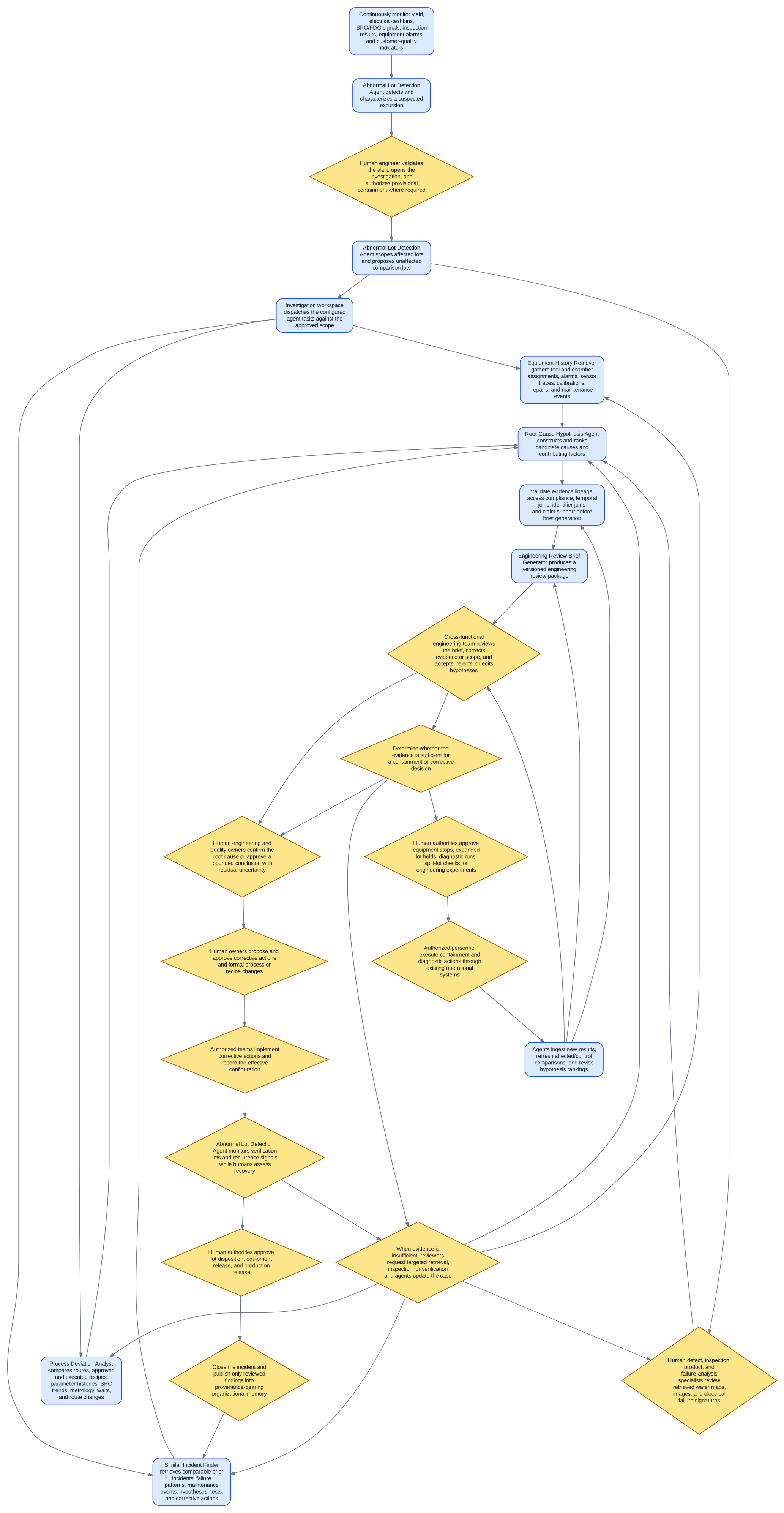
The post-agent workflow uses six named roles. The Abnormal Lot Detection Agent characterizes the signal and proposes affected and comparison cohorts. The Equipment History Retriever aligns chamber use, alarms, sensor traces, calibration, repair, and maintenance with wafer-processing intervals. The Process Deviation Analyst compares approved and executed recipes, route differences, waits, SPC trends, and metrology. The Similar Incident Finder retrieves only reviewed precedents and labels material differences. The Root-Cause Hypothesis Agent maintains candidate mechanisms with supporting, contradictory, and missing evidence. The Engineering Review Brief Generator separates facts, derived analyses, analogies, hypotheses, recommended checks, and decisions requiring approval.
A workflow coordinator dispatches these tasks in parallel, but it is not a new decision authority. Agents operate through least-privilege connectors and do not write to the fab’s operational control plane. Every material claim links to source records and transformation history. Only reviewed closure findings enter long-term incident memory; rejected hypotheses remain visible but cannot become authoritative precedent.
5. One Workflow Walkthrough
Over three shifts, electrical yield for an automotive power-management product fell from its normal range of roughly 93–95% to 86–88%, with a repeating edge-related failure pattern. The detection agent flagged the shift, summarized the affected bins and wafers, and proposed unaffected lots from the same product and route as controls. A yield engineer validated the alert, opened the case, and approved a provisional hold.
The equipment retriever found that many affected wafers had passed through one of three plasma-etch chambers after preventive maintenance, but it also surfaced unaffected wafers processed on the same chamber. The process analyst then identified a narrower interaction: the affected group combined that post-maintenance chamber state with one recipe version and a particular upstream wait pattern. The incident finder returned an older edge-defect case but marked differences in product and maintenance work. Human inspection specialists confirmed that the current wafer-map signature was similar but not identical.
The hypothesis agent ranked a chamber-calibration and recipe-interaction mechanism above a simple “alarm caused the failure” explanation. Because contradictory evidence remained, the engineering team rejected immediate recipe modification and approved a monitor-wafer check and a bounded diagnostic run. The new results were ingested, the hypothesis ranking changed, and a revised brief supported human confirmation of the cause, corrective maintenance, controlled verification lots, and eventual production release. Every retrieval, correction, approval, and release decision remained in the case record.
6. Results
- Baseline period: Historical manual investigations; complex excursions typically required many hours to several days.
- Evaluation period: Not yet measured; the case is specified for a shadow pilot before production use.
- Workflow scope/sample: Cross-functional yield excursions involving multiple process, equipment, inspection, maintenance, and test systems.
- Process change: Serial specialist requests become parallel, scoped retrieval and analysis tasks feeding one versioned case state.
- Decision/model change: Root-cause candidates must expose mechanism, evidence for and against, missing checks, affected scope, and confidence.
- Business effect: Expected reductions in engineer retrieval time, time to first credible hypothesis, unnecessary equipment downtime, and delay to controlled release.
- Evidence status: Planned and estimated, not observed production results.
The pilot should measure time to assemble the first review package, time to first supportable hypothesis, engineering hours spent retrieving data, percentage of required systems checked, number of review-loop iterations, time under unnecessary tool stop, and time from containment to approved release. Yield improvement should not be claimed as a direct agent output; it would be an indirect consequence of faster and better-supported corrective action.
7. What Failed First and What Changed
In a design review using the representative excursion, the first prototype over-ranked the post-maintenance equipment alarm because it was temporally close to the yield drop and appeared in a similar historical report. That logic ignored unaffected lots on the same chamber and understated the recipe-version interaction. The workflow was changed to require affected/control comparisons, sequential route context, contradictory evidence, and claim-level provenance before a hypothesis could enter the review brief. The remaining limitation is physical causality: an agent can organize evidence and propose discriminating checks, but qualified engineers must still determine whether the mechanism is technically credible and whether an experiment proves it.
8. Transferable Lesson
- Use agents to shorten the loop between an observation, the next evidence request, and a revised hypothesis—not to bypass engineering review.
- Preserve the existing systems of record and decision rights; place the agent layer above them as a governed investigation workspace.
- Treat reviewed incident memory as evidence with lineage, validity, and caveats, not as a collection of answers to imitate.
This case shows that agentic AI works best when operational knowledge is fragmented, investigation paths branch, and speed matters—but authority must remain with accountable human owners.
-
Sewoong Lee, Jinkyou Choi, and Min Su Kim, “Generative Pre-Training of Time-Series Data for Unsupervised Fault Detection in Semiconductor Manufacturing,” arXiv:2309.11427, 2023. ↩︎
-
Tsuyoshi Idé and Kohei Miyaguchi, “Cross-Process Defect Attribution using Potential Loss Analysis,” arXiv:2508.00895, 2025. ↩︎
-
Shunyu Yao et al., “ReAct: Synergizing Reasoning and Acting in Language Models,” arXiv:2210.03629, 2022. ↩︎
-
Qingyun Wu et al., “AutoGen: Enabling Next-Gen LLM Applications via Multi-Agent Conversation,” arXiv:2308.08155, 2023. ↩︎
-
Yiqi Wang et al., “From Agent Traces to Trust: A Survey of Evidence Tracing and Execution Provenance in LLM Agents,” arXiv:2606.04990, 2026. ↩︎