Executive Snapshot
- Client type: Independent, multi-service funeral home handling approximately 80–120 cases per month
- Industry: Funeral, memorial, burial, cremation, and related coordination services
- Core problem: One accountable funeral director had to synchronize family instructions, legal documents, facility reservations, transport, vendors, notices, and service-day readiness across fragmented systems.
- Why agentic AI: The work required persistent case state, role-specific handoffs, dependency tracking, exception handling, and selective human approvals rather than a single response or fixed automation.
- Deployment stage: Prototype operating-model design
- Primary result: A case-orchestration workflow that shifts staff effort from reconstructing status and propagating changes to family support, exception resolution, and accountable approval.
1. Business Context
The funeral home receives cases around the clock from hospitals, hospices, nursing homes, residences, police or coronial authorities, and other funeral providers. Each case moves from death notification and transfer through family arrangements, statutory documentation, facility and vendor booking, ceremony delivery, and final administrative closure. Staff work across funeral-management software, paper forms, scans, email, messaging applications, shared calendars, vendor portals, and telephone notes. Errors matter because the tasks are tightly coupled: a missing authorization can block cremation, an incorrect name can require several documents and notices to be reissued, and a changed service time can affect transport, clergy, flowers, catering, staffing, and the family’s public announcement.
2. Why Simpler Automation Was Not Enough
A checklist could show standard tasks, but it could not reliably determine which permits applied to a particular place of death, disposition method, destination, or authority. A dashboard could display bookings, but not reason about whether a provisional crematorium slot was usable before the legal documents arrived. A chatbot could draft an obituary, but it could not safely distinguish approved biographical facts from uncertain family notes. The workflow also changed after almost every significant conversation. What was needed was a stateful coordination layer that could preserve structured handoffs, monitor prerequisites, revise a linked plan when new information arrived, and stop at decisions reserved for the family or qualified staff.
3. Pre-Agent Workflow
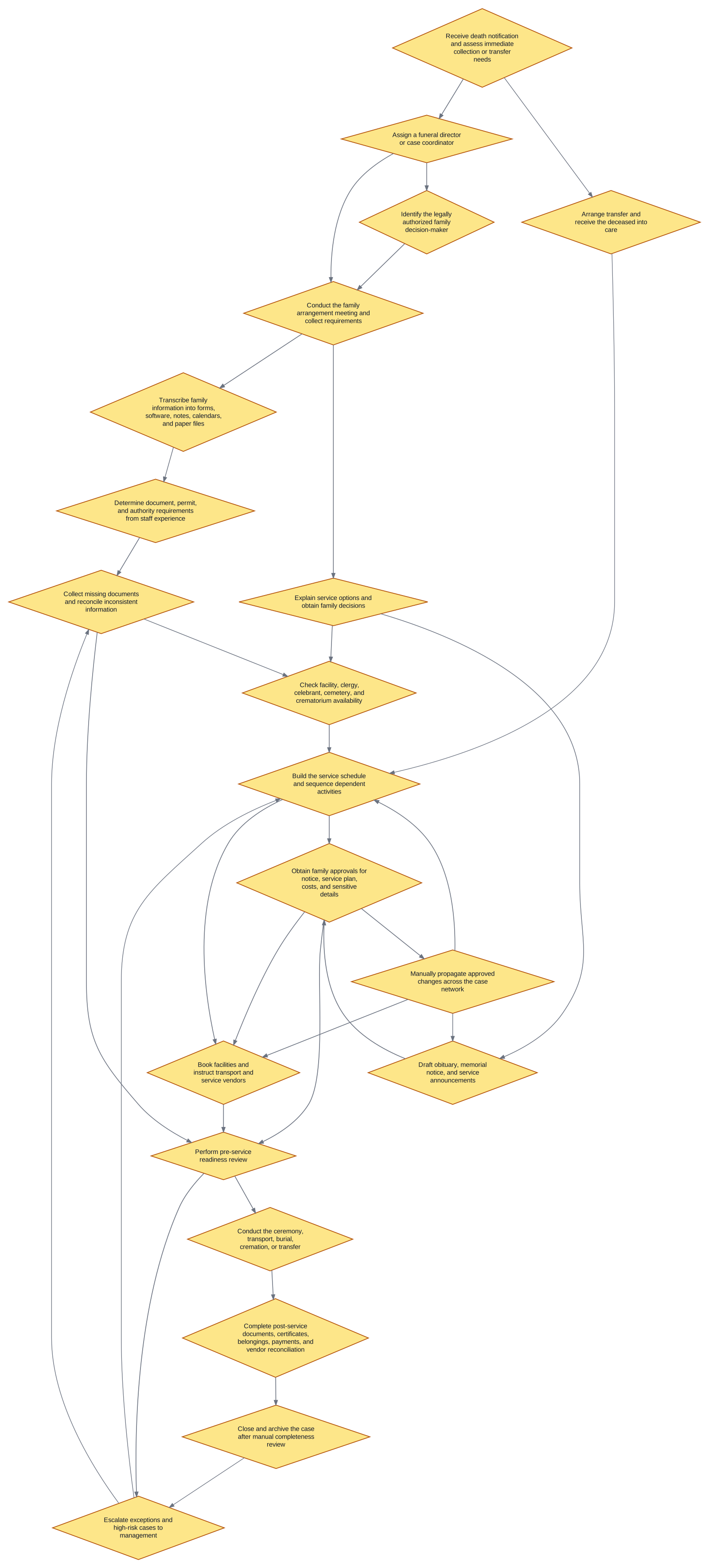
Before the redesign, one funeral director or case coordinator remained accountable for the case but depended heavily on personal memory and manual follow-up.
- Intake and custody: Reception or on-call staff received the death notification, assessed immediate release and transport needs, assigned a coordinator, and arranged transfer into care.
- Family arrangements and transcription: The coordinator identified the legally authorized decision-maker, conducted the arrangement meeting, and later re-entered names, preferences, contacts, and service choices into forms, software, calendars, notes, and paper files.
- Requirements and scheduling: Using experience, the coordinator determined permits and documents, chased missing information, checked cemetery, crematorium, venue, clergy, and celebrant availability, then assembled a feasible schedule.
- Bookings, notices, and approvals: Staff placed vendor and facility requests, drafted the obituary and notices, and obtained family approval for public wording, costs, service plans, and sensitive details.
- Change propagation and closure: When anything changed, the coordinator manually identified affected parties, revised records, reconfirmed arrangements, performed a pre-service review, escalated blocked cases, delivered the service, and later reconciled certificates, belongings, payments, and vendor records before closure.
Key pain points:
- Case truth was distributed across systems and individual staff memory, making management oversight reactive.
- Handoffs were informal: a fact corrected in one form could remain wrong in a notice, vendor instruction, or booking record.
- A single family change created a hidden dependency search across documents, providers, costs, staffing, and deadlines.
- Readiness reviews occurred late, when a missing approval or unconfirmed vendor was already capable of disrupting the service.
4. Agent Design and Guardrails
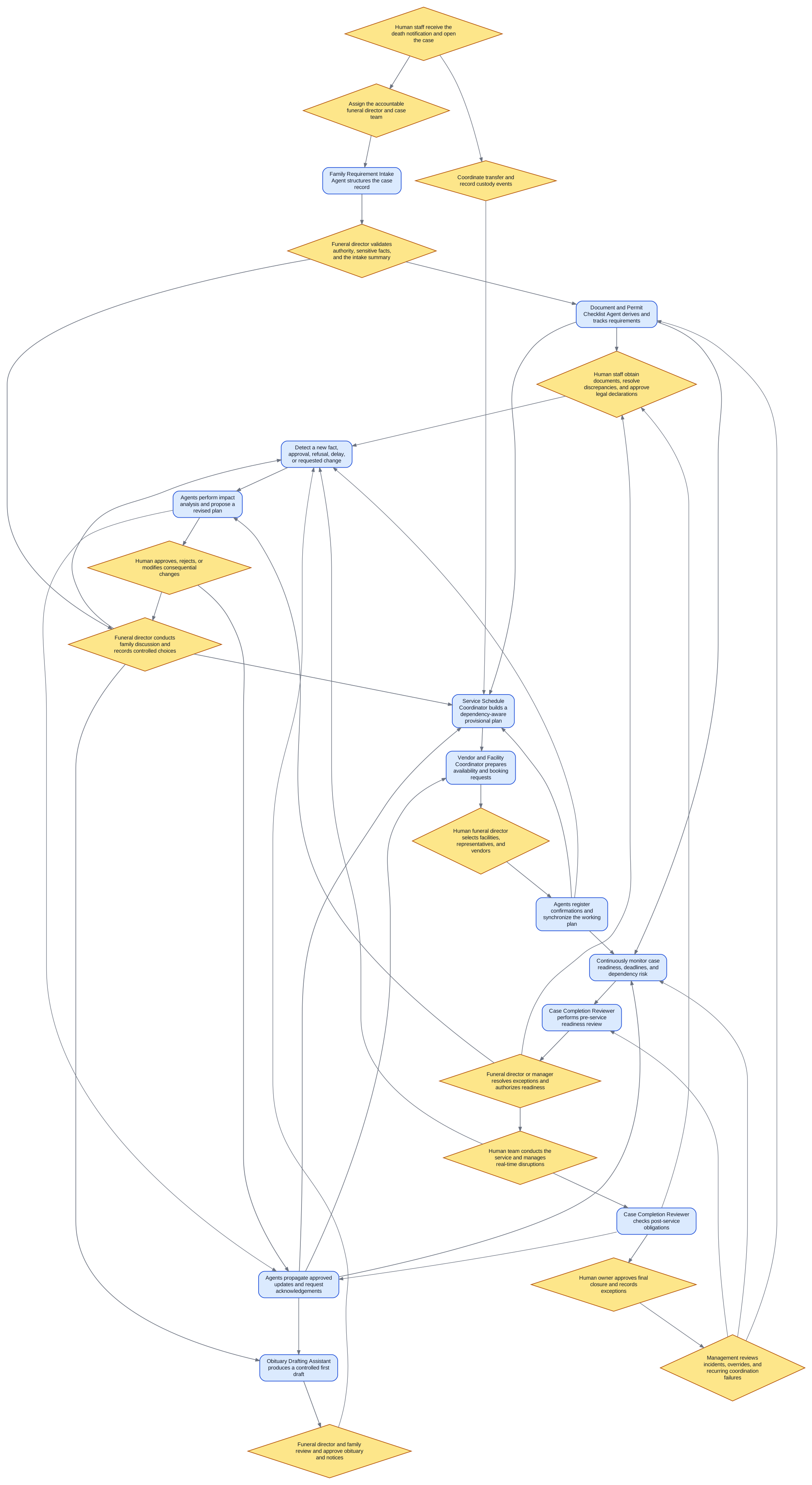
The redesign follows one analytical principle: agentic value comes from preserving dependencies through specialized handoffs while reserving consequential decisions for humans. Research on multi-agent systems supports role specialization, structured intermediate outputs, and explicit operating procedures rather than loosely connected model conversations.1 It also shows the value of configurable agent interactions that combine models, tools, and human input at selected stages.2 ReAct-style reasoning is relevant because the case plan must be updated as new observations arrive and exceptions appear.3 Reflexion motivates a separate review-and-feedback loop rather than blind retries.4 Human-agent research further supports co-planning, action approvals, hand-back of control, visible histories, and verification for high-stakes actions.5
- Inputs: Staff-entered death notification, custody events, family meeting notes, identity details, documents, approved preferences, facility responses, vendor confirmations, deadlines, and change requests
- Understanding: Structured extraction into confirmed, provisional, missing, conflicting, or source-uncertain facts; jurisdiction- and case-specific checklist matching; classification of changes as operational, financial, legal, personal, religious, or ceremonial
- Reasoning: Dependency-aware scheduling, prerequisite checks, impact analysis, readiness scoring, deadline monitoring, and escalation rules
- Actions: Prepare booking requests, register confirmations, draft obituary text, propose revised plans, synchronize approved updates, request acknowledgements, and generate readiness or closure exceptions
- Memory/state: One authoritative, versioned case record with source provenance, approvals, current commitments, outstanding obligations, and an auditable change history
- Human review points: Authority validation; legal declarations; family discussions; disposition, cultural, religious, ceremonial, preparation, viewing, venue, provider, cost, and publication choices; consequential schedule changes; pre-service authorization; real-time service decisions; and final closure
- Out-of-scope actions: Independent family communication, grief counselling, religious interpretation, legal advice, provider substitution, publication, or autonomous authorization of a service
The Family Requirement Intake Agent structures the case without inventing preferences. The Document and Permit Checklist Agent derives likely requirements but flags uncertain legal matches. The Service Schedule Coordinator produces a provisional linked plan. The Vendor and Facility Coordinator prepares and tracks requests but cannot select providers. The Obituary Drafting Assistant uses only approved facts. The Case Completion Reviewer checks readiness before the service and obligations after it, but a funeral director or manager remains the authorizing party.
5. One Workflow Walkthrough
A family had approved a morning ceremony and cremation, but later asked to delay the service so an overseas relative could attend. The funeral director recorded the request after speaking with the authorized decision-maker. The system classified it as a family-controlled ceremonial and schedule change, then paused execution rather than treating the request as an instruction. The impact analysis identified the crematorium arrival window, hearse schedule, celebrant availability, florist delivery, staff roster, family notice, and final cost estimate as dependent items. The Service Schedule Coordinator proposed two feasible alternatives based on current confirmations. The funeral director discussed those options with the family and approved the later one. Only then did the agents update the working plan, prepare revised provider messages, and request acknowledgements. The readiness monitor showed that the florist had not confirmed the new delivery time, so the case remained blocked. A staff member contacted the florist directly, recorded the confirmation, and the Case Completion Reviewer reran its checks. The funeral director authorized readiness, and the complete change history remained attached to the case for audit and post-service review.
6. Results
- Baseline period: Not available; the pre-agent state is reconstructed from the operating profile and inferred workflow.
- Evaluation period: Proposed pilot over 8–12 weeks
- Workflow scope/sample: All routine burial and cremation cases, with repatriation, police, coronial, authority-dispute, and active family-conflict cases routed to enhanced management review
- Process change: One structured case state replaces repeated status reconstruction; approved changes trigger explicit impact analysis and synchronized updates instead of memory-based follow-up.
- Decision/model change: Agents recommend, check, draft, and monitor; humans retain authority over legal, family, ceremonial, religious, provider, cost, and closure decisions.
- Business effect: Expected reductions in missed prerequisites, duplicate data entry, late escalation, and time spent chasing case status; expected increase in time available for family support and exception resolution.
- Evidence status: Planned; no production performance or financial metrics are claimed.
A credible pilot should measure document completeness at booking, number of post-approval corrections, unacknowledged provider changes, readiness exceptions discovered within 24 hours of service, coordinator time spent on status reconstruction, management escalations by cause, and family-facing response quality. Any claimed improvement should be reported separately for routine and complex cases.
7. What Failed First and What Changed
The first design risk was excessive automation of ambiguous intake. A model could turn tentative comments—such as a relative mentioning a possible religious preference or an unconfirmed service time—into apparently final case facts. That would make downstream coordination faster but less safe. The workflow was therefore changed so every intake item carries a state: confirmed, provisional, missing, conflicting, or source-uncertain. Personal and religious preferences cannot be inferred, and consequential changes cannot propagate until a named human approves the change set. A second limitation remains: too many approval interruptions can recreate the administrative burden the system is meant to reduce. Approval gates therefore need to be risk-based, with routine internal synchronization automated and family, legal, ceremonial, publication, provider, and material-cost decisions held for review.
8. Transferable Lesson
- Model the organization’s handoffs before assigning agents. Specialized agents are useful when their outputs correspond to real operational artifacts—an intake record, permit checklist, linked schedule, booking state, approved notice, or completion review.
- Place humans at decision boundaries, not at every keystroke. Human control is most valuable for authority, dignity, preference, legality, irreversible actions, and exceptions; routine state synchronization can remain automated.
- Treat changes as dependency events. The system should identify every affected task and party, obtain approval for the revised plan, propagate only the approved change set, and verify acknowledgements before declaring readiness.
This case shows that agentic AI works best in sensitive operations when it makes the workflow more coherent without making the human relationship less human.
-
Sirui Hong et al., “MetaGPT: Meta Programming for a Multi-Agent Collaborative Framework,” arXiv:2308.00352, 2023, https://arxiv.org/abs/2308.00352. ↩︎
-
Qingyun Wu et al., “AutoGen: Enabling Next-Gen LLM Applications via Multi-Agent Conversation,” arXiv:2308.08155, 2023, https://arxiv.org/abs/2308.08155. ↩︎
-
Shunyu Yao et al., “ReAct: Synergizing Reasoning and Acting in Language Models,” arXiv:2210.03629, 2022, https://arxiv.org/abs/2210.03629. ↩︎
-
Noah Shinn et al., “Reflexion: Language Agents with Verbal Reinforcement Learning,” arXiv:2303.11366, 2023, https://arxiv.org/abs/2303.11366. ↩︎
-
Hussein Mozannar et al., “Magentic-UI: Towards Human-in-the-loop Agentic Systems,” arXiv:2507.22358, 2025, https://arxiv.org/abs/2507.22358. ↩︎