Executive Snapshot
- Client type: Multi-branch franchise retail operator
- Industry: Convenience retail, service kiosks, salons, tutoring centers, or similar outlet-based franchising
- Core problem: Headquarters could not reliably monitor local execution quality, stock discipline, promotion compliance, customer feedback, and staff performance across many semi-independent branches.
- Why agentic AI: The workflow required continuous sensing, exception classification, prioritization, franchisee communication, and human approval loops rather than a static dashboard or one-off chatbot.
- Deployment stage: Prototype / pilot-ready design
- Primary result: A human-coordination-heavy monitoring process was redesigned into a stateful branch-exception workflow where AI agents detect issues, prepare evidence, recommend action, and route high-impact decisions to regional managers.
1. Business Context
A franchise business operates many small retail outlets under one brand. Headquarters defines the brand standards, operating manuals, promotional campaigns, supplier rules, pricing guidance, and reporting expectations. Franchisees and branch staff handle daily sales, merchandising, staffing, customer service, inventory handling, and local problem solving.
The workflow occurs every day at the branch level and every week or month at the regional-management level. The relevant information comes from POS reports, inventory records, branch photos, customer reviews, complaint logs, staff updates, inspection notes, and franchisee messages. Errors matter because a promotion can be announced by headquarters but poorly executed locally; a popular SKU can be repeatedly out of stock; a branch can accumulate customer complaints before anyone at headquarters notices; and a weak franchisee can damage the brand while still appearing normal in monthly sales summaries.
The key operational tension is simple: the brand is centralized, but execution is local.
2. Analytical Point: Agentic AI Works When Exceptions Become Managed Objects
The most useful analytical lens from recent agentic-AI research is that organizational value does not come merely from “adding AI” to individual tasks. It comes from turning scattered human coordination into managed workflow states. In this case, the valuable unit is not a chatbot answer or a dashboard chart. The valuable unit is a branch exception: a detected issue with evidence, severity, confidence, owner, deadline, review status, and closure condition.
This logic is consistent with research on agentic business process management, where agents sense process states, reason about improvement opportunities, and act within governance boundaries.1 It also fits recent retail supply-chain work showing how specialized agents can shift retail operations from manual request-response interaction toward workflow-centric automation supervised by humans.2 Customer-review multi-agent research supports the same move from descriptive summaries toward ranked, actionable business advice.3 The design therefore treats AI agents as an exception-routing layer, while humans remain accountable for relationship-sensitive and policy-level decisions.45
3. Why Simpler Automation Was Not Enough
A fixed dashboard could show sales decline, but it could not easily determine whether the issue came from weak promotion execution, late reordering, poor staff explanation, missing shelf labels, or local demand variation. A script could flag stockouts, but it would not know whether the cause was supplier delay, branch reorder discipline, or campaign-driven demand. A chatbot could answer policy questions, but it would not maintain issue state, collect evidence, re-check resolution, or escalate repeated problems.
The workflow branched constantly. A missing promotion photo might mean non-compliance, late submission, poor photo quality, or a real execution failure. A customer complaint might require no action, branch coaching, manager review, or headquarters escalation. Because the inputs were messy and the handoffs involved judgment, the better design was a stateful agent workflow with rule-based boundaries and human checkpoints.
4. Pre-Agent Workflow
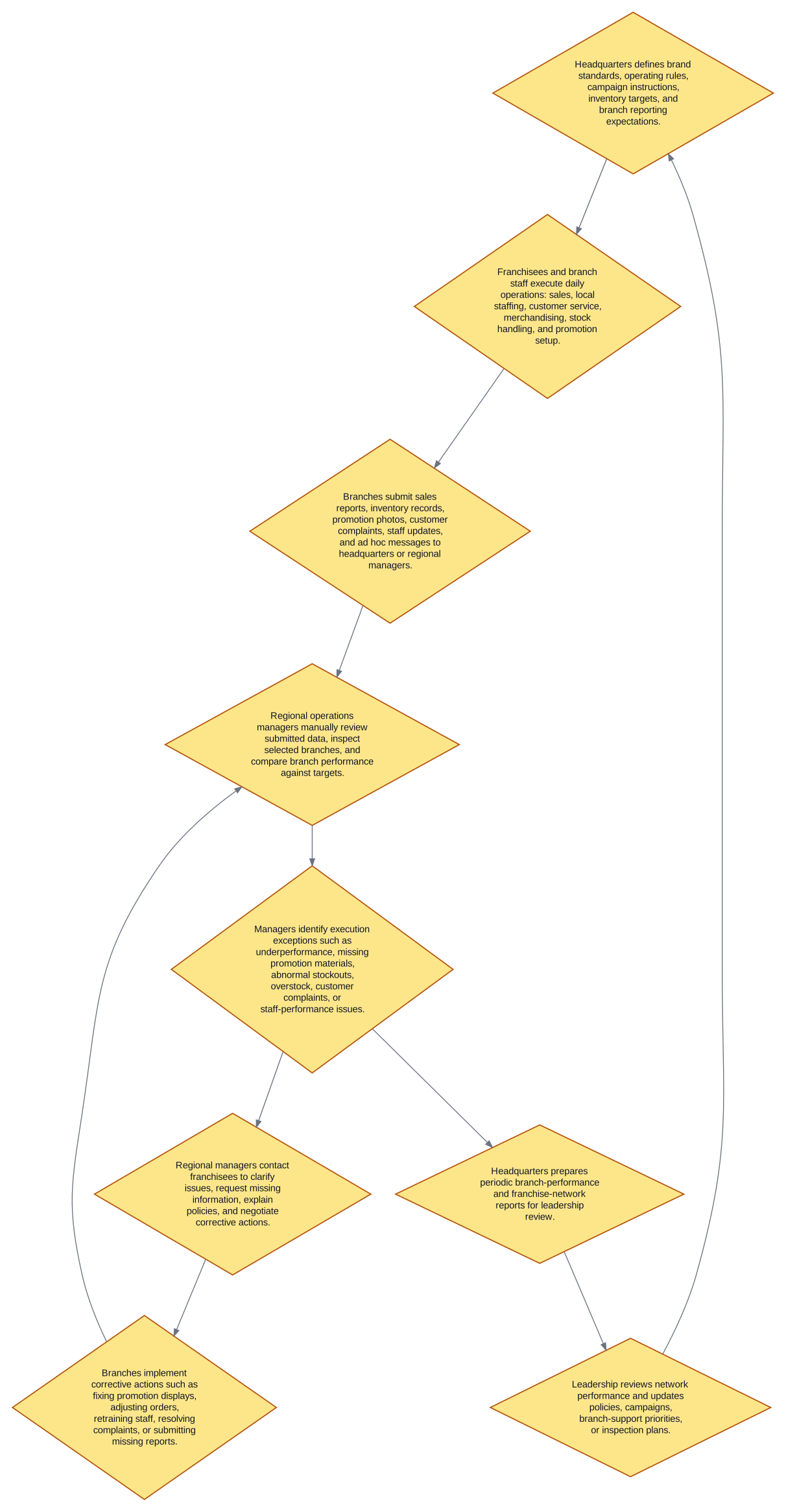
Before the AI agents were introduced, the organization operated through a mostly manual monitoring loop:
- Headquarters defined the rules. Operating standards, promotion instructions, inventory targets, and reporting templates were created centrally.
- Branches executed locally. Franchisees and branch staff handled sales, staffing, merchandising, customer service, ordering, and promotion setup.
- Branches submitted evidence. Sales reports, inventory updates, promotion photos, complaint notes, and ad hoc messages were sent through POS exports, spreadsheets, forms, chats, or email.
- Regional managers reviewed selectively. Managers manually checked selected branches, compared results with targets, and relied on field visits or experience to identify problems.
- Issues were handled through follow-up messages. Managers contacted franchisees, requested missing evidence, explained policies, negotiated corrective actions, and later tried to verify whether the branch actually fixed the issue.
- Headquarters received delayed summaries. Branch-performance and compliance reports were prepared weekly or monthly, often after the operational window had already passed.
Key pain points:
- Delayed detection: Weak branches were often discovered after several days or weeks of poor execution.
- Uneven monitoring: Branches that received more manager attention were checked more thoroughly than quieter branches.
- Fragmented evidence: Sales data, photos, complaints, and franchisee messages were rarely interpreted together.
- Repeated support burden: Regional managers answered similar franchisee questions many times.
- Weak closure discipline: Corrective actions were not always connected to evidence, deadlines, and follow-up verification.
5. Agent Design and Guardrails
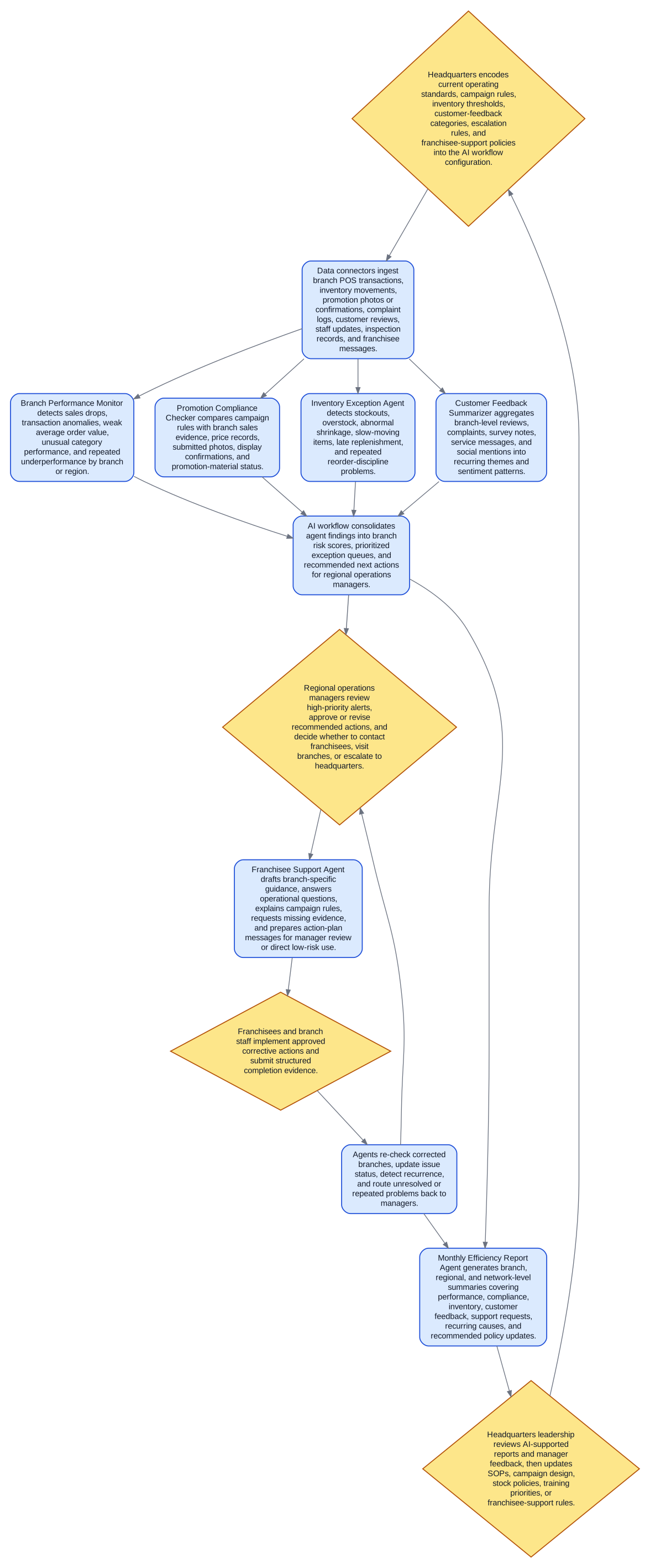
The new workflow introduced five specialized operational agents plus a reporting layer.
- Inputs: POS transactions, inventory records, promotion calendars, submitted branch photos, price records, complaint logs, customer reviews, staff updates, inspection records, supplier delivery notes, franchisee messages, SOPs, and campaign manuals.
- Understanding: The system tags branch ID, timestamp, source, issue type, evidence type, campaign period, SKU category, complaint theme, and risk level.
- Reasoning: Agents compare branch data against headquarters rules, peer branches, local history, campaign requirements, inventory thresholds, and customer-feedback patterns. They classify exceptions as performance decline, missing promotion evidence, likely non-compliance, stockout, overstock, shrinkage, recurring complaint, or support request.
- Actions: The system creates branch exception records, ranks issues, drafts franchisee guidance, requests missing evidence, prepares branch scorecards, and generates weekly or monthly management summaries.
- Memory/state: Each issue has lifecycle states: detected, manager-reviewed, sent-to-branch, evidence-submitted, rechecked, closed, recurrence, or escalated.
- Human review points: Regional managers approve actions that affect franchisee obligations, formal compliance status, financial penalties, staff discipline, customer compensation, sensitive complaints, supplier disputes, or policy changes.
- Out-of-scope actions: The agents cannot issue penalties, change franchise agreements, discipline staff, approve compensation, override campaign policy, or close high-risk issues without human review.
The agent roles are divided by operational responsibility. The Branch Performance Monitor detects sales drops and unusual category performance. The Promotion Compliance Checker compares campaign rules with evidence from sales, pricing, photos, and display confirmation. The Inventory Exception Agent flags stockouts, overstock, abnormal shrinkage, and reorder-discipline issues. The Customer Feedback Summarizer turns complaints and reviews into branch-level themes. The Franchisee Support Agent answers low-risk procedural questions and drafts action messages. The Monthly Efficiency Report Agent consolidates trends for leadership review.
6. Post-Agent Workflow
After the agentic workflow is introduced, the operating model changes from manual report checking to continuous exception management:
- Headquarters encodes current rules. Approved SOPs, campaign instructions, SKU thresholds, complaint categories, and escalation rules are versioned in the workflow configuration.
- Data connectors ingest branch signals. POS, inventory, photos, reviews, inspection records, and franchisee messages are normalized by branch, timestamp, source, and evidence type.
- Specialized agents detect exceptions. Each agent monitors one operational dimension and attaches evidence, severity, confidence, and recommended next action.
- The system consolidates priorities. Branch risk scores and exception queues are created by combining commercial impact, recurrence, customer impact, compliance risk, and confidence.
- Managers review high-priority alerts. Regional managers approve, revise, reject, or escalate recommended actions. Their decisions are recorded as part of the workflow history.
- Franchisee support becomes structured. The system drafts branch-specific guidance, requests missing evidence, and answers low-risk procedural questions using approved manuals.
- Corrective actions are verified. Branches submit completion evidence; agents re-check the issue and reopen or escalate unresolved cases.
- Leadership receives learning reports. Monthly summaries show recurring causes, weak branches, policy gaps, training needs, and campaign-design problems.
The important change is not that AI “automates franchise management.” The change is that every branch issue now has a traceable workflow state.
7. One Workflow Walkthrough
A weekly campaign for a bundled product was launched across all branches. On the second day, the Promotion Compliance Checker noticed that Branch 18 had almost no bundle sales, while peer branches in the same district showed normal campaign lift. It checked the submitted branch photo and found that the shelf label was missing from the promotion area. The Inventory Exception Agent also confirmed that the promoted items were in stock, so the issue was unlikely to be caused by supply shortage.
The system created a medium-confidence promotion-compliance exception and recommended a follow-up message. Because the issue involved possible branch non-compliance, the regional manager reviewed the evidence before sending the request. The Franchisee Support Agent then drafted a message asking the branch to install the correct shelf label, confirm the discount rule with staff, and submit a new photo before closing.
The next day, the branch uploaded the corrected display photo. The system rechecked the evidence, monitored bundle sales for two more days, and moved the issue to “closed” after sales returned to the normal range. The case was logged for campaign audit and future branch training.
8. Results
- Baseline period: Pre-agent operating model based on monthly reporting and selective regional-manager review.
- Evaluation period: Pilot-ready design; recommended controlled pilot of 8 weeks.
- Workflow scope/sample: 30 branches, five operational streams: sales, promotion compliance, inventory, customer feedback, and franchisee support.
- Process change: Branch monitoring shifts from periodic manual checking to continuous exception detection and manager-reviewed action routing.
- Decision/model change: The system separates facts, inferred causes, confidence, recommended action, and human approval status.
- Business effect: Expected pilot targets include 30–50% reduction in manual triage workload, 1–3 days faster detection of promotion and stock exceptions, more complete campaign evidence collection, and improved closure tracking for recurring branch issues.
- Evidence status: Estimated / planned. These figures should be treated as pilot targets, not production-observed results.
The main measurable improvement is workflow visibility. Headquarters no longer waits for monthly reports to discover branch issues. Regional managers receive a prioritized queue, while franchisees receive clearer and more consistent guidance.
9. What Failed First and What Changed
The first version over-flagged promotion problems. During campaign launch days, some branches had low sales simply because customer traffic was slow or the campaign had not yet reached peak hours. The system initially treated these cases as likely non-compliance.
The fix was to split promotion alerts into three categories: missing evidence, commercial underperformance, and likely rule violation. The revised workflow also required branch photo evidence and stock availability checks before escalating a campaign issue. This reduced noisy alerts and made manager review more meaningful. A remaining limitation is that photo quality and inconsistent branch submissions can still weaken confidence, so ambiguous cases must remain in the human-review queue.
10. Transferable Lesson
- Do not automate the manager; automate the exception queue. The highest-value workflow object is a tracked operational issue with evidence, owner, status, and closure rule.
- Specialize agents by business responsibility. Performance, promotion, inventory, customer feedback, and support require different evidence and different escalation logic.
- Keep human approval where incentives and relationships matter. Franchisee penalties, contractual disputes, sensitive complaints, and policy changes should remain human-governed.
This case shows that agentic AI works best when a business already has repeated coordination work, fragmented operational evidence, and recurring exceptions that need structured follow-up rather than one-time answers.
References
-
Marlon Dumas, “Agentic Business Process Management Systems,” arXiv:2601.18833, 2026. https://arxiv.org/html/2601.18833v1 ↩︎
-
Biruk Tadie Degie, “Flowr — Scaling Up Retail Supply Chain Operations Through Agentic AI in Large Scale Supermarket Chains,” arXiv:2604.05987, 2026. https://arxiv.org/html/2604.05987 ↩︎
-
Kartikey Singh Bhandari, Tanish Jain, Archit Agrawal, Dhruv Kumar, Praveen Kumar, and Pratik Narang, “A Multi-Agent System for Generating Actionable Business Advice,” arXiv:2601.12024, 2026. https://arxiv.org/html/2601.12024v1 ↩︎
-
E. Bandara, “A Practical Guide to Agentic AI Transition in Organizations,” arXiv:2602.10122, 2026. https://arxiv.org/html/2602.10122v1 ↩︎
-
Charlie Masters, Advaith Vellanki, Jiangbo Shangguan, Bart Kultys, Jonathan Gilmore, Alastair Moore, and Stefano V. Albrecht, “Orchestrating Human-AI Teams: The Manager Agent as a Unifying Research Challenge,” arXiv:2510.02557, 2025. https://arxiv.org/abs/2510.02557 ↩︎