Executive Snapshot
- Client type: Regional delivery and transport operator
- Industry: Logistics, last-mile delivery, and small-fleet transport
- Core problem: Vehicle maintenance was reactive; breakdowns triggered repair decisions only after routes, drivers, and customers were already affected.
- Why agentic AI: The work required more than a dashboard: messy driver notes, inspection forms, fuel receipts, repair invoices, and route-delay records had to be interpreted, linked, prioritized, and routed through human approval.
- Deployment stage: Pilot design
- Primary result: The workflow shifts from scattered human coordination to an early-warning maintenance loop where AI agents prepare evidence, recommend actions, and keep supervisors in control.
1. Business Context
The company operates a mixed regional fleet of vans, light trucks, and motorcycles for daily delivery routes. Every operating day creates a trail of driver logs, route-delay notes, fuel purchases, mileage records, vehicle inspections, repair invoices, mechanic comments, and customer-impacting incidents. Before the AI workflow, these records existed in separate places: spreadsheets, chat messages, paper forms, receipts, and supervisor memory. Errors mattered because one missed brake issue, fuel anomaly, overheating pattern, or repeated driver complaint could turn into a failed route, emergency repair, idle driver, disappointed customer, and avoidable cost.
2. Why Simpler Automation Was Not Enough
A fixed spreadsheet alert could remind the team about mileage thresholds, but it could not understand a driver message saying “the van shakes when braking,” connect it to a recent brake repair, compare fuel consumption against similar vehicles, and recommend a maintenance window that avoids a high-priority delivery route. A chatbot alone would also be insufficient because the workflow is not just question answering. It branches across inspection, repair approval, route reassignment, cost reporting, and management review. The right design is an agentic workflow: specialized agents prepare structured evidence and recommended actions, while human supervisors approve safety decisions, repair spending, vehicle restrictions, and replacement choices.
Analytical Lens: From Prediction to Governed Workflow
The selected research suggests one practical design point: agentic AI creates business value when prediction is converted into an auditable operating sequence. Agentic transition research emphasizes domain-specific delegation to specialized agents while keeping humans as workflow orchestrators.1 Vehicle-fleet maintenance studies show that downtime, repair cost, and service reliability improve only when maintenance records become usable for prediction and planning.23 Fuel-anomaly research adds that detection alone is insufficient unless the system explains likely causes and adapts recommendations to fleet managers and operators.4 Prescriptive-maintenance agent research then extends the logic from anomaly detection to structured recommendations, inspection checklists, corrective actions, parts requirements, and timing.5 In this case, the AI system is therefore designed as a governed maintenance loop, not a black-box prediction layer.
3. Pre-Agent Workflow
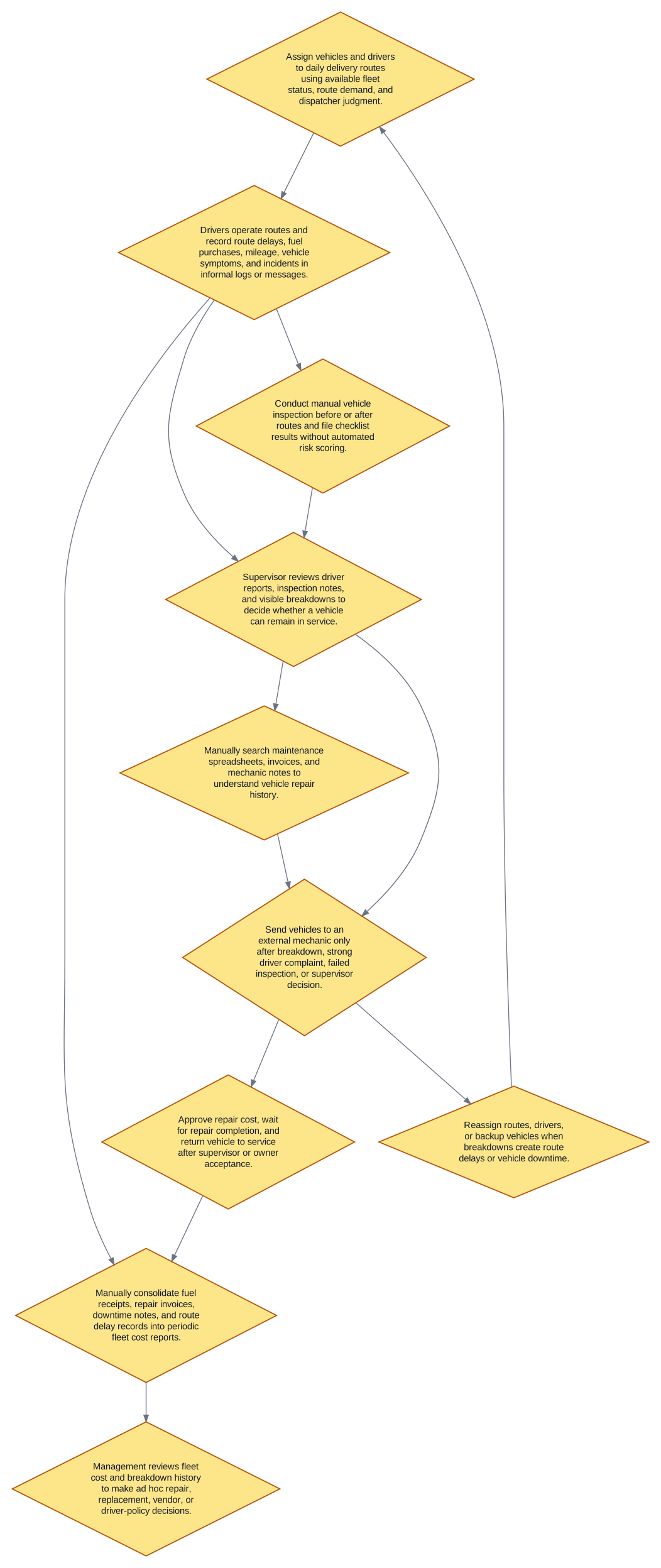
Before the agentic system, the fleet maintenance workflow depended on late human recognition and manual coordination.
- Dispatch assigned vehicles by availability and memory. Dispatchers selected vehicles and drivers using visible fleet availability, route demand, unresolved known issues, and supervisor judgment.
- Drivers reported problems informally. During or after routes, drivers recorded delays, fuel purchases, mileage, vehicle symptoms, and incidents through chat messages, verbal updates, paper forms, or end-of-day notes.
- Supervisors manually triaged roadworthiness. A fleet supervisor reviewed driver complaints, inspection checklists, and visible breakdowns to decide whether a vehicle could remain in service.
- Repair history was reconstructed manually. Maintenance spreadsheets, invoices, and mechanic notes were checked only when a complaint, failed inspection, or breakdown forced a decision.
- Repairs triggered exceptions. Vehicles were sent to external mechanics, repair costs were approved manually, routes were reshuffled, and fleet cost reports were consolidated later from receipts and spreadsheets.
Key pain points:
- Weak signals were visible separately but rarely connected: fuel drift, repeated vibration comments, minor inspection failures, and route delays did not form a vehicle-level risk picture.
- Maintenance timing was driven by breakdown pressure rather than planned service windows.
- Reports were backward-looking; by the time repair cost and downtime were summarized, the operational damage had already occurred.
4. Agent Design and Guardrails
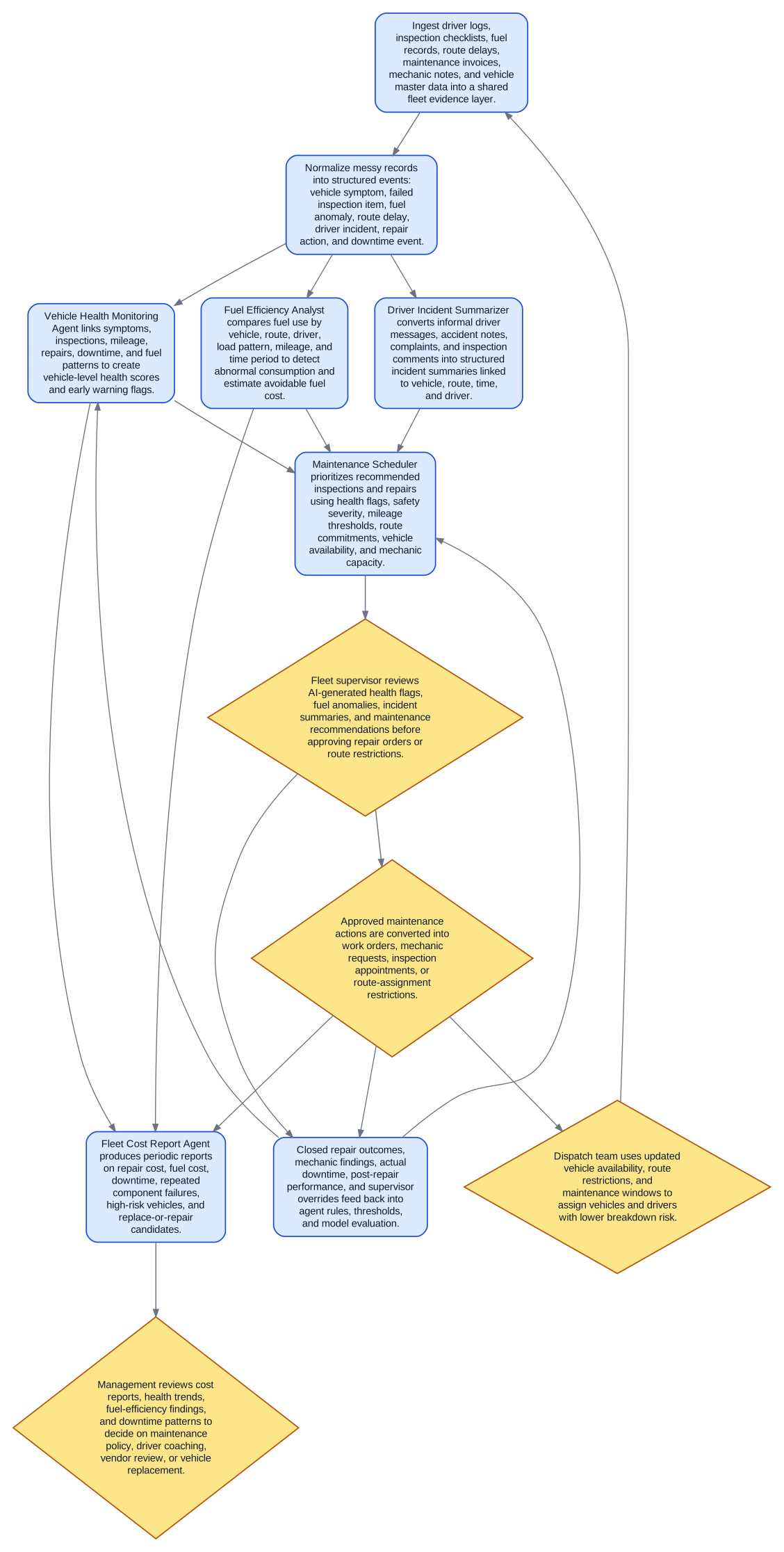
The AI Fleet Maintenance Agent system is organized as a shared evidence layer plus five specialized agents.
- Inputs: Driver logs, inspection checklists, fuel records, route delays, mileage, repair invoices, mechanic notes, accident reports, customer complaints, vehicle master data, and maintenance schedules.
- Understanding: The system normalizes messy records into structured events: vehicle symptom, failed inspection item, fuel anomaly, route delay, driver incident, repair action, and downtime event.
- Reasoning: The Vehicle Health Monitoring Agent links symptoms, inspections, mileage, past repairs, downtime, and fuel patterns to produce health flags. The Fuel Efficiency Analyst compares fuel use by vehicle, route, driver, load pattern, and time period. The Maintenance Scheduler ranks recommended inspections and repairs using severity, mileage thresholds, route commitments, mechanic capacity, and vehicle availability.
- Actions: The system prepares alerts, recommended maintenance windows, draft work orders, route restrictions, driver incident summaries, and monthly fleet cost reports.
- Memory/state: Each vehicle keeps a running operational memory: unresolved flags, recent repairs, repeated component failures, supervisor overrides, actual downtime, and post-repair performance.
- Human review points: Supervisors approve repair orders, route restrictions, safety-critical decisions, and cost thresholds. Management approves vehicle replacement, vendor review, driver coaching, and policy changes.
- Out-of-scope actions: The agents do not automatically discipline drivers, approve major repair spending, replace vehicles, or override safety rules for route pressure.
The guardrail principle is simple: agents can structure evidence, rank risks, draft actions, and monitor feedback, but human managers remain accountable for safety, spending, and employment-sensitive decisions.
5. One Workflow Walkthrough
On Monday morning, Vehicle V-014 was assigned to a normal urban delivery route. During the day, the driver sent a short message saying the van felt weak when accelerating and used more fuel than usual. In the old workflow, this might have become an end-of-day note. In the new workflow, the Driver Incident Summarizer converts the message into a structured symptom event. The Fuel Efficiency Analyst compares V-014 against similar vans on similar routes and flags a two-week fuel-efficiency deterioration. The Vehicle Health Monitoring Agent then links the fuel anomaly to mileage, a recent engine-related invoice, and two route-delay events. Because the risk is meaningful but not yet a confirmed breakdown, the Maintenance Scheduler recommends inspection within 48 hours, not immediate route removal. A supervisor reviews the evidence, approves a low-disruption inspection window, and restricts V-014 from long-distance routes until cleared. The mechanic’s findings and actual repair outcome are logged back into the vehicle memory.
6. Results
- Baseline period: Eight weeks of historical dispatch, fuel, inspection, repair, and route-delay records.
- Evaluation period: Proposed eight-week pilot across a sample of vans and motorcycles with sufficient maintenance and fuel history.
- Workflow scope/sample: Daily driver logs, inspection records, maintenance invoices, fuel receipts, route-delay notes, and supervisor repair decisions.
- Process change: The workflow changes from breakdown-triggered repair escalation to daily evidence ingestion, automated event normalization, vehicle-level health scoring, supervisor review, approved maintenance action, and feedback logging.
- Decision/model change: Supervisors no longer review isolated complaints; they review linked evidence across symptoms, inspection failures, fuel anomalies, repair history, and route impact.
- Business effect: The expected business effects are fewer emergency route disruptions, better maintenance-window planning, earlier detection of high-cost vehicles, clearer replace-or-repair discussions, and more disciplined fuel-cost review.
- Evidence status: Pilot-ready estimate. The case should not be presented as a production-measured ROI until downtime reduction, emergency repair frequency, fuel variance, and route-delay impact are measured after deployment.
A reasonable pilot scorecard would track four metrics: number of unplanned breakdowns per 1,000 vehicle-days, average repair lead time, fuel-consumption outlier rate by vehicle group, and percentage of maintenance actions scheduled before route failure.
7. What Failed First and What Changed
The first version over-flagged vehicles because it treated every driver complaint and fuel anomaly as a potential maintenance issue. This created alert fatigue for supervisors and risked removing vehicles from service unnecessarily. The workflow was revised to require cross-evidence before escalation: a fuel anomaly alone became a monitoring signal, but a fuel anomaly plus repeated symptom comments, failed inspection items, recent repair history, or route-delay impact became a higher-priority health flag. The remaining limitation is data quality. If drivers underreport symptoms or repair invoices lack component-level detail, the agent can still miss or misclassify early warnings.
8. Transferable Lesson
- Do not automate the final decision first. Start by automating evidence capture, event normalization, and risk ranking, then preserve human approval for safety and spending decisions.
- Design around handoffs, not dashboards. The value appears when the system converts signals into the next operational step: inspection, work order, route restriction, driver follow-up, or management review.
- Close the learning loop. Every mechanic finding, supervisor override, post-repair outcome, and false alarm should feed back into thresholds, rules, and future health scoring.
This case shows that agentic AI works best when an organization has many weak operational signals but lacks the workflow discipline to connect them before costly exceptions occur.
References
-
Eranga Bandara et al., “A Practical Guide to Agentic AI Transition in Organizations,” arXiv:2602.10122, 2026. https://arxiv.org/abs/2602.10122 ↩︎
-
Arindam Chaudhuri, “Predictive Maintenance for Industrial IoT of Vehicle Fleets using Hierarchical Modified Fuzzy Support Vector Machine,” arXiv:1806.09612, 2018. https://arxiv.org/abs/1806.09612 ↩︎
-
Josh Gardner et al., “Driving with Data in the Motor City: Mining and Modeling Vehicle Fleet Maintenance Data,” arXiv:2002.10010, 2020. https://arxiv.org/abs/2002.10010 ↩︎
-
Alberto Barbado and Óscar Corcho, “Interpretable Machine Learning Models for Predicting and Explaining Vehicle Fuel Consumption Anomalies,” arXiv:2010.16051, 2020. https://arxiv.org/abs/2010.16051 ↩︎
-
Chitranshu Harbola and Anupam Purwar, “Prescriptive Agents based on RAG for Automated Maintenance (PARAM),” arXiv:2508.04714, 2025. https://arxiv.org/abs/2508.04714 ↩︎