Executive Snapshot
- Client type: Regional museum, gallery, or cultural center
- Industry: Cultural heritage, public programming, education, and donor-funded nonprofit operations
- Core problem: A small team had to manage collection records, exhibitions, visitor inquiries, education materials, event programming, and donor communications through fragmented human handoffs.
- Why agentic AI: The work required source-grounded drafting, task routing, memory, exception handling, and human review rather than a single chatbot or fixed script.
- Deployment stage: Prototype / pilot design
- Primary result: The operating model shifted from human-coordination-heavy work to an AI-assisted review workflow where agents prepare structured drafts and staff retain control over interpretation, publication, and relationship-sensitive decisions.
1. Business Context
The institution is a small regional museum that runs temporary exhibitions, school visits, public events, donor campaigns, and collection-management work with a lean team. Operational requests arrive every day through email, phone, website forms, front-desk conversations, spreadsheets, event calendars, collection records, scanned catalogues, curatorial notes, donor files, and staff memory. A single exhibition can trigger several parallel workstreams: object metadata checks, wall-label drafting, school-visit materials, event copy, visitor FAQs, and donor updates. Delays matter because exhibition launches, school bookings, and grant deadlines are date-sensitive. Errors matter even more because incorrect provenance, unsupported historical claims, culturally insensitive wording, or careless donor communication can damage institutional trust.
2. Why Simpler Automation Was Not Enough
The museum did not only need faster text generation. It needed a controlled workflow that could observe a request, retrieve approved evidence, draft role-specific outputs, remember prior decisions, route exceptions, and preserve human accountability. A fixed script could not handle incomplete catalogue records or ambiguous curatorial notes. A dashboard could show pending work but could not draft object labels, visitor answers, or donor narratives from source material. A public chatbot would be risky because cultural-heritage outputs require provenance, institutional voice, and sensitivity review. The analytical point from the selected arXiv literature is that agentic AI creates value when it turns messy knowledge work into an evidence-to-draft-to-review loop: reasoning and action are interleaved, memory is explicit, feedback improves future behavior, and cultural claims remain grounded in traceable sources.12345
3. Pre-Agent Workflow
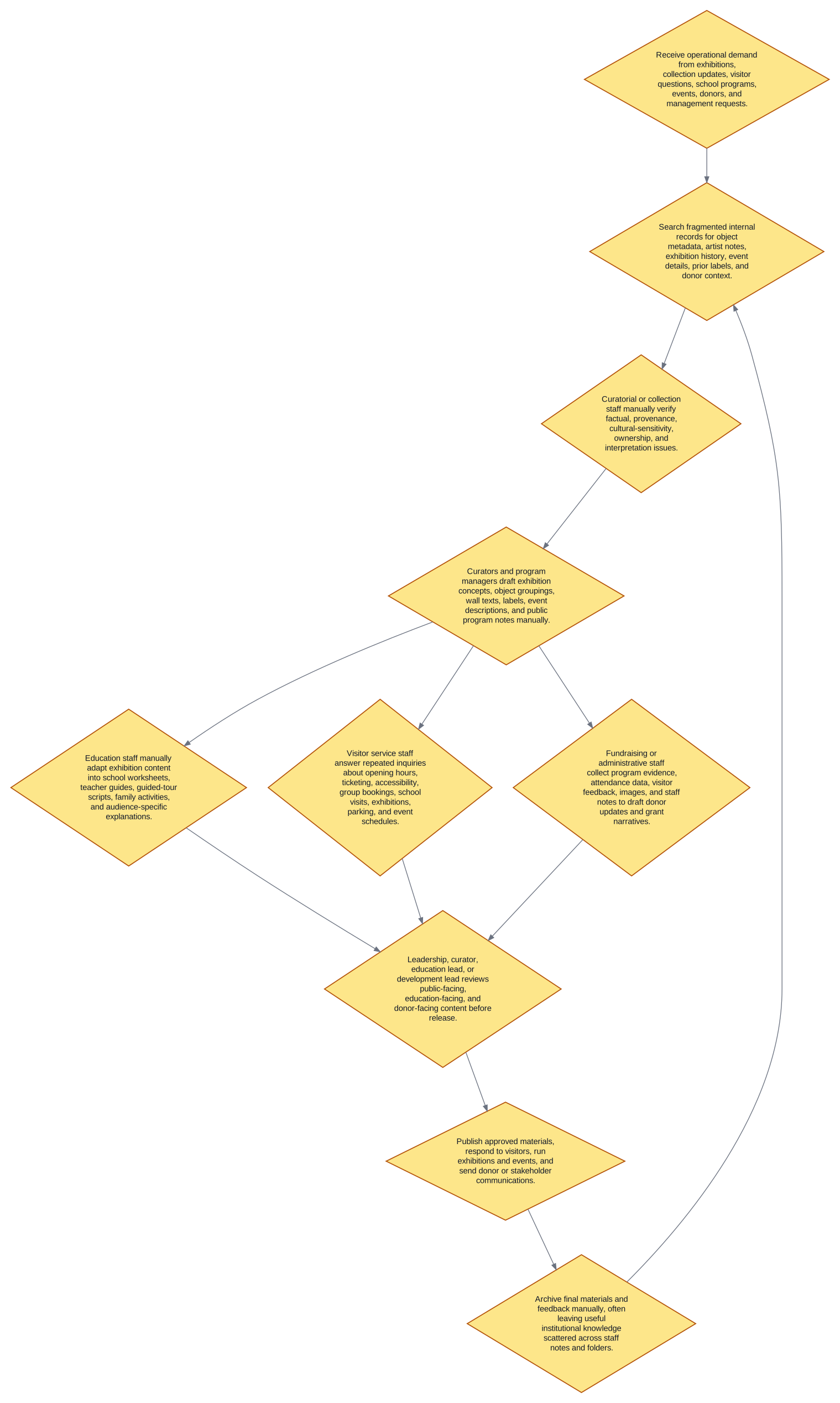
- Operational demand arrived from many channels. Exhibition requests, collection updates, visitor questions, school-program needs, donor updates, and management requests arrived through email, phone calls, calendars, spreadsheets, document folders, and informal staff conversations.
- Staff searched fragmented records. Curators, collection managers, education officers, and fundraising staff each searched for object facts, artist notes, exhibition history, prior labels, event details, visitor policies, program evidence, and donor context.
- Experts manually verified sensitive claims. Curatorial or collection staff checked provenance, ownership, cultural-sensitivity issues, interpretation risk, and factual accuracy before content could be reused.
- Separate teams drafted separate outputs. Curators drafted labels and wall text; education staff adapted the same content into worksheets and teacher guides; visitor staff answered routine questions; development staff collected evidence for donor updates and grant narratives.
- Leadership or team leads reviewed outputs before release. Review was necessary, but the review loop often restarted because supporting evidence was missing, drafts used inconsistent wording, or one team had updated information that another team had not seen.
Key pain points:
- The same source material was repeatedly searched, summarized, and rewritten by different teams.
- Review bottlenecks appeared late because unsupported claims were discovered after drafts had already circulated.
- Institutional learning was weak because final edits, approval decisions, escalations, and visitor feedback were archived manually or remained inside staff memory.
4. Agent Design and Guardrails
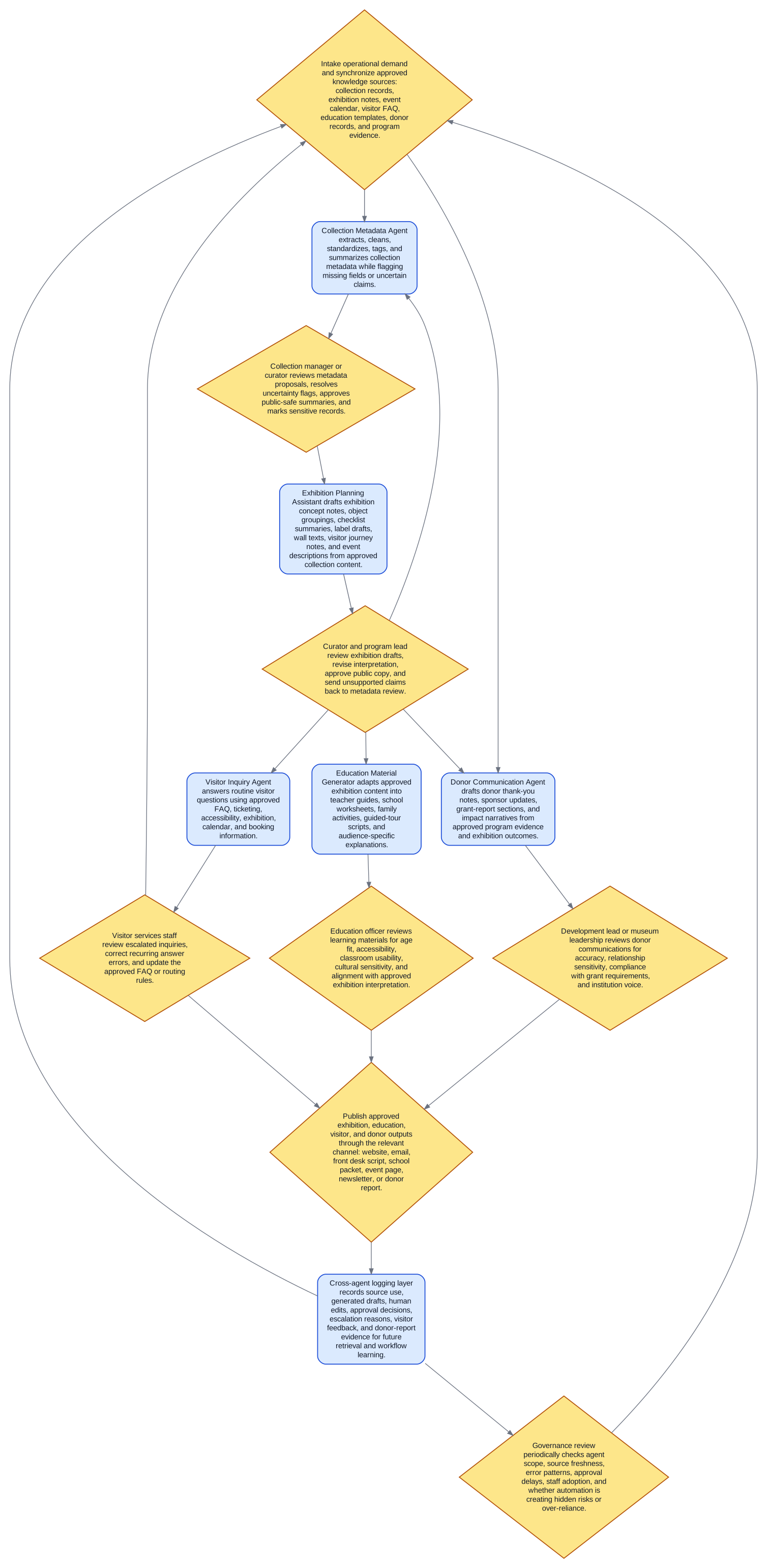
The proposed system uses five specialized agents, but the agents operate inside a permissioned workflow rather than as autonomous public representatives.
- Inputs: Collection database exports, object metadata, scanned catalogues, curatorial notes, exhibition plans, event calendar, visitor FAQ, ticketing and accessibility rules, school-program templates, donor records, grant requirements, program evidence, attendance data, images, and approved website copy.
- Understanding: OCR for scanned notes, metadata extraction, retrieval from approved sources, entity tagging, date and name normalization, controlled vocabulary suggestions, and confidence flags for incomplete or conflicting records.
- Reasoning: Task classification, source-ranking, draft planning, policy checks, sensitivity checks, audience adaptation, missing-evidence detection, and escalation logic.
- Actions: Create metadata proposals, draft object labels, draft wall text, prepare school worksheets, generate guided-tour scripts, answer routine visitor questions, prepare donor thank-you notes, assemble grant-report sections, and log review decisions.
- Memory/state: Source references, draft versions, curator corrections, approved public summaries, escalated questions, recurring visitor issues, donor communication history, and governance review notes.
- Human review points: Curator or collection manager approval for metadata and interpretation; education officer approval for school materials; visitor services review for escalated inquiries; development lead review for donor communications; leadership review for sensitive public claims.
- Out-of-scope actions: The system cannot publish public interpretation, alter official collection records, make provenance judgments, send donor-sensitive messages, change ticketing policy, or answer sensitive cultural questions without human approval.
The system therefore changes the staff role. Staff no longer begin each task by searching and rewriting from scratch. Instead, they review source-grounded drafts, resolve uncertainty flags, approve or reject outputs, and update the institutional knowledge base.
5. One Workflow Walkthrough
When the museum began planning a new exhibition on local river trade and community memory, the intake layer first grouped the request into collection, exhibition, education, visitor-service, and donor-communication workstreams. The Collection Metadata Agent extracted object titles, dates, donor history, material descriptions, prior exhibition mentions, and missing provenance fields from the collection database and scanned catalogue notes. Two records had uncertain dates, so the system flagged them for curator review instead of using them in public text. After the curator approved corrected public-safe summaries, the Exhibition Planning Assistant drafted object groupings, wall-label copy, and a visitor journey. The Education Material Generator turned the approved interpretation into a 45-minute school guide. The Visitor Inquiry Agent updated draft answers for opening hours, accessibility, school bookings, and exhibition highlights. The Donor Communication Agent prepared a sponsor update from approved program goals and attendance targets. Staff reviewed each output before publication, and the final edits, source links, uncertainty flags, and approval decisions were logged for future exhibitions.
6. Results
- Baseline period: Four-week pre-pilot review of exhibition-preparation, visitor-inquiry, education-material, and donor-update tasks.
- Evaluation period: Four-week controlled prototype using retrospective and simulated work samples.
- Workflow scope/sample: One exhibition packet, 20 collection-record updates, 40 visitor inquiry threads, two school-program drafts, and two donor communication drafts.
- Process change: First-draft work shifted from manual searching and rewriting to agent-prepared drafts with source links and uncertainty flags. Routine visitor responses moved from staff-only handling to approved-response automation with escalation.
- Decision/model change: The system separated low-risk drafting from high-risk interpretation, provenance, donor, and public-communication approvals.
- Business effect: Expected impact is faster first drafts, fewer late-stage review restarts, more consistent visitor answers, and better reuse of institutional knowledge across exhibitions and programs.
- Evidence status: Estimated prototype result, not a production measurement. Real deployment should replace these figures with observed cycle time, review-defect rate, escalation rate, staff adoption, and visitor satisfaction data.
The most important result is not “AI writes museum content.” The more useful result is that the museum gains a reviewable operating layer: every draft is tied to sources, every uncertainty has an owner, and every approved correction becomes part of institutional memory.
7. What Failed First and What Changed
The first version failed by sounding too confident when catalogue records were thin. It produced fluent object-label drafts even when dates, provenance, or prior exhibition references were incomplete. That was operationally dangerous because museum writing often carries institutional authority. The fix was to add confidence thresholds, source-visible drafting, missing-field flags, and role-specific approval gates. Public-facing language could only use approved summaries, and uncertain records were routed back to the curator or collection manager. The remaining limitation is that source-grounded agents still depend on the quality of internal records; the system can expose gaps, but it cannot fully repair undocumented provenance or unresolved historical interpretation.
8. Transferable Lesson
- Do not deploy a generic museum chatbot first. Start with controlled internal workflows where agents prepare drafts, expose missing evidence, and route work to accountable staff.
- Use agents to coordinate handoffs, not to erase expertise. The strongest value comes from connecting collection, exhibition, education, visitor-service, and donor workflows around approved institutional knowledge.
- Treat review logs as institutional memory. Human corrections, escalations, source choices, and approval decisions should become reusable knowledge for the next exhibition, school visit, donor report, or visitor question.
This case shows that agentic AI works best in cultural institutions when it acts as a source-grounded operations coordinator: fast enough to reduce repetitive work, but constrained enough to preserve curatorial judgment, public trust, and institutional accountability.
References
-
Shunyu Yao, Jeffrey Zhao, Dian Yu, Nan Du, Izhak Shafran, Karthik Narasimhan, and Yuan Cao, “ReAct: Synergizing Reasoning and Acting in Language Models,” arXiv:2210.03629, https://arxiv.org/abs/2210.03629. ↩︎
-
Joon Sung Park, Joseph C. O’Brien, Carrie J. Cai, Meredith Ringel Morris, Percy Liang, and Michael S. Bernstein, “Generative Agents: Interactive Simulacra of Human Behavior,” arXiv:2304.03442, https://arxiv.org/abs/2304.03442. ↩︎
-
Noah Shinn, Federico Cassano, Edward Berman, Ashwin Gopinath, Karthik Narasimhan, and Shunyu Yao, “Reflexion: Language Agents with Verbal Reinforcement Learning,” arXiv:2303.11366, https://arxiv.org/abs/2303.11366. ↩︎
-
Jinhao Li, Jianzhong Qi, Soyeon Caren Han, and Eun-Jung Holden, “MUSEKG: A Knowledge Graph Over Museum Collections,” arXiv:2511.16014, https://arxiv.org/abs/2511.16014. ↩︎
-
Naga Sowjanya Barla and Jacopo de Berardinis, “Competency Questions as Executable Plans: a Controlled RAG Architecture for Cultural Heritage Storytelling,” arXiv:2604.02545, https://arxiv.org/abs/2604.02545. ↩︎