Executive Snapshot
- Client type: Small to mid-sized electronics contract manufacturer
- Industry: Electronics components, devices, and assembled hardware
- Core problem: Defects were detected late, and managers could not quickly connect failures with suppliers, shifts, machines, batches, or rework history.
- Why agentic AI: The workflow required classification, evidence linking, report generation, corrective-action tracking, and human approval across several departments, not a single chatbot response.
- Deployment stage: Pilot design
- Primary result: A redesigned quality workflow that turns scattered defect evidence into ranked root-cause hypotheses, structured inspection reports, supplier evidence packages, and accountable CAPA follow-up.
1. Business Context
The factory produces small electronic devices and hardware modules for repeat-batch customers. A typical order moves through incoming component inspection, line assembly, in-process checks, functional testing, rework, final inspection, and delivery. Quality evidence exists, but it is fragmented across paper inspection sheets, Excel defect logs, inspection photos, supplier lot records, machine downtime notes, rework records, customer complaint emails, and supervisor messages. The workflow occurs daily, with urgent escalation whenever a batch fails final testing or a customer reports field defects. Errors matter because rework consumes thin margins, late shipments weaken buyer trust, and repeated defects can quietly become normalized if no one connects the pattern across products, suppliers, machines, and shifts.
2. Why Simpler Automation Was Not Enough
A dashboard could show defect counts, but it would not explain why similar failures appeared across different batches. A script could flag missing fields, but it would not compare inspection photos, supplier lots, shift notes, machine downtime, and customer complaints. A chatbot could summarize one report, but it would not maintain a stateful corrective-action loop. The useful design point is not “AI replaces quality engineers.” It is that specialized agents can divide the quality workflow into evidence intake, defect classification, root-cause hypothesis generation, supplier review, report drafting, and corrective-action tracking, while human managers retain authority over high-severity judgments, supplier decisions, customer communications, and process changes.12345
Analytical point used in this case: agentic AI contributes most when it becomes a governed coordination layer. It reduces the cost of connecting evidence across records, but it should not own irreversible operational decisions. The system must preserve traceability, expose uncertainty, and force human checkpoints where business, supplier, or customer consequences are material.
3. Pre-Agent Workflow
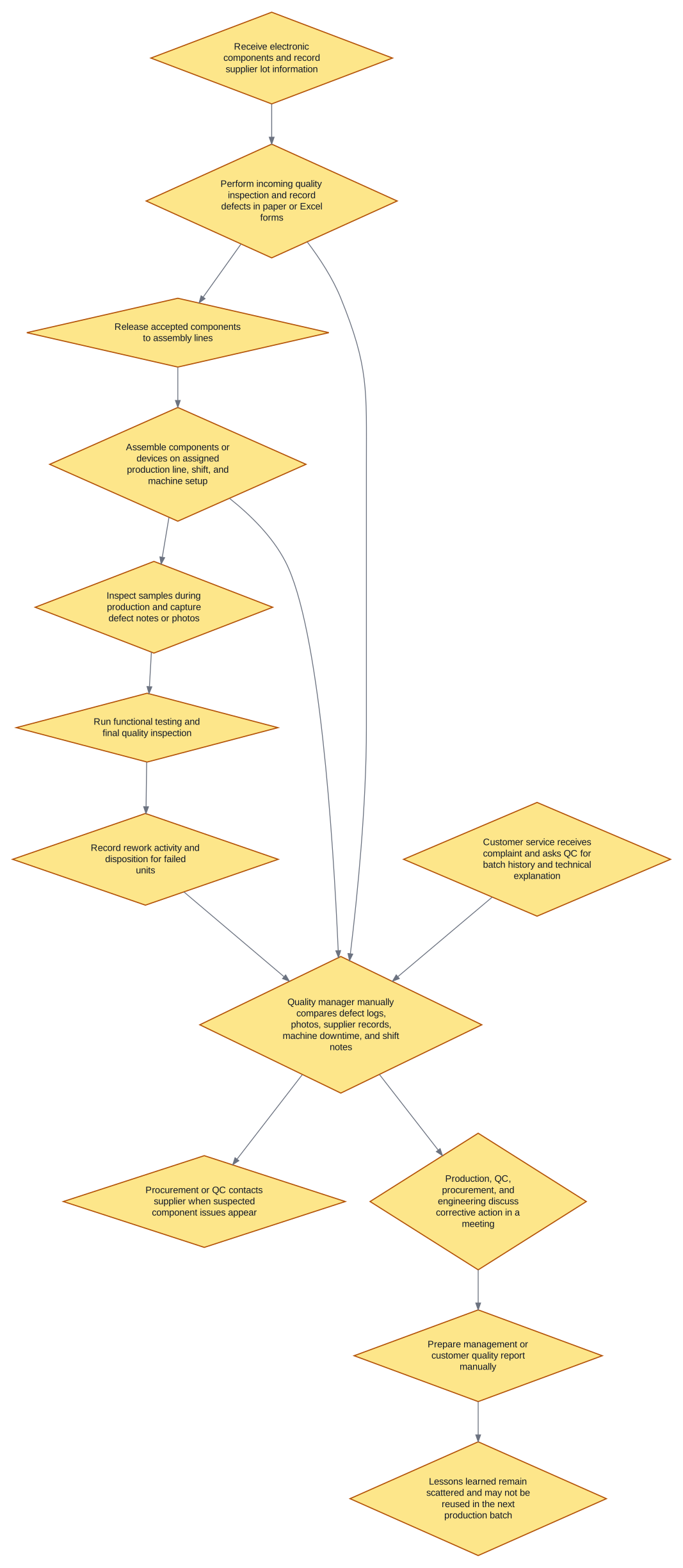
Before the agent system, the quality workflow was human-coordination-heavy:
- Warehouse and QC staff received components and recorded supplier lot information manually from invoices, labels, and receiving sheets.
- Inspectors performed incoming, in-process, and final inspection, entering defects into paper or Excel records and saving photos separately.
- Production supervisors and technicians recorded assembly context, including line, shift, machine setup, downtime, failed units, and rework activity.
- The quality manager manually compared logs, photos, supplier records, downtime notes, shift notes, and complaint emails when a defect pattern became visible.
- Corrective action was discussed in meetings, then written into a manual tracker or meeting note, with weak follow-through into later batches.
Key pain points:
- Defects were often escalated only after final testing or customer complaints.
- Root-cause analysis depended on a manager manually joining scattered records.
- Supplier quality issues were discussed case by case, not systematically tracked.
- Corrective actions had owners and due dates only when someone remembered to formalize them.
- Lessons learned did not reliably update inspection checklists, supplier watchlists, or production setup controls.
4. Agent Design and Guardrails
The AI Manufacturing Quality Agent was designed as a governed multi-agent workflow, not as an autonomous factory controller.
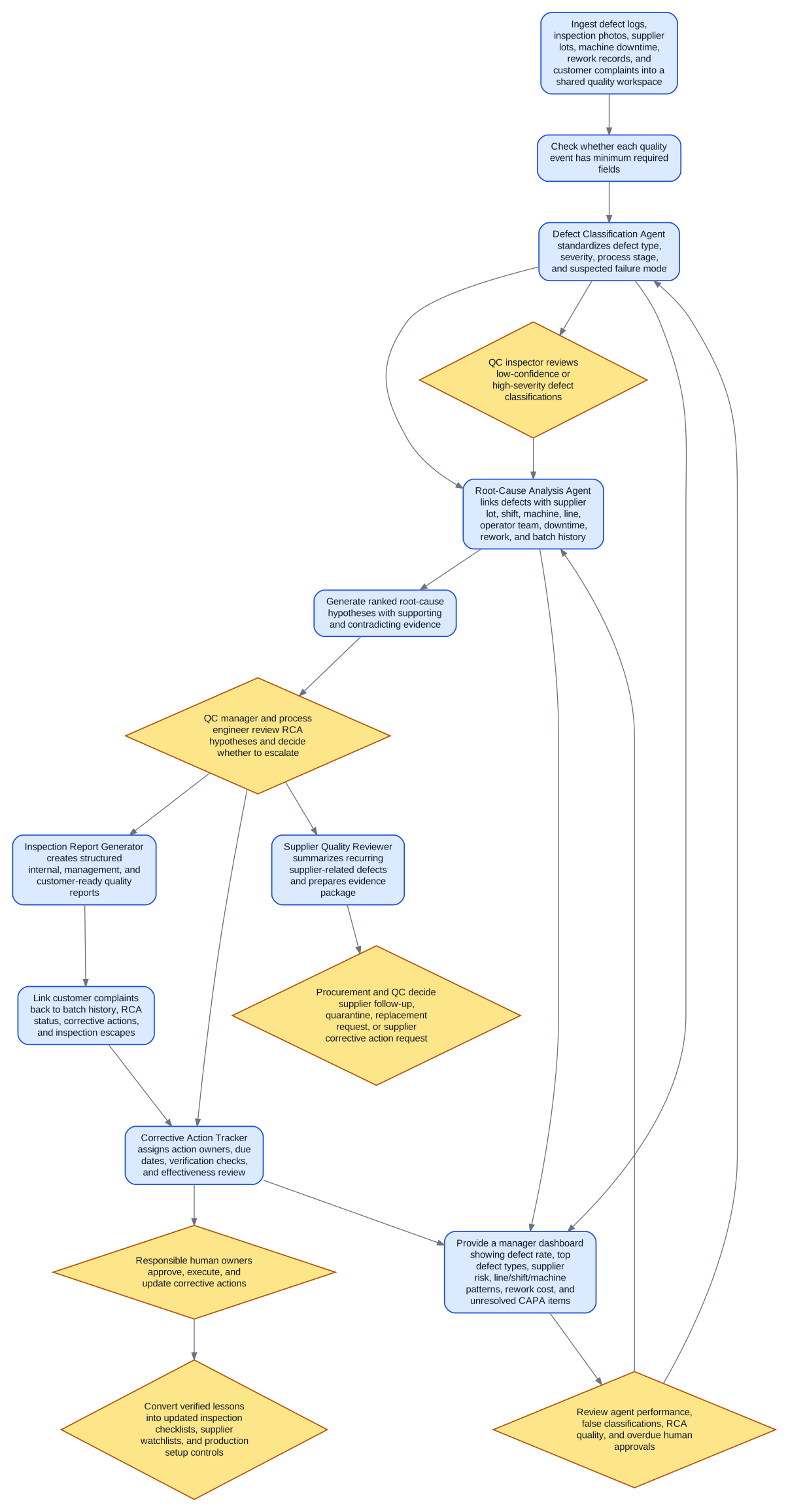
- Inputs: defect logs, inspection photos, supplier lot records, machine downtime notes, rework sheets, production batch records, shift notes, and customer complaint emails.
- Understanding: OCR and structured extraction from forms and photos; tagging by product model, batch, line, shift, machine, supplier lot, defect type, severity, and process stage.
- Reasoning: defect classification; cross-record linkage; ranked root-cause hypotheses; supplier-pattern review; corrective-action status checking; exception routing when evidence is incomplete or confidence is low.
- Actions: create structured quality events, draft inspection reports, prepare supplier evidence packages, generate customer-ready summaries, assign corrective-action tasks, and update dashboards.
- Memory/state: case history by batch, product model, supplier lot, defect class, machine, shift, rework action, CAPA owner, due date, and effectiveness status.
- Human review points: low-confidence or high-severity defect classification; RCA escalation; supplier quarantine or corrective-action requests; external customer reports; CAPA closure; changes to work instructions or inspection checklists.
- Out-of-scope actions: the agent cannot release quarantined lots, approve supplier claims, send customer-facing reports, change machine settings, close CAPA items, or modify work instructions without human approval.
The agent roles map directly to the operating workflow. The Defect Classification Agent standardizes raw defect notes and images. The Root-Cause Analysis Agent links defects with supplier lots, shifts, machines, operator teams, downtime, rework, and batch history. The Supplier Quality Reviewer prepares evidence for procurement and QC. The Inspection Report Generator drafts internal and customer-facing reports. The Corrective Action Tracker maintains owners, due dates, verification checks, and overdue alerts.
5. One Workflow Walkthrough
A customer reported that several delivered smart control boards failed during installation. The system first linked the complaint to shipment records and affected production batches. The Defect Classification Agent compared customer photos with final-test failures and in-process inspection notes, then tagged the issue as a repeated solder-joint defect near the same component area. The Root-Cause Analysis Agent checked batch history, supplier lot records, shift notes, and rework logs, and found that most failures came from two batches using the same capacitor lot and one night-shift machine setup.
Because the hypothesis involved both supplier material and process conditions, the system did not issue a final conclusion. It prepared two ranked RCA hypotheses with supporting and contradicting evidence. The QC manager and process engineer reviewed the evidence, confirmed the suspected supplier lot, and asked production to increase inspection frequency for the next run. Procurement approved a supplier follow-up request. The system then generated an internal report, a customer response draft, and a CAPA record with owner, due date, and verification check for later batches.
6. Results
- Baseline period: 8 weeks of historical quality records reviewed during pilot design
- Evaluation period: 4-week pilot simulation using recent defect logs, inspection photos, rework records, supplier lots, and customer complaints
- Workflow scope/sample: incoming inspection, in-process inspection, final functional testing, supplier-related defects, rework records, and customer complaint loop
- Process change: manual record-gathering was replaced by automatic quality-event creation, evidence linking, and dashboard updates.
- Decision/model change: RCA moved from single-manager memory and spreadsheet comparison to ranked hypotheses with explicit supporting evidence, missing-data flags, and required human review.
- Business effect: estimated reduction in RCA preparation time from several hours per recurring defect case to under one hour for a review-ready case package; estimated faster supplier escalation because lot-level evidence was assembled before procurement entered the loop.
- Evidence status: estimated from workflow redesign and pilot-style record replay, not observed production deployment.
The main business effect is not simply faster report writing. The deeper effect is that quality management becomes less dependent on one experienced manager’s memory. Defect patterns become visible across batches, suppliers, machines, shifts, and customer feedback before they turn into repeated rework or delivery disputes.
7. What Failed First and What Changed
The first version over-weighted inspection photos and defect descriptions. It could classify visible defects reasonably well, but it sometimes missed weak signals in supplier lot history, machine downtime, and shift notes. That created polished reports with incomplete causal logic. The design was changed so every quality event had minimum required fields, missing evidence was explicitly flagged, and RCA outputs had to separate probable cause, supporting evidence, contradicting evidence, and recommended human review. The remaining limitation is that the system depends on disciplined data capture. If receiving staff fail to record supplier lot numbers or supervisors skip machine notes, the agent can only expose the gap; it cannot reconstruct evidence that was never captured.
8. Transferable Lesson
- Use agents to reduce coordination cost, not to remove accountability. Quality managers should approve high-severity classifications, RCA conclusions, supplier actions, and customer-facing reports.
- Split the workflow into specialized agents. A single all-purpose quality chatbot is more likely to blur defect classification, root-cause reasoning, supplier review, and corrective-action tracking.
- Make missing data visible. In quality workflows, an explicit “cannot conclude because supplier lot is missing” is more useful than a confident but unsupported diagnosis.
This case shows that agentic AI works best when the business problem is not one isolated task, but a repeated operational workflow where evidence is scattered, judgment is required, and follow-through must be tracked.
-
Jonghan Lim, Bernhard Vogel-Heuser, and Ilya Kovalenko, “Large Language Model-Enabled Multi-Agent Manufacturing Systems,” arXiv:2406.01893, 2024. https://arxiv.org/abs/2406.01893 ↩︎
-
“Large Language Models for Manufacturing,” arXiv:2410.21418, 2024. https://arxiv.org/abs/2410.21418 ↩︎
-
Jonghan Lim and Ilya Kovalenko, “A Large Language Model-Enabled Control Architecture for Dynamic Resource Capability Exploration in Multi-Agent Manufacturing Systems,” arXiv:2505.22814, 2025. https://arxiv.org/abs/2505.22814 ↩︎
-
“SemiFA: An Agentic Multi-Modal Framework for Autonomous Semiconductor Failure Analysis Report Generation,” arXiv:2604.13236, 2026. https://arxiv.org/abs/2604.13236 ↩︎
-
“Toward Epistemic Stability: Engineering Consistent Procedures for Industrial LLM Hallucination Reduction,” arXiv:2603.10047, 2026. https://arxiv.org/abs/2603.10047 ↩︎