Executive Snapshot
- Client type: Small to mid-sized nonprofit organization
- Industry: Nonprofit, community development, social impact, donor-funded programs
- Core problem: Staff spent too much time rewriting similar grant proposals, collecting proof of impact, and preparing donor-specific reports.
- Why agentic AI: The workflow required retrieval, drafting, evidence matching, budget explanation, exception handling, and human approval rather than a single chatbot response.
- Deployment stage: Prototype / pilot-ready workflow design
- Primary result: The case reframes grant management from scattered document chasing into a governed agentic workflow with reusable institutional memory, source-linked drafts, and explicit human review points.
1. Business Context
HopeBridge Foundation is a fictionalized small nonprofit that runs education, livelihood, and community-support programs for underserved communities. Its work is funded mainly by institutional grants, foundation donors, corporate CSR programs, and occasional individual donor campaigns. Each year, the organization applies for several grants, manages active donor-funded projects, tracks milestones, collects field evidence, and prepares progress or final reports. The documents involved are familiar but fragmented: old proposals, donor templates, project budgets, attendance sheets, field photos, beneficiary stories, survey notes, partner letters, spreadsheets, emails, and messaging-app updates. Delays matter because missed deadlines reduce funding chances, weak proposals understate real field impact, and late reports damage donor trust.
2. Why Simpler Automation Was Not Enough
A fixed script could extract deadlines from a few websites, but it could not judge donor fit, retrieve old organizational language, adapt a proposal to a donor’s priorities, or explain why one budget line was reasonable. A dashboard could track milestones, but it would not turn field notes, photos, attendance sheets, and survey snippets into a donor-ready impact narrative. A chatbot could draft text, but without workflow state, evidence links, review loops, and approval gates, it would create polished but risky documents.
The analytical point from the selected agentic-AI literature is this: the value of agentic AI is not just text generation; it is the conversion of messy knowledge work into a stateful chain of reasoning, tool use, role-specific collaboration, memory, and human-governed revision. ReAct supports interleaving reasoning and actions; Toolformer supports tool use for external information and calculation; AutoGen and CAMEL support multi-agent role coordination; and Reflexion supports feedback loops through memory rather than one-off generation.12345
3. Pre-Agent Workflow

Before agentic AI, grant management depended on people remembering where information lived and manually coordinating across program, finance, field, and leadership roles.
- Grant discovery: Staff monitored donor websites, newsletters, NGO networks, and email announcements. Opportunities were often noticed late, and the first judgment was usually informal: “Does this look relevant?”
- Fit decision and document gathering: A program manager and executive director screened the opportunity. If they decided to pursue it, staff searched shared folders, past proposals, registration documents, templates, old budgets, and email attachments.
- Proposal and budget preparation: The proposal writer manually rewrote old text into a new donor format. Finance and program staff prepared the budget and wrote explanations for personnel, travel, training materials, monitoring, and administrative costs.
- Review and submission: Leadership, program, and finance teams reviewed the proposal near the deadline. Corrections often arrived late because the narrative, budget, and required documents were assembled in separate streams.
- Implementation and reporting: After an award, field staff tracked activities and collected photos, attendance records, beneficiary stories, and survey notes. Before reporting deadlines, staff manually reconciled field evidence, milestone progress, and budget utilization into a donor-specific report.
Key pain points:
- Institutional knowledge lived in old documents and staff memory rather than a structured knowledge base.
- Proposal writing and donor reporting repeated similar work but still required careful adaptation.
- Field evidence was collected during implementation but often organized only when a report deadline approached.
- Budget narratives required finance-program coordination, but the link between activity design and budget explanation was weak.
- Review was end-loaded, creating deadline pressure and avoidable rework.
4. Agent Design and Guardrails
The AI Nonprofit Grant Management Agent was designed as a governed multi-agent workflow, not as a standalone chatbot.
- Inputs: donor opportunities, donor templates, old proposals, approved organizational facts, project descriptions, budgets, milestone trackers, field reports, photos, attendance sheets, survey results, beneficiary stories, and donor correspondence.
- Understanding: source retrieval, template extraction, opportunity-field extraction, evidence tagging, milestone matching, budget-line interpretation, and donor-format mapping.
- Reasoning: donor-fit scoring, deadline-risk assessment, proposal-structure planning, evidence-to-claim matching, budget narrative consistency checks, missing-document detection, and low-confidence flagging.
- Actions: create opportunity summaries, draft proposal sections, draft budget explanations, organize evidence, generate donor reports, produce review queues, and update institutional memory after approval.
- Memory/state: opportunity status, proposal version, reviewer comments, evidence approval status, milestone progress, donor reporting requirements, budget narrative assumptions, and final approved reusable text blocks.
- Human review points: pursue/defer/reject decision, proposal logic review, finance sign-off, evidence consent and accuracy review, donor-report validation, final leadership approval, and submission authorization.
- Out-of-scope actions: autonomous grant submission, independent financial approval, unsupported impact claims, use of beneficiary images without consent, changes to official finance records, and direct donor communication without authorization.
The governing rule was simple: agents may scan, retrieve, draft, structure, compare, and flag; humans approve strategy, money, evidence use, and donor-facing commitments.
5. Post-Agent Workflow
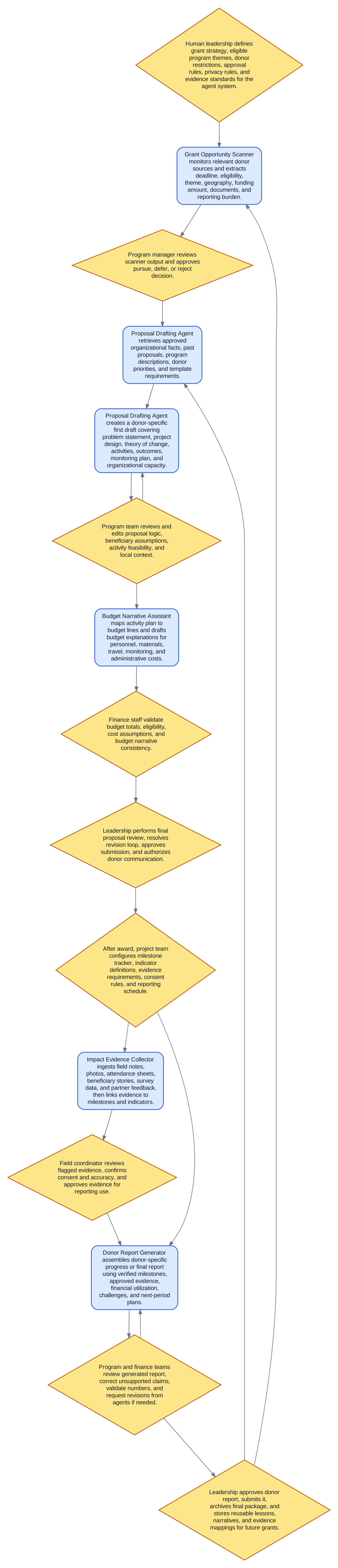
After the agentic workflow was introduced, the organization still followed the same grant lifecycle, but the handoffs became structured and reviewable.
- Governance setup: Leadership defined eligible program themes, donor restrictions, evidence standards, privacy rules, and approval gates. These rules governed all downstream agent behavior.
- Opportunity scanning: The Grant Opportunity Scanner monitored donor sources and extracted deadline, eligibility, theme, geography, funding size, required documents, and reporting burden. It produced a source-linked summary and a fit score.
- Human go/no-go review: The program manager reviewed the scanner output and decided whether to pursue, defer, or reject the opportunity. Drafting did not begin without this human approval.
- Proposal drafting: The Proposal Drafting Agent retrieved approved organizational facts, old proposal language, donor priorities, and template requirements. It drafted the problem statement, project design, theory of change, activities, outcomes, monitoring plan, and organizational capacity section.
- Program and finance review: Program staff reviewed activity logic and local feasibility. The Budget Narrative Assistant mapped activities to budget lines and drafted explanations, but finance staff validated totals, eligibility, and assumptions.
- Final application approval: Leadership reviewed unresolved risks, approved the final package, authorized submission, and archived the final application.
- Evidence-aware implementation: After award, the project team configured milestones, indicators, evidence requirements, consent rules, and reporting schedules. The Impact Evidence Collector linked field evidence to milestones and flagged missing metadata, privacy-sensitive content, or unsupported claims.
- Donor report generation: The Donor Report Generator assembled donor-specific progress or final reports from verified milestones, approved evidence, financial utilization, challenges, and next-period plans. Program and finance reviewers corrected unsupported claims and requested targeted revisions before leadership approval.
- Learning loop: Approved reports, donor feedback, evidence mappings, budget explanations, and reusable narratives were stored as institutional memory for future applications.
6. One Workflow Walkthrough
A foundation announced a grant for youth livelihood training with a deadline three weeks away. The Grant Opportunity Scanner extracted the eligibility rules, target geography, funding range, required attachments, and reporting expectations. It assigned a high fit score because the nonprofit already ran similar training programs, but it flagged two risks: the donor required recent beneficiary outcome evidence, and the proposal needed a detailed budget narrative.
The program manager approved pursuit. The Proposal Drafting Agent retrieved old training proposals, the approved organizational profile, past beneficiary outcomes, and the donor template. It generated a first draft with placeholders for income-improvement evidence. The Impact Evidence Collector searched field records and found attendance sheets, photos, and follow-up survey notes, but flagged several beneficiary stories because consent status was unclear. The field coordinator approved only evidence with complete metadata and consent. The Budget Narrative Assistant drafted explanations for trainer fees, materials, transport, and monitoring visits. Finance corrected two unit-cost assumptions. Leadership then approved the final package, and the system archived the submitted proposal, reviewer decisions, source evidence, and reusable narrative sections.
7. Results
- Baseline period: Current-state workflow mapping; not a measured production baseline.
- Evaluation period: Proposed 8-week pilot covering opportunity scanning, one live proposal cycle, and one donor-report preparation cycle.
- Workflow scope/sample: 10–20 grant opportunities, 2–3 proposal drafts, and 1 donor report.
- Process change: Expected reduction in first-draft preparation time because agents retrieve approved language, structure donor requirements, and generate source-linked drafts instead of asking staff to start from scattered folders.
- Decision/model change: Opportunity pursuit decisions become more consistent because donor fit, required effort, deadline risk, and missing evidence are summarized before drafting begins.
- Business effect: Expected benefits include more timely applications, fewer missing attachments, faster donor-report assembly, better traceability between impact claims and field evidence, and stronger institutional memory.
- Evidence status: Estimated / planned. These are pilot targets, not production-measured outcomes.
A reasonable pilot target is to reduce proposal first-draft assembly from several staff-days to one structured review cycle, and donor-report first-draft preparation from multiple fragmented collection sessions to a source-linked draft plus reviewer corrections. The more important result is not only speed. It is that each donor-facing claim becomes traceable to a source, a human reviewer, and an approval state.
8. What Failed First and What Changed
The first version of the system produced fluent proposal and report language too easily. It sometimes converted weak field notes into confident impact claims, which created a donor-trust risk. The fix was to introduce an evidence-to-claim matrix: every output claim had to be linked to a source, marked as verified or unverified, and routed to a reviewer when metadata, consent, or quantitative support was missing. This did not remove human work; it moved human work to the right point in the workflow. The remaining limitation is that field evidence quality still depends on how consistently staff collect metadata, consent records, and follow-up data during implementation.
9. Transferable Lesson
- Agentic AI works best when the workflow is not merely “write a document” but “retrieve, reason, draft, validate, revise, and archive under governance.”
- Human checkpoints should be placed where accountability lives: strategy, finance, evidence consent, factual claims, and external submission.
- Institutional memory is the compounding asset. Each approved proposal, donor report, reviewer correction, and evidence mapping should improve the next cycle.
This case shows that agentic AI is strongest in nonprofit grant management when it turns scattered operational evidence into governed, reusable, donor-ready knowledge without removing human accountability.
References
-
Shunyu Yao et al., “ReAct: Synergizing Reasoning and Acting in Language Models,” arXiv:2210.03629, 2022. https://arxiv.org/abs/2210.03629 ↩︎
-
Timo Schick et al., “Toolformer: Language Models Can Teach Themselves to Use Tools,” arXiv:2302.04761, 2023. https://arxiv.org/abs/2302.04761 ↩︎
-
Qingyun Wu et al., “AutoGen: Enabling Next-Gen LLM Applications via Multi-Agent Conversation,” arXiv:2308.08155, 2023. https://arxiv.org/abs/2308.08155 ↩︎
-
Guohao Li et al., “CAMEL: Communicative Agents for ‘Mind’ Exploration of Large Language Model Society,” arXiv:2303.17760, 2023. https://arxiv.org/abs/2303.17760 ↩︎
-
Noah Shinn et al., “Reflexion: Language Agents with Verbal Reinforcement Learning,” arXiv:2303.11366, 2023. https://arxiv.org/abs/2303.11366 ↩︎