Executive Snapshot
- Client type: Medium-sized commercial farm growing premium vegetables, fruits, herbs, and flowers
- Industry: High-value agriculture / commercial farming
- Core problem: Farm decisions depended on scattered field notes, WhatsApp messages, weather apps, spreadsheets, and manager intuition
- Why agentic AI: The work required stateful coordination across crop blocks, weather windows, labor capacity, pest risk, harvest timing, and buyer commitments—not a single chatbot or static dashboard
- Deployment stage: Pilot design with staged implementation
- Primary result: A daily reviewed Farm Operations Brief became the coordination layer between field reality and commercial commitments
1. Business Context
GreenValley Premium Farms operates 30–80 hectares of mixed greenhouse and open-field production for high-value crops such as hydroponic lettuce, tomatoes, herbs, strawberries, and cut flowers. Every day, managers coordinate field inspection, irrigation, pest monitoring, harvest readiness, labor allocation, packing capacity, and delivery commitments to supermarkets, restaurants, hotels, and distributors. The workflow repeats daily, but the inputs are unstable: field photos arrive through worker messages, pest notes sit in supervisor notebooks, irrigation logs are partial, weather forecasts change, and sales teams may confirm buyer orders before harvest readiness is clear. In this environment, one missed pest signal, one poorly timed irrigation round, or one over-committed delivery can quickly turn into product loss, quality rejection, or damaged buyer trust.
2. Why Simpler Automation Was Not Enough
The farm did not only need a dashboard. A dashboard could show weather, crop status, and orders, but it would not decide which exception mattered first. It also did not only need a chatbot. A chatbot could answer questions, but it would not maintain crop-block state, remember unresolved risks, compare tomorrow’s buyer commitments with today’s harvest probability, or route chemical-treatment decisions to a human reviewer.
The analytical point from recent agricultural AI research is that value appears when AI systems become workflow orchestrators with memory, evidence, critique, and human checkpoints. Multi-agent agricultural systems are useful because different agents can specialize in retrieval, monitoring, interpretation, reflection, and improvement rather than forcing one model to handle every decision path.1 Domain-specific agricultural LLM systems also emphasize retrieval, knowledge grounding, and evaluation because generic model answers can be misleading in operational settings.2 For farm operations, this means the AI layer should not be framed as “the AI tells the farmer what to do.” It should be framed as “the system converts messy observations into reviewed, auditable operating decisions.”
3. Pre-Agent Workflow
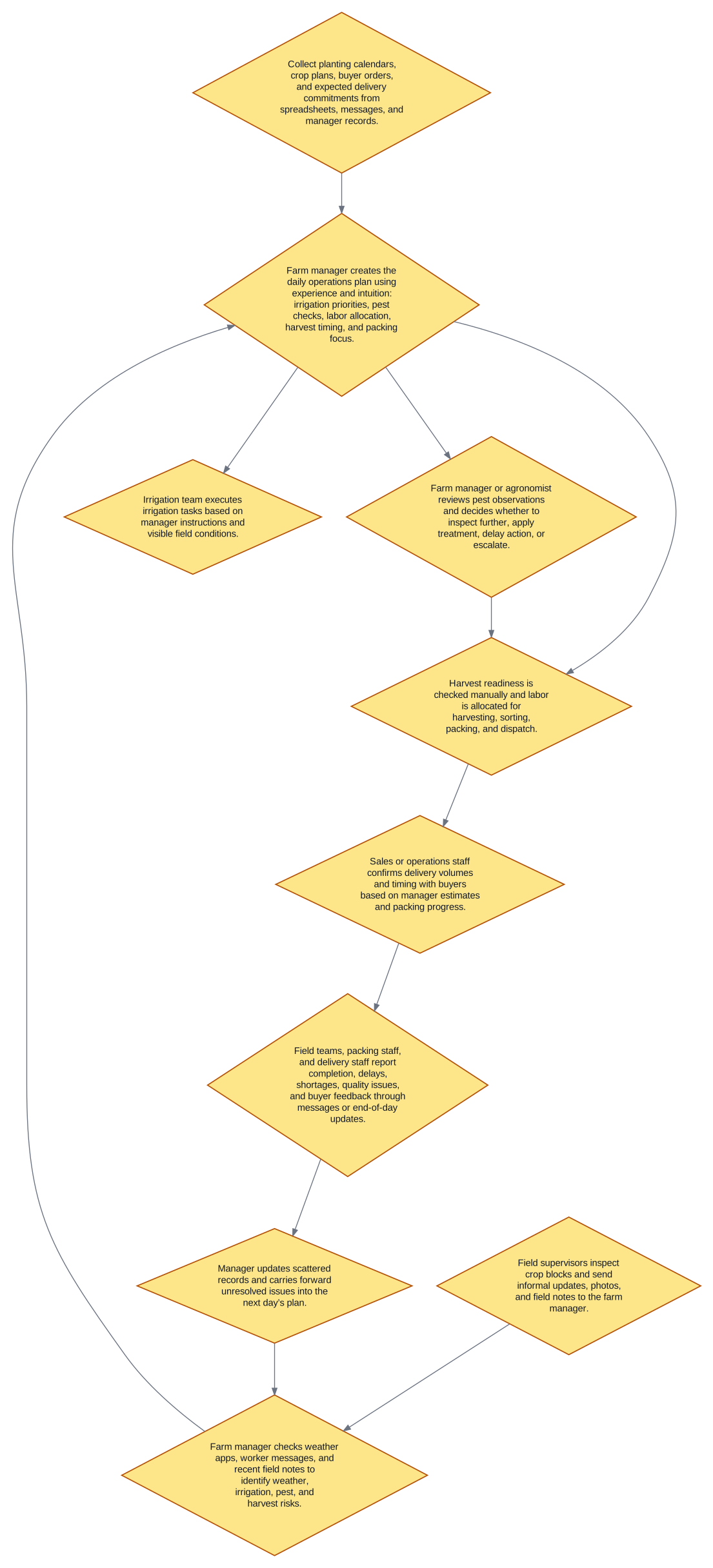
Before the agent system, the farm’s operating cycle depended on manual coordination:
- Operations staff and managers collected the day’s inputs. Planting calendars, buyer orders, delivery commitments, weather readings, and worker availability were checked across spreadsheets, message threads, notebooks, and memory.
- Field supervisors inspected crop blocks manually. They sent informal updates, photos, and field notes to the farm manager, often without consistent severity labels, timestamps, or crop-block identifiers.
- The farm manager interpreted risk and built the day’s plan. Weather apps, field notes, irrigation history, pest observations, labor capacity, and buyer requests were weighed through experience and intuition.
- Teams executed instructions through fragmented handoffs. Irrigation, pest inspection, harvest, packing, and dispatch teams received instructions by message or verbal update.
- Exceptions were carried forward manually. Harvest shortages, buyer delivery risks, pest concerns, and unresolved irrigation issues were reported at the end of the day, but they often stayed buried in messages until the next planning cycle.
Key pain points:
- Field visibility was delayed because crop stress, pest signals, and irrigation issues depended on manual reporting.
- Buyer commitments were confirmed with weak linkage to harvest readiness, packing capacity, and crop quality.
- The manager became the hidden integration layer for all operational judgment, creating bottlenecks and continuity risk.
- Pest and pesticide decisions required careful compliance checks, but the relevant dates and restrictions were not always visible during planning.
- End-of-day learning was weak because outcome records were scattered and override reasons were rarely captured.
4. Agent Design and Guardrails
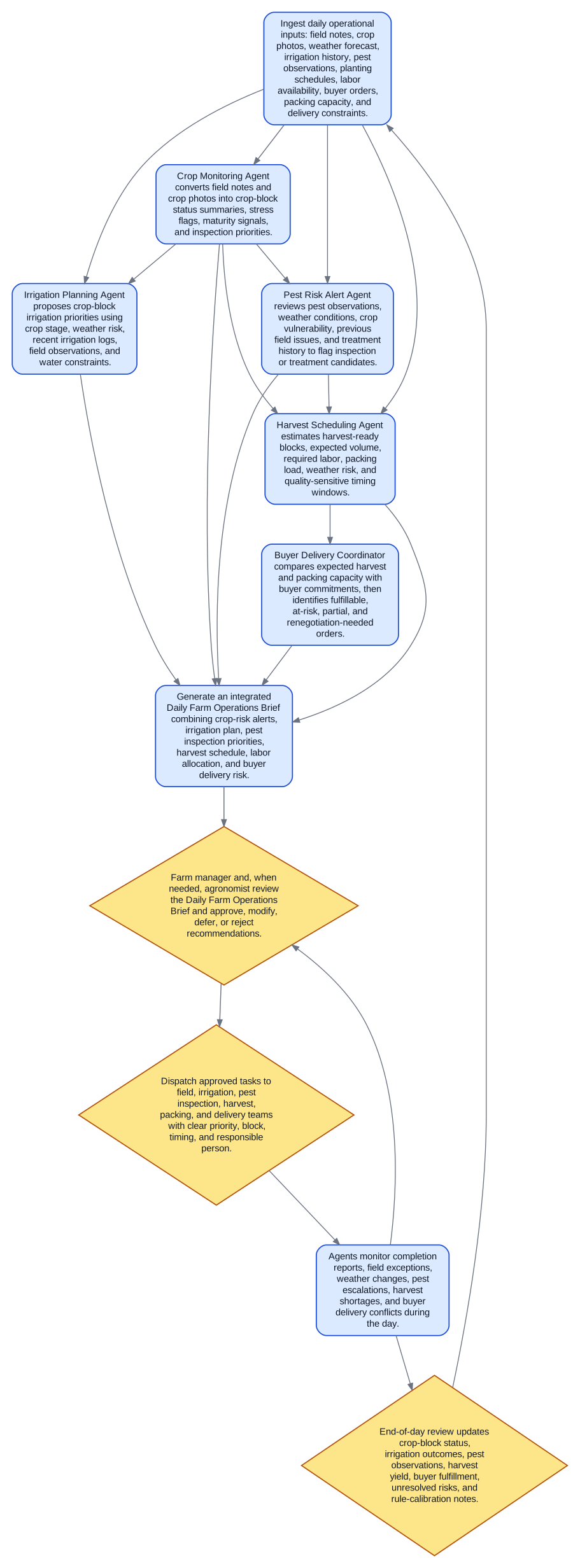
The agent system was designed around five specialized roles: Crop Monitoring Agent, Irrigation Planning Agent, Pest Risk Alert Agent, Harvest Scheduling Agent, and Buyer Delivery Coordinator. Their shared goal was not to automate farming end to end, but to produce a reviewed Daily Farm Operations Brief.
- Inputs: Field notes, crop photos, weather forecasts, irrigation history, pest observations, planting schedules, labor availability, buyer orders, packing capacity, delivery constraints, and pesticide application records.
- Understanding: The system extracted crop block, crop type, issue severity, timestamp, source, and uncertainty status from structured forms, messages, and photos. It separated observed facts from inferred risks.
- Reasoning: Agents ranked crop-block priorities, checked weather-sensitive timing windows, flagged pest and disease candidates, estimated harvest readiness, compared expected supply with buyer orders, and marked items requiring review.
- Actions: The system generated alerts, task drafts, order-risk labels, buyer-message drafts, and a Daily Farm Operations Brief. It did not directly approve chemical treatment, change buyer commitments, or reallocate major labor without human review.
- Memory/state: Crop-block status, unresolved risks, last irrigation, last pest inspection, last treatment date, re-entry interval, pre-harvest interval, expected yield, buyer linkage, and human override reasons were carried forward into the next cycle.
- Human review points: The farm manager reviewed the Daily Farm Operations Brief. The agronomist reviewed pest and chemical-treatment recommendations. Sales or operations approved material buyer-commitment changes. Supervisors confirmed field execution.
- Out-of-scope actions: Autonomous pesticide application, autonomous price renegotiation, autonomous buyer commitment changes, safety-sensitive instructions without review, and model-only agronomic diagnosis without field confirmation.
This design follows a governed-agent pattern: agents can observe, retrieve, rank, draft, and escalate, but the manager remains accountable for safety-sensitive, buyer-facing, and compliance-sensitive decisions. This matters because agricultural LLM evaluations show useful decision-support potential but also hallucination, missing information, and nomenclature errors, making human oversight essential in crop-protection decisions.3
5. One Workflow Walkthrough
On a humid Tuesday morning, field supervisors uploaded photos from Tomato Block C2 and noted increasing whitefly presence. The Crop Monitoring Agent converted the messages into a crop-block status update: “Tomato C2, visible pest signal, medium severity, photo evidence available.” The Pest Risk Alert Agent compared the report with recent humidity, previous pest notes, and treatment history, then flagged C2 for inspection rather than treatment. The Harvest Scheduling Agent also saw that part of C2 was linked to a Friday restaurant order, but the pesticide register showed that any chemical treatment would require a pre-harvest interval check.
The Daily Farm Operations Brief therefore recommended three actions: inspect C2 before noon, prepare a non-chemical mitigation option if severity remained moderate, and avoid confirming extra Friday volume until the agronomist reviewed the block. Because the recommendation touched both crop protection and buyer fulfillment, the manager and agronomist reviewed it together. They approved inspection, deferred treatment, and asked the Buyer Delivery Coordinator to draft a cautious availability update for the sales team. The final decision, override reason, and next inspection date were logged for the next day’s planning cycle.
6. Results
- Baseline period: Manual coordination baseline reconstructed from the pre-agent workflow
- Evaluation period: Planned 8–12 week pilot
- Workflow scope/sample: Daily operations planning across crop monitoring, irrigation planning, pest alerting, harvest scheduling, and buyer-delivery coordination
- Process change: The main coordination artifact shifts from scattered message threads to one reviewed Daily Farm Operations Brief
- Decision/model change: Recommendations are linked to crop block, source evidence, confidence, missing data, safety intervals, buyer risk, and review status
- Business effect: Expected improvement in harvest predictability, water-use discipline, pest-response speed, labor planning, and buyer-commitment reliability
- Evidence status: Estimated for pilot design; not presented as production-measured impact
For the pilot, the farm should track four practical metrics: time required to prepare the morning plan, number of unresolved issues carried forward without owner, share of buyer orders marked “at risk” before dispatch day, and number of pest or pesticide decisions with complete review records. The system should also track false alerts and human overrides. The purpose of the pilot is not only to prove faster planning; it is to test whether the farm can convert tacit manager judgment into a stable, auditable operating rhythm.
7. What Failed First and What Changed
The first version over-prioritized visible crop symptoms and under-weighted operational constraints. For example, it could flag a pest-risk block correctly but fail to connect that block to buyer delivery timing, labor availability, or pesticide safety intervals. This created too many alerts and made the manager feel that the system was adding another inbox rather than reducing coordination work. The fix was to make crop block the core state unit and require every recommendation to include reason code, confidence, missing information, review owner, and downstream dependency. The remaining limitation is that the system is only as reliable as the field data discipline behind it; if supervisors send vague updates, the agent must escalate uncertainty rather than invent precision.
8. Transferable Lesson
- Start with the operating unit of state. In this case, the crop block—not the farm as a whole—became the anchor for monitoring, irrigation, pest risk, harvest planning, and buyer linkage.
- Use agents to structure judgment, not erase it. The system proposes, ranks, drafts, and escalates; humans still approve chemical treatment, major labor changes, and buyer-facing commitments.
- Design the review loop before adding more data. Sensors, drones, and satellite imagery can help later, but the first productivity gain comes from converting existing notes, photos, logs, and orders into a governed daily decision cycle.
This case shows that agentic AI works best in agriculture when the core problem is not lack of information, but lack of a trusted coordination layer between field reality, operational constraints, and commercial commitments.
References
-
N. A. Cantonjos et al., “AgroAskAI: A Multi-Agentic AI Framework for Supporting Smallholder Farmers’ Enquiries Globally,” arXiv:2512.14910. https://arxiv.org/abs/2512.14910 ↩︎
-
B. Yang et al., “AgriGPT: a Large Language Model Ecosystem for Agriculture,” arXiv:2508.08632. https://arxiv.org/abs/2508.08632; S. B. Seal, A. Poddar, A. Mishra, and D. Roy, “AgriIR: A Scalable Framework for Domain-Specific Knowledge Retrieval,” arXiv:2604.16353. https://arxiv.org/abs/2604.16353 ↩︎
-
K. A. G. Wyckhuys, “General-purpose AI models can generate actionable knowledge on agroecological crop protection,” arXiv:2512.11474. https://arxiv.org/abs/2512.11474 ↩︎