Executive Snapshot
- Client type: Mid-sized private K-12 school with roughly 1,200 students across elementary, junior high, and senior high levels.
- Industry: Private education / school administration.
- Core problem: Admissions, parent messages, attendance, fee reminders, teacher reports, and internal updates were handled through fragmented spreadsheets, inboxes, chat groups, and paper records.
- Why agentic AI: The workflow required classification, routing, drafting, exception handling, memory of unresolved cases, and human approval—not just a static chatbot or dashboard.
- Deployment stage: Pilot design, with production controls specified for later rollout.
- Primary result: The redesign shifted school administration from a human-coordination-heavy workflow into a structured, reviewable case-management workflow where AI agents prepare work and humans retain authority over sensitive decisions.
Analytical Lens Used in This Case
The design logic is that agentic AI adds value when it converts scattered work into an explicit workflow graph: intake, classification, task-specific handling, human review, action logging, dashboard aggregation, and audit-based improvement. Recent agentic-AI literature supports this direction in three ways: organizational transition should start from domain workflows rather than generic tools; human-agent systems work best when humans provide oversight, feedback, and control; and production workflows need structured routing, explicit constraints, provenance, and reviewable state rather than free-form model responses.12345
In this case, the key improvement is not that the school adds five separate agents. The deeper improvement is that the school turns repeated administrative judgment into an auditable operating routine: every parent message, attendance concern, fee exception, and teacher observation is captured, classified, assigned, reviewed, and closed.
1. Business Context
The school manages admissions inquiries, enrollment documentation, parent communications, attendance records, fee reminders, teacher reports, and internal announcements every school day. The work occurs through email, phone calls, messaging apps, school portals, spreadsheets, accounting exports, and teacher notes. These inputs are operationally small but socially sensitive: a missed payment reminder may upset a parent, a delayed attendance alert may hide a welfare issue, and an unclear admissions answer may cause a prospective family to leave the pipeline. Before AI agents, the school office was not failing because staff lacked effort. It was failing because the workflow had no shared operating memory.
2. Why Simpler Automation Was Not Enough
A fixed script could send reminders, but it could not distinguish a routine fee notice from a disputed payment or a hardship arrangement. A dashboard could show attendance counts, but it could not prepare adviser follow-up or separate excused from concerning absence patterns. A chatbot could answer admissions FAQs, but it could not safely handle exceptions such as transfer histories, capacity limits, scholarships, or incomplete documentation. The real workflow branched constantly: some messages were routine, some needed drafting, some required routing, and some had to be escalated. That made a stateful agentic workflow more suitable than a single-purpose automation tool.
3. Pre-Agent Workflow
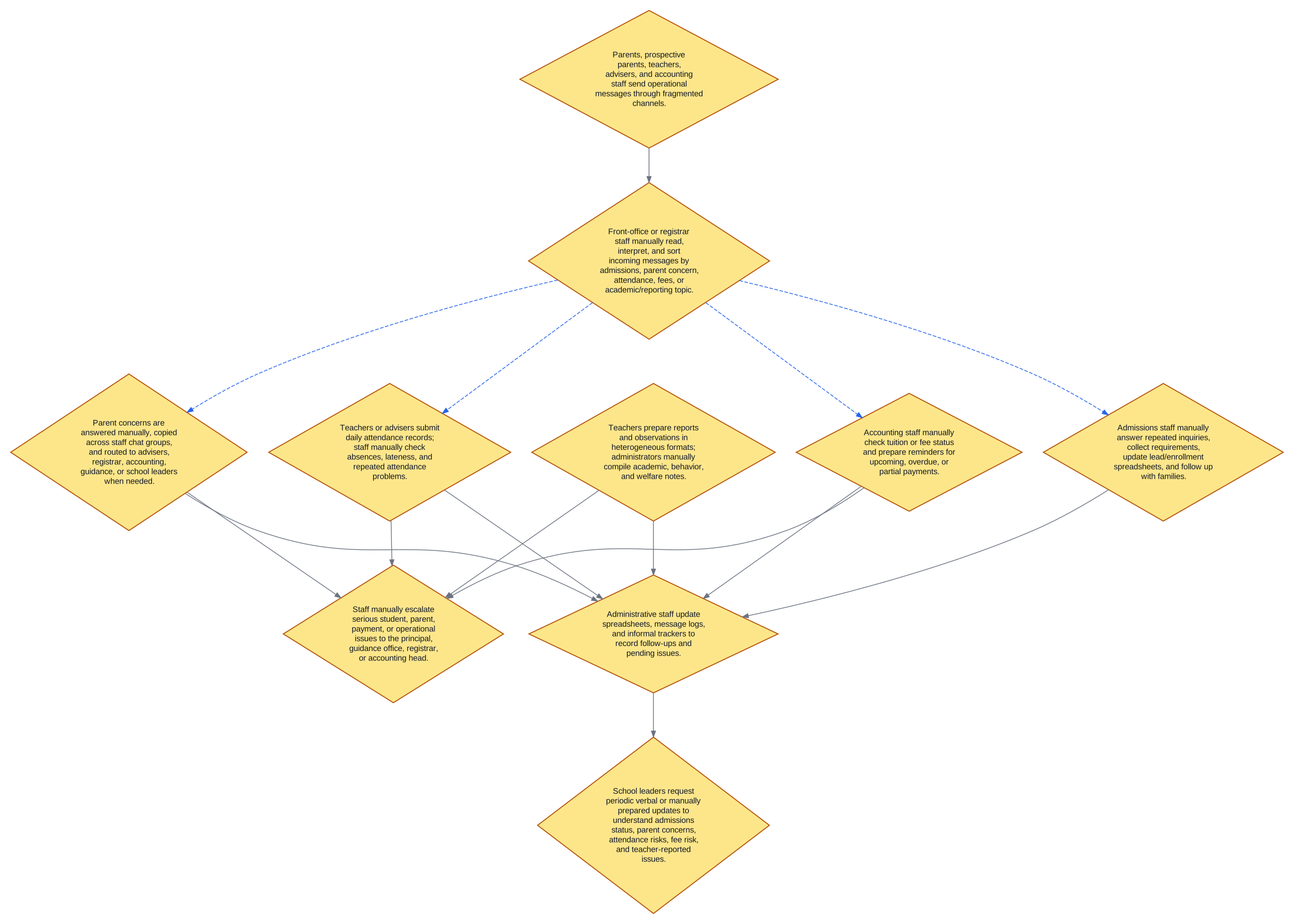
Before the redesign, school administration worked as a set of parallel manual routines:
- Parents, prospective parents, teachers, advisers, and accounting staff sent messages or records through fragmented channels.
- Front-office or registrar staff manually read each item and sorted it into admissions, parent concern, attendance, fee, teacher-report, or internal-announcement work.
- Admissions staff answered repeated questions, collected requirements, updated enrollment spreadsheets, and followed up with families.
- Parent concerns were copied into staff chat groups and routed to advisers, registrar, accounting, guidance, or school leaders when the issue became sensitive.
- Teachers submitted attendance and reports in different formats; staff manually compiled records, prepared updates, and escalated serious issues.
Key pain points:
- Triage depended on individual memory. Staff knew which parent, student, adviser, or accounting officer was involved, but that knowledge lived in chat history and personal habits.
- Follow-up records were duplicated. The same issue could appear in a spreadsheet, chat thread, email reply, and paper note without a single case status.
- Leadership visibility was delayed. School leaders saw problems after staff manually summarized them, not when patterns first emerged.
- Sensitive issues lacked consistent routing. Discipline, welfare, payment disputes, and high-conflict parent messages required judgment, but escalation rules were not always visible at intake.
4. Agent Design and Guardrails
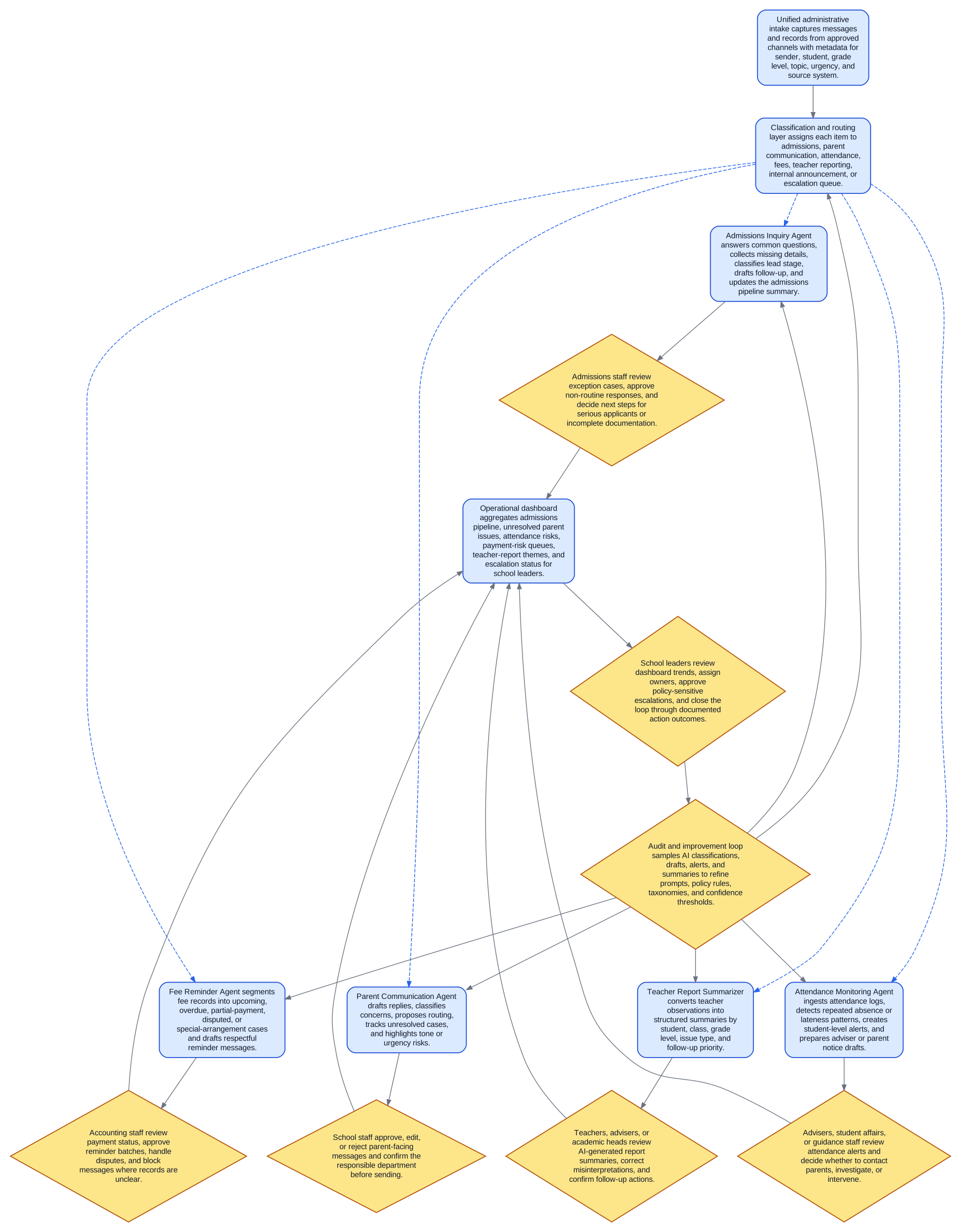
The proposed system introduces five task agents around a shared intake, routing, dashboard, and audit layer.
- Inputs: Admissions forms, parent messages, email, approved messaging channels, school-portal entries, attendance logs, accounting exports, teacher reports, and internal announcements.
- Understanding: The intake layer extracts sender, student, grade level, source channel, topic, urgency, and confidence score. The classification layer routes items into admissions, parent communication, attendance, fees, teacher reporting, internal announcement, or escalation queues.
- Reasoning: Each agent works inside a defined policy boundary. The Admissions Inquiry Agent can answer published FAQs and collect missing details, but cannot promise acceptance. The Parent Communication Agent can draft replies and route issues, but cannot independently handle discipline, safety, medical, legal, or high-conflict cases. The Attendance Monitoring Agent can flag patterns, but cannot trigger punishment. The Fee Reminder Agent can draft reminder batches, but accounting must verify records before sending. The Teacher Report Summarizer can structure observations, but teachers and academic heads remain accountable for interpretation.
- Actions: The system drafts messages, creates review queues, prepares notices, updates pipeline summaries, generates student-level alerts, aggregates unresolved cases, and produces leadership dashboards.
- Memory/state: Each case keeps topic, owner, source record, draft output, review status, action history, escalation status, and closure note.
- Human review points: Admissions exceptions, parent-facing messages, attendance interventions, fee-reminder batches, teacher-report summaries, leadership escalations, and monthly audit samples.
- Out-of-scope actions: The agents do not make admissions decisions, disciplinary decisions, student-welfare judgments, payment-dispute resolutions, or final academic interpretations.
The operating model is therefore not “AI runs the school office.” It is “AI prepares the administrative work into reviewable queues, and authorized staff decide what can be sent, escalated, corrected, or closed.”
5. One Workflow Walkthrough
A Grade 7 parent sends a late-night message through the school portal: the student has missed three mornings in two weeks, the parent is confused about whether the absences are excused, and the same parent also mentions a pending tuition balance.
Under the old workflow, the message could be read by front-office staff in the morning, forwarded to the adviser, separately checked against attendance records, and then informally passed to accounting. The adviser might reply first while accounting prepares a separate reminder, creating a fragmented parent experience.
Under the agent-enabled workflow, the unified intake captures the message with student, grade level, parent, topic, and channel metadata. The classification layer tags it as both attendance and fee-related, with a sensitivity flag because student absence and payment status appear in the same message. The Attendance Monitoring Agent checks recent attendance logs and prepares an adviser note. The Fee Reminder Agent checks whether the balance is upcoming, overdue, partial, disputed, or under special arrangement. Because the case crosses student welfare and payment information, the system blocks automatic sending. The adviser reviews the attendance summary, accounting verifies the fee status, and the Parent Communication Agent drafts a single coordinated parent reply. Staff approve the final message, assign follow-up ownership, and the case is logged for dashboard review.
6. Results
- Baseline period: To be established during a two-week discovery audit of admissions messages, parent inquiries, attendance logs, fee reminders, and teacher reports.
- Evaluation period: Recommended four- to six-week pilot during one grading cycle.
- Workflow scope/sample: Admissions inquiries, parent-facing messages, daily attendance alerts, fee reminder batches, and teacher-report summaries for selected grade levels.
- Process change: Manual first-pass sorting is replaced by AI-assisted classification and queueing. Staff move from searching across channels to reviewing structured cases.
- Decision/model change: The system separates routine drafts from sensitive exceptions and makes human review status explicit before any parent-facing or policy-sensitive action.
- Business effect: Expected benefits include faster response time for routine inquiries, fewer missed follow-ups, cleaner escalation ownership, and better leadership visibility into unresolved parent, attendance, fee, and academic issues.
- Evidence status: Planned pilot / estimated from workflow mapping, not production-measured results.
The success metric should not be “how many messages the AI sends automatically.” A safer metric is the percentage of cases correctly classified, reviewed by the right human owner, resolved within service targets, and traceable back to source records.
7. What Failed First and What Changed
The first version of the design treated the agents as separate assistants: one for admissions, one for parents, one for attendance, one for fees, and one for teacher reports. That looked neat on a slide but failed operationally because real school cases often cross categories. A parent message can involve absence, discipline, teacher feedback, and payment status in one thread. The redesign added a shared intake layer, cross-topic classification, escalation flags, and a unified case record before task agents act. The remaining limitation is integration quality: if attendance logs or accounting exports are delayed, the agent should draft cautiously and route to review instead of pretending the record is complete.
8. Transferable Lesson
- Start from the school’s real handoffs, not from agent names. The useful unit is the case record: who sent it, what it concerns, who owns it, what has been reviewed, and what remains unresolved.
- Separate AI preparation from human authority. AI can classify, summarize, draft, and flag. Admissions, welfare, discipline, finance exceptions, and parent-conflict decisions must remain with authorized staff.
- Build the dashboard from workflow state, not from generic analytics. Leaders need to see unresolved cases, escalation age, owner, sensitivity, and decision status—not just message volume.
This case shows that agentic AI works best in school administration when it turns scattered communication into structured, reviewable operational memory while keeping human judgment at the center of sensitive educational decisions.
-
Abdullah Wan et al., “A Practical Guide to Agentic AI Transition in Organizations,” arXiv:2602.10122, 2026. https://arxiv.org/abs/2602.10122 ↩︎
-
Henry Peng Zou et al., “LLM-Based Human-Agent Collaboration and Interaction Systems: A Survey,” arXiv:2505.00753, 2025. https://arxiv.org/abs/2505.00753 ↩︎
-
Kaiwen Zhang et al., “A Practical Approach for Building Production-Grade Conversational Agents with Workflow Graphs,” arXiv:2505.23006, 2025. https://arxiv.org/abs/2505.23006 ↩︎
-
Jiawei Xu et al., “Rethinking the Value of Multi-Agent Workflow: A Strong Single Agent Baseline,” arXiv:2601.12307, 2026. https://arxiv.org/abs/2601.12307 ↩︎
-
Nicholas Del Rio et al., “LLM Agents for Interactive Workflow Provenance: Reference Architecture and Evaluation Methodology,” arXiv:2509.13978, 2025. https://arxiv.org/abs/2509.13978 ↩︎