Executive Snapshot
- Client type: Small insurance broker or claims support team
- Industry: Insurance operations
- Core problem: Claims were delayed because staff manually classified claims, checked document completeness, requested missing materials, reviewed possible fraud signals, and prepared summaries for insurers or underwriters.
- Why agentic AI: The workflow required more than a chatbot: it needed stateful intake, document classification, checklist reasoning, exception routing, draft communication, and human-controlled approval.
- Deployment stage: Prototype-to-pilot design
- Primary result: The target operating model shifts claims staff from document chasing and case formatting to review, escalation, and customer judgment.
1. Business Context
The organization is a small insurance broker or claims unit that helps policyholders prepare and submit claims to insurers, underwriters, or adjusters. Its claims team receives motor, property, travel, health reimbursement, personal accident, and small commercial claims through email, WhatsApp, online forms, scanned PDFs, photos, receipts, medical documents, police reports, repair estimates, and customer explanations. The firm does not usually make the final claim decision, but it is responsible for turning messy submissions into complete, organized, insurer-ready packages. Errors matter because a missing police report, unclear invoice, wrong incident date, or poorly written summary can delay claim review, frustrate the customer, and create rework for both the broker and insurer.
2. Why Simpler Automation Was Not Enough
A fixed script could send reminders, and a dashboard could show open cases, but neither would solve the operational problem. Each claim followed a similar pattern, yet the path branched by claim type, insurer requirement, document quality, incident details, policy context, and risk indicators. A motor accident claim might require photos, a driver’s license copy, a repair quotation, and a police report; a medical reimbursement claim might require diagnosis, receipts, prescriptions, and discharge records. The useful design pattern is therefore bounded agentic workflow: agents are allowed to parse, classify, check, draft, and route work, while humans keep authority over customer-facing communication, fraud-sensitive interpretation, and final external handoff.1 This is consistent with recent agentic document-intelligence and regulated-workflow research, where the core value comes from converting unstructured packets into governed states rather than removing human accountability.2
3. Pre-Agent Workflow
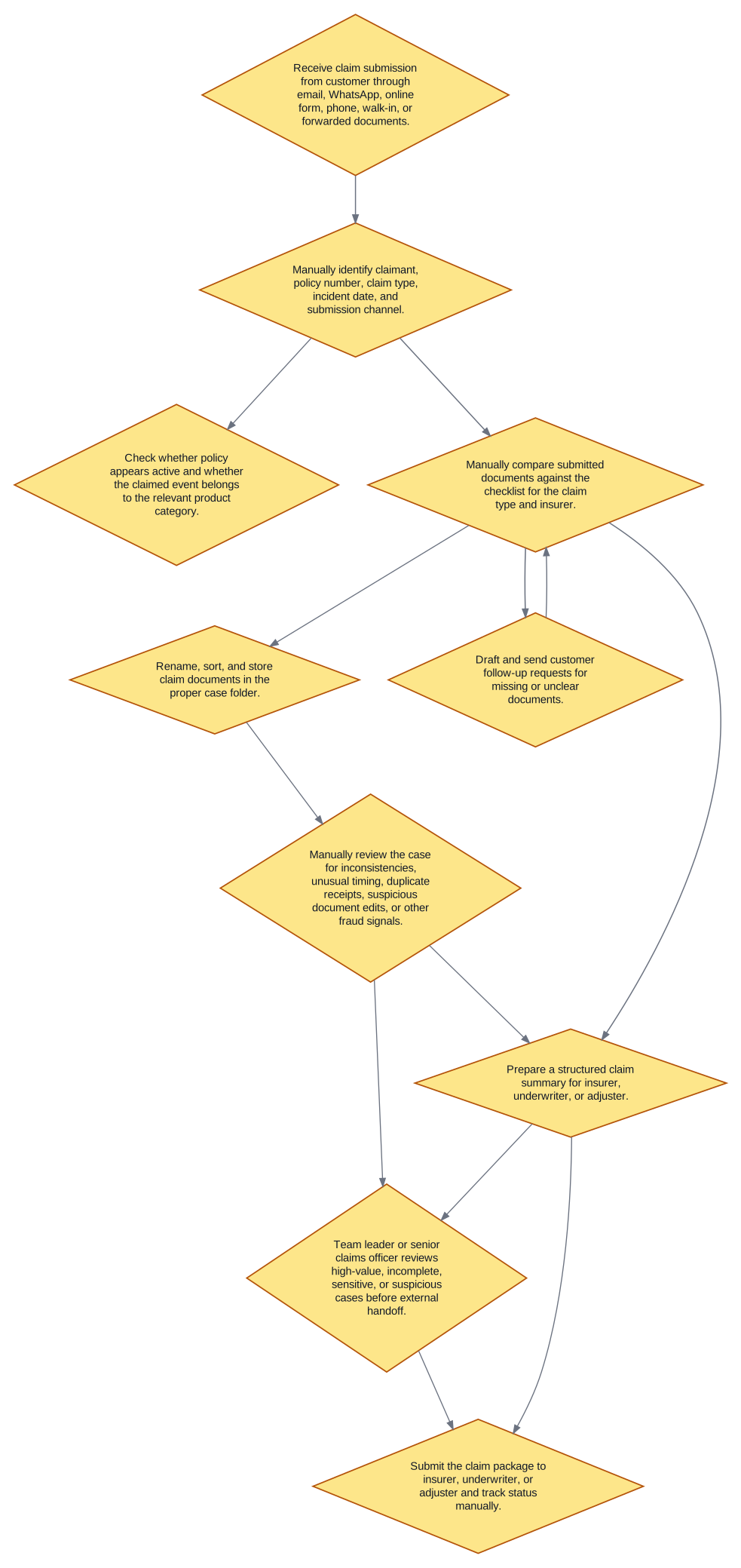
Before the agent system, the claims process was coordinated mostly by human claims officers.
- Claim materials arrived through fragmented channels. A customer might email a claim form, send damage photos through WhatsApp, and later forward a police report as a scanned PDF. Staff had to notice that all items belonged to the same case.
- A claims officer manually identified the case. The officer read the form and messages to determine claimant name, policy number, claim type, incident date, submitted documents, and likely insurer requirement.
- Document completeness was checked manually. Staff compared the claim packet against claim-type and insurer-specific checklists, then marked missing, unclear, expired, unsigned, duplicated, or mismatched items.
- Customer follow-up became a repeated loop. If a document was missing or unreadable, staff drafted a message, waited for the customer to reply, attached the new file, and restarted the completeness check.
- Summary preparation happened late. Only after documents were organized did a claims officer write a structured memo for the insurer, underwriter, or adjuster. High-value, incomplete, sensitive, or suspicious cases were escalated to a team leader before handoff.
Key pain points:
- Claims officers spent too much time renaming files, checking forms, and rewriting similar follow-up messages.
- Missing-document loops were hard to manage because case status lived across inboxes, chat histories, folders, and spreadsheets.
- Senior staff often discovered summary errors late, after the officer had already spent time preparing the package.
- Fraud or inconsistency checks depended heavily on staff experience and were not consistently recorded as structured risk indicators.
4. Agent Design and Guardrails
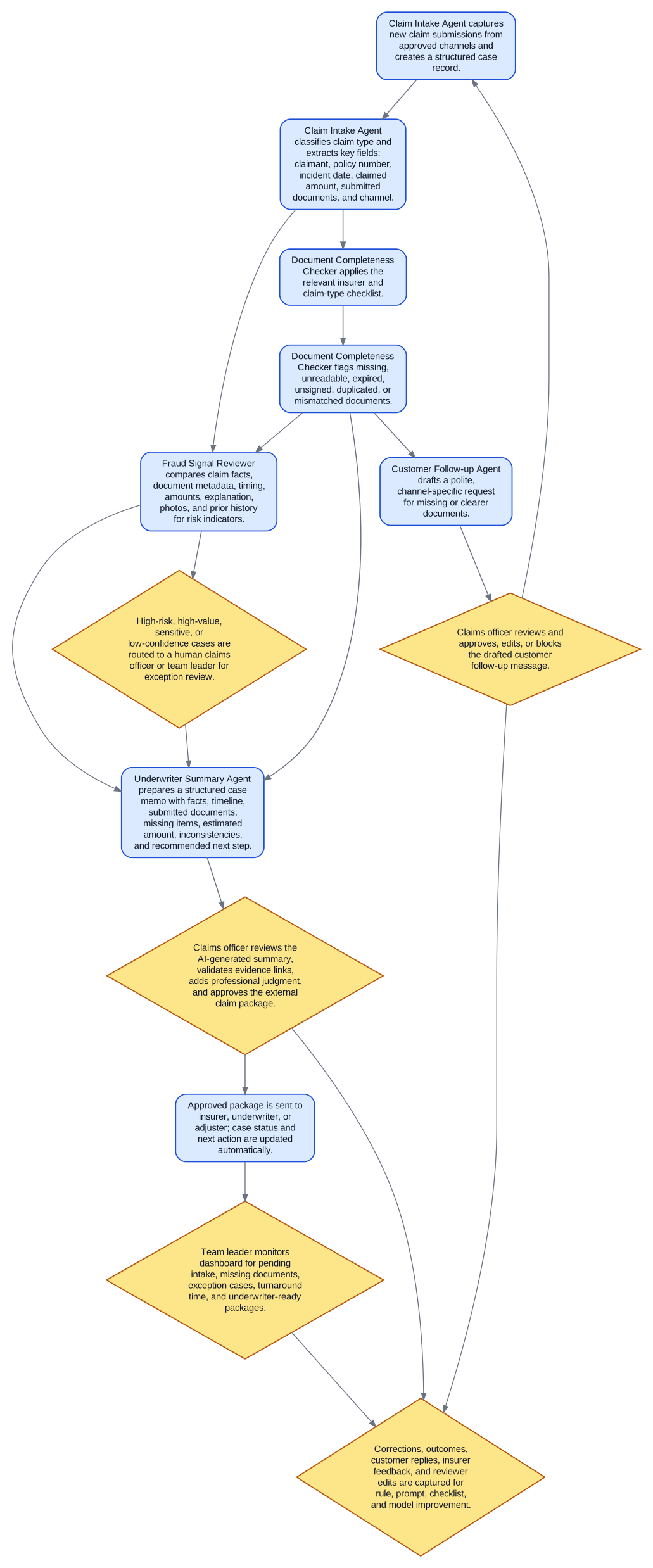
The redesigned workflow uses five specialized agents: Claim Intake Agent, Document Completeness Checker, Fraud Signal Reviewer, Customer Follow-up Agent, and Underwriter Summary Agent.
- Inputs: Claim forms, emails, WhatsApp exports, PDFs, scanned IDs, damage photos, receipts, invoices, police reports, repair estimates, medical certificates, diagnostic reports, and customer explanations.
- Understanding: OCR, document parsing, image/document tagging, claimant and policy-field extraction, claim-type classification, and source-channel tracking.
- Reasoning: Insurer-specific checklist matching, field-level confidence scoring, missing-item detection, inconsistency detection, risk-flag ranking, and exception routing.
- Actions: Create draft case records, populate document inventories, draft customer follow-up messages, prepare underwriter summaries, update case status, and route exceptions to human reviewers.
- Memory/state: Each claim receives a case ID, document inventory, extracted fields, missing-item list, risk flags, reviewer edits, customer replies, status history, and handoff version.
- Human review points: Claims officer approval for customer-facing messages; team-leader review for high-risk, high-value, sensitive, or low-confidence cases; claims officer approval before any external package is sent.
- Out-of-scope actions: The system does not approve or deny claims, accuse customers of fraud, determine final coverage, make payout decisions, or send external packages without human authorization.
The central guardrail is decision-negative design. The agents prepare work and expose evidence, but they do not make binding insurance decisions. Fraud signals are framed as risk indicators for review, not accusations. Customer messages must avoid approval language, legal conclusions, and threatening tone. Checklist rules are version-controlled by insurer, claim type, jurisdiction, and date. Reviewer edits are logged so that the system can improve prompts, templates, rules, and exception thresholds under governance rather than through uncontrolled self-updating.
5. One Workflow Walkthrough
A policyholder submits a motor accident claim by email, attaching a claim form and three photos. Later, the customer sends a repair quotation through WhatsApp. The Claim Intake Agent links both channels to one case ID, extracts the policy number, incident date, vehicle plate number, claimed amount, and submitted-document list, then classifies the case as a motor accident claim. The Document Completeness Checker applies the motor-claim checklist and finds that the police report and driver’s license copy are missing, while one rear-side vehicle photo is too blurry.
The Customer Follow-up Agent drafts a WhatsApp message asking only for those three items, with upload instructions and no claim-approval wording. A claims officer reviews the message, slightly softens the tone, and approves it. When the customer replies, the system reopens intake, updates the document inventory, and reruns the completeness check. The Fraud Signal Reviewer detects no major inconsistency, but notes that the repair estimate is above the branch’s normal review threshold. The case is routed to a senior officer, who confirms that the estimate should be sent to the adjuster for assessment rather than challenged at broker level. The Underwriter Summary Agent then prepares a structured memo with facts, timeline, documents received, remaining open questions, estimated amount, and reviewer note. A claims officer validates the evidence links and approves the final handoff package.
6. Results
- Baseline period: Representative pre-pilot workflow review of manual claims preparation
- Evaluation period: Planned six-week pilot
- Workflow scope/sample: New motor, property, travel, and health reimbursement claims handled by the broker’s claims support team
- Process change: Intake, classification, checklist matching, missing-document detection, draft follow-up, and summary drafting move from manual work to agent-assisted queues.
- Decision/model change: The system does not decide claims; it improves preparation quality by separating extracted facts, checklist results, risk signals, unresolved questions, and human reviewer notes.
- Business effect: Expected reduction in claims preparation time, fewer incomplete submissions to insurers, shorter missing-document loops, clearer case ownership, and earlier escalation of sensitive or suspicious cases.
- Evidence status: Planned pilot estimate, not production-measured.
For the pilot, the practical target is not full automation. A realistic success benchmark is that routine claims become review-ready faster, while exceptions become visible earlier. For example, the team could track average time from first claim submission to first missing-document request, percentage of claims returned by insurers for incomplete files, number of follow-up loops per claim, senior-review backlog, and claims-officer edits to AI-generated summaries. The most important quality metric is not whether the AI writes polished text; it is whether the package reaching the insurer is complete, traceable, and human-approved.
7. What Failed First and What Changed
The first version over-treated checklist gaps as simple missing-document problems. This created draft messages that were technically correct but operationally clumsy. For example, it might request a “medical certificate” without explaining whether a clinic note, discharge summary, or diagnostic report would satisfy the insurer’s requirement. It also tended to merge objective document defects with judgmental claim concerns. The fix was to split outputs into three fields: missing item, reason, and acceptable evidence examples. Risk indicators were moved into a separate review queue so that customer follow-up messages remained specific, neutral, and non-accusatory. The remaining limitation is that insurer rules still need maintenance; when a carrier changes requirements, the checklist library must be updated before the agent can apply the new rule reliably.
8. Transferable Lesson
- Design the workflow around case state, not around chat. The valuable object is the evolving claim file: documents, extracted fields, checklist status, risk flags, reviewer notes, and next action.
- Keep AI authority bounded. Agents can prepare, classify, draft, and route; humans should approve customer-facing messages, review exceptions, and control external handoff.
- Separate objective defects from judgmental concerns. Missing signatures, unreadable scans, and unmatched dates can be handled as document issues; fraud signals and coverage questions require human interpretation.
This case shows that agentic AI works best in insurance claims when it turns fragmented submissions into governed, review-ready operational packages—not when it pretends to replace claims judgment.
Analytical Point from the Reference Scan
The five selected arXiv papers point to the same design logic: agentic AI is strongest when it decomposes a high-friction workflow into typed, inspectable states. In this case, the state transition is from raw claim bundle to classified case, then to completeness-checked file, then to exception-routed review, and finally to human-approved underwriter package. This matters because claims processing mixes repetitive document work with high-stakes judgment. The practical advantage of agentic AI is therefore not autonomous settlement, but earlier structure, earlier exception visibility, and cleaner handoff to accountable human reviewers.3
-
Joyjit Roy and Samaresh Kumar Singh, “Agentic AI for Commercial Insurance Underwriting with Adversarial Self-Critique,” arXiv:2602.13213, https://arxiv.org/abs/2602.13213. ↩︎
-
Md Mofijul Islam et al., “IDP Accelerator: Agentic Document Intelligence from Extraction to Compliance Validation,” arXiv:2602.23481, https://arxiv.org/abs/2602.23481. ↩︎
-
The reference scan used five arXiv papers: Roy and Singh, “Agentic AI for Commercial Insurance Underwriting with Adversarial Self-Critique,” arXiv:2602.13213; Chukwunedum Agbata, “LLMs and Agentic AI in Insurance Decision-Making: Opportunities and Challenges For Africa,” arXiv:2508.15110; Islam et al., “IDP Accelerator: Agentic Document Intelligence from Extraction to Compliance Validation,” arXiv:2602.23481; Pratishtha V. Naik et al., “Co-Investigator AI: The Rise of Agentic AI for Smarter, Trustworthy AML Compliance Narratives,” arXiv:2509.08380; and Christos Revelas, Otilia Boldea, and Bas J. M. Werker, “Consistency of Selection Strategies for Fraud Detection,” arXiv:2509.18739. ↩︎