Executive Snapshot
- Client type: Multi-branch restaurant group operating several casual dining, quick-service, or café-style outlets.
- Industry: Food and beverage operations.
- Core problem: Daily sales, inventory, purchasing, staffing, menu performance, supplier coordination, and customer feedback were managed through fragmented spreadsheets, POS exports, and chat messages.
- Why agentic AI: The work required ongoing coordination across multiple operational streams, not a single chatbot response or a fixed dashboard.
- Deployment stage: Prototype-to-pilot design.
- Primary result: A human-coordination-heavy workflow was redesigned into an AI-agent-enabled operating loop with manager approval, exception routing, and outcome tracking.
1. Business Context
The restaurant group managed several branches with daily recurring decisions around expected demand, ingredient purchasing, staff schedules, menu performance, supplier communication, and customer reviews. Each branch produced useful signals: POS sales exports, stock counts, purchase notes, staff availability, supplier confirmations, promotion records, and customer complaints from Google, delivery platforms, social media, and direct messages. The problem was not the absence of data. The problem was that the data lived in disconnected spreadsheets, chat groups, manual reports, and branch-level habits. By the time head office reviewed the information, waste, stockouts, under-staffed peak hours, slow service, or repeated customer complaints had often already appeared.
2. Why Simpler Automation Was Not Enough
A script could import POS exports. A dashboard could show yesterday’s sales. A chatbot could draft a customer reply. None of those tools alone would solve the operating problem, because the workflow branched across demand, inventory, labor, menu design, supplier coordination, and customer service. The key analytical point from recent agentic-workflow research is that the value of agentic AI comes from stateful orchestration: specialized agents handle different sub-workflows, share operating context, produce reviewable recommendations, and feed outcomes back into the next cycle.1 For a restaurant group, this means the demand forecast is not just a number. It becomes the upstream signal for replenishment, staffing, menu decisions, and branch-level escalation. Human managers still approve high-impact actions because agentic systems can affect the real world through purchases, schedules, and public customer responses.2
3. Pre-Agent Workflow
Before the agent system, restaurant operations were managed through a chain of manual handoffs:
- Branch staff collected daily operating data in separate channels. Sales came from POS exports, stock counts from spreadsheets, supplier updates from chat, staff availability from rosters, and reviews from platform notifications or screenshots.
- Branch managers manually estimated demand. They reviewed yesterday’s sales, last week’s weekday pattern, expected foot traffic, delivery orders, and their own experience to guess how many meals and ingredients would be needed.
- Managers prepared purchase requests and coordinated suppliers manually. Current stock was compared against expected sales. Purchasing staff or branch managers then contacted suppliers about availability, prices, delivery windows, and substitutions.
- Staff schedules and menu decisions were handled separately. Rosters were drafted from past patterns and employee availability, while menu performance reviews were delayed because sales, margin, waste, prep complexity, and customer feedback were rarely analyzed together.
- Head office reviewed branch reports after the fact. Waste, stockouts, understaffing, slow service, supplier issues, and repeated complaints were discovered reactively through weekly or monthly operating reviews.
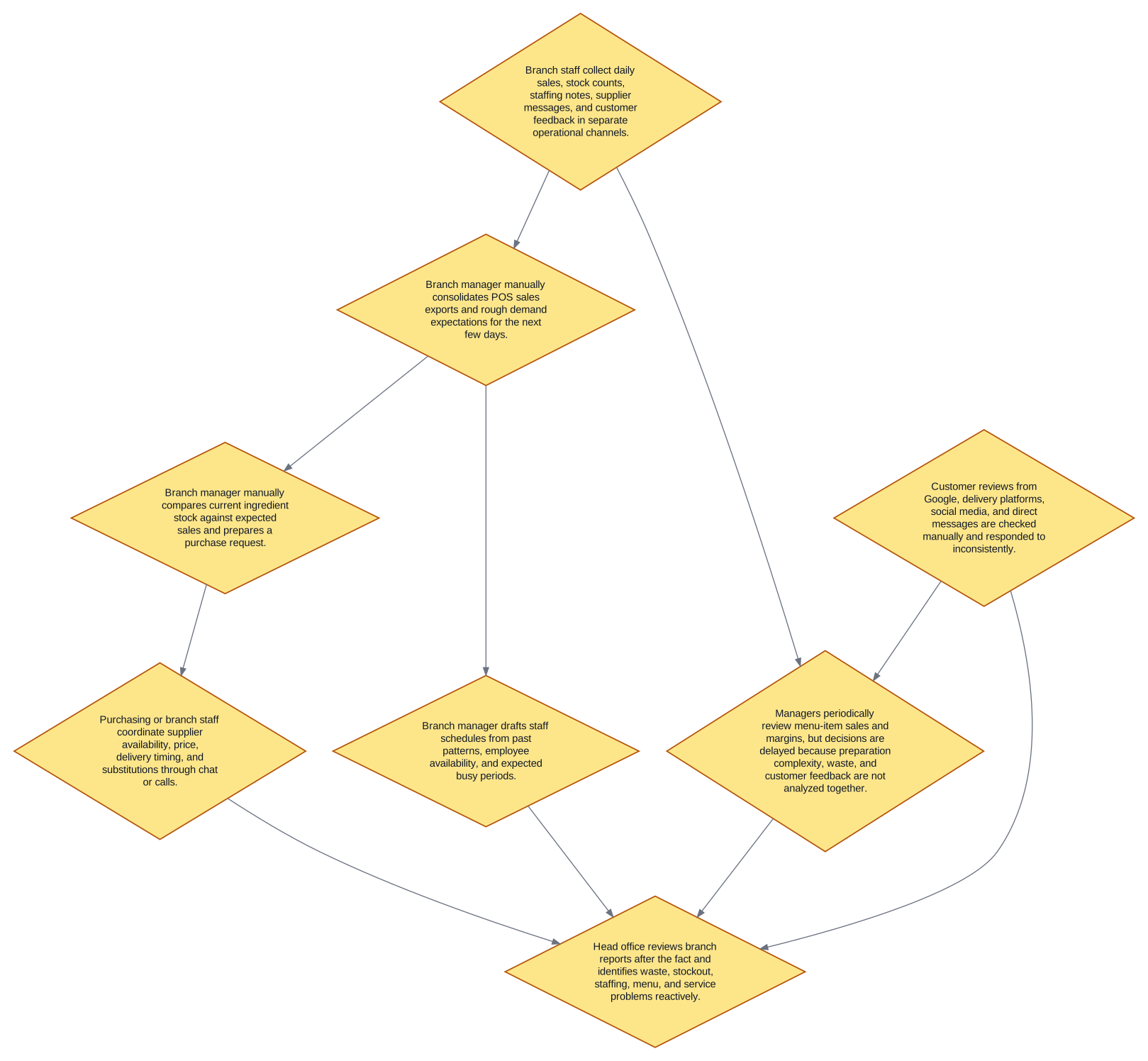
Key pain points:
- Demand estimation depended heavily on branch-manager intuition, making branch performance uneven.
- Inventory and purchasing decisions were exposed to both over-ordering and stockout risk, especially for perishable ingredients.
- Customer reviews were treated as isolated service issues instead of operating signals connected to menu, staffing, and branch execution.
4. Agent Design and Guardrails
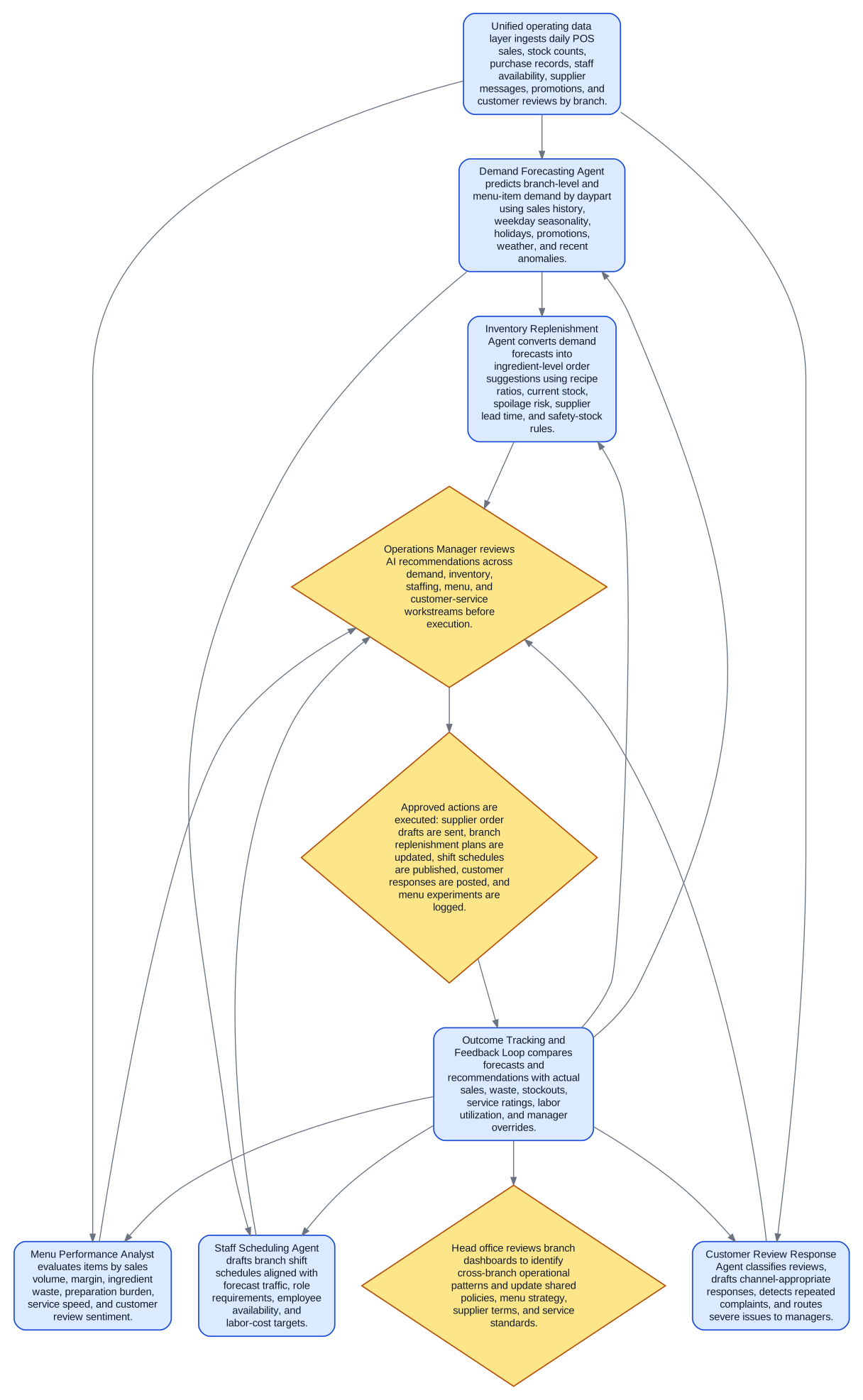
The redesigned system introduced five specialized agents around a shared operating-data layer.
- Inputs: POS sales, stock counts, purchase records, staff availability, supplier messages, promotions, recipe-to-ingredient mappings, menu-item cost data, review text, and branch metadata.
- Understanding: The system normalized branch, date, daypart, menu item, ingredient, supplier, staff role, and review-channel information into a common operating view.
- Reasoning: The Demand Forecasting Agent estimated branch-level and item-level demand. The Inventory Replenishment Agent translated forecast demand into ingredient order suggestions. The Staff Scheduling Agent drafted shift coverage. The Menu Performance Analyst combined volume, margin, waste, preparation burden, service speed, and customer sentiment. The Customer Review Response Agent classified reviews, drafted responses, and flagged serious issues.
- Actions: The system generated recommendations, supplier-order drafts, schedule drafts, menu scorecards, review-response drafts, branch alerts, and weekly head-office summaries.
- Memory/state: Forecast errors, waste incidents, stockouts, labor variance, review sentiment, manager edits, and override reasons were stored for the next cycle.
- Human review points: Managers approved supplier orders, final rosters, sensitive customer replies, menu changes, supplier substitutions, and large forecast deviations.
- Out-of-scope actions: The system did not autonomously commit high-cost orders, publish final schedules, change menu prices, approve supplier substitutions, or send sensitive complaint responses without human approval.
This design follows the same practical logic seen in agentic business-process research: deterministic workflows remain useful for stable steps, but agentic workflows become valuable when inputs are mixed, exceptions are frequent, and several specialized roles must coordinate around shared state.3 In this case, the agents are not replacing restaurant managers. They are converting scattered branch signals into structured options that managers can approve, edit, reject, or escalate.
5. Post-Agent Workflow
After the agent system is introduced, the daily workflow becomes a coordinated operating loop:
- The unified operating layer ingests branch data. POS exports, stock counts, supplier notes, staff availability, promotions, and reviews are imported or entered into structured forms.
- The Demand Forecasting Agent predicts demand by branch, menu item, and daypart. Forecasts include confidence levels and anomaly flags so managers can see where the system is uncertain.
- Operational agents convert forecasts into draft decisions. The Inventory Replenishment Agent recommends ingredient quantities, the Staff Scheduling Agent drafts rosters, the Menu Performance Analyst updates item scorecards, and the Customer Review Response Agent drafts responses and issue summaries.
- Operations managers review recommendations before execution. The dashboard shows suggested actions, explanation notes, confidence indicators, exceptions, and manager override options.
- Approved actions are executed and tracked. Supplier order drafts are sent, replenishment plans are updated, schedules are published, customer responses are posted, and menu experiments are logged.
- Outcomes feed back into the system. Actual sales, waste, stockouts, labor utilization, review changes, and manager overrides update forecasts, rules, prompts, and branch policies.
6. One Workflow Walkthrough
On a Thursday afternoon, the system detects that two branches are likely to face unusually high Friday dinner demand because sales have been rising for the same menu bundle, a local event is expected near one branch, and delivery-app orders have increased for similar time windows. The Demand Forecasting Agent marks the forecast as medium confidence and sends the signal to the Inventory Replenishment Agent and Staff Scheduling Agent. The Inventory Agent recommends increasing chicken, sauce, packaging, and drink stock, but flags that one supplier has a longer lead time. The Staff Scheduling Agent drafts an extra cashier and kitchen-helper shift for the peak period. Because the order value exceeds the branch threshold and one ingredient has substitution risk, the operations manager reviews the recommendation, reduces one perishable item, approves a supplier message, and confirms the schedule. After Friday service, the system compares the forecast with actual sales, waste, stockouts, and manager edits, then logs the result for future demand and replenishment tuning.
7. Results
This case should be evaluated as a pilot rather than presented as a completed production deployment.
- Baseline period: Four weeks of branch-level historical operations before agent support.
- Evaluation period: Six to eight weeks of prototype or pilot operation.
- Workflow scope/sample: Daily demand planning, inventory replenishment, scheduling support, menu scorecards, customer-review response drafts, and weekly branch dashboards across selected branches.
- Process change: Manual consolidation is replaced by a daily decision queue with forecast, replenishment, staffing, menu, and review-response recommendations.
- Decision/model change: Managers no longer review isolated sales, stock, and review records; they review linked recommendations with confidence levels, exception flags, and override history.
- Business effect: Target metrics include lower food waste, fewer stockouts, faster review response time, lower labor variance during peak periods, and clearer head-office visibility into branch differences.
- Evidence status: Planned or estimated for pilot evaluation; not yet claimed as observed production impact.
The most important result is not a single automation metric. It is the creation of a closed-loop operating rhythm: observe branch data, generate recommendations, route exceptions to humans, execute approved actions, and learn from outcomes. This is where agentic workflows differ from ordinary dashboards: they do not only display the business; they help move work from signal to decision to reviewed action.4
8. What Failed First and What Changed
The first version of the design treated replenishment too mechanically. It converted demand forecasts into ingredient quantities without enough attention to perishability, supplier lead time, manager confidence, and branch-specific preparation habits. That created a risk of over-ordering slow-moving ingredients when forecast confidence was only moderate. The improvement was to add reorder ceilings for perishable items, safety-stock floors for critical ingredients, supplier-lead-time flags, and mandatory manager approval for high-cost or low-confidence orders. The remaining limitation is data quality: menu analysis will stay weak if recipe costs, ingredient usage, and waste records are incomplete.
9. Transferable Lesson
- Start with the operating loop, not the chatbot. The useful unit of design is the full decision cycle from data capture to recommendation, human approval, execution, and feedback.
- Separate drafting from committing. AI can draft orders, schedules, responses, and scorecards, but real-world commitments should remain approval-gated until the system earns operational trust.
- Treat customer feedback as operating data. Reviews should not only trigger replies. They should update menu analysis, staffing assumptions, service-quality checks, and branch training priorities.5
This case shows that agentic AI works best where managers already make repeated judgment calls from messy operating signals, but need a shared, reviewable system to turn those signals into consistent decisions.
References
-
Mathias Weske, Marlon Dumas, et al., “Agentic Business Process Management Systems,” arXiv:2601.18833, 2026. https://arxiv.org/abs/2601.18833 ↩︎
-
Adam Fourney et al., “Magentic-UI: Towards Human-in-the-loop Agentic Systems,” arXiv:2507.22358, 2025. https://arxiv.org/abs/2507.22358 ↩︎
-
Hongyang Yang et al., “FinRobot: Generative Business Process AI Agents for Enterprise Resource Planning in Finance,” arXiv:2506.01423, 2025. https://arxiv.org/abs/2506.01423; Saket Saurabh Bagrodia et al., “Agent-S: LLM Agentic Workflow to Automate Standard Operating Procedures,” arXiv:2503.15520, 2025. https://arxiv.org/abs/2503.15520 ↩︎
-
Saket Saurabh Bagrodia et al., “Agent-S: LLM Agentic Workflow to Automate Standard Operating Procedures,” arXiv:2503.15520, 2025. https://arxiv.org/abs/2503.15520 ↩︎
-
Kartikey Singh Bhandari et al., “A Multi-Agent System for Generating Actionable Business Advice,” arXiv:2601.12024, 2026. https://arxiv.org/abs/2601.12024 ↩︎