Executive Snapshot
- Client type: Mid-sized construction firm operating in a paper-heavy accounting environment
- Industry: Construction / project-based finance
- Core problem: Receipts, invoices, and expense records arrived as photos, scans, and handwritten documents, creating slow reporting, repeated manual checking, and inconsistent handoffs across field, finance, and management
- Why agentic AI: The workflow was not just a data-entry problem; it required document understanding, routing, approval logic, exception handling, editable outputs, and managerial oversight across multiple downstream steps
- Deployment stage: Prototype / workflow redesign case
- Primary result: The redesigned workflow materially increases automation, reduces preventable human processing errors, cuts staff-to-staff communication overhead, and preserves decision quality even while response speed improves
1. Business Context
The firm’s accounting process started with physical receipts, invoices, and expense logs generated across active construction projects. Site staff captured documents on phones, finance staff re-entered details into spreadsheets or accounting records, and managers were pulled in when thresholds, coding ambiguity, tax treatment, or project allocation questions appeared. Because the same document often moved through several people before it became a usable accounting record, delays accumulated at every handoff. Errors mattered not only because they slowed month-end reporting, but because they also affected tax preparation, project profitability tracking, vendor analysis, bid costing, and short-term cash visibility. In practice, the workflow was operationally important every day, but still behaved like a loosely coordinated chain of manual interventions.
2. Why Simpler Automation Was Not Enough
A basic OCR script would not have solved the real problem, because extracting text was only the first step. The workflow branched after extraction: some items needed correction, some needed approval, some needed account coding and project tagging, and some triggered downstream reporting or cash-flow implications. A dashboard alone would only display problems after people had already done the work manually. A chatbot alone would not reliably manage state, thresholds, approvals, or auditability. What the business needed was a stateful workflow layer that could move a document from intake to decision-ready accounting output while preserving human checkpoints where policy, liability, or ambiguity still mattered.
3. Pre-Agent Workflow
- A site engineer, purchaser, or project coordinator collected a receipt or invoice and sent it to finance through chat, email, or manual upload.
- A finance staff member read the document, retyped key fields, guessed or checked the proper category, and asked follow-up questions when the scan was unclear or the project allocation was missing.
- If the amount or type required approval, the document was forwarded to a supervisor or executive, often with extra explanation added manually.
- After approval, finance staff drafted journal entries, prepared tax-related fields, and updated project cost files, often repeating information already sent in earlier messages.
- Reporting and cash tracking happened later, after records were manually consolidated, so anomalies and reserve gaps were identified with delay.
Key pain points:
- Repeated human re-entry created avoidable processing errors and inconsistent coding
- Staff spent too much time communicating with each other to clarify missing context, request approvals, and confirm status
- High-level managers were pulled into coordination and checking tasks instead of focusing on genuinely productive decisions
4. Agent Design and Guardrails
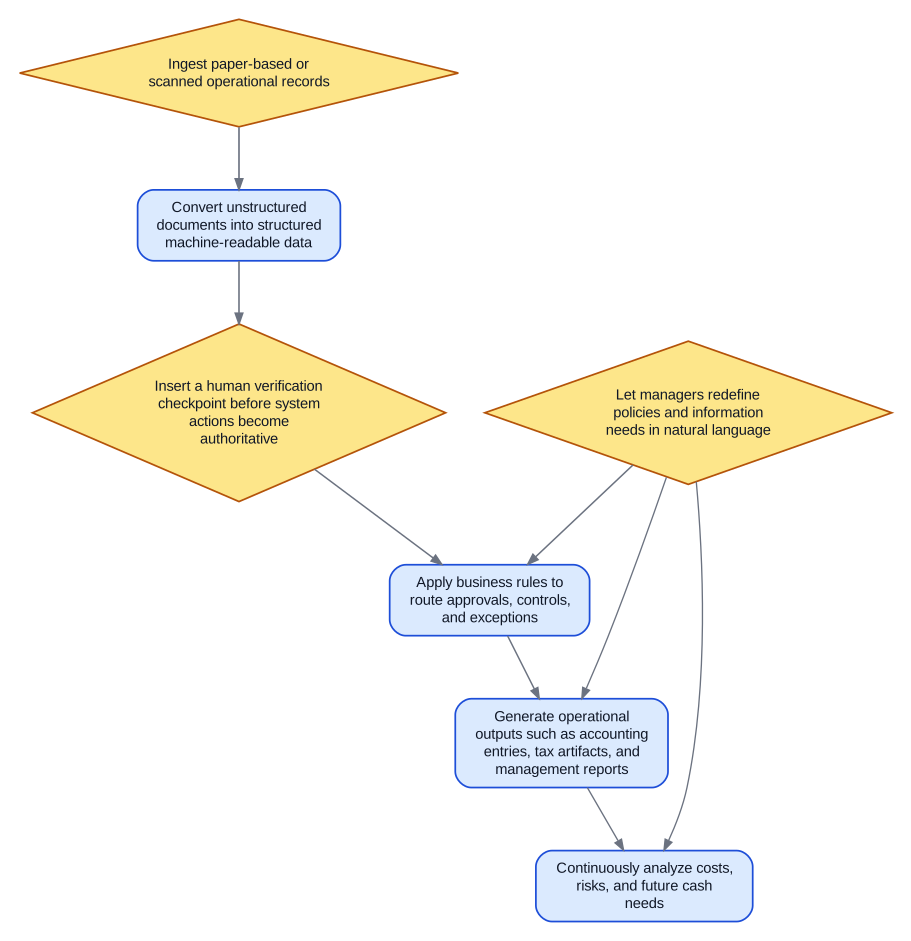
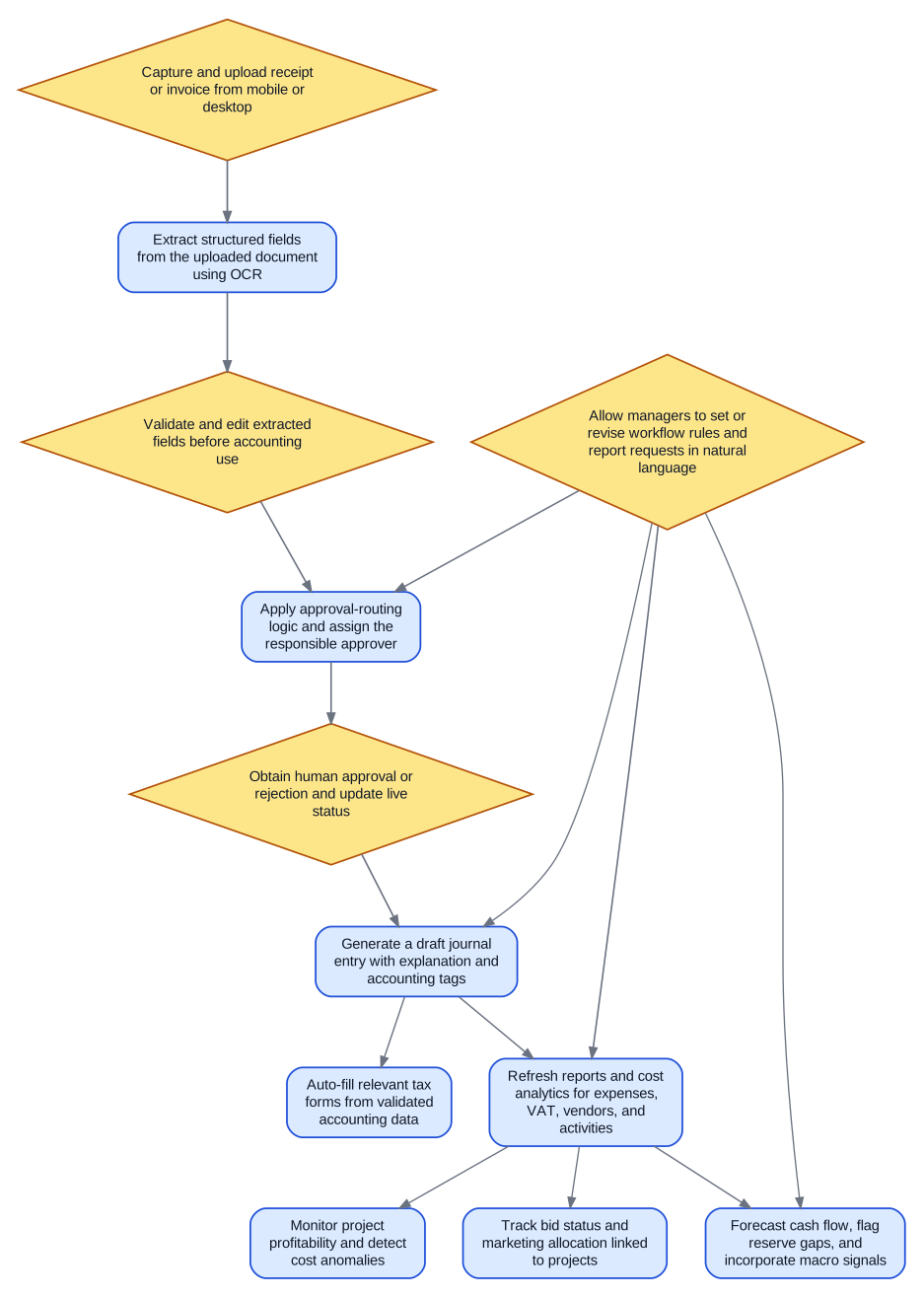
The redesigned system accepts scanned or photographed receipts and invoices from mobile or desktop inputs, then converts them into structured fields such as TIN, invoice type, invoice number, description, quantity, amount, and transaction date. From there, the workflow agent applies routing and policy logic rather than stopping at extraction. It suggests approvers based on amount or document type, maintains live workflow status, and moves only approved records into downstream accounting tasks.
- Inputs: Receipt images, invoice scans, user-supplied project or department context, and manager-issued rule instructions
- Understanding: OCR extraction, field normalization, tagging, and editable document interpretation
- Reasoning: Threshold logic, approval-policy checks, account-drafting rules, project allocation logic, and exception escalation
- Actions: Create structured document records, route approvals, generate draft journal entries with explanations, prepare tax-form fields, refresh analytics, and trigger forecast updates
- Memory/state: Each document retains workflow state across intake, correction, approval, posting, analytics, and later audit review
- Human review points: Field correction after OCR, approval for policy-sensitive items, and final review of journal and tax outputs where needed
- Out-of-scope actions: Fully autonomous tax filing, unrestricted posting without approval, or silent handling of unresolved anomalies
This design matters because it automates more than recognition. It automates progression. The system reduces human pro errors by carrying forward validated data instead of forcing multiple staff members to reconstruct the same information in different places. It also reduces human communication costs: instead of finance chasing site staff for details and managers repeatedly checking status across channels, the workflow itself becomes the coordination layer. That allows senior personnel to spend more time on actual financial judgment, cost control, and project decisions rather than on approval traffic and low-value governance overhead.
5. One Workflow Walkthrough
When a project team uploaded a photographed fuel receipt from a mobile phone, the system first extracted the vendor identity, date, amount, invoice type, and line-item details. It then presented those fields in editable form so a finance staff member could correct one ambiguous quantity field before the record advanced. After correction, the agent checked the document amount and category against the approval policy, determined that supervisory approval was required, and routed the item automatically to the correct approver with the document context already attached. Once approved, the system generated a draft journal entry, tagged the expense to the relevant project and activity bucket, and prepared the tax-related fields for downstream compliance handling. Because the item increased fuel spending for that project beyond its recent pattern, the analytics layer also surfaced the change in the monitoring view. A human reviewed the drafted accounting treatment, accepted it, and the case was logged with its correction and approval history preserved for audit and later model improvement.
6. Results
- Baseline period: Legacy manual workflow as reconstructed from the paper-based operating model
- Evaluation period: Workflow redesign / prototype-stage comparison
- Workflow scope/sample: Receipt intake, approval routing, journal drafting, tax preparation support, and project-cost reporting
- Process change: Manual multi-person handoffs are replaced with a single structured workflow that carries validated data forward across stages
- Decision/model change: More decisions are made consistently by explicit policy logic and structured draft generation, with humans focused on exceptions and approvals
- Business effect: Faster document-to-record processing, fewer preventable data-entry mistakes, shorter communication loops among staff, and improved management visibility into costs and cash needs
- Evidence status: Estimated from workflow redesign and prototype capabilities; not yet reported as production benchmark metrics
The most important gain is not only speed. It is the combination of speed and retained quality. In the old process, faster handling usually meant skipping checks or increasing the chance of misclassification. In the redesigned process, speed comes from eliminating repeated manual relay work, not from removing control. That means the firm can respond faster while still maintaining a high standard for approvals, account treatment, and downstream reporting. The reduction in human-to-human communication is also economically meaningful: fewer clarification loops mean lower coordination cost and less managerial attention wasted on operational traffic.
7. What Failed First and What Changed
The first weak point in this kind of system is usually not approval logic but document quality. If OCR confidence is poor on local receipt formats, handwriting, or low-quality phone images, bad extraction can contaminate everything downstream. The design response was not to pretend the model was already perfect. Instead, the workflow inserted editable extraction as an explicit checkpoint before routing and posting. That change prevented early automation errors from hardening into accounting records. The remaining limitation is that full performance still depends on better receipt-specific fine-tuning and continued review of edge cases, especially for messy local documents.
8. Transferable Lesson
- Start by automating the workflow state transitions, not just the document reading step
- Keep human review exactly where liability and ambiguity concentrate, but remove human relay work everywhere else
- The biggest economic gain may come from reducing internal communication and governance friction, not just reducing keystrokes
This case shows that agentic AI works best where messy real-world inputs, branching business rules, and repeated human coordination all exist in the same operational chain.