Executive Snapshot
- Client type: Digital marketing operation serving personal wealth management and finance audiences
- Industry: Financial content marketing / social growth
- Core problem: The team had to monitor high-signal finance influencers continuously, turn relevant posts into repost-ready content for other platforms, and expand the influencer network without API dependence, privacy leakage, or account bans.
- Why agentic AI: The work was not a single scriptable action; it was a looping process with ambiguous inputs, platform-specific judgment, confidence thresholds, risk checks, and exceptions that had to be routed differently depending on evidence strength and account risk.
- Deployment stage: Production-upgrade redesign grounded in the inferred old and new workflows
- Primary result: The redesigned workflow shifts routine work from staff handoffs to autonomous agents, while keeping humans at policy-setting and high-risk approval points.
1. Business Context
The operating environment was a high-frequency social intelligence and content production loop. The team watched selected finance influencers on X throughout the day, captured new posts, chose supporting context from finance media, rewrote content for platforms such as Xiaohongshu, published with media preserved, and periodically expanded the monitored network through hashtags, Lists, and second-degree followers. The workflow touched browser automation, local archives, prompt templates, destination posting tools, and security controls such as MFA, RBAC, and isolated deployment. Delays mattered because finance narratives lose value quickly; errors mattered because unsupported claims, poor tone adaptation, or unsafe posting behavior could damage credibility, increase moderation risk, and create avoidable rework across monitoring, content, operations, and management staff.
2. Why Simpler Automation Was Not Enough
A fixed scraper or a simple chatbot would only solve fragments of the problem. The workflow branched whenever the system had to interpret shorthand, decide whether a post was worth reusing, choose supporting context, adapt tone to a different platform, judge whether confidence was strong enough to publish, or decide whether a discovered account should enter the monitored influencer tier. The operation also had to manage anti-ban behavior, private deployment, rollback, and role-based controls. In other words, the work was stateful: each step depended on prior monitoring history, creator context, network expansion history, policy thresholds, and the outcome of earlier decisions. That is exactly where an agentic design is more suitable than isolated scripts.
3. Pre-Agent Workflow
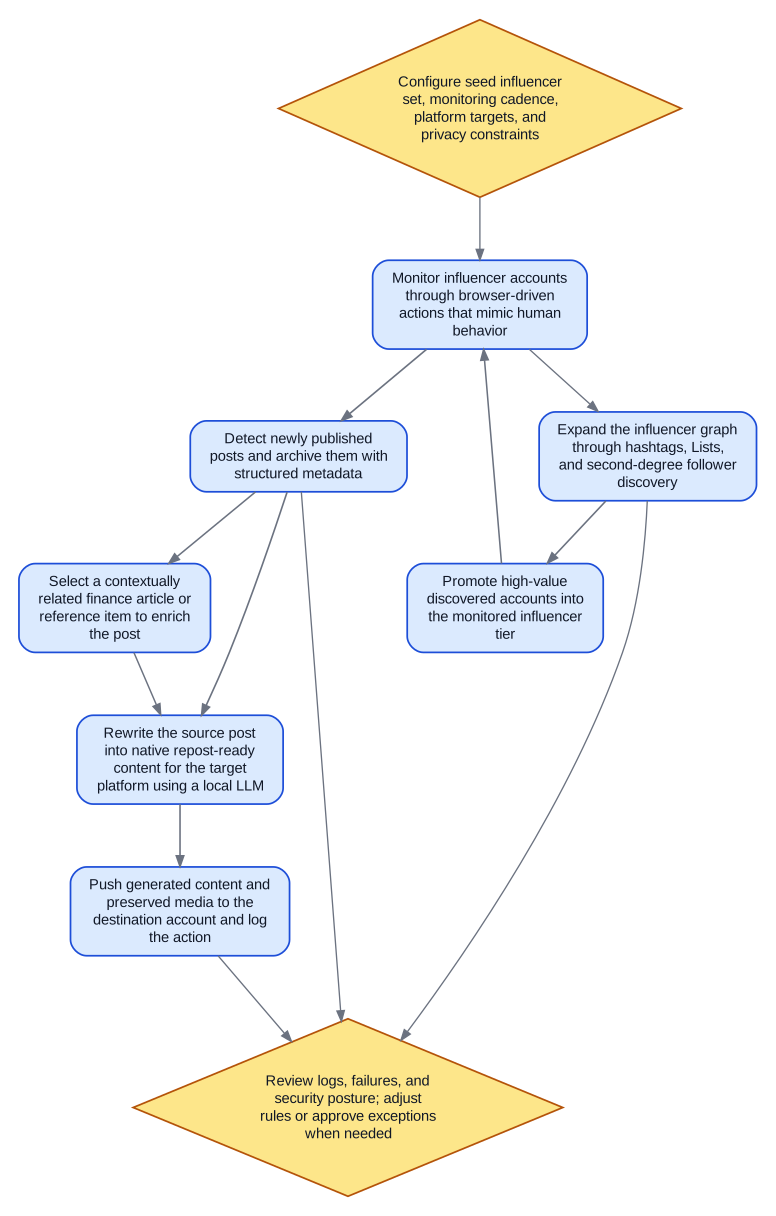
Before the agentic redesign, the business effectively operated as a tool-assisted but human-coordination-heavy workflow that mirrored the same business stages:
- Monitoring staff watched a seed list of finance influencers, using browser tools and manual checks to detect new posts.
- Operations staff archived the post and media, then content staff picked a context article or reference item and judged how to angle the repost.
- A copywriter or editor rewrote the post for the destination platform, adjusted hashtags, and passed the draft onward.
- Publishing staff uploaded the final text and media, logged the action, and reported exceptions to a manager.
- Growth staff periodically searched hashtags, Lists, and second-degree followers to expand the network, while managers reviewed logs, decided rollbacks, and updated rules.
Key pain points:
- Too many handoffs between monitoring, archiving, rewriting, publishing, and growth functions
- High dependence on human judgment for context selection and quality checking, which increased professional errors and inconsistency
- Slow coordination cycles whenever a case was ambiguous, high-reach, or risky
The old design could still automate parts of the work, but the business logic lived largely in people: who to watch, which context to trust, whether a draft was strong enough, when to escalate, and how to tune the network. That meant speed depended on staff availability, while quality depended on whether the right person saw the case at the right time.
4. Agent Design and Guardrails
The improved system turns the same business objective into a governed agent workflow rather than a chain of staff relays.
- Inputs: monitored posts, media, timestamps, engagement signals, creator/account metadata, approved finance sources, platform rules, glossary terms, thresholds, and historical case records
- Understanding: browser-driven collection, entity and shorthand normalization, creator-memory enrichment, retrieval over approved context sources, reranking, and evidence-quality scoring
- Reasoning: threshold logic, policy checks, confidence gating, exploration-versus-exploitation logic for network growth, and escalation routing
- Actions: archive source artifacts, generate retrieval queries, create drafts, score risk, auto-publish low-risk items, queue high-risk items for approval, update graph state, and log every case
- Memory/state: creator memory, social graph state, glossary, approval history, evidence provenance, rollback handles, and feedback data for threshold tuning
- Human review points: initial policy and threshold configuration, approval of high-risk or low-confidence cases, rollback decisions, and major governance changes
- Out-of-scope actions: unsupervised policy changes, unsupported factual claims, unrestricted outbound data sharing, and autonomous handling of flagged edge cases without escalation
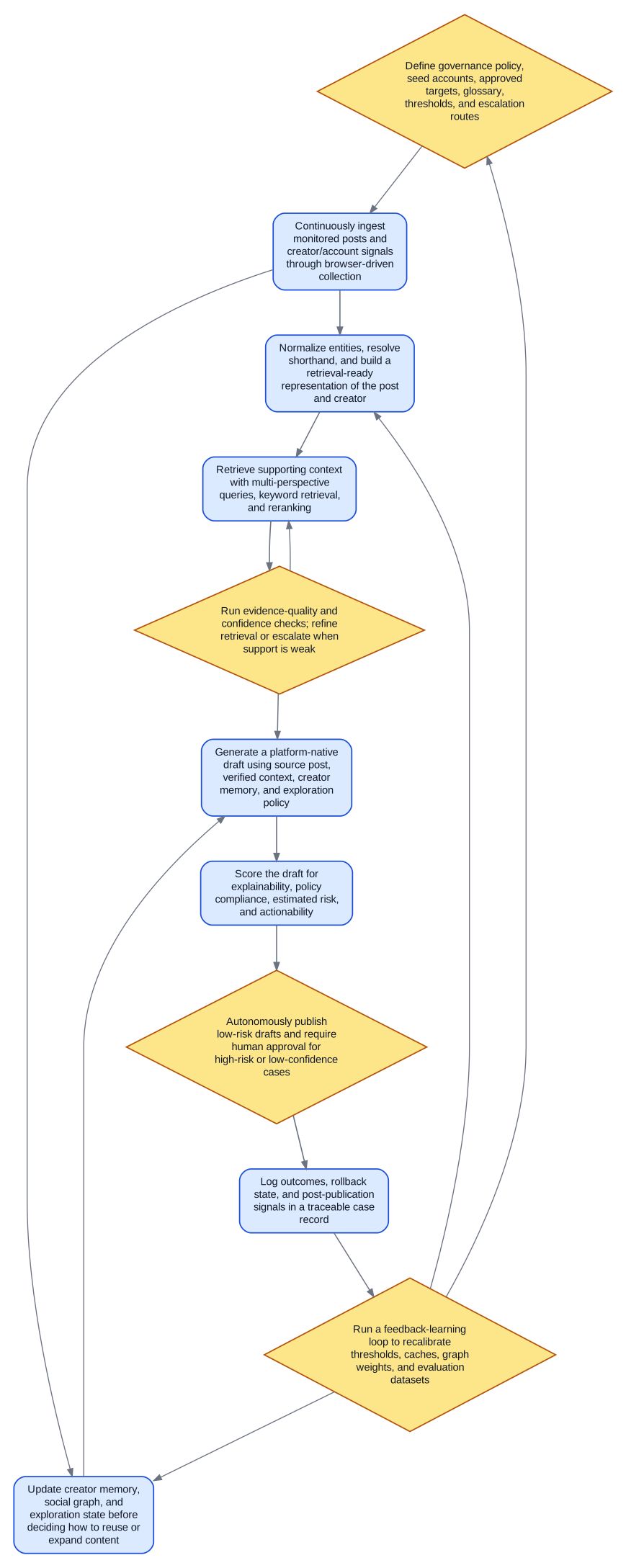
Operationally, the key change is that the system no longer jumps from “new post detected” straight into a loosely judged rewrite. It first normalizes finance terms and creator context, then retrieves evidence through multiple complementary queries, reranks the results, and scores whether the support is strong enough. If evidence is weak, the workflow loops back into retrieval refinement or routes the case to a human. If the support is strong, the local model generates a platform-native draft with explicit provenance, after which a risk-and-explainability layer decides whether the case may be auto-published or must wait for approval. The result is more automation, fewer human professional errors, far less internal communication, and faster output without treating speed as a license to lower standards.
5. One Workflow Walkthrough
When a monitored finance influencer posted a short market comment with jargon and an attached chart, the new system first captured the text, media, timestamp, engagement snapshot, and account metadata through its browser-driven collector. It then expanded shorthand terms, attached the creator’s historical profile and audience tags, and generated several retrieval queries instead of relying on a single context guess. After reranking the retrieved support, the QA layer found that the first pass was only moderately supported, so the case looped once into broader retrieval before generation. With stronger support assembled, the local model produced a 小红书-ready draft, adapted tone and hashtags to the destination platform, and attached evidence IDs and a rationale summary. Because the source account was high-reach, the draft was routed to human approval rather than auto-posted. A manager reviewed the evidence summary rather than rebuilding the case from scratch, approved the draft, and the system published it, logged the full trace, and updated creator-memory and performance records for future runs.
6. Results
- Baseline period: Reconstructed pre-improvement operating model based on the old workflow
- Evaluation period: Redesigned target-state operating model based on the new workflow
- Workflow scope/sample: End-to-end handling of monitored finance posts, cross-platform rewriting, publication, and influencer-network expansion
- Process change: Routine work moves from a serial five-stage human relay to an exception-based flow in which most cases can proceed autonomously after policy setup, while only high-risk or low-confidence items require approval
- Decision/model change: Loose or lightly judged context selection is replaced by normalization, multi-query retrieval, reranking, confidence scoring, explicit uncertainty handling, and creator-memory support
- Business effect: The redesign is expected to shorten response time, cut avoidable human professional errors, reduce staff-to-staff communication overhead, and maintain higher content quality even while throughput rises
- Evidence status: Workflow-grounded design estimate; no production KPI time series was supplied for this rewrite
The most defensible measured change at the workflow level is structural rather than numeric: the system reduces mandatory human coordination points and concentrates management attention on policy and exceptions. The strongest quality improvement comes from replacing ad hoc context choice with evidence-backed retrieval and thresholded escalation. That is the mechanism by which the business gets both speed and consistency.
7. What Failed First and What Changed
The weakest part of the earlier design was the context step. Once a post had been captured, the workflow could move too quickly from “context match” to “rewrite,” which made quality sensitive to whoever chose the reference article and how well they interpreted platform tone under time pressure. That produced rework, inconsistent angles, and more manager intervention than the team wanted. The improvement was not merely “use a better model.” It was to insert normalization, multi-query retrieval, reranking, confidence checks, and explicit escalation before drafting. The remaining limitation is that source-platform behavior, moderation rules, and anti-ban constraints can still change suddenly, so high-risk cases still need human oversight.
8. Transferable Lesson
- If a workflow mixes monitoring, retrieval, generation, and publishing, the real bottleneck is usually not raw content generation but the hidden human coordination between those stages.
- Better agentic design comes from moving humans to policy, thresholds, and exceptions rather than leaving them inside every routine handoff.
- Faster response only becomes sustainable when evidence quality, uncertainty handling, and audit logging are part of the workflow itself rather than after-the-fact checks.
This case shows that agentic AI works best when the business problem is a recurring operational loop with many small judgments, frequent exceptions, and costly human coordination between otherwise simple tasks.