TL;DR for operators
The most revealing moment in this study is not that GPT-5.1 moved a robot toward a plush penguin. After the robot struck the target, the model reversed to regain visual perspective, saw that the penguin was still upright, commanded another strike, then reversed again to verify the result.
That sequence suggests something more operationally relevant than one-shot visual command generation: the controller retained a task state across several actions, interpreted the likely consequence of a collision, gathered new evidence, and corrected its plan.
A second run provides a different diagnostic signal. After forward motion pushed a previously visible penguin outside the camera frame, GPT-5.1 inferred that the target should still lie off-frame to the left and rotated left to reacquire it.
For robotics product teams, these observations justify testing general-purpose multimodal models as high-level closed-loop controllers above tightly constrained motor execution. They do not justify removing conventional collision protection, sensing redundancy, or low-level control. The experiment covers one model, ten trials, two related missions, and no comparison baseline. Most importantly, previous images and reasoning traces were continuously supplied back to the model, so the study cannot determine whether the observed persistence comes from a distinct internal world model or from reasoning over externally retained interaction history.
The revealing behavior happened after the robot acted
Consider a simple physical-control problem. A robot sees an object, moves, and the object disappears from view. It now has to infer where the object went relative to its own movement. Or the robot hits something and must decide whether the physical goal was actually achieved.
Those are different problems from recognizing an object in an image. They require the controller to carry task-relevant information across actions and use new observations to update what it believes about the environment.
Spinelli and Martins test whether GPT-5.1 can do this while directly controlling a differential-drive robot.1 The model had no embodiment-specific, simulation, or sensorimotor training of the kind considered in the study. At each control cycle it received a first-person camera image, mission context, and accumulated prior images and reasoning traces. It then selected from a constrained action vocabulary: move forward, reverse, or rotate.
That architecture turns the experiment into a test of closed-loop behavior rather than isolated image interpretation.
Two traces are more informative than the success rate
The aggregate results are modest. GPT-5.1 completed four of five touch missions. In five harder knock-down trials, it achieved two full successes, one partial outcome, and two failures.
Those numbers establish that the system could sometimes perform the task. They say much less about how it did so.
Two run-level traces carry more diagnostic weight.
In one touch run, the penguin had been visible to the robot’s left. The robot then moved forward far enough that the target disappeared from the frame. GPT-5.1 inferred that the object should remain off-frame to the left and rotated in that direction to reacquire it. The significant behavior is not object recognition itself; it is preservation of a relative spatial relationship after self-motion.
The knock-down sequence probes a different capability. After apparent contact, GPT-5.1 did not simply declare success. It reversed to obtain another view, observed that the penguin remained upright, initiated another strike, and reversed again to inspect the result.
That sequence has the structure of an action-verification loop:
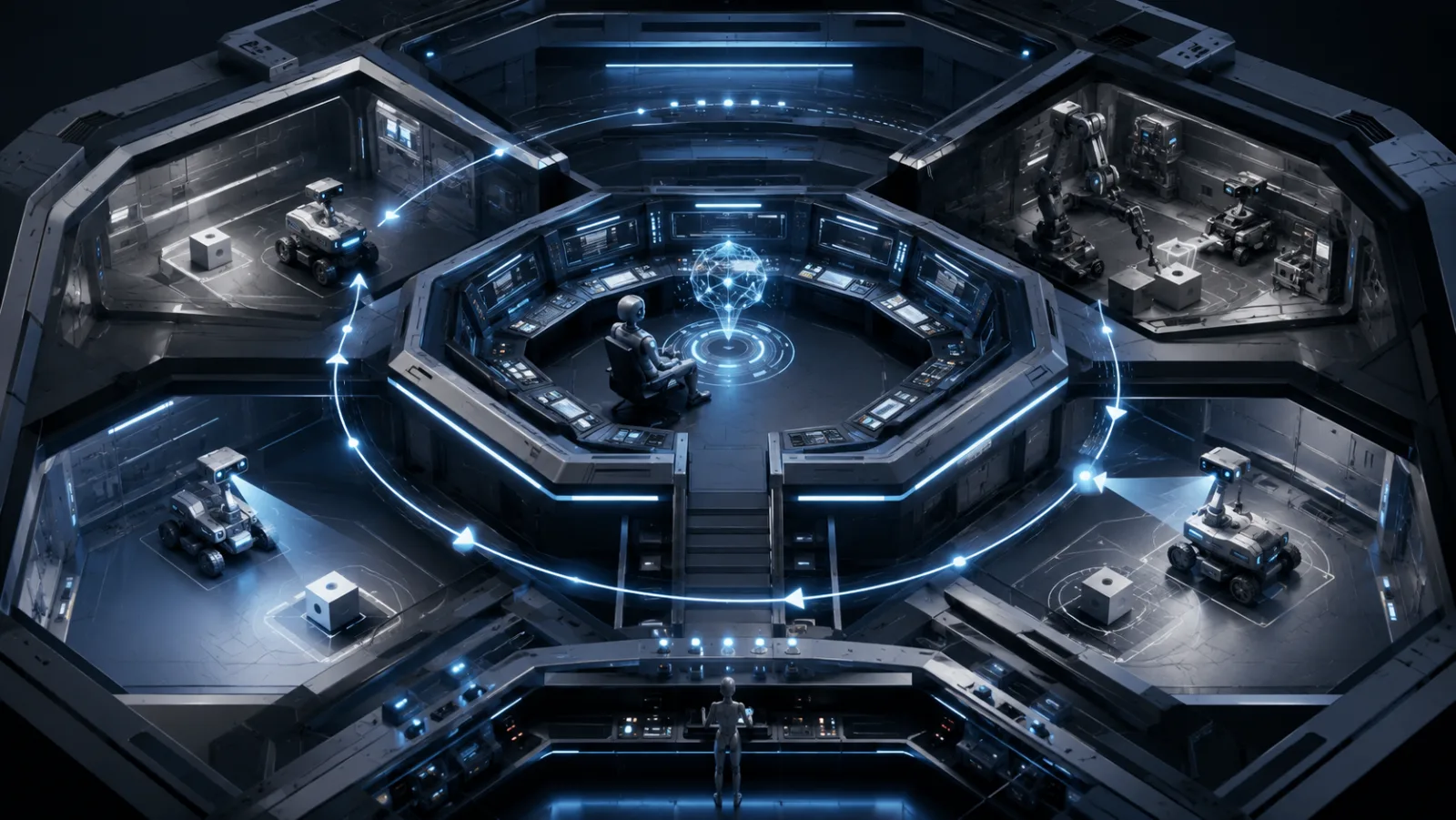
observe → act → infer consequence → inspect → correct → verify
A system that repeatedly follows this pattern can recover from some execution uncertainty without requiring every physical contingency to be encoded as a fixed script.
What the experiment supports—and what it does not
The authors interpret these behaviors as being consistent with a world-model-like capability: a representation that helps an agent keep track of environmental structure and anticipate how actions may change it.
The paper supports the narrower behavioral claim more strongly than the architectural one.
| Observation | What it supports | Operational meaning | Boundary |
|---|---|---|---|
| Target recovered after leaving the camera frame | Short-horizon spatial persistence across self-motion | High-level controller can sometimes reason beyond the current frame | Prior images and reasoning traces remained in context |
| Reverse-inspect-restrike sequence | Action-outcome reasoning and explicit verification | Controller can use observation to correct physical action | Demonstrated in selected qualitative traces |
| 4/5 touch successes | Basic goal-directed closed-loop control | General multimodal control is feasible in a constrained prototype | One failure came from getting stuck without tactile sensing |
| 2/5 full knock-down successes, 1/5 partial | Some capability on a harder physical task | Physical interaction is possible but unreliable | Two trials failed to find the target |
The central unresolved question is therefore not whether GPT-5.1 produced behavior compatible with state tracking. It did.
The unresolved question is where that state lives and how general it is.
Because the system explicitly re-supplied previous images and reasoning traces at every cycle, the study does not isolate an internal representation from inference over an external interaction history. There is also no memory ablation, comparison architecture, or alternative model against which to judge the behavior.
Calling the result proof of a distinct internal world model would therefore go beyond the experiment.
The failures show where a robotics stack still has work to do
The controller’s weaknesses are as informative for deployment as its strongest traces.
GPT-5.1 often approached the target inefficiently, alternating forward motion with small rotations rather than aligning cleanly first. The resulting spiral-like paths indicate that competent high-level reasoning does not automatically produce efficient motion planning.
Perception was also fragile. In one detailed run, after losing sight of the original target, the model adopted a distant distractor penguin instead. That limits stronger claims about persistent object identity.
One touch trial failed when the robot became stuck against a table leg. The robot had no tactile sensing, so the controller lacked an observation channel that could directly reveal the obstruction.
These failures point to a division of responsibility. A multimodal model may handle semantic state, goal interpretation, coarse navigation decisions, and post-action verification while conventional systems continue to enforce collision limits, local motion constraints, obstacle detection, and other execution guarantees.
The product opportunity is higher-level control, not stack replacement
Cognaptus infers a practical architecture worth testing from these results: place a general multimodal model above constrained motor execution rather than asking it to replace the full robotics stack.
The affected user is a robotics team prototyping systems in environments where goals are semantically rich but low-level actions can be bounded. The affected decision is whether to train a dedicated embodied policy for every new prototype or allow a general model to handle portions of high-level state tracking and corrective planning.
The study weakly favors experimentation with the second option under narrow conditions.
A sensible prototype would preserve the loop demonstrated here—observe, act, verify, correct—while adding independent safeguards that do not depend on the language model’s interpretation. Collision detection, tactile or proximity sensing, motion envelopes, and execution-level limits become especially relevant because the reported failures already show that visual-semantic reasoning alone does not resolve every physical state.
The implication is architectural rather than model-specific: some robotics intelligence may be delegated upward to general multimodal reasoning without requiring that every useful behavior first be learned through a dedicated embodied policy.
Ten trials cannot answer the generality question
The study is exploratory by design. Only GPT-5.1 was evaluated. The sample contains ten trials across two closely related missions involving the same robot and target type. There is no comparison model, no control architecture, and no ablation removing accumulated interaction history.
The visual observations were also low-resolution, compressed, noisy, and sampled as a single static frame per action cycle. The robot lacked tactile sensing. Those constraints both create genuine difficulties and make it harder to determine which failures belong to the model versus the embodiment.
The next research step should therefore focus less on accumulating additional success demonstrations and more on discriminating among explanations.
Remove or vary interaction history. Compare models. Change embodiments and object classes. Introduce controlled target disappearance and self-motion. Measure whether the controller predicts where objects should reappear. Test whether action-verification behavior survives changes in task wording and environmental layout.
Those experiments could separate a compelling behavioral demonstration from a reproducible capability.
What changed after this experiment
Before these trials, a conservative view would treat a general multimodal model attached to a robot primarily as a vision-and-command interface.
The reported traces justify a somewhat stronger hypothesis. Given persistent interaction context and a constrained action space, such a model may be able to maintain short-horizon spatial relationships, reason about the consequences of its own actions, and deliberately gather new observations when physical outcomes remain uncertain.
That is enough to change a prototyping decision.
It is not enough to settle the world-model question.
Cognaptus: Automate the Present, Incubate the Future.
-
Roberto Spinelli and Thiago C. Martins (2026). Embodied GPT-5.1: Evidence of a World Model?. arXiv:2607.23899. https://arxiv.org/abs/2607.23899 ↩︎