TL;DR for operators
A room-tour video is a deceptively simple test for a video model. The objects do not explode, the camera does not enter a car chase, and nobody asks the model to perform cinematic philosophy. The hard part is duller and therefore more operationally relevant: the model must remember where things were, how rooms connected, what changed, and which earlier view matters now.
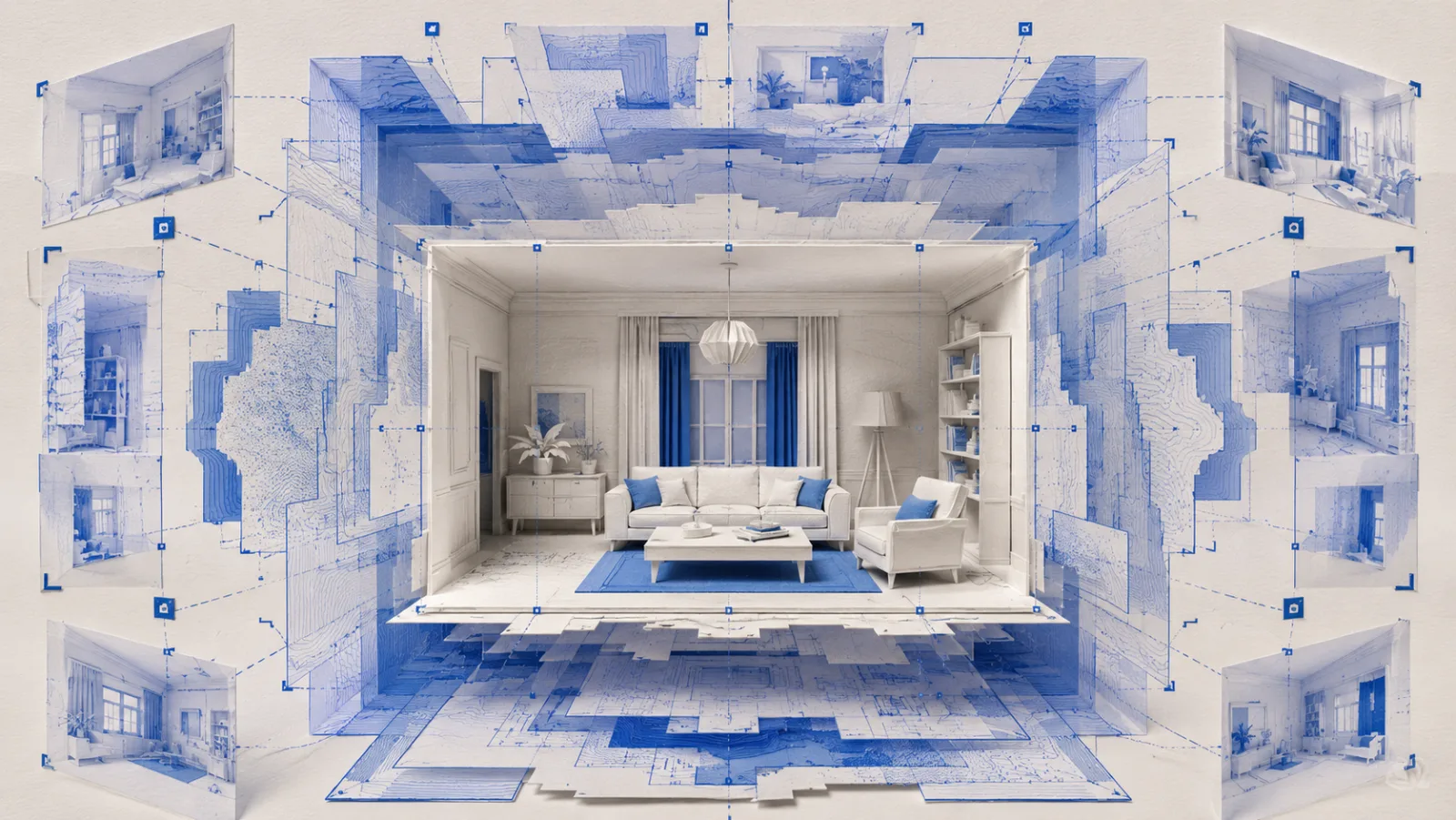
LongSpace argues that this is not solved by throwing more frames into a longer context window. The paper introduces LongSpace-Bench, a benchmark of 445 real indoor room-tour videos, roughly 159 hours of footage, and 4,073 question-answer pairs covering scene perception, spatial relations, and spatial memory. It also proposes LongSpace, a video MLLM framework that processes long videos as chunks, injects 3D spatial structure into early decoder layers, stores compressed layer-aware KV memories, and retrieves question-relevant evidence at answer time.1
The business translation is straightforward, though not magical. If an enterprise wants video agents for facilities, real-estate diligence, inspection review, embodied assistance, robotics support, or long-form operational monitoring, the agent needs a memory system that preserves spatial evidence in a usable form. “We support long context” is not a memory strategy. It is a receipt.
The result worth caring about is not just that LongSpace-9B scores 49.2 overall on LongSpace-Bench and 70.8 on VSI-Bench. The interesting result is where the gains appear: Appearance Order, State Change, Route Recall, and longer videos. The ablations say the quiet part clearly: organization beats capacity. Layer-aware, role-specific memory matters more than simply increasing the amount of stored memory.
The boundary is equally clear. This is mostly passive indoor room-tour video. It is not proof of active navigation, outdoor spatial reasoning, object manipulation, robotic safety, or autonomous-driving readiness. Some proprietary models still beat LongSpace on scene classification, scene consistency, relative distance, egocentric reasoning, and route planning. LongSpace is not the final spatial intelligence machine. It is a useful reminder that memory has structure, and models that ignore that structure pay for it later.
The problem is not seeing the room; it is remembering the room correctly
A video model can recognize a sofa, a staircase, or a kitchen counter from a single frame. That is useful, but it is not the problem LongSpace is built around.
The real problem begins after the camera moves on. The model may later be asked which room came before the hallway, whether a door was on the left or the right, whether the table was moved, which path connects the entrance to the bedroom, or what object appeared after the viewer passed the stairs. These are not just object-recognition questions. They require spatial evidence to survive time.
That phrase matters. In ordinary video understanding, time often means event order: first someone opens the fridge, then they pour the milk, then the model gets bored but continues politely. In long-horizon spatial reasoning, time is tied to layout. A scene observed ten minutes ago may define the route being recalled now. A viewpoint change may alter whether “left” still means anything. A stable object relation may matter even when neither object is visible in the current frame.
The authors frame this as long-horizon spatial memory: the ability to retain, organize, retrieve, and use spatial evidence across prolonged visual observations. The important word is not “retain.” It is “organize.” Retaining everything is how systems become expensive, slow, and oddly bad at finding the one thing they retained everything for.
LongSpace’s central correction is therefore not glamorous. It says that long-video spatial reasoning needs a memory architecture, not a bigger visual landfill.
LongSpace-Bench makes spatial memory measurable instead of merely admired
Before the model, the paper builds the test. This is the correct order. A field cannot improve a capability it keeps describing with hand gestures.
LongSpace-Bench is constructed from real-world YouTube indoor room-tour videos. The authors retain clips containing layout, object-position, viewpoint-change, and route evidence. Annotators then create questions, candidate answers, and ground-truth answers under a task taxonomy. Samples are filtered out when answers are ambiguous, require external commonsense knowledge, depend on heavily occluded objects, or contain conflicting options.
The resulting benchmark contains:
| Benchmark property | LongSpace-Bench value | Why it matters |
|---|---|---|
| Videos | 445 | Enough scale to compare model behavior across many room-tour layouts, not just a few curated examples. |
| Total duration | ~159 hours | Long enough to test memory over extended observation, not merely short-clip recognition. |
| QA pairs | 4,073 | Sufficient question volume to split across task categories and video lengths. |
| Average video duration | 21.4 minutes | Much longer than the representative video spatial benchmarks compared in the paper, which sit around 0.6 to 1.6 minutes. |
| Task types | 10 | Covers perception, relation, and memory rather than one narrow spatial trick. |
| Answer format | Numerical for object counting; multiple choice otherwise | Useful for controlled evaluation, though not the same as open-ended operational deployment. |
The ten task types are grouped into three levels:
| Ability group | Tasks | What the model must do |
|---|---|---|
| Scene perception | Object Counting, Scene Classification, Scene Consistency | Understand stable visual and scene-level evidence. |
| Spatial relationship | Relative Distance, Relative Orientation | Infer distance and direction under changing viewpoints. |
| Spatial memory | Appearance Order, State Change, Egocentric Reasoning, Route Planning, Route Recall | Preserve and retrieve spatial evidence across the full observation sequence. |
This taxonomy is the first useful contribution. It prevents the usual category error: treating “spatial reasoning” as one capability. It is not. Counting objects, judging orientation, recalling a route, and deciding whether the scene changed are different demands. Lumping them together produces the kind of benchmark score that looks tidy and teaches little. A familiar achievement in AI evaluation, sadly.
The benchmark also gives the article its mechanism-first logic. If the question is memory-heavy, the model needs preserved evidence. If the question is relation-heavy, it needs geometric structure. If the question is scene-level, stronger semantic recognition may be enough. Different task types should reward different internal machinery. LongSpace-Bench is designed to expose that separation.
The mechanism: perception writes structure, memory preserves evidence, retrieval answers the question
LongSpace has two main technical parts: Spatial Structure Perception and Hierarchical KV Memory.
The first part strengthens local perception. The system starts from Qwen3-VL-8B and adds 3D spatial tokens from a geometry encoder. These spatial features are pooled, length-aligned, normalized, and fused into decoder-side visual states. The key design choice is that the 3D spatial stream is not simply merged once at the input and then left to dissolve into the model’s usual machinery. Instead, geometry is injected into visual-token positions in early decoder layers through a gated residual update.
That sounds like implementation detail. It is not just plumbing. It tells us what the authors think the model lacks: not more pixels, but better structural signals about depth, orientation, and layout before the memory system starts preserving anything. Bad local spatial representations stored faithfully are still bad. Memory does not launder weak perception into intelligence. It just preserves the crime scene.
The second part is the real center of the paper. Hierarchical KV Memory processes a long video as ordered chunks. For each chunk, it stores selected key-value states, position indices, and hidden features inside decoder layers. The memory is not flat. Layers are assigned different roles:
| Memory role | What it is intended to preserve | Operational interpretation |
|---|---|---|
| Sensory memory | Fine-grained visual and spatial evidence | Keep local details that may matter later. |
| Working memory | Object bindings, local relations, recent changes | Maintain short-term structure inside the current segment. |
| Long memory | Stable temporal anchors and scene cues | Preserve route-level and scene-level evidence across long gaps. |
The update process scores candidate memory entries using four signals: feature salience, adjacent feature difference for state change, temporal anchors for coverage, and recency. When memory exceeds its budget, the system keeps recent or high-scoring entries in raw form and compresses the rest in temporal order. Position information is retained, so the memory does not become a bag of visual impressions with amnesia and confidence.
At question time, the model encodes the question and retrieves relevant evidence from the stored hierarchical memories. For sensory and working memories, it does sparse top-ranked reading over stored positions. For long memory, it uses a coarse-to-fine strategy: first find relevant segments using summaries or prototypes, then retrieve compact KV entries from them. The retrieved KV states are injected as a frozen memory prefix during decoding, without changing the attention operator.
The mechanism can be reduced to this:
long video
  -> ordered chunks
  -> geometry-aware local representations
  -> layer-aware memory entries
  -> question-guided retrieval
  -> answer grounded in selected spatial evidence
That is the paper’s thesis in operational form. Spatial intelligence is not only a property of the model backbone. It is also a property of how observations are written, compressed, indexed, and read.
The main results say memory helps most when memory is actually needed
The paper evaluates LongSpace on standard spatial reasoning and on the new long-horizon benchmark. These are not the same test, and the distinction matters.
On VSI-Bench, a standard video spatial reasoning benchmark, LongSpace-9B reaches an average score of 70.8. The paper reports gains of 22.4 points over InternVL3-78B, 12.9 points over Qwen3-VL-8B, and 7.9 points over Cambrian-S-7B. This result mainly supports the benefit of geometry-aware perception and spatial tuning for more conventional spatial estimation tasks.
But VSI-Bench is not the main business-relevant evidence for long-horizon memory. It is closer to a local competence check: can the system perceive and reason spatially before we ask it to remember a long tour? Useful, but not sufficient.
The more interesting test is LongSpace-Bench. There, LongSpace-9B reaches 49.2 overall, ahead of Qwen3-VL-32B at 46.5, Gemini-3-Pro at 45.3, Qwen2.5-VL-72B at 44.2, Cambrian-S-7B at 40.5, and VLM-3R-7B at 40.2.
| Model | LongSpace-Bench overall | Interpretation |
|---|---|---|
| LongSpace-9B | 49.2 | Best overall score in the reported comparison. |
| Qwen3-VL-32B | 46.5 | Strongest open-source baseline reported by the authors. |
| Gemini-3-Pro | 45.3 | Strong proprietary baseline; still wins several subcategories. |
| Qwen2.5-VL-72B | 44.2 | Large general model, competitive but below LongSpace overall. |
| Cambrian-S-7B | 40.5 | Spatial-centric model, behind LongSpace by 8.7 points. |
| VLM-3R-7B | 40.2 | 3D-aware model, behind LongSpace by 9.0 points. |
The overall score is only half the story. LongSpace-9B is strongest on Appearance Order at 52.5, State Change at 44.9, and Route Recall at 51.8, and it ties the best score on Relative Orientation. These are exactly the places where preserved spatial evidence should matter.
That alignment between mechanism and result is what makes the paper more convincing than a leaderboard entry. If LongSpace had improved everything uniformly, the story would be less informative. Uniform gains often mean “better model, better training, more compute, please admire our bar chart.” Here, the gains concentrate where the proposed memory system should help.
The negative evidence is also useful. Gemini-3-Pro remains stronger on Scene Classification, Scene Consistency, Relative Distance, Egocentric Reasoning, and Route Planning. That means LongSpace does not dominate all spatial cognition. Its memory mechanism appears especially useful for tasks where earlier observations must be retrieved across time. It is less clearly superior when the task depends on strong scene recognition, higher-level planning, or model-scale reasoning.
A practical reader should not miss this. LongSpace is evidence for structured memory, not evidence that a 9B specialized model beats every frontier system at all spatial behavior. The paper does not ask for that interpretation, and neither should we donate it.
The ablations are the argument, not the appendix decoration
The ablations are where the paper becomes more useful for builders. They separate three questions that are often blurred together:
- How much geometry should be injected?
- Does long-memory inference beat simple frame sampling?
- Does memory organization matter more than memory capacity?
The answer to the first is restrained. Injecting geometry into 8 decoder layers gives the best average score across VSI-Bench, CV-Bench, and SPAR-Bench: 72.4. Using 12 layers is nearly identical at 72.3. More is not monotonically better: 24 layers drops the average to 71.3, despite giving the highest SPAR-Bench score in that comparison. This is a sensitivity test, not a second thesis. It says geometry helps when placed moderately and early; saturating the model with spatial updates does not automatically improve reasoning. Apparently, even geometry can become managerial overhead.
The second answer is stronger. On LongSpace-Bench, uniform sampling with 32 frames scores 36.1, while a recent-window inference setup scores 37.7. Long-memory inference reaches 49.2. The gain over uniform sampling is 13.1 points, and the advantage grows with video length: +4.8 for short videos, +12.8 for medium videos, and +15.1 for long videos.
This is the cleanest evidence for the paper’s central claim. If relevant observations are close together, memory helps but is not transformative. If evidence is separated by longer temporal gaps, structured memory becomes much more valuable. That is exactly the expected shape if the mechanism is doing real work.
The third answer is the most operationally important. The authors compare layer-agnostic and layer-aware memory. Layer-agnostic memory scores 41.8 overall, while layer-aware memory reaches 49.2. Removing hierarchical roles also damages performance: without the working role, the score falls to 35.8; without the long-memory role, it falls to 34.8. Meanwhile, the reported read-capacity and bank-capacity variants stay around 35.8–35.9 in the paper’s component ablation.
The lesson is blunt: the memory system does not win merely because it stores more. It wins because it stores different kinds of evidence in different representational places and retrieves them under a question condition.
| Test or figure | Likely purpose | What it supports | What it does not prove |
|---|---|---|---|
| Benchmark comparison table | Comparison with prior work | LongSpace-Bench targets longer, multi-dimensional spatial memory than common image or short-video benchmarks. | It does not prove the benchmark covers all spatial intelligence. |
| LongSpace-Bench main results | Main evidence | LongSpace improves overall long-horizon spatial memory performance, especially on memory-heavy tasks. | It does not show dominance over proprietary models on every task. |
| VSI-Bench results | Comparison with prior work and supporting evidence | Geometry-aware perception improves standard spatial reasoning. | It is not itself the strongest evidence for long-horizon memory. |
| Geometry-injection layer study | Robustness/sensitivity test | Moderate early geometry injection works best; more layers are not automatically better. | It does not identify a universal optimal layer count for all backbones. |
| Uniform sampling vs recent window vs long memory | Main evidence / ablation | Structured memory beats naive sampling, especially as videos get longer. | It does not isolate every possible retrieval design alternative. |
| Layer-aware and role-removal ablations | Ablation | Memory organization and hierarchical roles matter more than capacity alone. | It does not prove this exact hierarchy is globally optimal. |
| Evidence localization heatmap | Exploratory qualitative extension | LongSpace can focus on sparse question-relevant evidence across long videos. | A heatmap is not a full causal audit of reasoning. |
| Appendix data and annotation protocol | Implementation detail / benchmark validity support | The benchmark filters ambiguity and grounds questions in video evidence. | It cannot eliminate all dataset bias or shortcut opportunities. |
This table is where the paper should be read with adult supervision. The main result gives the score. The ablations explain why the score matters.
The business lesson is queryable memory, not heroic ingestion
For operators, LongSpace is not mainly a paper about room tours. It is a paper about how video evidence should be made available to a model that must answer later questions.
That matters in several enterprise settings.
In real-estate diligence and facilities management, teams increasingly have long visual records: walkthroughs, inspections, maintenance videos, renovation documentation, safety checks, and tenant turnover footage. A useful assistant should answer questions such as: Where was the leak visible? Did the second-floor corridor show emergency signage? Which rooms had exposed wiring? Was the staircase connected to the rear exit or the lobby? These are spatial-memory questions disguised as ordinary video QA.
In robotics and embodied assistance, a model may need to remember previously observed layout evidence before deciding how to interpret the current view. LongSpace does not solve active navigation, but it points to a useful architectural requirement: perception must create structured spatial evidence, and memory must preserve it in a way downstream policies or assistants can query.
In inspection and compliance review, repeated video queries are common. The appendix notes that LongSpace constructs video memory once and can reuse it for multiple questions from the same video. That is operationally relevant. If a 40-minute walkthrough needs to support many follow-up checks, recomputing or reprompting the full visual record for every question is not just inefficient; it invites inconsistent evidence use.
In autonomous-driving support, the paper should be interpreted carefully. The authors mention autonomous driving as a long-horizon spatial-memory application area, but the benchmark evidence is indoor passive room-tour video. The transferable lesson is architectural: retain and retrieve spatial evidence over time. The non-transferable leap is to treat a room-tour benchmark as validation for road safety. That leap should be left to pitch decks, where evidence goes to retire.
The practical framework looks like this:
| Paper result | Cognaptus inference for business use | Boundary |
|---|---|---|
| LongSpace-Bench exposes memory-heavy spatial failures | Evaluate video agents on recall, route, state-change, and relation tasks, not only frame-level description. | Indoor room tours are not the whole operating world. |
| Geometry-aware perception improves standard spatial reasoning | Add structural cues when the task depends on layout, depth, orientation, or route relations. | The paper does not prove every 3D encoder or fusion method will help. |
| Layer-aware HKM beats layer-agnostic memory | Treat memory as typed infrastructure, not a flat transcript of frames. | The exact sensory/working/long split is one design, not a universal standard. |
| Long-memory gains grow with video length | The ROI of memory systems rises when evidence is temporally dispersed. | Short clips may not justify the same complexity. |
| Memory can be built once and reused across questions | For review workflows, persistent video memory may reduce repeated encoding and improve consistency. | The paper reports the protocol, not a production cost benchmark. |
The most useful enterprise takeaway is therefore not “use LongSpace.” It is: build evaluation and architecture around evidence retrieval. A video agent that cannot say which earlier segment supports its answer is not a spatial assistant. It is a confident tourist.
Where the paper is strong, and where the floorboards still creak
LongSpace is strongest when interpreted as a mechanism-plus-benchmark paper. It identifies a missing evaluation target, builds a benchmark around it, proposes an architecture aligned with the target, and uses ablations to show that the alignment matters.
The boundary conditions are not minor.
First, the benchmark is primarily indoor room-tour video. That is a reasonable domain for long-horizon spatial memory: rooms, corridors, layouts, object arrangements, route transitions. It is also a constrained domain. Outdoor environments introduce scale, weather, occlusion, dynamic agents, road topology, signage, and changing visibility. Industrial environments introduce repetitive structures and safety-critical details. A model that remembers a bedroom route may still behave badly in a warehouse or at a construction site. Shocking, I know.
Second, the tasks are observation-based. The model passively watches video. It does not choose where to look next, update a map through active exploration, manipulate objects, or handle closed-loop control. That keeps the benchmark clean, but it also limits deployment interpretation. Active agents need memory plus action policy, uncertainty handling, localization, and safety constraints.
Third, most tasks use multiple-choice answers. This enables controlled scoring and reduces evaluation ambiguity, but it is not the same as open-ended operational reporting. In business workflows, users often ask messy questions with missing context, ambiguous references, and compliance consequences. Multiple choice is useful scaffolding, not the finished building.
Fourth, the model comparisons use different input protocols because the evaluated systems have different practical interfaces and constraints. Proprietary models, open-source long-video models, spatial-centric models, and LongSpace do not all receive identical inputs. The paper is transparent about this, and it reflects real deployment constraints. Still, it means the leaderboard should be read as a practical comparison, not a perfectly controlled anatomy lesson.
Finally, LongSpace does not erase the advantage of stronger general models. Gemini-3-Pro remains ahead in several task categories. This matters because spatial memory is only one ingredient in video intelligence. Scene recognition, planning, reasoning, and instruction following still matter. The winning enterprise system may combine frontier-model reasoning with explicit spatial memory infrastructure, rather than pretending one component has eaten the whole stack.
The quiet shift: from video context to video memory
The paper’s deeper value is conceptual. It shifts the unit of design from context length to memory usability.
Long context asks: how much can the model ingest?
Spatial memory asks: what should be preserved, where should it live, how should it be compressed, and how should a later question retrieve it?
That shift is not academic ornament. It changes how teams should evaluate products. A vendor claiming long-video understanding should not only show that the system accepts a long upload. It should be tested on questions where the answer depends on evidence that appeared far apart, under viewpoint changes, with distractors, and across repeated queries. The model should not merely summarize the tour. It should remember the house.
LongSpace-Bench gives one way to test that. LongSpace gives one architecture for improving it. The result is not a finished enterprise platform. It is a useful piece of architectural evidence: long-horizon video agents need spatial memory that is structured, queryable, and selective.
The model does not need to watch everything forever. It needs to remember the right things well enough to answer later.
That is less romantic than “world models.” It is also more useful.
Cognaptus: Automate the Present, Incubate the Future.
-
Shiqiang Lang, Jing Liu, Haoyang He, Peiwen Sun, Yuanteng Chen, Tao Liu, Lan Yang, Longteng Guo, and Honggang Zhang, “LongSpace: Exploring Long-Horizon Spatial Memory from Perception to Recall in Video,” arXiv:2606.05677v1, 4 June 2026, https://arxiv.org/abs/2606.05677. ↩︎