TL;DR for operators
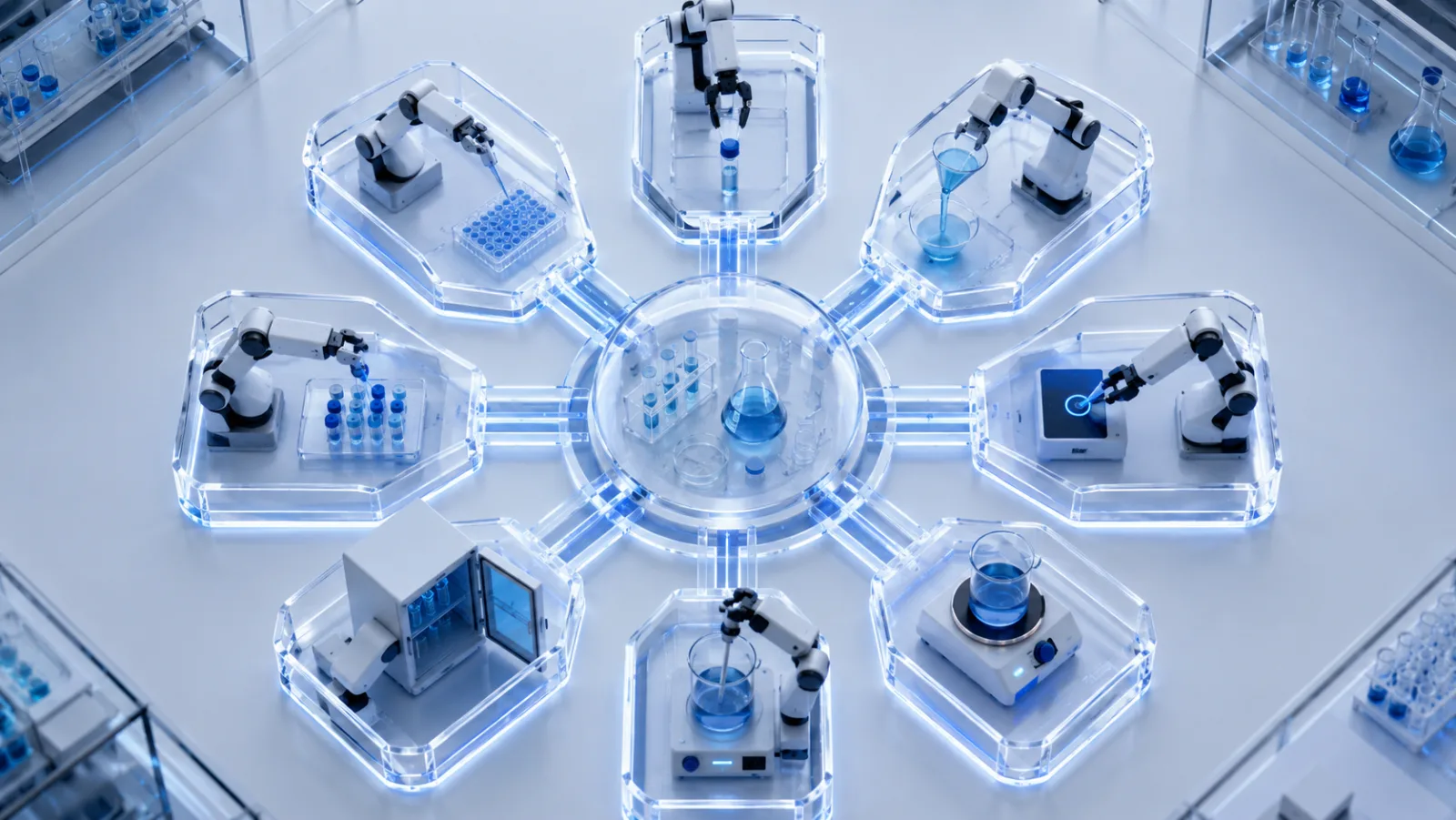
LabVLA is best read as an operating system for laboratory robot supervision, not as another paper claiming the robot scientist has arrived. The authors argue that laboratory automation is constrained by data and embodiment: most vision-language-action models have learned household and tabletop manipulation, but not pipettes, beakers, heaters, transparent liquids, instrument buttons, protocol steps, or the awkward fact that different robots have different bodies.1
The paper’s mechanism is the interesting part. RoboGenesis builds synthetic laboratory environments, composes fixed procedures from atomic skills, randomizes scenes and robot profiles, filters failed rollouts, and exports richly annotated demonstrations. LabVLA then trains a Qwen3-VL-based policy with FAST action-token pretraining, flow-matching posttraining, and a stop-gradient design the authors call knowledge insulation.
The main result is strong but bounded. On LabUtopia, LabVLA reports the highest average success rate among evaluated baselines: 71.1% in-distribution and 70.0% out-of-distribution. It also improves a smaller X-VLA model when LabEmbodied-Data is added, suggesting the synthetic laboratory data has value beyond the authors’ own architecture. A real-robot Franka study shows competitive performance on four benchtop tasks, but this is still a limited validation setting.
For business readers, the path is not “AI scientist replaces lab staff.” That interpretation is both lazy and, charmingly, wrong. The nearer opportunity is supervised Level-2 technician-like execution: repetitive preparation, simple instrument interaction, controlled transfers, and observation-support workflows where protocol structure is known in advance. The unresolved parts are exactly the expensive ones: safety, contamination control, real reagents, measurement awareness, long-horizon recovery, and judgment under uncertainty.
The bench is not a chatbot with arms
Laboratory automation has a familiar fantasy: write a protocol, press a button, and let the robot do science. It is a comforting idea, especially for anyone who has spent too much time watching a human operator perform a repetitive bench procedure with the emotional texture of a printer jam.
LabVLA starts from a less theatrical premise. The difficulty is not that AI systems cannot read scientific text. They increasingly can. The difficulty is that reading a protocol and physically executing it live in different worlds. A sentence such as “transfer liquid to the beaker and heat the sample” hides object identity, container geometry, contact precision, liquid state, instrument affordances, workspace layout, camera viewpoint, robot kinematics, and the small tragedy of spilling things.
That is why the paper’s first contribution matters. It reframes scientific laboratory automation as a vision-language-action grounding problem where data and embodiment are bottlenecks, not merely as a model-design problem. Existing VLA models have broad manipulation priors, but the source paper argues that their supervision largely comes from household and tabletop settings. Scientific labs form a different scene family: instruments, transparent materials, fixed workflows, physical state changes, and cross-robot execution all matter.
The paper’s practical claim is therefore not “bigger VLA, better robot.” It is closer to: if the training distribution does not contain the laboratory world, the policy cannot be expected to behave like it understands the laboratory world. This is not deep mysticism. It is distribution shift wearing a lab coat.
RoboGenesis is the paper’s real factory
The easiest way to misread LabVLA is to jump to the benchmark table. The harder and more useful reading begins one layer earlier: the authors are building a data factory for laboratory behavior.
RoboGenesis, their programmable workflow and data engine, has three connected stages. First, it builds executable laboratory environments. Second, it generates agentic workflows from atomic skills and deploys them across robot profiles. Third, it exports successful rollouts as annotated LabEmbodied-Data.
That sequence is not decorative. Each stage solves a different failure mode in synthetic robot data.
| Pipeline stage | What it does | Why it matters operationally | What it does not guarantee |
|---|---|---|---|
| Environment building | Generates and validates lab assets, scenes, layouts, textures, and reachable workspaces | Prevents downstream training from inheriting obviously broken scenes | It does not prove real-world physical fidelity for every instrument or reagent |
| Workflow generation | Composes protocols from atomic skills such as pick, pour, place, stir, shake, press, open, close, and navigation | Makes fixed laboratory procedures reusable across scenes and robots | It does not create scientific judgment or adaptive protocol design |
| Domain randomization | Varies scene, clutter, camera, object, lighting, spatial placement, and instruction phrasing | Trains invariance to benign visual and spatial variation | It only helps if randomization preserves the task semantics |
| Success-filtered export | Keeps only rollouts that pass task-specific success checks and contact-safety monitors | Raises data quality and gives debugging signals | It can filter known failures, not every future real-world failure mode |
| Structured annotations | Adds robot state, camera metadata, step timing, object state, relations, success explanations, collisions, temporal segments, subgoals, quality scores, interventions, and episode metadata | Makes the data useful for protocol-aware VLA training rather than raw imitation alone | Annotation richness is not the same as validated lab safety |
The paper reports that RoboGenesis produced a LabAssetLibrary with 2,947 annotated assets, generated 10,000 laboratory scenes, and supports a robot profile pool spanning single-arm, bimanual, and mobile manipulator settings. The engine represents protocols as workflow templates with natural language instructions, named scene objects, target references, and ordered atomic skills. Composite workflows exceeding 20 skill steps reportedly still achieved collection success rates above 75%.
That detail matters because the system is not simply generating pretty lab rooms. It is creating executable supervision. A beautiful synthetic centrifuge is useless if the robot cannot reach it, the object roles are ambiguous, the task label lies, or the randomization quietly changes the protocol. RoboGenesis is designed around exactly those mundane constraints. The glamour is minimal. The leverage is not.
The data engine randomizes the room, not the experiment
Domain randomization is often treated as “add visual noise and hope reality becomes less rude.” RoboGenesis is more disciplined. The authors explicitly separate variation that should change from semantics that must not.
The engine can randomize scene layout, clutter, camera pose, compatible object appearance, lighting, spatial placement, and instruction phrasing. But a source beaker remains the source beaker. A heating button remains attached to the heating device. Clutter stays outside the task-object contract used for labels and bounding boxes.
This is the right distinction. In a laboratory, variation is useful only when it preserves the protocol. If randomization changes which container is the source, swaps the role of a reagent, or makes the target object ambiguous, the model is no longer learning robust execution. It is learning from corrupted supervision. That is not synthetic data. That is synthetic confusion, which is already available in generous quantities.
For business use, this is one of the more important design lessons in the paper. Synthetic process data is valuable when it preserves operational invariants. In a lab, those invariants are not just visual categories. They include role, state, sequence, affordance, reachability, and safety constraints.
LabVLA makes the VLM action-aware before asking it to control anything
Once RoboGenesis produces data, LabVLA handles the policy side. The architecture pairs a Qwen3-VL-4B-Instruct backbone with a DiT action expert. The combined model is described as 5B parameters. It observes RGB camera views, a language instruction, and robot state, then predicts a 50-step continuous action chunk.
The training recipe has two stages.
First, the model receives VLM pretraining with FAST action tokens. The reason is simple: a generic vision-language model has not learned action semantics. If a continuous control head is attached immediately, the action expert is trying to build motor behavior on top of representations that were never trained to mean “move this robot this way.” FAST tokenization converts continuous action chunks into discrete tokens, letting the VLM learn next-token prediction over action-like sequences before continuous action learning begins.
Second, LabVLA attaches the DiT action expert and trains with flow matching. FAST tokens give action awareness, but discrete action tokens are not ideal for smooth laboratory trajectories. Flow matching trains a vector field that maps noise into continuous action chunks. The paper emphasizes that inference uses 10 Euler steps, which is positioned as fast enough for closed-loop laboratory control.
The training sequence is therefore not arbitrary:
- Give the VLM a laboratory-aware visual-language-action prefix.
- Use FAST tokens to make action prediction legible to the VLM.
- Attach a continuous action expert.
- Use flow matching for smooth action chunks.
- Keep the VLM’s laboratory grounding from being damaged by control gradients.
The last point is the paper’s “knowledge insulation” mechanism.
Knowledge insulation is a small stop-gradient with a large editorial point
Knowledge insulation blocks the flow-matching loss from updating the VLM prefix representations, while token losses can still train the VLM. The authors report that directly co-training the VLM with the flow loss made prefix representations less reliable for downstream attention.
This is a useful pattern beyond the specific model. The system has two kinds of knowledge that should cooperate but not freely contaminate each other. The VLM needs language and visual grounding: what the instruction means, which object is the beaker, where the heating plate is, what rare instruments look like. The action expert needs continuous motor control: how to produce feasible action chunks. If the continuous action objective drags the shared representations too aggressively, it can degrade the very grounding the robot needs to decide what action should mean.
In business language: do not let the execution optimizer rewrite the operating manual.
That is the quiet significance of knowledge insulation. It is not magic. It is interface discipline. The VLM provides a grounded prefix. The DiT action expert specializes in motion. The stop-gradient keeps the boundary from becoming mush.
The main benchmark evidence says “balanced technician,” not “scientist”
The primary experimental evidence is LabUtopia. The benchmark covers six laboratory operations: Pick Up, Press Button, Open Door, Pour Liquid, Heat Beaker, and Transport Beaker. Each task is evaluated in-distribution and out-of-distribution, with 120 episodes per setting. The baselines include recent VLA policies across sub-1B, 3B, and 4B families, using public checkpoints under the same evaluation harness.
LabVLA reports the highest average success rate among evaluated baselines:
| Setting | LabVLA average success | Next-best average | Gap | Interpretation |
|---|---|---|---|---|
| In-distribution | 71.1% | 63.3% | +7.8 pp | Strongest aggregate performance under familiar task distribution |
| Out-of-distribution | 70.0% | 63.2% | +6.8 pp | Domain randomization appears to help preserve performance under perturbation |
The average matters, but the task breakdown matters more.
Press Button is nearly saturated. LabVLA reaches 100% in-distribution and 98.3% out-of-distribution, but many baselines also perform well. This is main evidence, but not very discriminative evidence. Button pressing is the part of the lab where robots are least likely to embarrass themselves.
Pour Liquid is the stress test. LabVLA scores 43.3% in-distribution and 34.2% out-of-distribution. No baseline exceeds 50% on that task. This result is more revealing than the aggregate average because liquid transfer involves container geometry, tilt control, surface tracking, and sensitivity to error. In other words, it resembles an actual laboratory operation rather than a polite simulator greeting card.
Heat Beaker and Transport Beaker show a different pattern. Some baselines outperform LabVLA on individual tasks: GR00T N1.5 reaches 99.2% on Heat Beaker, and another baseline leads Transport Beaker in-distribution. But LabVLA is comparatively balanced across task families. The authors explicitly argue that breadth matters for chained laboratory procedures, because a protocol fails when any critical step collapses.
That is the right business reading. Laboratory automation value usually comes from sequences, not isolated hero moves. A system that is excellent at one step and useless at the next is not a technician. It is a demo reel.
The transfer test asks whether the data is useful without the authors’ model
The LabEmbodied-Data transferability experiment is important because it separates the value of the data from the value of the LabVLA architecture. The authors fine-tune X-VLA, a sub-1B baseline, on LabEmbodied-Data and evaluate it on five non-saturated LabUtopia tasks. Press Button is excluded because it is already near saturated.
This is best read as a robustness and transfer test, not as the paper’s main benchmark.
| Test | Likely purpose | Result | What it supports | What it does not prove |
|---|---|---|---|---|
| X-VLA + LabEmbodied-Data | Test whether RoboGenesis data helps another architecture | ID average rises from 49.3% to 64.3%; OOD average rises from 43.7% to 63.0% | The synthetic laboratory data contains transferable supervision | It does not prove all models, robots, or real labs will benefit similarly |
| Heat Beaker improvement | Check instrument-specific contact learning | ID improves from 25.8% to 68.3% | Lab-specific data helps instrument-like operations | It does not show mastery of precision instruments |
| Pour Liquid improvement | Check difficult liquid-transfer behavior | OOD improves from 25.0% to 65.0% | Data distribution can improve contact-heavy lab tasks | It does not solve liquid transfer universally, given LabVLA’s own lower LabUtopia Pour Liquid score |
This experiment is one of the better pieces of evidence for business relevance. If LabEmbodied-Data only helped LabVLA, the contribution would be narrower. Since it improves X-VLA, the practical claim becomes more interesting: synthetic protocol-conditioned laboratory demonstrations may become reusable infrastructure for the field.
The boundary is equally important. The test still happens inside the LabUtopia evaluation setting. It demonstrates transfer across architectures more than transfer into unconstrained wet labs.
The real-robot study is encouraging, but it is not deployment evidence
The paper also includes a physical Franka evaluation. This is a comparison with prior work and a limited sim-to-real validation, not the main evidence for deployable laboratory autonomy.
The authors test four tasks: Shake Liquid, Pour Liquid, Magnetic Stir, and Funnel Plug/Unplug. Each task composes 2–4 atomic skills. They collect 50 demonstrations per task with target object and final placement randomized within a region. Evaluation crosses target location and clutter: in-domain versus out-of-domain, clean versus cluttered.
LabVLA performs competitively with DreamZero and consistently above another baseline in most aggregate conditions:
| Real-robot condition | LabVLA | DreamZero | Other baseline | Interpretation |
|---|---|---|---|---|
| In-domain, clean | 86.5% | 87.0% | 85.0% | LabVLA is essentially tied with the strongest baseline |
| In-domain, cluttered | 80.0% | 81.0% | 76.5% | Clutter hurts, but performance remains strong |
| Out-of-domain, clean | 80.0% | 78.0% | 77.0% | LabVLA leads this aggregate condition |
| Out-of-domain, cluttered | 74.0% | 75.5% | 71.5% | Hardest aggregate condition; LabVLA remains competitive |
The task-level pattern is more informative than the average. Pour Liquid degrades under clutter and position shift for all policies. Funnel Plug/Unplug is the longest-horizon task and remains difficult. These are exactly the kinds of failure modes one would expect when moving from simulated protocol execution toward physical benchtop manipulation.
The study supports a cautious inference: simulation pretraining can transfer into constrained benchtop tasks on a physical Franka platform. It does not support a stronger claim that the system is ready for real laboratory deployment with live reagents, contamination constraints, measurement logging, human collaboration, or safety-certified operation.
That distinction is not nitpicking. It is the difference between a prototype roadmap and a procurement mistake.
The appendix is an engineering audit trail, not extra decoration
The appendices are unusually useful because they expose failure modes that do not appear in the main benchmark table.
One training-history note concerns action dimension padding. LabVLA pads action vectors to a fixed 32-dimensional tensor, while a typical single-arm robot may only use about 8 active dimensions. Early runs averaged the flow-matching loss over all dimensions, including padded zeros. That silently scaled down the action expert gradient. The final recipe averages only over active dimensions and non-padded frames.
This is an implementation detail with strategic meaning. Cross-embodiment training is not just “put every robot into one big batch.” Padding, masks, loss normalization, and action dimensionality can change the effective optimizer. In robotics, bookkeeping errors can wear a very convincing lab coat.
Another appendix note says warmstart base quality dominated architecture choices for TransportBeaker fine-tuning. Under the same fine-tuning recipe, increasing the diversity and volume of posttraining data improved TransportBeaker success from 60% to 86% on a 120-episode evaluation. The authors attribute this to a better action prior from higher-fidelity real robot demonstrations.
That observation reinforces the paper’s central thesis: the data distribution can dominate model tweaks. For businesses, this is the part to underline. If a vendor claims the architecture solves laboratory robotics while being vague about the training distribution, they are asking you to admire the wrench while ignoring the parts bin.
The compute appendix is also instructive. Training the 5B-parameter configuration required practical optimizations: selective gradient checkpointing, fused kernels, FlashAttention-2-compatible mask choices, background batch prefetching, and host memory management for video caching. The authors report that fused linear cross-entropy avoids materializing a dense annotation logits tensor that would consume roughly 10 GB of fp32 memory at the stated batch and annotation length. They also report reducing mean worker resident memory by 55% through global caching and allocator controls, at a 3–8% step-time cost.
These details should not be mistaken for hardware-independent benchmarks. They do, however, reveal the operational shape of the work. Laboratory VLA training is not just model science. It is data plumbing, GPU memory discipline, video I/O, schema management, and several opportunities to lose a week to a mask.
What the paper directly shows
The paper directly shows four things.
First, laboratory-specific synthetic data can be generated through a structured engine that links assets, scenes, workflows, robot profiles, randomization, success filters, and annotations.
Second, a LabVLA policy trained with FAST pretraining, flow matching, and knowledge insulation achieves the highest average success rate among evaluated baselines on LabUtopia in both in-distribution and out-of-distribution settings.
Third, LabEmbodied-Data improves X-VLA on the selected non-saturated LabUtopia tasks, suggesting that the data contributes transferable supervision beyond the LabVLA architecture.
Fourth, the LabVLA recipe transfers to a constrained real-robot Franka setting across four benchtop tasks, with performance competitive against DreamZero and stronger than another baseline in most aggregate conditions.
Those are meaningful results. They are not the same as autonomous scientific work.
What Cognaptus infers for business use
The business-relevant pathway is from programmable synthetic protocol data to lower-cost prototyping of robotic lab assistants.
A company exploring laboratory automation could use this kind of approach to prototype fixed workflows before investing in large-scale physical data collection. The most plausible near-term applications are repetitive, supervised, and protocol-bound: moving containers, shaking or stirring samples, pressing device controls, transporting beakers, preparing simple setups, or generating observation-support data in controlled workcells.
The value proposition is not simply labor replacement. It is faster iteration on whether a procedure can be robotically expressed, simulated, randomized, trained, and evaluated before expensive hardware integration. RoboGenesis-style infrastructure could help answer questions such as:
| Business question | How the LabVLA mechanism helps | Remaining uncertainty |
|---|---|---|
| Can this protocol be decomposed into reusable atomic skills? | Workflow templates make the sequence explicit | Real-world edge cases may require new skills or recovery logic |
| Which robot embodiment is appropriate? | Robot profiles allow the same workflow to be instantiated across supported platforms | Simulation success may not predict hardware reliability under real constraints |
| Where does the task fail? | Step-level success checks and annotations expose failure points | Failure explanation is still not the same as autonomous recovery |
| Does synthetic variation improve robustness? | Domain randomization tests perturbations in scene, clutter, camera, lighting, object, and space | It may miss reagent variability, wear, contamination, and unexpected human activity |
| Is the data useful beyond one model? | X-VLA gains after LabEmbodied-Data fine-tuning suggest transferability | Transfer to other architectures, instruments, and labs remains to be tested |
The operational lesson is simple: treat laboratory robotics as a data-engineering and process-grounding program before treating it as a model-selection contest. The model matters. But the protocol representation, success filters, annotations, and cross-embodiment schema are where much of the institutional value sits.
What remains outside the result
The paper is unusually clear about its own boundary. It positions LabVLA at Level 2 in a four-level competence pyramid: Technician. Level 1 covers simple object interactions. Level 2 covers fixed multistep protocols with physical state changes. Level 3 adds precision instruments, measurement logging, and safety constraints. Level 4 involves scientific judgment: modifying procedures based on observations, adjusting concentrations, branching protocols, and deciding whether an objective has been met.
LabVLA is not Level 3 or Level 4.
This matters because laboratory automation is a high-consequence environment disguised as a repetitive one. A task can look simple until the liquid is the wrong viscosity, the surface is contaminated, the pipette tip is misaligned, a cap is overtightened, a reagent crystallizes, a human moved a tray, or the system has to decide whether a color change is meaningful. The paper’s benchmarks do not resolve those problems.
The real-robot study uses four benchtop tasks on one Franka platform. Most validation remains in simulation. The work does not demonstrate real reagent handling under safety constraints, contamination control, robust measurement logging, long-horizon failure recovery, natural collaboration with scientists, or self-explanation of failure modes.
Those are not small deployment details. They are the laboratory.
The benchmark average is useful, but the failure profile is the product roadmap
LabVLA’s 71.1% and 70.0% LabUtopia averages are useful headline numbers. But the more valuable signal is the uneven task profile.
Button pressing is close to solved in this setting. Heating and transport are approachable. Picking and opening remain discriminative. Pouring is still hard. Real-robot clutter and position shift degrade performance. Funnel Plug/Unplug stresses horizon and object handling. Training stability depends on mask normalization, warmstart data quality, and infrastructure choices.
That failure profile tells an operator where to invest:
- better liquid-state perception;
- tighter contact control;
- explicit recovery policies;
- richer real-world calibration;
- safer instrument interfaces;
- higher-quality demonstrations for contact-heavy actions;
- protocol-level monitoring that detects when a prior step failed before the next step compounds it.
Averaging these categories together produces a number. Separating them produces a roadmap.
The real contribution is turning protocols into supervision
LabVLA is not a declaration that the AI scientist has entered the wet lab. Good. The wet lab has enough hazards without adding premature metaphors.
The paper’s contribution is more practical and more interesting: it shows a path for converting written laboratory protocols into structured, validated, cross-embodiment robot supervision. RoboGenesis supplies the data machinery. LabVLA supplies the training recipe. LabUtopia supplies a benchmark where the resulting policy can be compared against other VLA systems. The real-robot study shows early transfer under constrained conditions.
For businesses, the takeaway is not to buy a robot and ask it to “do science.” The takeaway is to start by identifying fixed procedures that can be decomposed, simulated, annotated, randomized, and supervised. The nearer opportunity is a protocol-following assistant, not a scientific colleague. The farther opportunity is embodied AI for science, but that road runs through safety, measurement, recovery, and domain validation—not through vibes, benchmark averages, or another slide with a robot holding a beaker.
The bench is not waiting for a genius. It is waiting for infrastructure.
Cognaptus: Automate the Present, Incubate the Future.
-
Baochang Ren, Xinjie Liu, Xi Chen, Yanshuo Liu, Chenxi Li, Daqi Gao, Zeqin Su, Jintao Xing, Zirui Xue, Rui Li, Xiangyu Zhao, Shuofei Qiao, Minting Pan, Wangmeng Zuo, Lei Bai, Dongzhan Zhou, Ningyu Zhang, and Huajun Chen, “LabVLA: Grounding Vision-Language-Action Models in Scientific Laboratories,” arXiv:2606.13578v2, 2026. https://arxiv.org/abs/2606.13578 ↩︎