Cover image

Model Citizens: Why Agentic AI Needs Laws, Not Just Loops

Opening — Why this matters now The current agentic AI conversation has a charmingly reckless habit: attach a large language model to tools, add a planner, sprinkle in memory, and call the result an autonomous system. This is not entirely wrong. It is merely incomplete in the way a paper airplane is technically aviation. ...

April 27, 2026 · 13 min · Zelina
Cover image

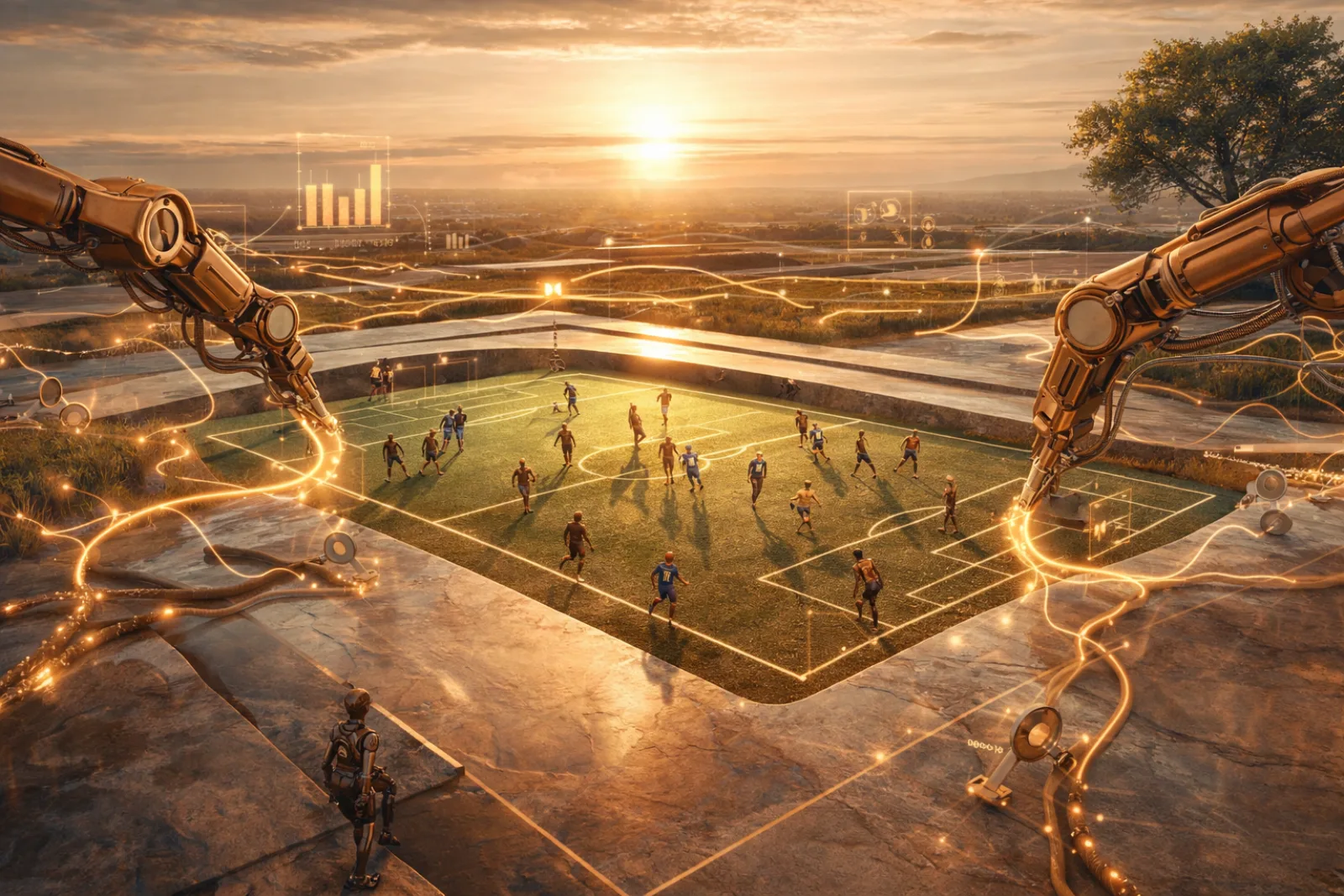
From Playbooks to Probabilities: When AI Starts Thinking Like a Football Manager

Opening — Why this matters now AI has spent the past decade predicting outcomes. Now it wants to simulate realities. That shift—from prediction to generation—is subtle but consequential. In markets, it means scenario analysis instead of point forecasts. In operations, it means stress-testing decisions rather than merely optimizing them. And, somewhat unexpectedly, one of the clearest demonstrations of this shift comes not from finance or logistics, but from football. ...

April 14, 2026 · 5 min · Zelina
Cover image

Playing Both Sides: How Multi-Agent Scripts Teach AI to Lie, Detect, and Decide

Opening — Why this matters now AI can describe images, summarize documents, and even write passable essays. But ask it to navigate deception, partial information, and conflicting incentives, and the performance drops—often embarrassingly so. This is not a niche limitation. It’s the core bottleneck for deploying AI in real-world decision systems: finance, legal reasoning, negotiations, and multi-agent environments where not everyone is telling the truth. ...

April 14, 2026 · 5 min · Zelina
Cover image

Simulate This: When LLMs Stop Talking and Start Modeling

Opening — Why this matters now For decades, modeling and simulation lived in a world of equations, agents, and carefully bounded assumptions. Then large language models arrived—verbose, confident, and oddly persuasive. At first, they looked like narrators: useful for documentation, maybe scenario description, but not serious modeling. The paper behind this article argues that this view is already outdated. ...

February 6, 2026 · 3 min · Zelina
Cover image

When VR Shooters Meet Discrete Events: Training Security Policies Without Endless Human Trials

Opening — Why this matters now School security research lives in a permanent bind: the events we most need to understand are precisely the ones we cannot ethically or practically reproduce at scale. Real-world shooter data is sparse, incomplete, and morally costly. Virtual reality (VR) improves matters, but even VR-based human-subject experiments remain slow, expensive, and fundamentally non-iterative. ...

February 6, 2026 · 5 min · Zelina
Cover image

When Diffusion Learns How to Open Drawers

Opening — Why this matters now Embodied AI has a dirty secret: most simulated worlds look plausible until a robot actually tries to use them. Chairs block drawers, doors open into walls, and walkable space exists only in theory. As robotics shifts from toy benchmarks to household-scale deployment, this gap between visual realism and functional realism has become the real bottleneck. ...

January 14, 2026 · 3 min · Zelina
Cover image

Let There Be Light (and Agents): Automating Quantum Experiments

Opening — Why this matters now Quantum optics sits at an awkward intersection: conceptually elegant, mathematically unforgiving, and operationally tedious. Designing even a “classic” experiment often means stitching together domain intuition, optical components, and simulation code—usually in tools that were never designed for conversational exploration. As AI agents move from text completion to task execution, the obvious question emerges: can they design experiments, not just describe them? ...

December 20, 2025 · 3 min · Zelina
Cover image

DeepPersona and the Rise of Synthetic Humanity

Opening — Why this matters now As large language models evolve from word predictors into behavioral simulators, a strange frontier has opened: synthetic humanity. From virtual therapists to simulated societies, AI systems now populate digital worlds with “people” who never existed. Yet most of these synthetic personas are shallow — a few adjectives stitched into a paragraph. They are caricatures of humanity, not mirrors. ...

November 11, 2025 · 4 min · Zelina
Cover image

When Algorithms Command: AI's Quiet Revolution in Battlefield Strategy

Opening — Why this matters now Autonomous systems have already taken to the skies. Drones scout, strike, and surveil. But the subtler transformation is happening on the ground—inside simulation labs where algorithms are learning to outthink humans. A recent study by the Swedish Defence Research Agency shows how AI can autonomously generate and evaluate thousands of tactical options for mechanized battalions in real time. In other words: the software isn’t just helping commanders—it’s starting to plan the war. ...

November 10, 2025 · 4 min · Zelina
Cover image

When the Sandbox Thinks Back: Training AI Agents in Simulated Realities

Opening — Why this matters now The AI industry has a curious paradox: we can train models to reason at Olympiad level, but they still fumble at booking flights or handling a spreadsheet. The problem isn’t intelligence—it’s context. Agents are trained in narrow sandboxes that don’t scale, breaking the moment the environment changes. Microsoft and the University of Washington’s Simia framework tackles this bottleneck with a provocative idea: what if the agent could simulate its own world? ...

November 6, 2025 · 4 min · Zelina