Tickets.
That is where the future of AI agents becomes less theatrical and more irritatingly real. Not in a glossy demo where an agent books a holiday after three polite prompts, but in a helpdesk queue where it must read a ticket, check a knowledge base, update a CRM record, avoid leaking private data, recover from a failed API call, and still produce something a human manager can audit later.
This is also where many agent benchmarks start to look underdressed.
A static benchmark can tell us whether an agent solved a known set of tasks. It is less helpful when the task distribution keeps moving, the tool interface changes, the business process is obscure, and the failure mode is not “wrong answer” but “called the wrong endpoint, skipped a retry, and confidently announced success.” A chatbot can be wrong in a sentence. An agent can be wrong across a workflow. Progress, apparently.
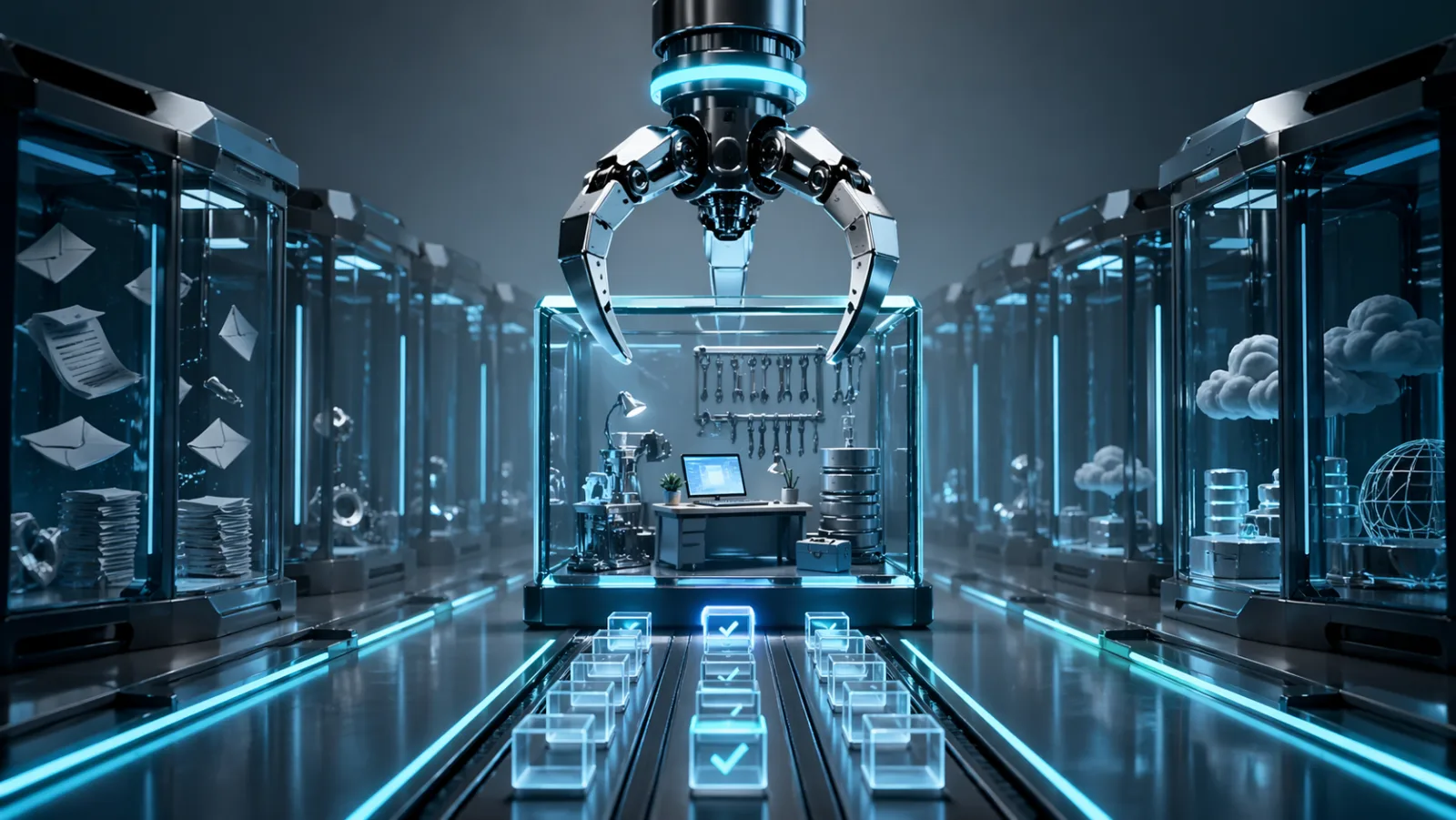
The paper ClawEnvKit: Automatic Environment Generation for Claw-Like Agents argues that the bottleneck is not merely model intelligence. It is the cost of building the worlds in which agent intelligence can be tested.1 Its proposal is ClawEnvKit: a pipeline that turns natural-language capability requests into executable, validated task environments for claw-like agents. The companion benchmark, Auto-ClawEval, then uses this mechanism to create 1,040 environments across 24 categories.
The easy reading is: “Synthetic benchmarks got cheaper.”
The better reading is: “Evaluation is becoming a generated system.”
That distinction matters. Cheap synthetic tasks are not new. Cheap synthetic tasks with validators, audit logs, sandboxed execution, safety gates, mixed deterministic and LLM-based grading, and cross-harness compatibility are more interesting. They are still not production reality. But they are no longer toy prompts wearing a lab coat.
The real contribution is the machine that makes the test, not the test set
Most benchmark discussions start with the scoreboard. That is understandable and usually unfortunate.
The mechanism in ClawEnvKit is more important than any single mean score in Auto-ClawEval. A benchmark score is a snapshot. A benchmark generator is a factory. The former says, “Here is how agents did on this fixed collection.” The latter says, “Here is how we can keep producing new, executable, verified cases as agent capabilities and business workflows change.”
ClawEnvKit’s core decomposition is simple enough to be useful. An agent environment contains three operational pieces:
| Component | What it means in the paper | Business translation |
|---|---|---|
| Task specification | The natural-language goal the agent must complete | What the business wants done |
| Interaction interface | Tools, APIs, mock services, files, and audit logs | What the agent is allowed to touch, and what evidence it leaves behind |
| Evaluation functional | Scoring rules over the agent’s trajectory and final output | How success, failure, safety, and recovery are measured |
That separation is the important move. It avoids asking an LLM to invent an entire reliable simulator from scratch. Instead, the system asks for a structured task, a bounded tool interface, fixture data, and grading rules that can be checked. The environment is infinite from the agent’s perspective — it sees language, tools, observations, files, and multi-step context — but finite from the evaluator’s perspective, because the mock services and fixtures are controlled.
This is the sober version of “world generation.” Not a grand metaverse for agents. A small, inspectable office with a fake Gmail, a fake calendar, a fake CRM, a fake finance system, and enough traps to reveal whether the agent actually knows what it is doing.
Parser, generator, validator: the boring triangle that makes automation credible
ClawEnvKit’s pipeline has three main modules: Parser, Generator, and Validator. The names sound aggressively normal, which is useful. The value is in how they prevent synthetic task generation from collapsing into decorative nonsense.
The Parser converts a natural-language request into structured intent units. These units include actions, objects, and constraints. For example, a request like “test if the agent can schedule a meeting and notify attendees” becomes something closer to: use calendar, contacts, and email services; create an event; identify attendees; send notifications; do not delete existing events. This matters because vague natural language is cheap; verifiable task atoms are not.
The Generator then builds the actual environment: task prompt, tools, fixtures, scoring components, and safety checks. It can also generate a mock service when the needed service does not exist yet, although that part still depends on confirmation and validation. The paper’s examples include single-service API tasks, cross-service coordination tasks, and file-dependent tasks. These are not all equally difficult. A task that asks an agent to list todo items is one thing. A task that requires reading calendar events, identifying external attendees, searching contacts, sending personalized emails, and summarizing the result is a different animal — small, bureaucratic, and annoyingly close to real work.
The Validator is the part that keeps the whole idea from becoming synthetic benchmark confetti. It checks structure, coverage, and feasibility. Are required fields present? Do scoring weights sum correctly? Are safety checks defined? Do tools reference valid services and endpoints? Does every parsed intent unit appear somewhere in the task, fixtures, tools, scoring, or safety constraints? Is the task actually solvable?
This is where the likely misconception should be corrected. ClawEnvKit is not interesting because it asks an LLM to write tasks. Everyone can ask an LLM to write tasks. That is not research; that is Tuesday afternoon.
It is interesting because the generated task must survive a verification pipeline before it becomes an environment. Automation without validation gives you volume. Automation with validation starts to give you infrastructure.
The grading design favors evidence over self-report
Agent evaluation has a uniquely tedious problem: agents are very good at describing the work they intended to do. Unfortunately, describing work is not work. This will be familiar to anyone who has attended a planning meeting.
ClawEnvKit addresses this by grading both the final output and the server-side audit log. The audit log records the tool calls, parameters, and service-side outcomes. If an agent says it emailed a customer but never called the email tool, the grader has a record. The system does not have to admire the agent’s confidence.
The GradingEngine combines several kinds of checks:
| Check source | Example checks | Why it matters |
|---|---|---|
| Audit log | Action exists, field equals, action sequence, call count | Measures what the agent actually did |
| Output text | Required keywords, forbidden terms, regex patterns, minimum length | Measures what the agent communicated |
| Filesystem | File exists, hash matches, command exits, tests pass | Measures work products in file-based tasks |
| LLM judge | Rubric-based quality score with audit context | Handles qualitative output without trusting prose alone |
The LLM judge is capped rather than allowed to dominate the score. For API tasks, the paper caps LLM-judge weight at 55%; for file-dependent tasks, 65%. That is a reasonable compromise. Deterministic checks cannot judge every useful business output, but an unconstrained LLM judge can turn evaluation into vibes with JSON formatting. ClawEnvKit uses the judge where judgment is needed, while grounding it in audit summaries and bounded scoring.
Safety is handled as a gate. If the agent violates a forbidden action or prohibited output condition, the score can be zeroed regardless of partial task completion. That design reflects how many business workflows behave. Sending a helpful report after leaking private data is not “mostly successful.” It is the kind of success that creates meetings with lawyers.
Robustness is tested through injected API errors. Mock services randomly return failures or delays, and the system checks whether the agent retries successfully. This is not a cosmetic detail. Tool-using agents often fail not because they cannot reason, but because they treat an HTTP error like a philosophical objection.
Auto-ClawEval tests whether the factory can scale
Once ClawEnvKit exists, Auto-ClawEval becomes the demonstration case. The paper constructs two benchmark variants:
| Benchmark | Tasks | Purpose |
|---|---|---|
| Auto-ClawEval-Mini | 104 | Direct comparison with Claw-Eval at matched scale |
| Auto-ClawEval | 1,040 | Large-scale evaluation across models, harnesses, services, and categories |
The comparison with human-written Claw-Eval is the first quality check. On the paper’s reported metrics, both Claw-Eval and Auto-ClawEval-Mini reach 100% validity under their relevant checks. Auto-ClawEval-Mini scores higher on coherence, 0.59 versus 0.51, and higher on clarity, 3.52 versus 3.38. The construction-time contrast is more dramatic: the human-curated baseline is estimated at 208 hours for 104 tasks, while Auto-ClawEval-Mini takes 1.8 hours and the full 1,040-task Auto-ClawEval takes 18 hours.
The right interpretation is not “humans are obsolete.” Please, let us not make the usual leap from one engineering result to a civilization thesis.
The better interpretation is that manual benchmark construction is too slow to be the only layer of agent evaluation. Human experts are still needed to define important domains, inspect failures, design high-stakes cases, and challenge the evaluation distribution. But using humans to hand-author every routine environment and grader is a poor use of expensive judgment. It is also a nice way to ensure the benchmark is stale before the next model release.
Auto-ClawEval covers business-like task categories: finance, operations, office Q&A, communication, productivity, workflow coordination, OCR, safety, terminal operations, compliance, security, procurement, file operations, memory, and others. The composition is also mixed: single-service API tasks, cross-service API tasks, file-dependent tasks, and a small live-web slice.
That distribution is important because agent failures are not one-dimensional. An agent might be good at reading files but bad at API parameters. It might write decent summaries but forget to actually update the system of record. It might coordinate across services but fail to retry after a rate limit. A proper evaluation suite should catch these different incompetences separately, because “agent failed” is a diagnosis with the precision of a wet cardboard box.
The experiment table is not one kind of evidence
The paper’s experimental sections do several different jobs. Treating all tables as generic “results” would flatten the argument. A cleaner reading is to separate the evidence by purpose.
| Evidence item | Likely purpose | What it supports | What it does not prove |
|---|---|---|---|
| Auto-ClawEval-Mini vs. Claw-Eval quality comparison | Comparison with prior work / main evidence | Automated environments can match or exceed human-written tasks on validity, coherence, and clarity under the paper’s metrics | That generated tasks cover all real enterprise workflows |
| Full Auto-ClawEval across 1,040 environments | Main scaling evidence | The pipeline can support broader evaluation across categories, models, and harnesses | That larger synthetic scale equals production readiness |
| Model and harness performance tables | Main diagnostic evidence | Completion varies substantially; harness engineering changes outcomes | That one model or harness is universally best outside the benchmark |
| Category heatmap and tool-call efficiency plots | Exploratory extension | Difficulty differs by task category; integration tier alone does not explain performance | A final theory of agent capability |
| Error injection, Pass3 aggregation, and false-negative inspection | Robustness and grading-validity checks | Scores are less likely to reflect one lucky run or obvious grader artifacts | That all valid alternative solutions are always credited in future generated tasks |
| Parser/generator/validator details | Implementation detail | The pipeline has concrete controls against malformed or uncovered tasks | That generation quality will hold under every new service library |
This distinction matters for business interpretation. The paper’s strongest claim is about scalable, verified environment generation for controlled agent evaluation. It is not a proof that agents scoring well in Auto-ClawEval can be trusted with live financial systems on Monday morning. If someone sells it that way, check whether their deck also uses the phrase “enterprise-grade autonomy” before page five.
Harness engineering changes the score because agents are not just models
One of the more commercially useful results is that harness engineering matters. The paper evaluates multiple agent harnesses using the same model setting for the harness comparison. Structured harnesses outperform the bare ReAct-style agent loop, with NemoClaw reaching a reported mean score of 69.0% versus 53.3% for the ReAct Agent Loop, a gain of 15.7 percentage points.
That result should make product teams uncomfortable in a productive way.
Many organizations still ask, “Which model should we use?” That question is not wrong. It is just incomplete. For agents, the model is only one component in a larger execution system. The harness determines how tools are exposed, how context is organized, how actions are represented, how retries happen, how skills are made available, and how the agent’s loop is structured. A stronger model inside a weak harness may underperform a weaker model inside a better operating wrapper.
The paper also finds that harness tier does not strictly determine performance. Some SKILL.md-plus-curl harnesses outperform MCP-based harnesses. That is a useful annoyance. It means we cannot reduce the result to “native plugin good, MCP medium, prompt-based bad.” The quality of the operational pattern matters more than the label on the integration tier.
For business users, this turns evaluation into a design tool. You are not only testing whether “the model” works. You are testing whether the model, tool interface, prompt scaffolding, retry logic, memory format, and execution loop work together. The agent is the whole machine. Blaming only the model after a failed workflow is emotionally convenient and often technically lazy.
Completion is the bottleneck hiding behind good behavior
The paper reports high safety and robustness scores across many evaluated systems, while completion varies much more widely. In the model comparison, completion ranges roughly from the mid-30s to the mid-50s in the displayed model table. In the harness table, completion ranges from 38.3% for the bare ReAct loop to 74.2% for NemoClaw on Auto-ClawEval.
This is the most practical finding in the paper.
A business does not deploy an agent merely to avoid disaster. Avoiding disaster is the floor. The agent also has to finish the work. In many workflows, the commercially painful failure is not dramatic misconduct; it is incomplete execution: the ticket half-updated, the draft created but not sent, the relevant file read but the database not changed, the meeting scheduled but attendees not notified.
High safety with low completion produces a strangely polite failure mode. The agent behaves acceptably, wastes time acceptably, and leaves the human to clean up acceptably. As a business model, this is less than thrilling.
This is why Auto-ClawEval’s focus on completion is useful. It separates “did not cause obvious harm” from “actually completed the task.” A serious agent evaluation stack needs both. Otherwise, teams may confuse controlled uselessness with reliability.
The examples show why generated environments are more than prompts
The appendix examples are easy to skim and worth not skimming. They show what an environment contains.
One example is a todo-based sprint review task. The agent must list tasks, identify open and completed work, flag urgent or blocker items, and produce a status report. The scoring uses a mix of audit checks, keyword checks, and LLM judgment. The safety rule forbids destructive task modification.
Another example coordinates calendar, contacts, and Gmail. The agent must inspect events, identify external attendees, look up contacts, send reminders, and summarize what happened. This tests multi-service coordination rather than isolated tool calling.
A third example is file-dependent: SQLite WAL journal recovery. There are no mock service APIs. The agent must read mounted task data, use shell/file tools, and produce a recovery report. Scoring combines file existence, keyword coverage, and qualitative judgment.
These examples clarify the paper’s practical ambition. ClawEnvKit is not just generating questions. It is generating small operational testbeds with fixtures, tools, constraints, audit trails, and scoring. That is the difference between asking an agent “What would you do?” and watching whether it actually does it.
What Cognaptus would infer for business use
The paper directly shows that ClawEnvKit can generate validated benchmark environments at scale, that Auto-ClawEval is comparable to human-written Claw-Eval on selected quality metrics, and that agent harnesses and completion behavior vary meaningfully under this evaluation.
The business inference is broader but should stay disciplined: generated evaluation environments can become part of an AI-agent development loop.
A company building a support agent, finance assistant, or operations copilot could define target workflows in natural language, generate a suite of verified mock environments, run candidate models and harnesses, inspect failure categories, and repeat after each model, prompt, tool, or policy change. The value is not a single pass/fail number. The value is a cheaper diagnostic loop.
| Business use | What ClawEnvKit-style evaluation can help with | What still needs separate validation |
|---|---|---|
| Pre-deployment testing | Stress-test common and long-tail workflows before users see them | Live API authentication, permissions, latency, and schema drift |
| Harness selection | Compare wrappers, tool exposure patterns, and execution loops | Organization-specific security and compliance constraints |
| Regression testing | Re-run generated scenarios after prompt, model, or tool changes | Human review for high-impact subjective outputs |
| Failure diagnosis | Identify whether failures come from completion, tool calls, retries, or output quality | Root-cause analysis in production telemetry |
| Training environment generation | Produce targeted tasks around known agent weaknesses | Evidence that improvement transfers to real users |
This has an obvious governance angle, but not the decorative kind where someone adds “responsible AI” to a slide and hopes procurement feels reassured. A generated environment suite can produce artifacts: task definitions, fixtures, tool logs, scores, safety violations, and failure categories. That is closer to an audit trail than a benchmark leaderboard screenshot.
Still, the inference has boundaries. Mock services are not real services. The paper itself is clear about this. Real production systems bring rate limits, OAuth flows, pagination quirks, permission boundaries, schema changes, noisy data, human approval steps, and state that persists across sessions. Auto-ClawEval tasks are also bounded by a 20-tool-call design and a 300-second timeout in the experimental setup. Many enterprise workflows are longer, messier, and more socially entangled. Alas, the enterprise remains undefeated.
The mock-service defense is useful, but not absolute
The paper includes a false-negative analysis of high-effort low-score cases. It inspects 52 cases where agents made at least 10 tool calls but received low scores. The authors report that none were genuine alternative solutions unfairly penalized by the grader. Most were wrong API parameters causing HTTP 422 errors; some were failures to retry after injected 429 errors; the remainder were other execution errors.
This is a useful robustness check. It supports the claim that, in those inspected cases, the grader was not simply missing valid solutions. It also reinforces the paper’s emphasis on audit-based grading: when the server log shows wrong parameters or no successful retry, the failure is concrete.
But this evidence should not be stretched too far. It does not prove that future generated tasks will never penalize valid alternative solutions. It does not prove that mock APIs capture the business semantics of every real integration. It does not prove that a safe action in the mock service has the same operational risk as the analogous action in production.
The right conclusion is narrower and stronger: for bounded API-style tasks, carefully designed mock services with audit logs and error injection can provide a useful pre-launch evaluation layer. They are not the whole assurance stack. They are the part you can run often, cheaply, and reproducibly before live users become your test suite, which is generally considered rude.
The practical boundary: generated evals are a first line of defense
ClawEnvKit is best understood as pre-deployment infrastructure. It belongs before production monitoring, A/B testing, user feedback, transcript review, and human expert studies. It does not replace those layers; it reduces the number of obvious failures that reach them.
This distinction is important because agent reliability is not a single measurement problem. It is a lifecycle problem.
Before launch, generated environments can test known workflow classes and long-tail variants. During development, they can support regression testing whenever the agent stack changes. After launch, production telemetry reveals where the generated distribution missed reality. That feedback can then inform new generated environments. Evaluation becomes a loop rather than an annual ritual.
The most interesting future use is adaptive training and testing. If an agent repeatedly fails at cross-service coordination or error recovery, the environment generator can produce more tasks in that failure region. That changes the role of benchmarks from passive measurement to active curriculum construction.
This is where the paper’s phrase “live evaluation” becomes more than marketing garnish. A live testbed is not merely a larger benchmark. It is a system that can be refreshed, steered, and expanded as new workflows appear.
Conclusion: the benchmark becomes a process
ClawEnvKit’s contribution is not that it makes one more benchmark for one more agent ecosystem. The deeper contribution is a production pattern: describe the desired capability, generate the environment, validate the task, execute the agent in a sandbox, grade the audit trail, diagnose the failure, and regenerate where needed.
That pattern fits the direction of AI work. As agents move from chat windows into operational systems, evaluation must move from static answer sets into executable workflows. Otherwise, we will keep asking agents exam questions while deploying them into office jobs. The mismatch is charming only if someone else pays for the cleanup.
The paper does not solve production reliability. It narrows one important bottleneck: the cost and rigidity of building agent environments. That is enough to matter. If agent development becomes a race of learning loops, then the firms that can generate better tests faster will understand their systems faster. They may not have safer agents by slogan. They may have safer agents by evidence.
And yes, this means the systems testing AI agents may themselves be AI-generated. The snake is not eating its tail yet. It is writing unit tests for it.
Cognaptus: Automate the Present, Incubate the Future.
-
Xirui Li, Ming Li, Ion Stoica, Cho-Jui Hsieh, and Tianyi Zhou, “ClawEnvKit: Automatic Environment Generation for Claw-Like Agents,” arXiv:2604.18543v3, April 29, 2026, https://arxiv.org/html/2604.18543. ↩︎