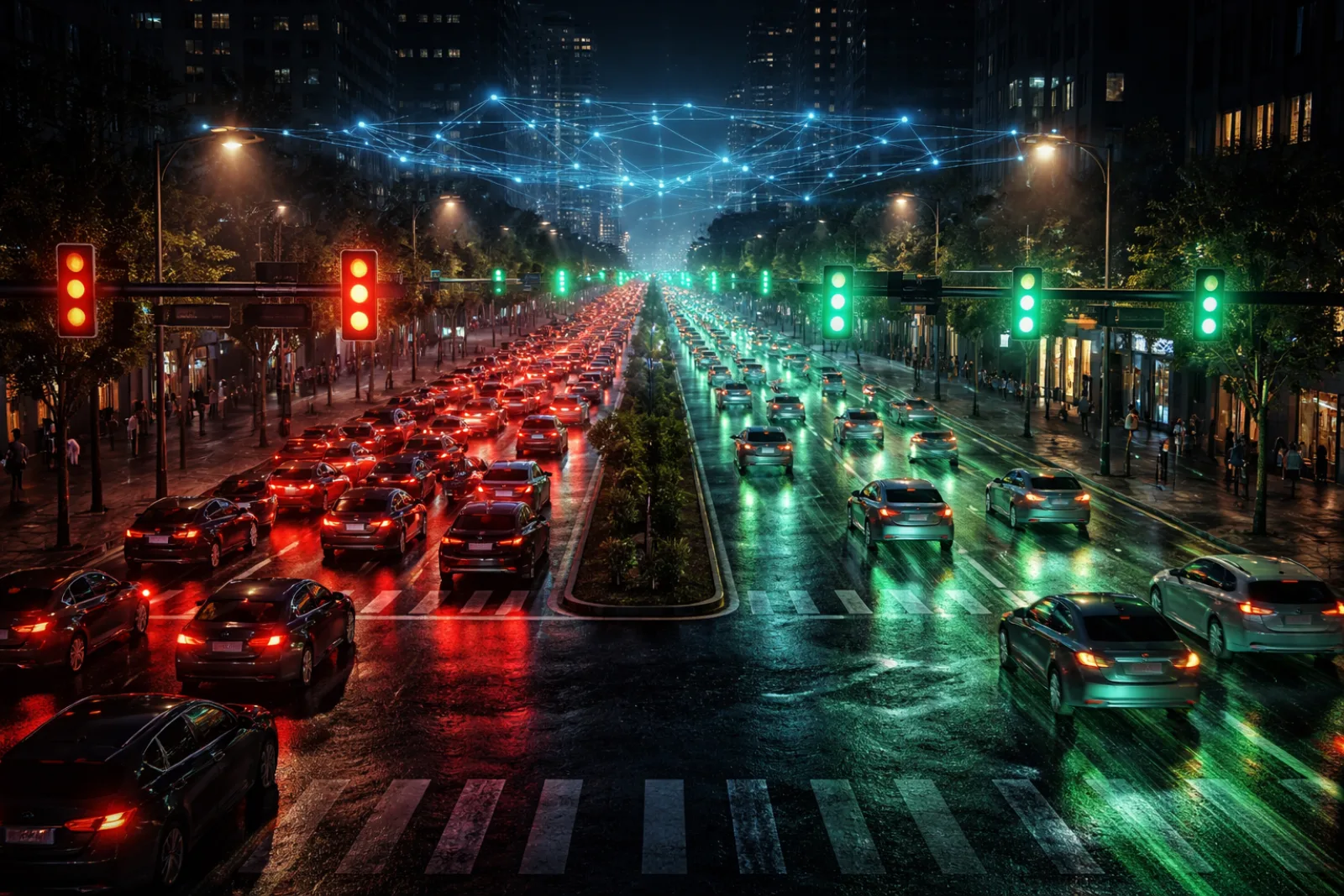
Traffic lights are not stupid. They are obedient.
That is the problem.
A fixed-time signal does exactly what it was told to do: hold this green for this long, clear the junction, move to the next phase, repeat. It does not care that one lane is empty, another is spilling backward, and a third has just received a platoon of vehicles from the previous intersection. It is not being malicious. It is merely following a plan designed for a world that stopped changing five minutes ago.
That is why reinforcement learning has always looked tempting for traffic signal control. Let each intersection observe traffic, choose a signal action, and learn from outcomes such as travel time, waiting time, delay, and throughput. The pitch practically writes itself: self-adapting lights, less congestion, smoother corridors, smarter cities. Wonderful. The brochure can go home early.
The harder question is not whether reinforcement learning can outperform a fixed signal plan in a simulator. It often can. The harder question is whether a learned traffic controller can survive the boring, brutal constraints of deployment: traffic patterns change, drivers expect cyclic phases, and a city cannot run every intersection as if one giant central brain were watching everything.
The paper behind this article, A Robust and Efficient Multi-Agent Reinforcement Learning Framework for Traffic Signal Control, is useful because it does not treat “AI traffic lights” as one magic algorithmic upgrade.1 It treats deployment as three linked engineering problems: robustness, stability, and scalability. The proposed framework combines Turning Ratio Randomization, Exponential Phase Duration Adjustment, and neighbor-based multi-agent reinforcement learning using MAPPO with Centralized Training and Decentralized Execution.
That sounds like a conference-paper mouthful because it is. But the idea is practical: traffic-light AI does not become useful by becoming more unconstrained. It becomes useful by learning under uncertainty, acting within safe signal logic, and coordinating with just enough information to be scalable.
The real deployment problem is not intelligence; it is controlled adaptation
The common misunderstanding is that traffic-signal reinforcement learning mainly improves by seeing more of the network or by choosing phases more freely. Give the model global visibility, let it pick any phase, and surely the machine will optimize the road better than a timing plan.
That is a seductive mistake. Also a rather expensive one.
Traffic control is not a video game. A signal cannot arbitrarily jump from one movement to another just because the model sees a queue. Drivers expect a predictable order of phases. Intersections need yellow and all-red clearance intervals. Adjacent signals must coordinate without requiring every controller to receive full-network state at every decision point. A controller that is clever in the lab but operationally strange on the street is not innovative. It is a liability with a GPU.
The paper’s framework is best read as a three-part answer to three deployment failures:
| Deployment failure | Paper mechanism | Practical interpretation |
|---|---|---|
| The agent memorizes static traffic patterns | Turning Ratio Randomization | Train the controller to react to state, not to replay a clock |
| The action space is either too twitchy or too slow | Exponential Phase Duration Adjustment | Preserve cyclic signal order while allowing both fine and large green-time changes |
| Full-network observation does not scale | Neighbor observation with MAPPO/CTDE | Learn cooperation centrally, execute using only local and adjacent information |
This is why a mechanism-first reading matters. If we only summarize the benchmark table, the paper becomes another “AI beats baseline” story. We have enough of those. Many of them age like milk.
The more useful lesson is that the authors are shaping the learning problem so the resulting policy looks more like something a traffic agency could pilot on a real corridor.
Mechanism 1: randomize turning ratios so the agent stops memorizing the clock
Traffic volume and turning ratios are not the same thing.
Volume tells us how much traffic enters the system. Turning ratios tell us where that traffic wants to go: straight, left, right, into this branch, away from that branch. For signal control, turning ratios are especially important because they affect how green time should be split across competing movements.
A standard RL training setup often fixes both volume and turning patterns. This makes training neat. Unfortunately, neat training can produce a lazy policy. If the same demand pattern appears every episode, an agent can learn an implicit schedule: after this much elapsed time, expect this queue, switch around here. It is not really reading traffic; it is memorizing the rhythm of the simulator.
The authors attack this with Turning Ratio Randomization. At the beginning of each training episode, they perturb each movement’s turning probability using multiplicative noise, then renormalize the probabilities so the full set still sums to one:
The elegance is not in the formula. It is in what the formula avoids.
Additive noise could distort small and large movements in unrealistic ways. Multiplicative noise preserves the broad structure of demand while forcing variation around it. The dominant flows remain dominant unless the perturbation says otherwise, but the exact distribution changes enough that the agent cannot safely memorize one timing pattern.
In business terms, this is not “more data” in the usual dashboard sense. It is training discipline. The controller is exposed to plausible operational variation before deployment, so the learned policy has less incentive to become a brittle lookup table.
The paper makes a careful choice here: it randomizes turning ratios rather than simply varying total traffic volume. The authors argue that fluctuating volume can destabilize reward magnitudes because metrics like waiting time naturally change with load, even if the policy quality is not worse. Turning ratios, by contrast, stress the green-split decision while keeping the learning signal more interpretable.
That distinction matters. A bad simulation curriculum can teach an agent the wrong lesson with great confidence. Traffic control already has enough confident wrongness. It is called a rush-hour timing plan from 2017.
Mechanism 2: keep the signal cycle, but make green-time adjustment multi-scale
Some RL traffic-control systems use flexible action spaces: choose a phase, switch when convenient, respond aggressively. That may look powerful in a model. On a road, it can violate the fixed phase sequence drivers expect and introduce unstable oscillation.
The paper therefore keeps a cyclic phase-control scheme. Green, yellow, and red ordering is preserved. Yellow and all-red clearance are fixed. The learning problem focuses on one operationally safer question: how long should the green duration of the next phase be?
Instead of linear adjustment steps, the authors propose an exponential adjustment set:
The next green duration is then clipped within minimum and maximum limits:
With $\lambda=2$, the adjustment set becomes:
This is a small design choice with a large operational meaning.
A purely small-step linear action space is precise but sluggish. If a queue suddenly grows, the controller may need several cycles to catch up. A purely large-step action space is responsive but coarse. It can overcorrect, creating unstable green times and unnecessary oscillation.
The exponential set creates a coarse-to-fine controller. Small actions handle normal variation. Larger actions remain available when congestion needs a stronger response. The signal still behaves like a traffic signal, not a caffeinated roulette wheel.
This is one of the more important business lessons in the paper: real-world AI control often improves not by removing constraints, but by encoding the right constraints into the action space. The model should not be free to do anything. It should be free to do useful things within a safe operating grammar.
Mechanism 3: use neighbors, not omniscience
Network-level traffic control has an information problem.
Local observation is scalable, but myopic. A signal that only sees its own lanes may fail to anticipate upstream platoons or coordinate green waves along a corridor. Global observation contains richer information, but it becomes harder to scale as the network grows. Input dimensions expand with the number of intersections, communication requirements rise, and the architecture starts to look suspiciously like the city is being run from one overworked spreadsheet.
The paper’s middle ground is neighbor-level observation. Each agent observes its own intersection plus directly connected upstream and downstream neighbors:
That gives the agent enough context to coordinate with nearby signals without requiring full-network state during execution.
The learning architecture uses MAPPO under Centralized Training with Decentralized Execution. During training, a centralized critic can use broader system information to evaluate how local actions affect the network. During deployment, each decentralized actor uses only partial observations.
This is the part of the paper that should interest anyone building AI systems for infrastructure, not only transportation. The pattern is familiar: train with richer information, deploy with constrained information. It is a way to borrow global coordination during learning without paying full global-coordination costs during operation.
In plain business language: the city does not need every intersection to know everything. It needs each intersection to know the right nearby things and to have been trained in a way that rewards cooperation.
The experiment is a corridor pilot, not a citywide victory lap
The authors test the framework in PTV Vissim, a microscopic traffic simulator, using a calibrated digital twin of Zhongzheng East Road in Taoyuan City, Taiwan. The road network contains five consecutive signalized intersections with short spacing and strong interaction.
That experimental setup is more realistic than many toy-grid simulations, but it is still a corridor. The distinction matters. A five-intersection arterial is a plausible pilot environment. It is not proof that the same policy structure will automatically scale to a full metropolitan grid with buses, pedestrians, motorcycles, emergency vehicles, incidents, and weather disruptions politely joining the chaos.
The traffic scenarios are also specific. The authors analyze 24-hour detector data and extract two demand levels:
| Scenario | Time window | Vehicle count |
|---|---|---|
| Peak hour | 9:00–10:00 | ~4,800 veh/hr |
| Off-peak | 21:00–22:00 | ~1,800 veh/hr |
The agents are trained on peak-hour data and evaluated on both peak and off-peak scenarios. This makes the off-peak test especially important: it checks whether a policy trained under high-pressure conditions can generalize to a different demand regime.
The paper only considers four-wheeled vehicles. That is a clean experimental boundary, not a minor footnote. Any city pilot would need to ask what happens when the traffic stream includes buses, motorcycles, cyclists, pedestrians, freight behavior, curbside activity, and signal-priority rules. Reality is annoyingly multimodal. It refuses to stay inside a table.
The main result: the robust neighbor model wins where deployment realism matters
The headline result is that the proposed framework performs strongly against fixed-time control, MaxPressure, and standard RL variants.
The most deployment-relevant model is the robust neighbor-based version, $M^{randomized}_{neighbor}$, because it combines randomized training with scalable neighbor observation. It is not always the best across every metric and scenario, but it gives the most useful trade-off between performance and deployability.
| Method | Peak ATT ↓ | Peak AWT ↓ | Peak AD ↓ | Peak VC ↑ | Off-peak ATT ↓ | Off-peak AWT ↓ |
|---|---|---|---|---|---|---|
| Fixed-time | 383.92 | 352.87 | 319.04 | 4015.87 | 129.20 | 50.74 |
| MaxPressure | 265.79 | 285.93 | 196.54 | 4223.80 | 126.57 | 45.96 |
| Static RL, neighbor | 249.54 | 215.47 | 181.08 | 4448.13 | 130.27 | 50.02 |
| Robust RL, neighbor | 230.58 | 231.01 | 160.34 | 4416.53 | 124.37 | 44.09 |
| Robust RL, global | 256.39 | 219.30 | 188.08 | 4398.80 | 119.32 | 36.12 |
Average travel time tells the cleanest story. In the peak scenario, the robust neighbor model reaches 230.58 seconds, compared with 265.79 seconds for MaxPressure and 249.54 seconds for the static neighbor RL model. That is about a 13.2% reduction versus MaxPressure and about a 7.6% reduction versus the static neighbor RL variant.
Average delay tells a similar peak-hour story: 160.34 seconds for robust neighbor control, versus 196.54 for MaxPressure and 181.08 for static neighbor RL.
Average waiting time is more nuanced. The robust neighbor model improves substantially over MaxPressure in the peak case, but it does not beat the static neighbor RL variant on peak-hour AWT. This is not a problem for the paper; it is a problem for lazy summaries. The method is strong, but not magically dominant in every cell. Good analysis should be able to survive a table without sanding off the inconvenient numbers.
The off-peak scenario is where the generalization argument becomes more interesting. Standard static RL variants degrade under the unseen demand condition. The robust neighbor model records 124.37 seconds ATT and 44.09 seconds AWT, beating MaxPressure on both and approaching the robust global model’s ATT of 119.32 seconds. The global model performs best off-peak, as expected, but global observation is exactly the option that becomes difficult to scale.
So the paper’s practical result is not “global information wins.” That would be boring and operationally expensive.
The practical result is that neighbor-based observation, when combined with randomized training and CTDE, gets close enough to global coordination to become a plausible corridor-control architecture.
The ablations explain why the gains are not just benchmark luck
The paper includes component analyses that are more useful than the headline comparison because they test whether the proposed mechanisms are actually doing work.
| Test | Likely purpose | What it supports | What it does not prove |
|---|---|---|---|
| Table 2: baseline comparison | Main evidence | Robust neighbor MARL performs strongly against fixed-time, MaxPressure, and static RL | Full citywide deployability |
| Table 3: MAPPO/CTDE vs IPPO | Ablation | Centralized critic improves multi-agent coordination | That CTDE is always superior across all network types |
| Table 4: exponential vs linear actions | Ablation and design sensitivity | Exponential action steps improve the stability-responsiveness trade-off | That the exact base values are universally optimal |
| Figure 8: signal duration vs demand | Qualitative diagnostic | The learned controller adapts green time with traffic demand | Causal proof beyond the tested intersection and phase |
The CTDE ablation is especially sharp. The authors compare MAPPO with a non-CTDE IPPO setup while holding neighbor observations and randomized training constant. In the peak scenario, IPPO records 298.43 seconds ATT and 319.72 seconds AWT. MAPPO with CTDE records 230.58 seconds ATT and 231.01 seconds AWT.
That is not a small difference. It suggests the centralized critic is not decorative. It helps solve the credit-assignment and coordination problem created when multiple neighboring agents update simultaneously.
The action-space comparison is also persuasive. The authors compare two linear adjustment schemes against exponential Base-2 and Base-3 action sets:
| Action design | Peak ATT ↓ | Peak AWT ↓ | Off-peak ATT ↓ | Off-peak AWT ↓ |
|---|---|---|---|---|
Linear small-scale {0, ±2, ±4, ±6, ±8} |
263.11 | 289.70 | 158.10 | 73.18 |
Linear large-scale {0, ±5, ±10, ±15, ±20} |
283.56 | 267.24 | 144.96 | 59.32 |
Exponential Base-2 {0, ±1, ±2, ±4, ±8} |
230.58 | 231.01 | 124.37 | 44.09 |
Exponential Base-3 {0, ±1, ±3, ±9, ±27} |
234.36 | 215.12 | 125.98 | 43.11 |
The point is not that Base-2 is sacred. The point is that exponential granularity gives the controller small moves near equilibrium and larger moves when congestion requires them. Base-3 even beats Base-2 on peak and off-peak AWT, while Base-2 leads on ATT and AD. Again, the table rewards people who read past the first bold claim. A rare but endangered species.
Figure 8 then offers a qualitative stability check: the learned green duration rises and falls with traffic demand at the busiest intersection’s primary phase, while staying within feasible action bounds. That figure should be read as diagnostic evidence, not as a second thesis. It shows that the learned policy is behaving in an interpretable demand-responsive way; it does not by itself prove generalization across all corridors.
What this means for city operators and AI vendors
The business implication is not “replace traffic engineers with MARL.” Please do not build that pitch deck. Someone will, but we do not have to encourage them.
The better implication is that adaptive traffic control should be evaluated as an operational control system, not merely as an AI model. The paper suggests four practical requirements for any serious pilot.
First, training scenarios must include structured uncertainty. A model trained only on one static flow pattern may perform well in a benchmark and still fail under daily variation. Domain randomization should be part of procurement language, not a buried research detail.
Second, the action space must respect traffic engineering constraints. If an RL controller violates phase order or produces unstable oscillations, its theoretical reward improvement is not reassuring. The paper’s cyclic green-duration adjustment is a useful example of AI being made more practical by being made less free.
Third, coordination should be local enough to deploy but informed enough to matter. Neighbor-level observation is a sensible compromise for corridor control. It asks for adjacent-intersection information, not omniscience. This reduces communication and scaling pressure while still allowing green-wave-like coordination.
Fourth, ablation evidence should be demanded. If a vendor claims its AI signal system works because “multi-agent learning,” ask what happens without centralized training, without randomized demand, and with a simpler action space. If the answer is a very glossy silence, enjoy the silence but do not buy the system.
The ROI is operational resilience, not just seconds shaved from a table
For city agencies, the value path is not only lower average travel time. The deeper value is operational resilience.
A fixed-time plan is cheap to understand but expensive to maintain when patterns shift. Manual retiming requires studies, field adjustment, and repeated engineering effort. A robust adaptive controller could reduce the frequency and cost of retiming, especially on corridors where demand changes by time of day, event schedule, nearby development, or commuter behavior.
For infrastructure vendors, the paper points toward a product architecture:
| Product layer | What the paper suggests | Buyer-facing value |
|---|---|---|
| Simulation layer | Use calibrated microscopic simulation such as Vissim | Safer pre-deployment validation |
| Training layer | Randomize turning ratios across episodes | Less overfitting to historical demand |
| Control layer | Use cyclic exponential green-time adjustment | Operationally compatible adaptation |
| Coordination layer | Train with CTDE, execute with neighbor observations | Scalable corridor cooperation |
| Evaluation layer | Report ATT, AWT, AD, and throughput across scenarios | Evidence beyond one cherry-picked metric |
The immediate opportunity is not a fully autonomous citywide traffic brain. That phrase belongs in a keynote, preferably far away from a traffic operations center.
The opportunity is a constrained corridor pilot: five to twenty interacting intersections, detector data available, known congestion patterns, measurable before-after metrics, and a safety envelope approved by traffic engineers. The system should start as decision support or supervised adaptive control before graduating into more autonomous operation.
The boundaries are real, and they matter
The paper’s evidence is promising, but the boundary is clear.
The simulation is a calibrated Vissim corridor in Taoyuan City, not a live field deployment. The network has five consecutive signalized intersections, not a full urban grid. The demand scenarios are peak and off-peak conditions derived from detector data, not a comprehensive stress test including incidents, construction, weather, school dismissal, emergency preemption, bus priority, pedestrian surges, or motorcycle-heavy traffic. The authors also state that the paper considers only four-wheeled vehicles.
These limitations do not weaken the paper’s contribution. They locate it.
This is pilot-ready evidence for a specific class of adaptive corridor control, not citywide proof. It supports the argument that robust MARL can be engineered closer to deployment by combining demand randomization, constrained action design, and scalable coordination. It does not prove that transportation agencies can skip field trials, safety audits, integration planning, or human oversight.
Also, the metrics should be interpreted together. ATT, AWT, AD, and VC do not always rank methods identically. The robust neighbor model is compelling because it offers a practical balance, not because it wins every metric under every condition. Mature infrastructure AI should be allowed to have trade-offs. In fact, if a vendor claims there are none, that is usually where the invoice becomes dangerous.
The broader lesson: useful AI control is shaped, not unleashed
This paper is about traffic signals, but the design pattern travels.
In factories, power grids, logistics networks, and urban infrastructure, AI agents rarely operate in unconstrained environments. They must respect physical constraints, safety rules, human expectations, communication limits, and legacy systems. The winning architecture is usually not the most flexible model. It is the model whose learning problem has been shaped around the real operating environment.
That is the quiet strength of this work. Turning Ratio Randomization makes training less brittle. Exponential Phase Duration Adjustment makes actions more operationally sane. Neighbor-based CTDE makes coordination scalable. None of these mechanisms is flashy on its own. Together, they move MARL traffic control from “interesting simulator trick” toward “something a city might responsibly test.”
The smartest traffic light is not the one that sees everything or changes anything.
It is the one that has learned enough uncertainty to avoid memorization, enough restraint to remain safe, and enough local coordination to keep the corridor moving.
A green light, after all, is only useful when it arrives for the road that actually needs it.
Cognaptus: Automate the Present, Incubate the Future.
-
Sheng-You Huang, Hsiao-Chuan Chang, Yen-Chi Chen, Ting-Han Wei, I-Hau Yeh, Sheng-Yao Kuan, Chien-Yao Wang, Hsuan-Han Lee, and I-Chen Wu, “A Robust and Efficient Multi-Agent Reinforcement Learning Framework for Traffic Signal Control,” arXiv:2603.12096v1, 12 March 2026, https://arxiv.org/abs/2603.12096. ↩︎