Opening — Why this matters now
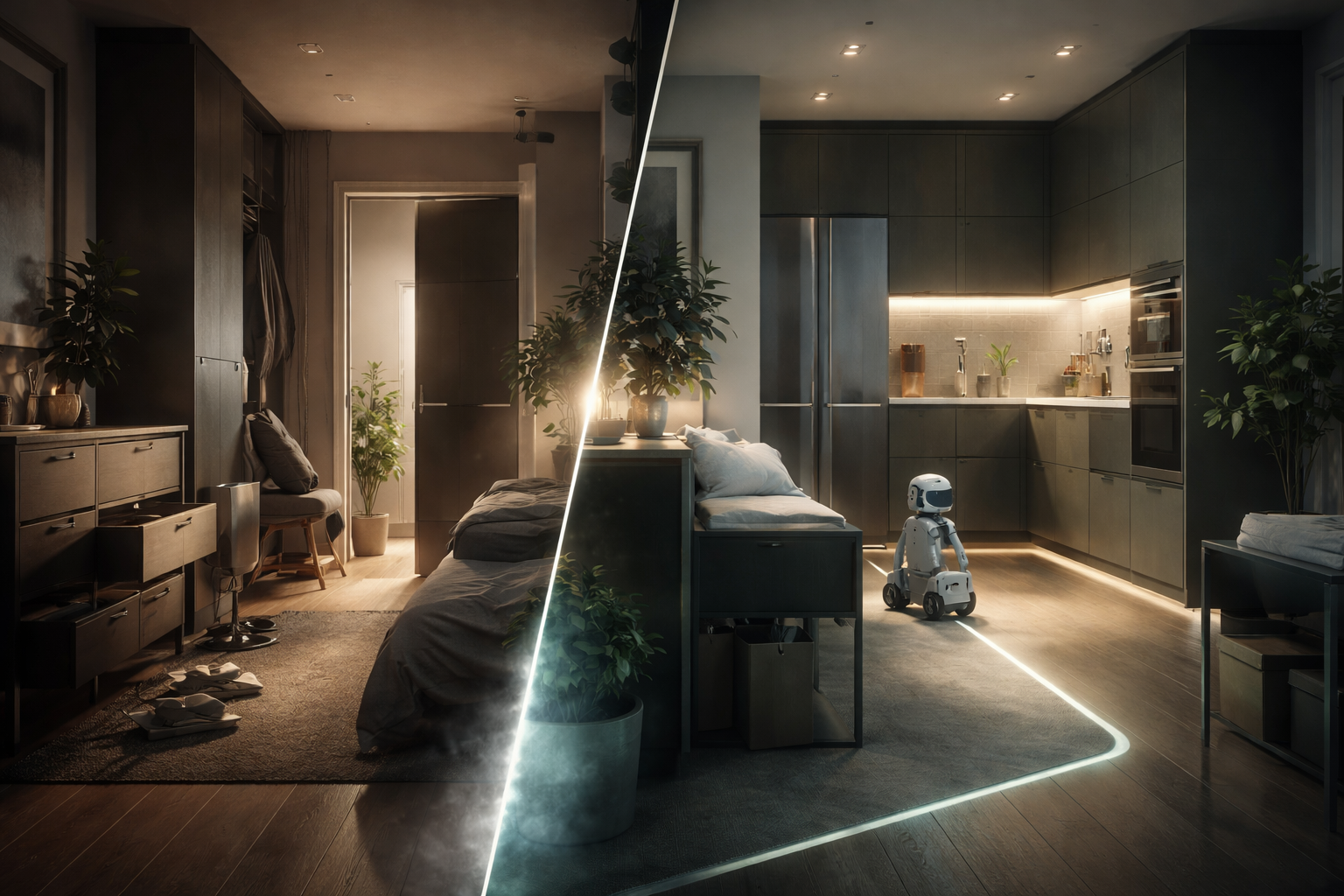
Embodied AI has a dirty secret: most simulated worlds look plausible until a robot actually tries to use them. Chairs block drawers, doors open into walls, and walkable space exists only in theory. As robotics shifts from toy benchmarks to household-scale deployment, this gap between visual realism and functional realism has become the real bottleneck.
The paper SceneFoundry: Generating Interactive Infinite 3D Worlds confronts this problem head-on. Its core claim is simple but uncomfortable for much of the generative modeling community: a scene is not realistic unless it can be used.
Background — From pretty rooms to usable worlds
The last few years have seen rapid progress in 3D indoor scene generation. Autoregressive models like ATISS brought semantic consistency, diffusion models like DiffuScene improved global coherence, and procedural systems such as Infinigen proved that apartment-scale layouts were possible.
Yet three structural limitations persisted:
- Scale — Many learning-based methods stop at single rooms.
- Control — High-level user intent rarely maps cleanly to low-level generation parameters.
- Functionality — Articulated objects (drawers, cabinets, chairs) are treated as static geometry.
SceneFoundry positions itself precisely at this intersection: apartment-scale generation, language-level control, and functional interactivity.
Analysis — What SceneFoundry actually does
SceneFoundry is not a single model, but a deliberately staged pipeline:
1. LLM-guided floor plan control
Instead of asking users to tune obscure procedural parameters, SceneFoundry uses an LLM to translate natural language (“3-bedroom apartment”, “non-square rooms”) into a parameterized reward space for procedural layout generation. Importantly, this does not eliminate stochasticity—it constrains it.
The result is semantic intent without brittle determinism.
2. Diffusion with posterior guidance
Furniture placement is handled by a diffusion model operating on unordered object sets. Rather than training multiple conditional models, SceneFoundry applies diffusion posterior sampling—injecting differentiable constraints directly into the reverse process.
This design choice matters. It keeps the base model general while allowing late-binding control at inference time.
3. Functional constraints that actually matter
SceneFoundry introduces three constraints that most prior work quietly avoids:
| Constraint | What it fixes | Why it matters |
|---|---|---|
| Object Quantity Control | Exact object counts | Dataset balance, curriculum learning |
| Articulated Collision Constraint | Drawer / door clearance | Manipulation realism |
| Walkable Area Control | Navigability | Mobile robots don’t teleport |
The articulated collision constraint is the standout. By expanding bounding boxes along articulation axes and penalizing overlap during sampling, the model learns to leave space for motion—not just placement.
Findings — Results that reflect real control
Quantitatively, SceneFoundry performs competitively on standard perceptual metrics, but that’s not the interesting part. The real signal is in the task-specific metrics:
- Object count success rates consistently above 95%
- Articulated collision ratio reduced by ~40% compared to baselines
- Walkable area success rates dramatically improved across thresholds
These are not aesthetic wins. They are operational ones.
Implications — Why this changes the conversation
SceneFoundry quietly reframes what “realism” means for generative environments:
- For robotics, it enables scalable Sim-to-Real pipelines without hand-authored scenes.
- For embodied learning, it supports curriculum control over complexity and accessibility.
- For industry, it hints at future design tools where functionality is guaranteed, not inspected afterward.
Equally important are its limitations: inference remains slow, articulation modeling is heuristic, and dataset bias still bounds cultural diversity. But these are engineering constraints—not conceptual dead ends.
Conclusion — From images to affordances
SceneFoundry is not flashy. It doesn’t chase photorealism for its own sake. Instead, it insists on something more demanding: that generated worlds behave like places, not pictures.
As embodied AI inches closer to homes, factories, and hospitals, this distinction will matter more than any benchmark score.
Cognaptus: Automate the Present, Incubate the Future.