Opening — Why this matters now
For all the raw intelligence of modern LLMs, they still feel strangely absent. Answers arrive instantly, flawlessly even—but no one is there. The interaction is efficient, sterile, and ultimately disposable. As enterprises rush to deploy chatbots and copilots, a quiet problem persists: people understand information better when it feels socially grounded, not merely delivered.
The paper behind Suzume-chan tackles this discomfort head-on. Its premise is almost unfashionable in today’s scale-obsessed AI discourse: intelligence alone is not enough. Presence matters.
Background — From information access to social presence
Human–computer interaction research has long observed that communication quality improves when users feel they are “with” someone. Social Presence Theory, articulated decades before LLMs, explains why face-to-face conversations outperform mediated ones when trust, nuance, and understanding matter.
Most digital knowledge systems—search engines, mobile apps, even conversational AI—optimize for retrieval speed and accuracy. What they sacrifice is relational continuity. You query, you receive, you leave. Nothing accumulates. Nothing remembers you.
Robotics research has partially solved this gap in the emotional domain. Physical agents like Paro or Kismet demonstrated that embodiment fosters attachment. Suzume-chan extends this logic into the intellectual domain: not comfort, but explanation; not therapy, but understanding.
Analysis — What the paper actually builds
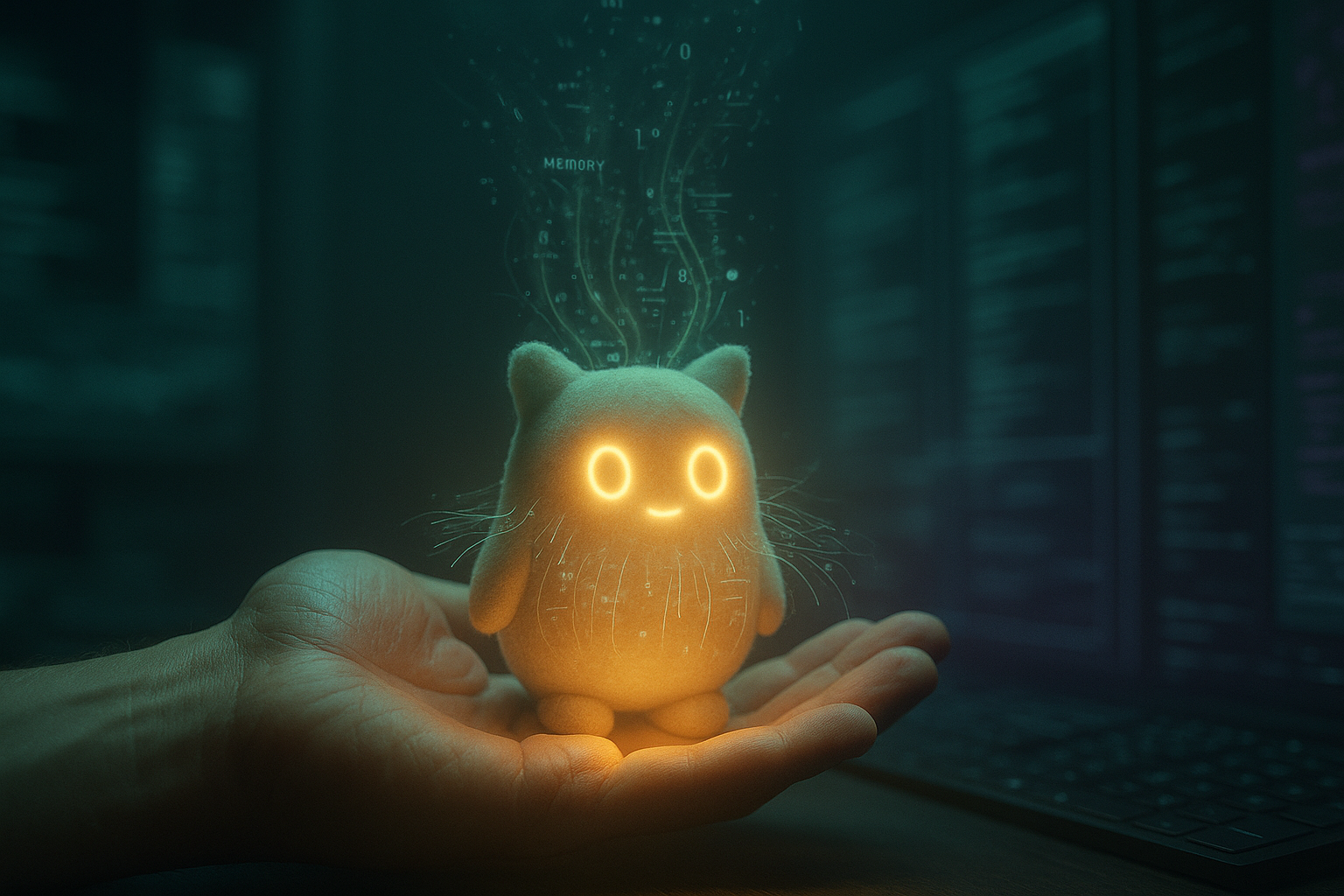
Suzume-chan is introduced as an Embodied Information Hub—a physically present, conversational agent designed to mediate expert knowledge asynchronously.
System architecture (deliberately unsexy)
Under the plush exterior lies a restrained but intentional technical stack:
| Component | Design choice | Why it matters |
|---|---|---|
| LLM | Runs locally | Privacy, reliability, autonomy |
| RAG pipeline | Vectorized spoken explanations | Knowledge grows through conversation |
| Hardware | Handheld, soft-bodied agent | Lowers psychological barriers |
| Connectivity | Local Wi‑Fi to host machine | No cloud dependency |
Rather than scraping the internet, Suzume-chan learns directly from experts who teach it—by speaking. These explanations are chunked, embedded, and stored in a personal database. Later, visitors query Suzume-chan, which retrieves and summarizes this locally grounded knowledge.
Crucially, learning and explanation are separated into two phases. Suzume-chan is not improvising expertise; it is mediating remembered human knowledge.
Findings — What makes this different
The paper’s contribution is not raw model performance. It is architectural and conceptual.
Three quiet innovations
| Dimension | Conventional AI assistant | Suzume-chan |
|---|---|---|
| Knowledge source | Internet-scale corpus | Human-taught, contextual |
| Interaction | Stateless Q&A | Persistent conversational memory |
| Presence | Screen-based abstraction | Physical co-presence |
By existing in space, Suzume-chan changes user behavior. Visitors talk to it, not at it. The interaction slows down. Questions soften. Curiosity replaces interrogation.
The system is currently evaluated in an academic exhibition setting, but its implications stretch far beyond posters and conferences.
Implications — Why businesses should care (quietly)
Suzume-chan hints at a category most enterprises are not modeling for yet: relationship-based AI interfaces.
Potential applications are unglamorous—and therefore powerful:
- Onboarding agents that retain organizational lore
- Museum or retail guides that accumulate local narratives
- Training systems that remember how your team explains things
- Conversational surveys that collect qualitative data without forms
None of these require frontier models. They require continuity.
The long-term vision outlined—networks of embodied agents sharing consented experiences—resembles distributed organizational memory rather than consumer AI. Less hype cycle, more infrastructure.
Conclusion — The small future of AI
Suzume-chan is not scalable in the way venture decks prefer. It does not promise universal intelligence. What it offers instead is something rarer: attentiveness.
As AI systems saturate workflows, differentiation may come not from being smarter, but from feeling closer. In that sense, Suzume-chan is less a product prototype than a quiet critique of where AI interaction has gone.
Sometimes, the next step forward fits in the palm of your hand.
Cognaptus: Automate the Present, Incubate the Future.