Build an Internal Knowledge Assistant
How to design an internal AI assistant that helps staff find policies, procedures, and operating knowledge without creating a guessing machine.
How to design an internal AI assistant that helps staff find policies, procedures, and operating knowledge without creating a guessing machine.
How to build a lightweight retrieval-augmented knowledge tool with grounded answers, source citations, narrow scope, and a realistic MVP.
A business-friendly explanation of retrieval-augmented generation and why it matters when your AI must work from company knowledge.

TL;DR for operators A team building RAG over scientific PDFs has at least two separate decisions to make: how a page should be found, and what representation of that page the answering model should read. Those decisions do not receive the same answer. In the IRPAPERS benchmark,1 text and image retrieval recover partially different correct pages. Fusing their signals raises open-source retrieval to 49% Recall@1 and 95% Recall@20, above either modality alone. But once retrieved material is passed to GPT-4.1 for question answering, OCR text is substantially stronger: TextRAG scores 0.82 alignment at five retrieved pages versus 0.71 for ImageRAG. ...

TL;DR for operators A long generated report can contain low-risk statements alongside claims that deserve much stronger evidence checking. Applying the strictest verification rule everywhere spends verifier capacity without distinguishing where factual failure is most likely. FACTOR turns that problem into a routing decision. The framework estimates uncertainty for individual claims, applies progressively stricter evidence requirements as estimated risk rises, and then selects among multiple generated candidates. In the reported benchmark, FACTOR reached a FActScore of 42.3 versus 36.8 for static verification while reducing average verification calls from 194.0 to 41.9.1 ...
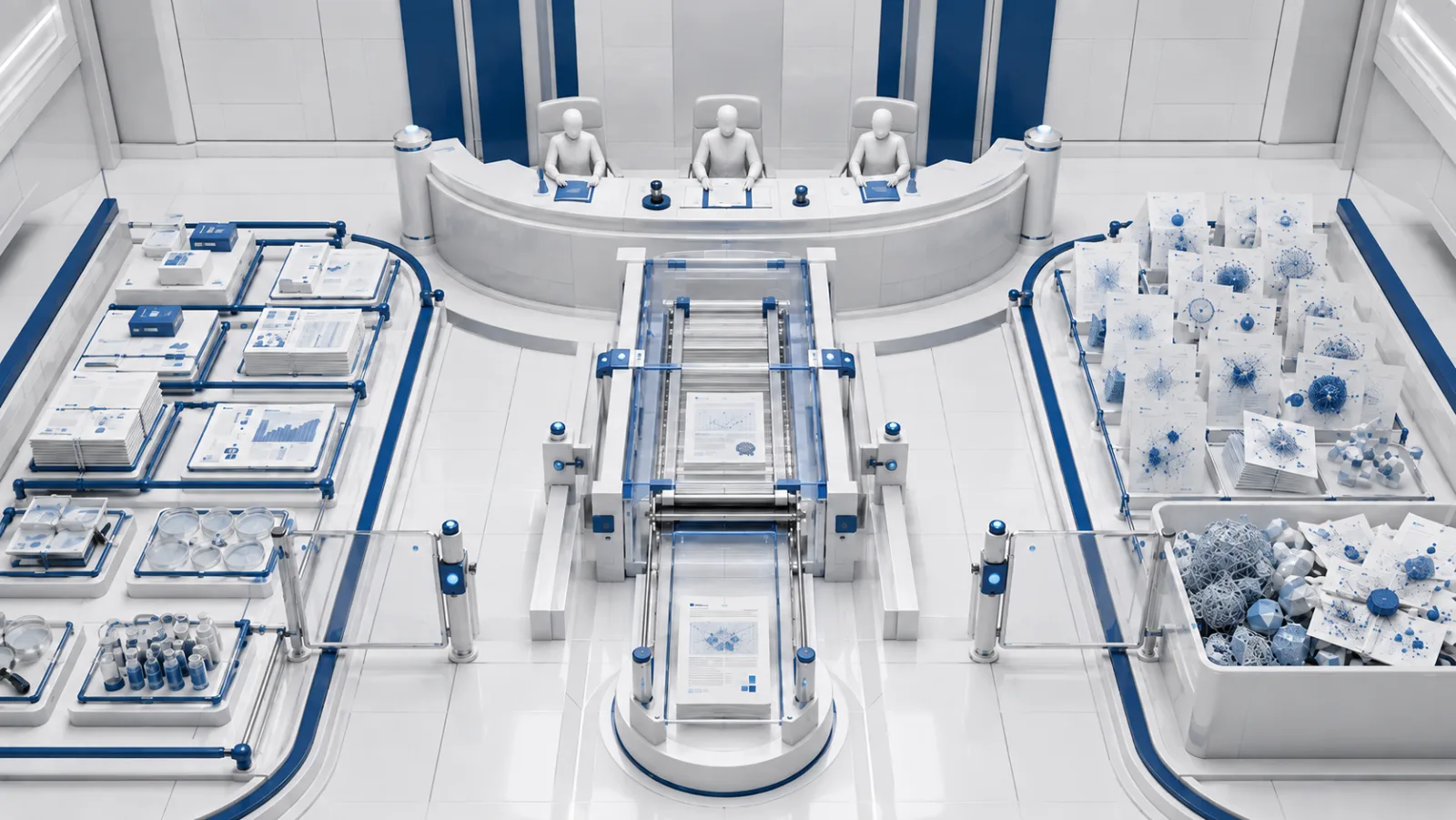
TL;DR for operators Synthetic data should have a defined job before anyone scales its production. For model training, the relevant test is whether generated examples add nonredundant learning signal and improve held-out performance without unacceptable regressions. For consumer research, the test changes: statistically diverse text is not enough if the business claim concerns what real customers believe. ...

TL;DR for operators A retrieval system can find a useful first document and still be searching incorrectly afterward. That document may reveal a person, relationship, date, product, or policy that makes the missing evidence much easier to specify than it was from the original request. EviReform1 makes that change explicit: it reads initially retrieved evidence, generates new queries describing what remains unresolved, retrieves against those queries, preserves part of the original-question signal, and only then uses graph connections to consolidate evidence. The paper’s component tests indicate that this query reformulation accounts for most of the improvement; graph propagation adds a smaller, consistent increment. ...

TL;DR for operators A retrieval system can answer only the questions a user thinks to ask. That becomes a design constraint when the user’s main problem is not missing information but missing awareness that information is missing. VeriForge addresses this by giving AI initiative over discovery while leaving the writer in control of synthesis. In a study of 12 writers, blind-spot alerting averaged 6.33 with VeriForge versus 3.00 with a strengthened baseline, and 11 of 12 participants rated VeriForge higher. Creativity support, exploration behavior, and expert-rated perceived domain competence also improved after statistical correction.1 ...

TL;DR for operators When a question requires several facts to be connected, improving entity coverage is not enough if the graph still lacks the relations needed to move between those facts. In a 200-query structural-connectivity pilot, pure Freebase connected the required endpoints within three hops in 24.1% of cases. Wikidata raised entity linking from 77.0% to 85.6%, but connectivity reached only 37.6%. Adding document text into the Freebase-based graph raised connectivity to 69.7%. ...

TL;DR for operators A production RAG system returns the same answer five times. The operator still has to decide whether to release it, investigate it, or send it for review. Repeated agreement is useful evidence that generation is stable, but it does not show that the system retrieved the right material. All five answers may have been generated from the same empty, incomplete, or incorrect context. In that case, repeated sampling does not independently test the answer; it repeatedly tests the decoder under one defective retrieval state. A wrong answer that remains effectively unchanged across samples is a silent error. ...