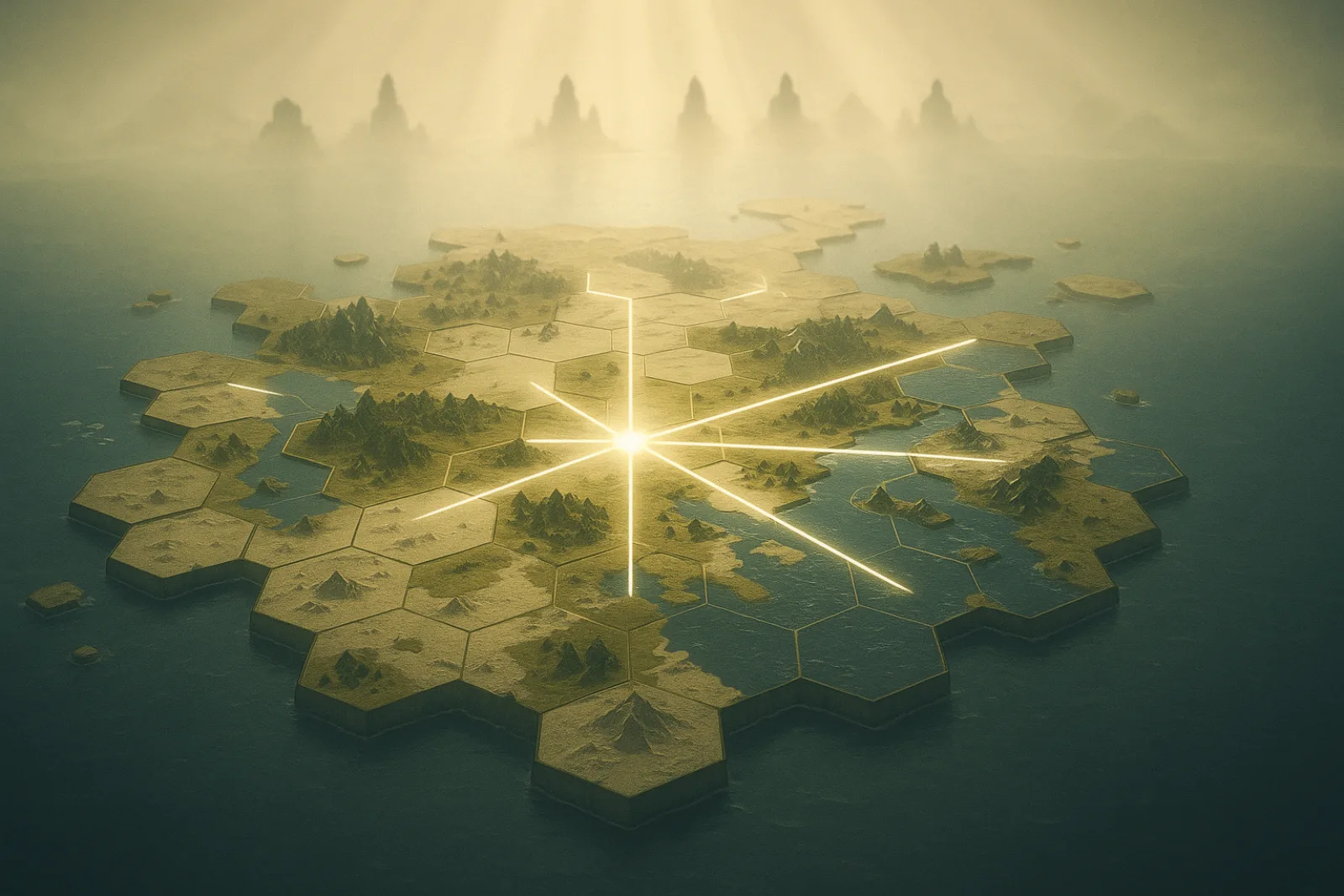
A strategy game is a cruelly efficient way to embarrass an intelligent system.
Not because games are magic. Not because hexagonal maps secretly contain the meaning of cognition. They do not, despite what several overexcited benchmark papers might imply after a strong coffee. Games are useful because they compress decision pressure. They make planning visible. They force trade-offs. They punish agents that confuse local competence with strategic understanding.
That is the real point of Terra Nova, a Civilization V-inspired comprehensive challenge environment for reinforcement learning agents.1 The obvious reading is that this is another big benchmark: larger map, more actions, more opponents, more ways to win. The more interesting reading is that Terra Nova is an argument about coupling. It is designed around the idea that agent intelligence should not be tested by isolating one neat capability at a time, but by forcing many hard capabilities to collide in the same environment.
Partial observability. Long-horizon credit assignment. Multi-agent competition. Strategically useful cooperation. Large structured action spaces. Divergent win conditions. Procedural maps. These are not separate checklist items. In Terra Nova, they are mutually contaminating pressures. The agent does not merely have to choose a good action. It has to choose an action whose value depends on hidden terrain, future technologies, rival incentives, diplomatic exposure, resource scarcity, and a victory condition it may later regret pursuing.
So no, Terra Nova is not mainly “Civilization, but for RL.” That is the souvenir-shop version. The stronger claim is that Terra Nova exposes a weakness in how the field often talks about agent progress: we keep measuring pieces of intelligence and then acting as if the assembled machine has been tested.
The benchmark problem is not size; it is strategic entanglement
Many AI benchmarks become difficult by adding volume. More tasks. More states. More tools. More text. More buttons for an agent to press while everyone pretends the problem is now “realistic.”
Terra Nova makes a different move. Its difficulty comes from interaction effects.
A single action can matter on several timescales. A worker improving a tile may produce immediate yield benefits. A building may pay off many turns later. A city placement decision may shape the entire game hundreds of turns downstream. A research path can unlock one strategic route while delaying another. A trade agreement can accelerate growth while strengthening a future rival. The agent is not solving a sequence of independent puzzles. It is creating the future state distribution in which its later decisions will either make sense or look faintly ridiculous.
That mechanism matters because real business environments look less like isolated tasks and more like coupled systems. A procurement decision changes supplier leverage. A pricing decision changes customer expectations. A credit policy changes portfolio composition. A logistics reroute changes inventory risk somewhere else. Enterprise agents that perform well on clean operational subtasks may still fail when those subtasks become linked through incentives, delays, and incomplete information.
Terra Nova is valuable because it makes that coupling explicit.
Six players turn planning into political economy
Terra Nova is a six-agent, free-for-all environment. That detail is not decorative. A one-versus-one game can often be framed as direct optimisation against an opposing policy. A single-player game can become planning under environmental uncertainty. Terra Nova sits in the more awkward middle: several independent parties can win, each with incomplete information, each capable of cooperating or competing depending on strategic advantage.
The paper highlights this through its comparison with other comprehensive challenge environments. StarCraft II and Dota 2 bring partial observability and large action spaces, but their standard competitive framing is one-versus-one. NetHack and Craftax provide difficult environments, but without multiple competing agents that can win the same game. Diplomacy has strategically dominant cooperation, but not partial observability in the same sense. Terra Nova combines one-versus-many competition, strategically important cooperation, partial observability, a large action space, and four win conditions.
That combination matters because cooperation is not treated as a polite add-on. In Terra Nova, trade deals can exchange resources, gold, or promises of peace. The paper is blunt about the consequence: agents that do not trade quickly fall behind those that do. In other words, cooperation is not moral decoration. It is an instrument of competitive survival.
That is the kind of mechanism enterprise AI evaluations usually under-test. In organisations, agents will not operate in empty rooms. They will interact with other agents, human departments, vendors, customers, regulators, and competing objectives. Sometimes cooperation will be efficient. Sometimes withholding cooperation will be rational. Sometimes cooperation will create future dependency. A benchmark that cannot express those tensions can still be useful, but it is not testing strategic agency in the richer sense.
Terra Nova’s six-player design turns agency into political economy. That is inconvenient. Good. Convenient benchmarks have already had their moment.
Partial observability makes memory and inference unavoidable
Partial observability in Terra Nova is not one generic fog-of-war trick. It appears in several forms.
Unexplored regions of the map are hidden. Once terrain and resource locations are discovered, static information remains visible. Dynamic information, such as unit movement or newly founded cities, is visible only when it lies within the line of sight of the agent’s units or cities. The technology tree adds another form of hidden information: agents may infer which technologies have been unlocked globally, but cannot directly observe which specific rivals have researched them.
This creates a useful distinction. The agent is not merely missing information. It is missing different kinds of information with different persistence and strategic meaning.
Some uncertainty can be resolved by exploration. Some must be tracked through memory. Some must be inferred from rival behaviour. Some may remain ambiguous until it is too late to respond cheaply. That is much closer to the uncertainty structure of operational decision-making than a benchmark where the missing variable is just another hidden card.
For business readers, the practical inference is not “train your agents on Terra Nova and they will run your company.” Please do not give the procurement department a hex map and call it transformation. The useful lesson is evaluation design: if an agent is expected to operate under incomplete knowledge, the test environment should distinguish between unknown facts, stale facts, inferred facts, and adversarially concealed facts.
A customer-support agent, for example, may not know a user’s full history. A credit-risk agent may see delayed signals. A supply-chain agent may infer supplier stress from delivery patterns before formal disclosure. A market-making agent may see flow but not intent. These are all different observability problems. Terra Nova’s design is a reminder that “partial information” is not one failure mode. It is a family of them.
The large action space is not the deepest problem
Terra Nova’s action space is large and highly structured. The paper describes it as factorised from roughly 450 sub-action spaces, with sub-action sizes ranging from two to 2,772 options. Agents must manage city populations, choose technologies, move units, conduct combat, allocate production, handle trade routes, and respond to context-dependent unit and city states.
It would be easy to make this the headline: enormous action space, therefore hard benchmark. That is true, but incomplete.
The more important issue is that the action space is heterogeneous. The agent is not choosing among many versions of the same kind of move. It is selecting across qualitatively different control surfaces. A city-management decision, a military movement, a technology choice, and a diplomatic trade are not merely different buttons. They are interventions into different sub-systems whose effects interact.
This is where many agent evaluations become too clean. Tool-use benchmarks often treat tool calls as discrete, locally evaluated operations. Did the agent call the right API? Did it update the file? Did it retrieve the right document? Useful questions. But strategic agency requires more: did the agent choose the right type of intervention, at the right level of abstraction, given future commitments and rival responses?
Terra Nova forces that issue. The agent must decide not only what to do, but what kind of decision problem it is currently facing. Is the binding constraint military? Scientific? Diplomatic? Economic? Exploratory? Is the best move a direct action or an investment that changes the option set later?
That is a better proxy for high-stakes business automation than another pass/fail task. Real agents in finance, operations, compliance, or logistics will not just execute steps. They will select among intervention types under uncertainty. The expensive failures will come from choosing the wrong frame, not from clicking the wrong button.
Four victory paths turn optimisation into commitment
Terra Nova includes four distinct win conditions: science, domination, culture, and diplomacy.
A science victory requires constructing the Space Shuttle components after completing major prerequisites, including the Apollo Program and specific advanced technologies. A domination victory requires sacking every other agent’s capital city. A culture victory requires tourism output to eclipse each opponent’s cumulative culture individually. A diplomatic victory requires receiving 12 votes to become World Leader during the World Congress.
The crucial design choice is that these paths are mutually exclusive in practice. They require specialised investments. The paper notes that buildings and social policies that help science do not directly advance cultural or diplomatic victory. A cultural path may require investment in civics and culture-related technologies at the expense of military or scientific development. Progress in one direction can make later pivots more costly.
This is the benchmark’s sharpest business analogy.
Most enterprises do not fail because they lack objectives. They fail because objectives become entangled with resource commitments. Optimising for short-term margin may weaken resilience. Optimising for growth may overload support capacity. Optimising for compliance may slow product iteration. Optimising for automation efficiency may increase systemic brittleness. The problem is not “multi-objective optimisation” in the abstract. The problem is that early investments reshape the feasible strategy set.
Terra Nova gives this issue a clean game-theoretic expression. Victory conditions are not just alternative endings. They are commitment structures.
That makes the environment useful for studying whether agents can recognise when a strategic path has become dominant, when a pivot is still viable, and when a tempting local gain undermines the chosen route. Those are not cosmetic skills. They are exactly the kind of planning competence enterprise agents will need if they are expected to handle anything more consequential than inbox origami.
The paper’s evidence is a design comparison, not a performance result
The paper does not present benchmark results showing that a particular RL method succeeds in Terra Nova. That boundary matters. This is not an article about an agent achieving a new score. It is an article about an environment designed to make certain scores meaningful later.
The central evidence is architectural and comparative. Terra Nova is positioned against prior comprehensive challenge environments across opponent structure, cooperation, partial observability, action-space scale, and number of win conditions. Its contribution is the combination.
| Paper claim | Evidence in the paper | Business meaning | Boundary |
|---|---|---|---|
| Terra Nova is designed as a comprehensive challenge environment | It combines multiple canonical RL challenges in one game rather than aggregating unrelated tasks | Evaluation should test capability interaction, not just isolated competence | The paper does not prove that performance in Terra Nova transfers to enterprise settings |
| Cooperation is strategically important | Trade deals and peace promises can materially affect growth; non-trading agents are disadvantaged | Real agents need to reason about cooperation as a competitive instrument | The paper does not study emergent negotiation behaviour empirically |
| Partial observability is multi-form | Hidden map areas, line-of-sight dynamics, and imperfect technology knowledge all constrain decisions | Tests should separate unknown, stale, and inferred information | Terra Nova is still a simulated game, not a live organisation |
| Victory paths create strategic commitment | Science, domination, culture, and diplomacy require specialised investments | Agent evaluation should include irreversible or costly-to-reverse choices | No reported agent results show current systems managing these trade-offs |
| The software is built for research use | It includes maps, distributed simulation support, recordings, viewer tools, and starter neural architecture | Usability matters because hard benchmarks without tooling become museum pieces | Tooling lowers adoption friction but does not solve the learning problem |
This distinction may sound pedantic. It is not. The agent industry has a habit of converting evaluation infrastructure into capability claims with the grace of a magician hiding a rabbit in a quarterly deck. Terra Nova should not be read that way. Its current value is as a challenge design and research platform. The performance story remains open.
The formal game matters because reward and winning can separate
The paper formalises Terra Nova as a turn-based partially observable stochastic game. Full games involve six agents. Each game turn consists of six agent turns, one per player. The state includes discrete and continuous components, the currently active agent, timestep, and game turn. Observations are generated from state through the agent’s limited view. The process continues until a maximum number of game turns is reached or a victory condition is satisfied.
The most interesting part is not the notation. It is the separation between reward and victory.
The paper notes that Terra Nova’s reward function can provide rewards for playing the game well, such as growing city population or building World Wonders, rather than only rewarding progress toward one victory type. A sparse reward alternative could instead focus on winning. This creates two different research targets: agents that play competently across the game’s systems, and agents that win consistently.
That distinction is operationally important. In business settings, local performance indicators often reward “good behaviour” that may or may not produce the strategic outcome. A sales agent can increase activity while degrading lead quality. A logistics optimiser can reduce today’s cost while increasing tomorrow’s fragility. A compliance assistant can maximise policy coverage while burying decision-makers in unusable paperwork.
Reward design is not bookkeeping. It defines what kind of intelligence the system is being trained or evaluated to exhibit. Terra Nova makes that visible by allowing researchers to study game-playing competence and game-winning competence as related but non-identical objectives.
That is a useful warning for enterprise AI programmes: before celebrating agent performance, ask whether the evaluation rewards the behaviour you actually need, or merely the behaviour that was easy to measure.
The software contribution keeps the benchmark from becoming theatre
Hard environments are only useful if researchers can actually run them, inspect them, and build against them. Terra Nova’s software contribution is therefore not a footnote. It is part of the paper’s practical value.
The initial release includes 10,000 procedurally generated maps. The maps are generated to support balanced six-player starts, including regional resources that can create trade asymmetries. This matters for generalisation: agents should not simply memorise openings against a fixed map.
The environment also supports distributed games across visible XLA devices using JAX shard map utilities. That is not glamorous, but it is important. If training throughput collapses, a benchmark becomes a philosophical exercise with a GitHub link. Terra Nova’s distributed simulation design is an attempt to make large-scale experimentation feasible.
The recording and viewer tools are equally important. Researchers can replay games, inspect cities, follow technology and social-policy progress, track demographics, and examine the full game state. This makes the environment more diagnosable. In complex agent settings, aggregate scores are often close to useless without behavioural inspection. An agent may lose because it failed to explore, overinvested in culture, misread a rival, neglected trade, or pursued a victory path it had already made infeasible. Those are different failures requiring different research responses.
Finally, the paper provides a starter neural architecture. It includes encoders for categories of observation information, handles spatial information by scattering values onto a map, uses bottlenecked representations with cross-attention among relevant components, and provides learnable action heads for sub-action spaces. The architecture is not presented as a solved baseline. It is scaffolding.
That is the right posture. A benchmark this complex should not merely invite researchers to suffer. It should provide enough structure to make the suffering reproducible.
What Terra Nova suggests for enterprise agent evaluation
Terra Nova does not tell companies which agent architecture to buy, deploy, or fine-tune. It does not claim that a model capable of playing Terra Nova will automatically manage procurement, capital allocation, or incident response. The business relevance is more specific and more useful: it suggests how agent evaluations should be designed when the deployment environment is strategic, uncertain, and multi-stakeholder.
First, evaluations should test coupled pressures. If an enterprise agent is expected to plan under uncertainty while using tools, negotiating constraints, and managing long-term objectives, the test should include those interactions together. Testing each component separately is necessary, but not sufficient.
Second, evaluations should include delayed consequences. Many agent demos reward immediate task completion. Real operations often punish decisions only later. Terra Nova’s multi-timescale credit structure is a reminder that short evaluation windows can systematically overrate agents that harvest local rewards while damaging future options.
Third, evaluations should distinguish cooperation from compliance. Cooperation in Terra Nova is strategic. It changes growth trajectories and competitive positioning. In business, collaboration between agents, departments, vendors, and humans will also involve incentives. An agent that follows instructions politely is not necessarily an agent that understands cooperative strategy.
Fourth, evaluations should inspect behavioural traces, not just final outcomes. Terra Nova’s viewer tools are valuable because they make failure analysis possible. Enterprise agent evaluation should copy that instinct. Logs, replay, state inspection, counterfactual review, and trajectory-level diagnosis are not governance theatre. They are how organisations learn whether an agent is brittle, confused, overconfident, or simply optimising the wrong thing.
Finally, evaluations should include strategic commitment. Agents should be tested on whether they can recognise when early decisions constrain later options. This is especially important in finance, supply chain, hiring, cybersecurity, capital projects, and compliance programmes, where reversibility is often expensive or fictional.
Where the argument should not be overread
There are three important boundaries.
First, Terra Nova is a challenge environment, not evidence that current agents can handle it. The paper gives the field a harder arena. It does not crown a champion. Any business interpretation should therefore focus on evaluation design rather than immediate deployment capability.
Second, Terra Nova is still a game. Games are valuable because they compress strategic structure into a controllable simulation. They are not the same as organisations, markets, regulators, customers, or physical infrastructure. Transfer from game competence to business competence remains a hypothesis, not a conclusion.
Third, complexity can be both a strength and a liability. A benchmark that combines many challenges can reveal interaction failures, but it can also make causal diagnosis harder. If an agent fails, did it fail because of exploration, memory, planning, reward design, action selection, negotiation, representation learning, or compute limits? Terra Nova’s tooling helps, but the interpretation burden remains real.
These limitations do not weaken the paper’s contribution. They define it properly. Terra Nova is not a shortcut to general intelligence. It is a better stress chamber.
The frontier is not another leaderboard; it is a harsher question
The useful question Terra Nova asks is not “Can an agent win this game?”
That question will matter eventually. But the more immediate question is sharper: can an agent maintain coherent strategy when every decision changes the value of future decisions?
That is the frontier Terra Nova pushes toward. It rejects the comforting fiction that agent intelligence can be validated through tidy tasks, isolated skills, or leaderboard increments that look suspiciously like progress because the spreadsheet says so. It offers a messier test: hidden information, rival agency, delayed payoffs, trade dependencies, irreversible investments, and multiple ways to win that cannot all be pursued at once.
For researchers, Terra Nova is a call to build agents that can reason across entangled systems rather than optimise inside narrow lanes. For businesses, it is a warning about agent evaluation. If your proposed autonomous system will operate in a strategic environment, do not validate it only on tasks that remove strategy for convenience.
Hexes are optional. Coupling is not.
Cognaptus: Automate the Present, Incubate the Future.
-
Trevor McInroe, “Terra Nova: A Comprehensive Challenge Environment for Intelligent Agents,” arXiv:2511.15378, 2025. https://arxiv.org/abs/2511.15378 ↩︎