TL;DR for operators
Legal AI does not fail only because models “hallucinate”. That word has become the industry’s favourite fog machine. The more operational diagnosis is sharper: models fail when they answer current legal questions from stale internal memory and then dress the error in confident reasoning.
The L-MARS paper is useful because it separates two tasks that vendors often blend together for convenience: retrieving current legal facts and reasoning over stable legal principles.1 On LegalSearchQA, a new 50-question benchmark built around recent U.S. legal facts verified in March 2026, L-MARS reaches 96.0% accuracy. Zero-shot GPT-4o-mini reaches 58.0%. Chain-of-thought falls to 30.0%, because step-by-step reasoning from outdated premises merely creates a more articulate mistake.
That is the good news for RAG. The bad news, for anyone selling RAG as seasoning for every workflow, is that the same system barely helps on Bar Exam QA: 55.9% with L-MARS versus 55.2% zero-shot. Retrieval is not magic legal judgment. It is an evidence-access layer. When the answer lives in updated IRS, USCIS, SEC, Federal Register, or court sources, retrieval matters. When the task is mainly applying known doctrine to a hypothetical, web search may add noise in a very expensive hat.
The business lesson is therefore not “use multi-agent legal AI”. It is: classify the question first. If the question depends on current authority, route it through authoritative retrieval, citation checks, jurisdiction checks, and date validation. If it depends on legal reasoning over a stable fact pattern, retrieval may not be the bottleneck. Paying for the wrong bottleneck is still paying, just with nicer dashboards.
The easy mistake is to call every legal question “reasoning”
Legal work has a branding problem inside AI systems. Everything gets labelled as reasoning because reasoning sounds valuable, billable, and vaguely serious. But many operational legal questions are not deep jurisprudential puzzles. They are freshness problems.
“What is the 2025 standard deduction for a single filer after a legislative amendment?” is not asking the model to become Learned Hand with a GPU. It is asking whether the system can find the current number. “What is the status of an executive order after a later revocation?” is not an invitation to philosophise about executive power. It is a demand for current authority.
L-MARS is interesting precisely because it does not reward the model for sounding careful. It tests whether the system can reach the right source before answering. That distinction matters for any business building legal, compliance, HR, tax, immigration, privacy, procurement, or regulatory-support tooling.
The old article on this paper leaned too heavily into a judge-in-the-loop multi-turn architecture story. That story exists in the system design, but it is not what the benchmark actually proves. The evaluated configuration is L-MARS Simple Mode, using Serper web search and agents in a single-pass pipeline. The paper describes Multi-Turn Mode, local BM25 indexing, and CourtListener integration, but those are not benchmarked as the source of the headline result. Architecture deserves applause only for what it actually did on stage.
The comparison is the argument
The paper’s main contribution is not merely a new legal RAG system. It is a split-screen test.
On one side sits LegalSearchQA: 50 multiple-choice questions across Tax, Corporate & Financial Regulation, Labor & Employment, Immigration, Technology & Privacy, and Criminal, Drug & State Law. The questions are factual, current, and grounded in sources such as IRS.gov, USCIS.gov, SEC.gov, Federal Register materials, and Supreme Court opinions. They were verified against primary legal authorities in March 2026.
On the other side sits Bar Exam QA: 594 historical multistate bar examination questions from a reasoning-focused legal retrieval benchmark. These questions are not mainly about discovering today’s rule change. They test whether a model can apply doctrine to fact patterns.
That comparison is the paper’s spine.
| Evaluation setting | What it mainly tests | What L-MARS shows | Business meaning |
|---|---|---|---|
| LegalSearchQA | Current factual legal knowledge | Large gain from structured retrieval | Use retrieval when freshness and authority are the risk |
| Bar Exam QA | Legal reasoning over exam-style hypotheticals | Negligible gain from retrieval | Do not assume search fixes reasoning bottlenecks |
| Retrieval-depth ablation | Whether more search context helps reasoning-heavy QA | More snippets can add noise; deeper search can add latency | Retrieval has a cost curve, not just an accuracy curve |
| Error analysis | Where L-MARS still fails | Buried facts can evade snippet-level search | Evidence access needs depth controls and escalation |
The useful business reading is not “L-MARS beats lawyers” or “multi-agent systems solve legal AI”. Please retire both sentences with appropriate ceremony. The paper shows that a retrieval-oriented workflow performs very well when the benchmark is intentionally designed around current legal facts. It also shows that the same retrieval layer has limited value when the task is not primarily an information-access problem.
That boundary is the point.
LegalSearchQA is small, targeted, and unusually revealing
LegalSearchQA contains only 50 questions. That is not large enough to support sweeping claims about all legal AI. It is, however, large enough to demonstrate a very specific failure mode: models trained before a legal development cannot reliably answer questions that depend on that development.
The benchmark spans five domains:
| Domain | Questions | Zero-shot | CoT | L-MARS |
|---|---|---|---|---|
| Tax, Corporate & Financial Regulation | 13 | 30.8% | 15.4% | 92.3% |
| Labor & Employment | 11 | 63.6% | 18.2% | 100.0% |
| Technology & Privacy | 9 | 55.6% | 44.4% | 100.0% |
| Immigration | 9 | 66.7% | 22.2% | 88.9% |
| Criminal, Drug & State Law | 8 | 87.5% | 62.5% | 100.0% |
| Overall | 50 | 58.0% | 30.0% | 96.0% |
The largest gain appears in Tax, Corporate & Financial Regulation: L-MARS improves by 61.5 percentage points over zero-shot. That is exactly where one would expect retrieval to matter. Dollar thresholds, filing deadlines, settlement dates, disclosure rules, and regulatory requirements are not timeless truths. They are moving targets wearing formal clothing.
The smallest gain appears in Criminal, Drug & State Law, where zero-shot already reaches 87.5%. The paper suggests that some of these facts were likely more public or better represented in general information flows. In other words, retrieval helps most when the model’s internal memory is least likely to contain the answer.
That is a practical routing rule hiding inside a benchmark table.
Chain-of-thought becomes dangerous when the premise is stale
The most entertainingly grim result is not L-MARS at 96.0%. It is chain-of-thought at 30.0%.
A four-choice random baseline is 25%. Chain-of-thought does not fall below random overall, but it performs disastrously relative to zero-shot and falls below 25% in three of the five domains. That is not because reasoning is inherently bad. It is because reasoning from obsolete facts is just error with stationery.
The paper calls this “confident confabulation”: the model recalls an outdated rule, old dollar amount, or superseded policy, then builds a coherent explanation around it. The structure of reasoning makes the answer look more responsible while making it less correct.
The appendix examples make the mechanism obvious. In one question, the model treats Executive Order 14110 as still active because it remembers the original 2023 order and does not know about the later revocation. In another, it selects an outdated standard deduction figure because it extrapolates from prior-year tax information instead of retrieving the amended 2025 amount.
This is not a legal-only problem. It applies to any operational domain where facts change faster than model training cycles:
| Domain | Stale premise risk | Bad “reasoning” output |
|---|---|---|
| Tax | Old thresholds, deductions, filing rules | Plausible calculations using obsolete numbers |
| Immigration | Updated visa procedures or eligibility rules | Confident guidance based on superseded policy |
| HR compliance | New wage, leave, or classification rules | Polished advice that violates current law |
| Privacy | Updated state rules, enforcement guidance, deadlines | Jurisdictionally wrong compliance steps |
| Finance compliance | New settlement cycles or disclosure rules | Correct-looking workflows using old dates |
This is where “let the model think step by step” becomes a weak control. Thinking is not a substitute for knowing what year it is. A painful sentence, but apparently necessary.
What L-MARS actually does in the evaluated path
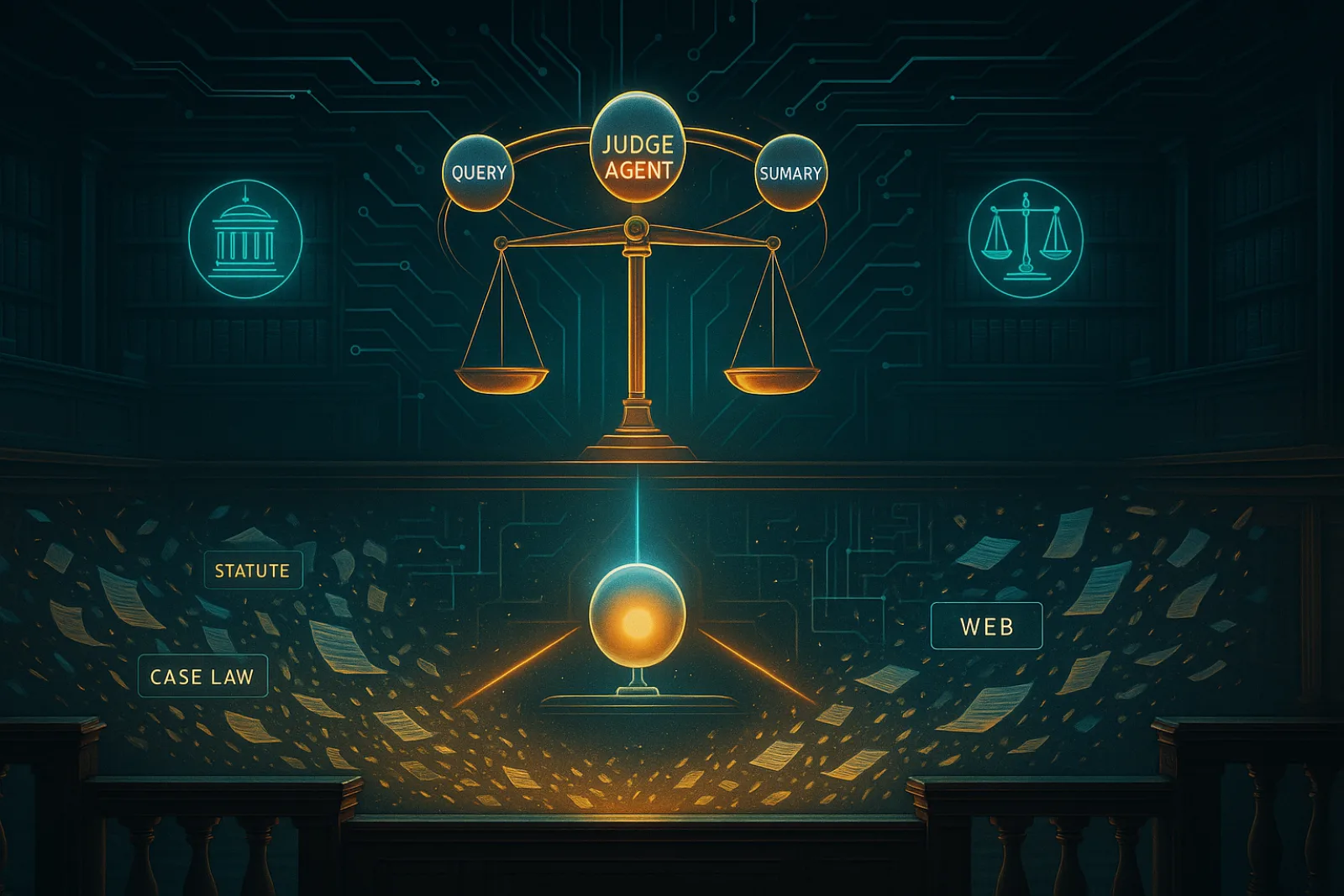
L-MARS stands for Legal Multi-Agent Workflow with Orchestrated Reasoning and Agentic Search. The full system includes Query, Search, Judge, and Summary agents, plus multiple retrieval backends. But the evaluated headline result comes from Simple Mode.
In Simple Mode, the workflow is straightforward:
- The Query Agent structures the user question into a search intent.
- The Search Agent retrieves evidence using web search.
- The Summary Agent selects the answer and cites supporting evidence.
The paper also describes a Multi-Turn Mode, where a Judge Agent checks evidence sufficiency, jurisdiction, temporal specificity, contradictions, and missing information before allowing the workflow to stop. That loop is conceptually important, especially for open-ended research tasks. But the experiments in the paper evaluate Simple Mode to isolate the value of structured retrieval without iterative refinement.
This distinction matters because business readers often over-credit the most elaborate part of an architecture diagram. In this paper, the main evidence supports a simpler claim: even a single-pass structured retrieval workflow can outperform model memory when current legal facts are required.
The optional components still have operational relevance. Local BM25 indexing matters for firms with private memos, policy manuals, contract repositories, or annotated legal materials. CourtListener integration matters for case-law-grounded workflows. Multi-turn judging matters when search results include weak secondary sources, unofficial forums, or conflicting authority. But those are implementation extensions, not the proven source of the 96.0% figure.
The Bar Exam result keeps the story honest
On Bar Exam QA, the numbers are far less dramatic:
| Condition | Accuracy | Correct |
|---|---|---|
| Zero-shot | 55.2% | 328 / 594 |
| L-MARS with Serper | 55.9% | 332 / 594 |
| L-MARS with Tavily | 54.4% | 323 / 594 |
This is the anti-hype table. It says retrieval is not automatically useful just because the domain is legal. L-MARS with Serper improves by 0.7 percentage points. L-MARS with Tavily declines by 0.8 points. At subject level, some areas improve modestly, such as Contracts and Evidence, while others regress, such as Constitutional Law and Torts.
The interpretation is not that L-MARS fails. The interpretation is that the bottleneck changed. Bar Exam QA asks the model to reason through hypothetical fact patterns using legal principles that are usually stable and already represented in the model’s training. Search results can distract the system, introduce irrelevant generalities, or surface near-matching doctrine that does not fit the specific facts.
For business deployment, this is the difference between adding a search layer and adding a decision layer. If a compliance assistant is asked, “What is the current reporting threshold?”, retrieval is probably the right first move. If it is asked, “Given these facts, which exception applies?”, retrieval may help only after the relevant authority is already identified. The system needs task classification, not a universal RAG reflex.
The ablation is about cost control, not a second breakthrough
The paper’s retrieval-depth ablation is easy to overread. It is not a new theory of legal search. It is a practical warning that more retrieval is not always better.
On a 50-question Bar Exam QA subsample, the authors compare retrieval depth and search mode. The reported result is that additional snippets reduce accuracy in that setting, while deep search produces similar accuracy to basic snippets but much higher latency: 30.4 seconds versus 0.75 seconds in the reported comparison.
This is an ablation, not the main evidence. Its likely purpose is to explain why the authors use lighter retrieval in Simple Mode and reserve deeper search for settings where a judge loop can filter noise. That is a reasonable engineering conclusion.
For operators, the lesson is blunt:
| Design choice | When it helps | When it hurts |
|---|---|---|
| More snippets | Current factual lookup with sparse initial evidence | Reasoning-heavy tasks where irrelevant sources distract |
| Deep extraction | Buried facts, primary documents, statutes, PDFs | Low-risk triage where latency dominates |
| Judge-gated iteration | Conflicting or unofficial sources | Simple factual questions where one primary source is enough |
| Local indexing | Proprietary policy and contract repositories | Public-law questions where official web sources are fresher |
Retrieval has unit economics. Every extra search, scrape, parse, and summarise step consumes latency, tokens, and operational patience. In a legal research memo, 30 seconds may be acceptable. In a user-facing intake assistant, it may be a small eternity with a spinner.
The two L-MARS errors are the real implementation warning
L-MARS misses only two LegalSearchQA questions. Those misses are more useful than another victory lap.
One error concerns H-1B weighted selection details involving wage-level assignment across multiple registrations. The retrieved results did not surface the specific Federal Register provision. The other concerns the exact effective date of T+1 settlement; search results discussed the policy generally but missed the precise date.
Both errors share the same pattern: the correct answer exists, but the retrieval layer does not expose the critical sentence.
That is the uncomfortable part for enterprise RAG. A system can have web search, source citations, agent roles, and a clean architecture diagram, yet still fail because the answer is buried one paragraph deeper than the snippet. The business problem is not merely hallucination. It is evidence granularity.
This suggests three operational controls:
| Control | Purpose | Practical test |
|---|---|---|
| Source escalation | Move from snippets to full primary documents when precision matters | Does the system fetch the statute, rule, notice, or agency page itself? |
| Fact-type detection | Recognise dates, dollar figures, deadlines, thresholds, and procedural exceptions as high-risk | Does the system treat numeric answers as requiring stronger evidence? |
| Citation-locality checks | Ensure the cited text actually contains the answer, not just a related topic | Can a reviewer find the answer in the cited passage within seconds? |
A citation to a relevant page is not enough. A citation to the exact answer-bearing passage is the thing. Otherwise the system has merely outsourced hallucination to the user’s patience.
Business value: freshness routing, not legal omniscience
The business relevance of L-MARS is strongest for workflows where the cost of stale information is high and the answer can be grounded in authoritative sources.
Good candidates include:
- tax threshold and filing-rule assistants;
- immigration eligibility and procedure checkers;
- employment-law policy triage;
- privacy and technology regulation monitors;
- financial compliance threshold lookup;
- internal policy assistants for regulated firms;
- contract playbook tools that need current fallback clauses or approval rules.
The pattern is consistent: the user asks for an answer whose correctness depends on a current external record. The system should not begin by “thinking harder”. It should begin by locating authority.
A useful enterprise architecture would therefore classify legal questions into at least three lanes:
| Question type | Example | Best first action |
|---|---|---|
| Current factual authority | “What is the 2025 threshold?” | Retrieve official current source |
| Stable doctrinal reasoning | “Which exception applies to these facts?” | Reason over doctrine, retrieve only targeted authority |
| Open-ended legal research | “What is the current split across jurisdictions?” | Multi-turn search, sufficiency judging, source comparison |
This classification step is where many AI products quietly fail. They treat every question as a prompt. In regulated work, a question is not just text. It is a risk object.
What the paper directly shows, what we infer, and what remains uncertain
The paper directly shows that L-MARS Simple Mode performs strongly on a 50-question benchmark designed around post-training U.S. legal facts. It also directly shows that chain-of-thought can degrade performance when models reason from stale internal knowledge, and that retrieval provides negligible improvement on Bar Exam QA.
Cognaptus infers that enterprises should use retrieval-gated workflows for time-sensitive legal and compliance facts, especially where answers involve dates, thresholds, eligibility conditions, jurisdiction-specific requirements, or recently changed rules. We also infer that question classification should precede retrieval. Search is a tool, not a personality trait.
What remains uncertain is broader deployment performance. LegalSearchQA is small. It covers U.S. law in English. It uses one backbone model, GPT-4o-mini. It evaluates multiple-choice questions, not messy client narratives, contract negotiations, conflicting authorities, or multi-jurisdictional research memos. The system’s Multi-Turn Mode, local RAG indexing, and CourtListener integration are described but not tested as part of the headline benchmark.
Those limitations do not weaken the central finding. They keep it in its lane. L-MARS is strong evidence for retrieval when current facts matter. It is not proof that multi-agent legal systems can replace legal judgment. Conveniently, civilisation survives another benchmark.
The operating principle: do not let stale memory impersonate authority
The practical value of L-MARS is that it gives teams a cleaner diagnostic vocabulary.
When a legal AI system fails, ask which failure it suffered:
| Failure mode | Symptom | Fix |
|---|---|---|
| Stale memory | Confident answer based on old law or old number | Current authoritative retrieval |
| Weak retrieval | Cites related but non-answer-bearing sources | Better source depth and locality checks |
| Wrong jurisdiction | Correct rule, wrong place | Query schema and jurisdiction filtering |
| Reasoning failure | Correct authority, wrong application | Better legal reasoning or human review |
| Over-retrieval | Too many irrelevant sources | Retrieval gating and task classification |
This is a better conversation than “the model hallucinated”. It tells the operator where to intervene. Sometimes the fix is not a bigger model. Sometimes it is a date field, a jurisdiction field, and a refusal to answer until the cited source actually says the thing.
That may be less glamorous than autonomous legal intelligence. It is also far closer to how useful systems get built.
Bottom line
L-MARS is not a victory parade for RAG everywhere. It is a judgment about where RAG earns its keep.
For current legal facts, structured retrieval cuts through stale model memory and prevents chain-of-thought from becoming a ceremonial wrong-answer generator. For reasoning-heavy legal exams, retrieval adds little and can add noise. That comparison is the paper’s real contribution.
The business lesson is simple enough to be dangerous: do not ask a model to reason its way into facts it cannot know. Route current authority questions through search, verification, and citation-locality checks. Save deeper reasoning for the places where reasoning is actually the bottleneck.
Legal AI does not need more confidence. It needs better evidence discipline.
Cognaptus: Automate the Present, Incubate the Future.
-
Ziqi Wang and Boqin Yuan, “L-MARS: Legal Multi-Agent Workflow with Orchestrated Reasoning and Agentic Search,” arXiv:2509.00761v3, 2026. ↩︎