TL;DR for operators
Training data is not a warehouse inventory problem. It is closer to nutrition. What helps a model early in pretraining may not be what helps it later, and a sample’s value can depend on the other samples sitting in the same batch. Obvious, perhaps. Operationalised? Less often.
The paper behind this article, LLM Data Selection and Utilization via Dynamic Bi-level Optimization, proposes a Data Weighting Model, or DWM, that does not merely decide which data enters training. It assigns weights to samples within each batch, freezes those weights while the language model trains for a stage, then updates the weighting model using validation performance through a bi-level optimisation loop.1
The headline result is not that DWM crushes every baseline. It does not. The more interesting result is subtler: a 370M Llama2-style model trained on 30B randomly selected SlimPajama tokens improves from a two-shot average of 45.1 to 46.4 with DWM. DWM also transfers to DSIR-selected data, QuRating-selected data, and a 1.3B model, but the gains are modest and task-wise uneven. This is research evidence, not a procurement brochure.
For operators, the useful lesson is this: if you are pretraining, continued-pretraining, or building a domain model, the real question is not only “Which documents should we keep?” It is also “When should the model listen harder to which documents, and according to what validation signal?” Static filtering is still useful. Treating it as the whole strategy is where the trouble begins.
The business implication is practical but bounded. DWM suggests a way to squeeze more learning out of an already-selected corpus, especially when compute budgets make “just train on more tokens” sound charmingly expensive. The boundary is equally clear: the paper’s evidence is at 370M and 1.3B scales, with 30B-token selections from SlimPajama, LAMBADA as the main validation task, and roughly 9% extra overhead when transferring a 370M weighting model to a 1.3B target model. In other words, interesting enough to test; not enough to tattoo on the infrastructure budget.
Static data selection solves only the entry problem
Most LLM data-selection work asks a sensible first question: which samples deserve to be in the training set?
That question has produced several families of methods. Some filter at token level. Some tune mixtures across large data pools. Some select individual samples using reference datasets or reference models. DSIR, for example, uses target distributions such as Wikipedia and books to guide selection. QuRating uses GPT-3.5-turbo preferences to score dimensions of data quality and train rating models. These approaches are not trivial. They are already a step beyond “scrape everything and hope the loss curve forgives you.”
But they mostly share one assumption: once the data has been selected, its job is stable. A sample is good or bad, useful or not useful, relevant or noise. The model then trains on selected samples more or less uniformly.
That assumption is convenient. It is also probably too tidy.
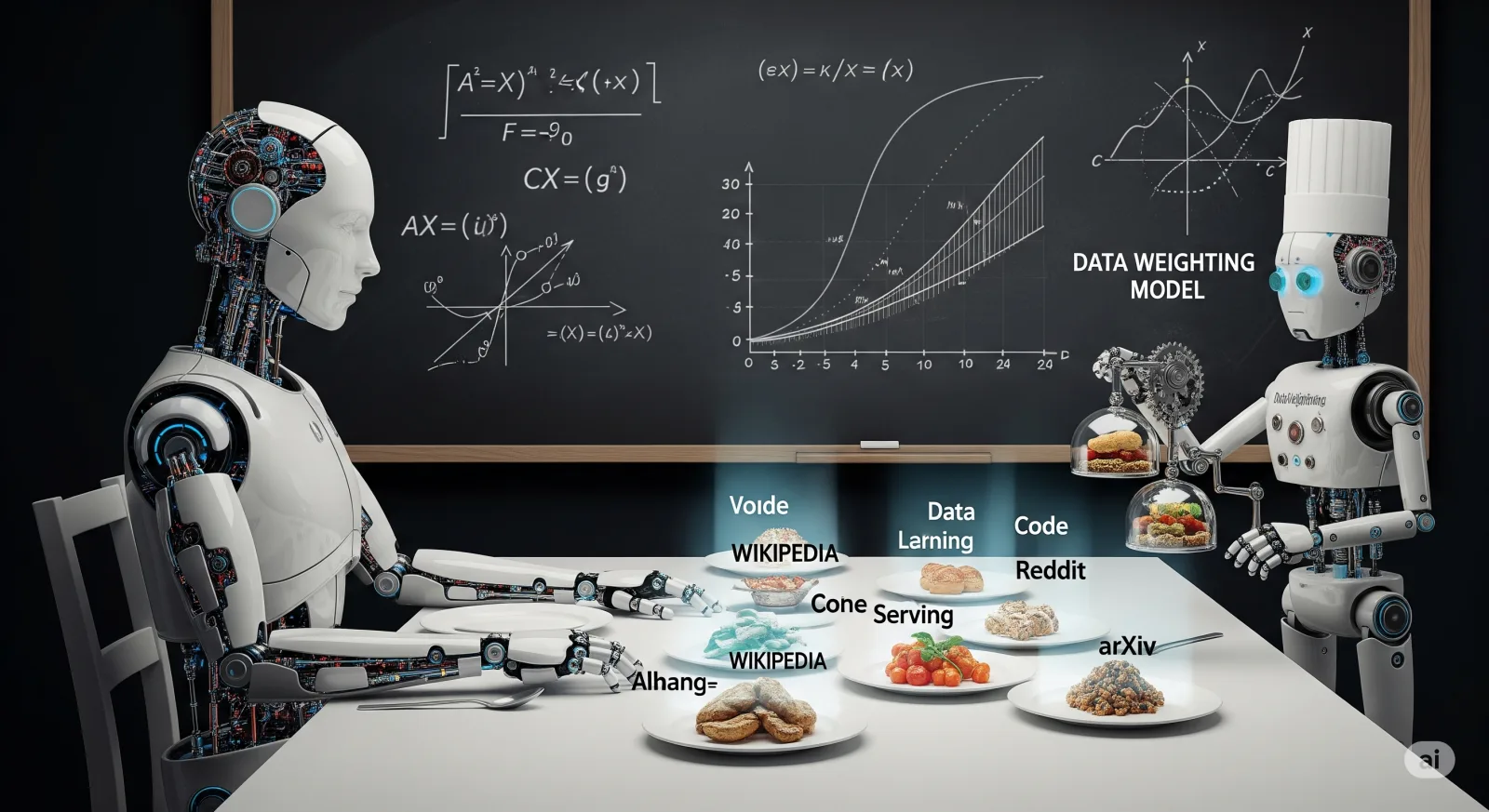
The paper’s criticism is that selection and utilisation are different problems. Selection decides what enters the kitchen. Utilisation decides what the model actually eats, when, and in what proportion. Static selection can remove low-quality data, but it does not answer whether a model at stage three needs the same data emphasis as a model at stage one. Nor does it account for the fact that samples do not update the model in splendid isolation. A batch produces one combined update direction. Samples interact, whether the training recipe admits it or not.
That is the conceptual move worth taking seriously. DWM is not “another filter.” It is a mechanism for turning selected data into stage-aware, batch-aware training pressure.
DWM turns data selection into a feedback loop
The Data Weighting Model sits inside training as a separate model that assigns a contribution weight to each sample in a batch. During normal language model training, each sample contributes through its autoregressive loss. With DWM, the batch loss becomes a weighted sum:
The notation is less important than the operational fact: the weight for one sample is generated in the context of the whole batch, not as a detached certificate of quality. The model is not saying, “This document is good forever.” It is saying, “Given this batch and this training stage, this sample should push the update more or less.”
The obvious failure mode is also obvious. If the weighting model were trained directly to minimise training loss, it could learn useless tricks: lower the weight of hard samples, or even suppress data in ways that make the immediate training objective look cleaner without improving the language model. Congratulations, the optimiser has found the spreadsheet loophole. A tiny civilisation collapses each time this happens.
The paper avoids that by using a bi-level optimisation objective. The lower level updates the language model using the DWM-weighted training loss. The upper level updates the weighting model according to how the updated language model performs on a validation set. The authors call this validation-based criterion “weight influence”: the performance of the trained LLM on validation data after being optimised with the weighting model.
A simplified view:
selected batch
    ↓
DWM assigns sample weights
    ↓
LLM updates on weighted training loss
    ↓
updated LLM is evaluated on validation task
    ↓
DWM is updated to favour weights that improve validation performance
    ↓
next training stage
This is why the mechanism matters. The weighting model is not rewarded for making training loss pretty. It is rewarded for producing sample weights that lead to better validation behaviour after the LLM update. In the experiments, that validation task is LAMBADA, chosen because it requires broad discourse context and is commonly used in language-model pretraining evaluation.
The training process is also staged. The paper splits pretraining into five stages. In the first stage, the language model trains from scratch and weights samples uniformly. Later, the weighting model is partially initialised from the previously trained model and updated across stages. During each LLM training stage, the DWM is frozen for stability; during DWM updates, the LLM is fixed to prevent leakage and preserve the alternating structure.
That alternating structure is not decorative. It is the core claim: model preference changes over training, so the weighting rule should be updated over training too.
The main evidence: modest gains, stronger late-stage effects
The first main experiment uses randomly selected SlimPajama data to train a 370M Llama2-style model from scratch. This is the cleanest test of the mechanism because it asks whether dynamic utilisation adds value even when the selected data itself is not curated by a sophisticated baseline.
The answer is yes, but not in the cartoon version of yes.
At stage five, the 370M model trained on random data reaches a zero-shot average of 44.0 across nine downstream tasks. RANDOM+DWM reaches 45.0. In two-shot evaluation, RANDOM reaches 45.1 and RANDOM+DWM reaches 46.4. The gains are not enormous, but they are consistent enough to make the mechanism worth examining.
The more revealing pattern is timing. DWM has only a small effect in early stages. Its effect becomes more pronounced later in training. That is exactly what the mechanism-first framing predicts: early training may still benefit from broad, relatively undifferentiated exposure, while later training can benefit from more selective pressure.
The task-level results are uneven. On the 370M random-data two-shot table, DWM improves BoolQ from 51.6 to 56.6, LogiQA from 22.9 to 25.8, SciQ from 78.9 to 80.5, and WinoGrande from 50.8 to 53.4. It slightly reduces ARC-Challenge, HellaSwag, and OBQA. This is not a universal performance escalator. It is a weighting mechanism whose benefits depend on which capabilities the validation signal is steering toward.
That point matters for business use. A company should not ask, “Does dynamic weighting improve benchmark average?” The better question is, “Can we choose a validation signal that steers the model toward the capabilities we actually need?” If the answer is no, DWM gives you a beautifully engineered way to optimise the wrong thing. Very elegant. Still wrong.
Transfer results show portability, not magic
The second evidence block tests whether a DWM trained in the 370M random-data setting can be transferred to other selected datasets and larger models.
For 370M two-shot performance, the paper reports:
| Setting | Without DWM | With DWM | Interpretation |
|---|---|---|---|
| RANDOM | 45.1 | 46.4 | Clear average gain; main support for data utilisation |
| DSIR | 45.3 | 46.4 | Useful gain on curated reference-data selection |
| QuRating | 48.5 | 48.6 | Average gain is tiny; task-level changes are mixed |
This table tells a useful story, provided one resists the urge to round it into a victory parade. DWM helps random and DSIR-selected data more visibly than QuRating at 370M. The authors suggest one reason: QuRating’s educational dimension includes high-quality step-by-step reasoning data, and smaller models may saturate quickly on such data, leaving less room for DWM to improve utilisation.
At 1.3B two-shot scale, the pattern changes:
| Setting | Without DWM | With DWM | Interpretation |
|---|---|---|---|
| RANDOM, 30B tokens | 47.6 | 48.7 | Useful gain |
| DSIR, 30B tokens | 48.7 | 48.7 | No average gain, though task-level results shift |
| QuRating, 30B tokens | 50.3 | 51.0 | Modest gain |
| RANDOM, 60B tokens | 51.4 | — | More random tokens still set a strong reference point |
Two points deserve attention.
First, DWM transfers. The learned 370M weighting model can be used with a 1.3B target model without retraining the weighting model. That is operationally important because learning a weighting policy at smaller scale and reusing it at larger scale is a plausible route to lower experimentation cost.
Second, transfer does not mean domination. The 1.3B RANDOM_60B model reaches a two-shot average of 51.4, ahead of QuRating+DWM at 51.0 and ahead of RANDOM+DWM at 48.7. More tokens remain powerful. The paper does not abolish scaling; it offers a way to use selected data more intelligently when compute or data budgets constrain the obvious brute-force route.
The reported overhead is also material but not absurd. The authors estimate that when transferring the 370M weighting model to a 1.3B target model, the additional training overhead is roughly 9%, because the weighting model performs forward inference rather than full backpropagation. That is small compared with doubling token count, but not small enough to ignore in production accounting. Infrastructure teams, regrettably, still notice 9%.
The preference shift is the most strategically interesting result
The paper’s most useful business insight may not be the average benchmark gains. It is the analysis of what the weighting model prefers at different training stages.
The authors use QuRating’s scoring model to examine preferred and unpreferred samples along dimensions such as writing style, expertise, facts/trivia, and educational value. Early in training, DWM tends to prefer samples that score positively across the dimensions. Later, the pattern shifts: better writing style becomes less preferred, while expertise-heavy data becomes more preferred. The appendix also reports stronger later-stage attention to domains such as arXiv and reasoning-intensive code data such as StackExchange, while warning that domain is only a crude proxy because domain and quality are weakly correlated.
This is the part operators should underline. The model’s appetite changes.
Early training may need broad linguistic coverage and clean general patterns. Later training may benefit more from harder, expertise-rich, reasoning-heavy material. Static data selection collapses that temporal structure into one decision. DWM makes the temporal structure measurable, at least imperfectly.
This also reframes data strategy for domain adaptation. Suppose a company is training a legal, financial, scientific, or engineering model. The tempting approach is to select a “high-quality” domain corpus and run continued pretraining. That may work. But the DWM evidence suggests a better diagnostic question: should domain-heavy data be emphasised throughout training, or only after the model has stabilised on broader language patterns?
For smaller models, too much hard reasoning data too early may saturate or misalign training. For larger models, the same data may become more valuable because capacity is no longer the bottleneck. The paper’s QuRating result hints at exactly that: high-quality educational reasoning data gives little extra room for DWM at 370M, but leaves more exploitable room at 1.3B.
This is not proof of a universal curriculum. It is evidence that model capacity, training stage, and data type interact. Which is precisely the sort of sentence that makes a spreadsheet-based data strategy sweat quietly.
The ablations explain what should not be overread
The paper’s ablations are not a second thesis. They are there to test which parts of the mechanism matter and where it becomes fragile.
| Test | Likely purpose | What it supports | What it does not prove |
|---|---|---|---|
| RANDOM vs RANDOM+DWM across stages | Main evidence | Dynamic weighting improves 370M random-data training on average, especially later | That every task improves or that gains scale monotonically |
| DSIR/QuRating with DWM | Transfer and comparison with prior selection methods | DWM is broadly compatible with static selection methods | That DWM always adds large value to curated data |
| 370M-to-1.3B transfer | Robustness and scalability probe | A small-model-trained weighting policy can help a larger model | That the same policy works at frontier scale |
| Preferred/unpreferred data analysis | Exploratory diagnostic extension | Data preference shifts over training stages | That arXiv or StackExchange are inherently superior domains |
| Static weighting model vs dynamic DWM | Ablation | Updating preferences over stages matters | That five stages is universally optimal |
| LAMBADA vs held-out SlimPajama validation | Sensitivity test | Validation-task choice affects the learned weighting policy | That LAMBADA is best for all downstream objectives |
| Two, five, and eight training stages | Stage-granularity ablation | More stages can capture preferences better, but cost rises | That performance improves indefinitely with more stages |
The static-weighting ablation is especially important. The paper compares dynamic DWM with using a fixed weighting model from an early stage or later stage. An early-stage weighting model spreads attention more evenly and fails to exploit later-stage needs. A late-stage weighting model focuses more on expertise and reasoning data, which can help early but reduces diverse exploration and ultimately trails dynamic adaptation.
That supports the mechanism. The value is not simply “find good data.” It is “update the weighting policy as the model changes.”
The validation-task ablation is equally revealing. The paper compares LAMBADA-guided DWM with DWM trained using a held-out validation set from SlimPajama. LAMBADA does better: zero-shot average 45.0 versus 44.6 for DWM_VAL, and two-shot average 46.4 versus 46.1. The difference is small, but the lesson is large. The validation signal is not a minor implementation detail. It is the steering wheel.
For operators, this is where the method becomes both useful and dangerous. If your validation set reflects the behaviour you want, DWM can help steer training. If it does not, DWM may faithfully optimise a proxy that your business never actually needed. A proxy failure with better optimisation is still a proxy failure. It just arrives wearing a lab coat.
What the paper directly shows
The paper directly shows five things.
First, in a 370M Llama2-style model trained on 30B randomly selected SlimPajama tokens, DWM improves average downstream performance over uniform use of random selected data. The final-stage zero-shot average moves from 44.0 to 45.0, and the two-shot average moves from 45.1 to 46.4.
Second, DWM is orthogonal enough to static selection methods to be applied after DSIR and QuRating. The average gains vary: DSIR benefits more than QuRating at 370M two-shot scale, while QuRating benefits more than DSIR at 1.3B two-shot scale.
Third, a weighting model learned around a 370M setting can be transferred to a 1.3B model. The 1.3B RANDOM two-shot average improves from 47.6 to 48.7, and QuRating improves from 50.3 to 51.0. DSIR stays flat on average at 48.7, which is worth saying plainly.
Fourth, DWM’s learned preferences change across training stages. Later stages favour expertise-heavy and reasoning-related data more than polished writing style. Domain-level analysis points toward arXiv and StackExchange later in training, but the authors explicitly note that domain and quality correlate weakly.
Fifth, the mechanism depends on design choices. Dynamic stage-wise updating beats fixed weighting variants in the final reported setting, LAMBADA works better than an i.i.d. held-out SlimPajama validation set, and increasing stages from two to five helps more than the small extra gain from five to eight.
That is a useful set of findings. It is not a licence to claim that dynamic weighting replaces data curation, scaling, or careful evaluation. Nobody gets to retire the evaluation team. Sad, but healthy.
What Cognaptus infers for business use
For businesses building or adapting LLMs, the paper points to a more mature data operations model.
The first inference is that data pipelines should separate three decisions: selection, scheduling, and weighting. Selection asks which samples are eligible. Scheduling asks when certain kinds of samples should matter. Weighting asks how strongly each sample should affect updates in context. Many organisations collapse all three into “we curated a dataset.” That may be fine for a pilot. It is weak architecture for repeated model development.
The second inference is that smaller-scale experiments can become useful probes for larger-scale training. The paper’s transfer result suggests that teams may be able to train or evaluate weighting policies at smaller model sizes before applying them to larger runs. This does not remove the need for large-scale validation, but it offers a practical way to reduce the search space before money starts evaporating in GPU-shaped clouds.
The third inference is that validation design becomes strategic. DWM is steered by validation performance. For a finance model, that validation signal should not be generic text prediction alone if the business needs numeracy, regulatory comprehension, and evidence-grounded reasoning. For a legal model, it should not merely reward fluent continuation if the desired behaviour is citation-aware, jurisdiction-sensitive analysis. The method makes validation central; business teams should act accordingly.
The fourth inference is that “high-quality data” is not one thing. The paper shows that writing style, expertise, facts, educational value, and domain source can matter differently across training stages. A polished article and a dense technical discussion may both be useful, but not necessarily at the same time or for the same model capacity. Data quality is conditional. The uncomfortable word here is “conditional,” because it ruins many procurement slides.
Where the evidence stops
The boundaries are not cosmetic.
The experiments are at 370M and 1.3B parameters. Those scales are valuable for research, but they are far from frontier-scale pretraining. The transfer overhead may shrink with larger target models, as the authors argue, but performance behaviour at much larger scale remains unproven in this paper.
The data source is SlimPajama, with 30B-token selections and a 60B random-token reference in the 1.3B experiment. Results may differ for proprietary enterprise corpora, multilingual data, noisy domain archives, code-heavy datasets, or regulated data environments where document provenance and compliance constraints dominate selection.
The validation signal is mostly LAMBADA. The paper sensibly tests a held-out SlimPajama validation alternative and finds it weaker, but that does not establish LAMBADA as a universal target. It establishes that validation choice matters. In enterprise use, the validation task should be designed around target behaviour, not borrowed because it is convenient.
The gains are modest. That does not make them irrelevant. In pretraining economics, a one-point average improvement can be meaningful if it comes cheaply and consistently. But the task-wise variation means DWM should be judged against the capabilities that matter, not against a single averaged number that politely hides the mess.
Finally, DWM adds complexity. It introduces another model, another training loop, another validation dependency, and additional compute overhead. That may be a good trade. It is not a free one.
The operational takeaway: stop treating selected data as equally useful forever
The neat story says that better data selection gives better models. The better story says that selection is only the first control surface.
DWM turns data utilisation into something trainable. It watches how weighted samples affect validation behaviour, updates the weighting rule across stages, and reveals that a model’s data preference shifts as training progresses. Early broad exposure and later expertise-heavy pressure may both be useful, but the timing matters. The model’s diet changes. Apparently even neural networks develop taste.
For Cognaptus readers, the lesson is not “adopt DWM tomorrow.” The lesson is to stop designing LLM data pipelines as one-off filtering exercises. If you are spending real money on domain adaptation or pretraining, you need to ask whether your data policy is static because that is optimal, or static because it is easier to implement and looks tidy in a deck.
Static selection is still valuable. Dynamic utilisation is the next question.
And in model training, as in most business operations, the second question is usually where the money is hiding.
Cognaptus: Automate the Present, Incubate the Future.
-
Yang Yu, Kai Han, Hang Zhou, Yehui Tang, Kaiqi Huang, Yunhe Wang, and Dacheng Tao, “LLM Data Selection and Utilization via Dynamic Bi-level Optimization,” arXiv:2507.16178, 2025. https://arxiv.org/abs/2507.16178 ↩︎