Cover image

Think, Then Do: Why ReAct Turned LLMs into Real Agents

A chatbot answers. An agent checks. That distinction sounds small until a workflow fails at 2:17 p.m. because the model confidently invented a policy clause, skipped the database lookup, and then explained itself with the serene authority of a consultant who has already left the building. The 2022 paper ReAct: Synergizing Reasoning and Acting in Language Models matters because it made that failure mode harder to ignore.1 It did not simply ask language models to “think step by step.” Chain-of-thought prompting already did that. It did not simply attach a search box to a model. Retrieval-augmented systems were already moving in that direction. The paper’s real contribution was more architectural: it showed that a language model could alternate between reasoning, acting, observing, and revising its next move. ...

March 4, 2026 · 16 min · Zelina
Cover image

Consistency Is Not a Coincidence: When LLM Agents Disagree With Themselves

A support ticket arrives. The agent reads the same customer history, sees the same policy document, and has access to the same tools. On Monday, it searches for the refund rule, retrieves the correct clause, and gives a clean answer. On Tuesday, with the same input, it searches for a different phrase, retrieves a less relevant document, wanders through two extra steps, and ends with a confident answer that is only approximately useful. ...

February 14, 2026 · 16 min · Zelina
Cover image

Agentic Systems Need Architecture, Not Vibes

Agentic AI has a habit of sounding more engineered than it is. A demo connects an LLM to a search tool, adds a memory store, wraps the whole thing in a planner, and suddenly the slide deck says “autonomous agent.” The system may still forget what it just saw, retrieve the wrong context, misuse tools, loop on bad actions, or politely hallucinate its way into a support ticket. But the diagram has arrows, so morale remains high. ...

February 2, 2026 · 14 min · Zelina
Cover image

Org Charts for Robots: What AgentArch Really Tells Us About Enterprise AI

If you’ve ever tried turning a clever chatbot into a reliable employee, you already know the pain: great demos, shaky delivery. AgentArch, a new enterprise-focused benchmark from ServiceNow, is the first study I’ve seen that tests combinations of agent design choices—single vs multi‑agent, ReAct vs function-calling, summary vs complete memory, and optional “thinking tools”—across two realistic workflows: a simple PTO process and a gnarly customer‑request router. The result is a cold shower for one‑size‑fits‑all playbooks—and a practical map for building systems that actually ship. ...

September 20, 2025 · 4 min · Zelina
Cover image

ReAct Without the Chaos: AgentScope 1.0 Turns Tools into Strategy

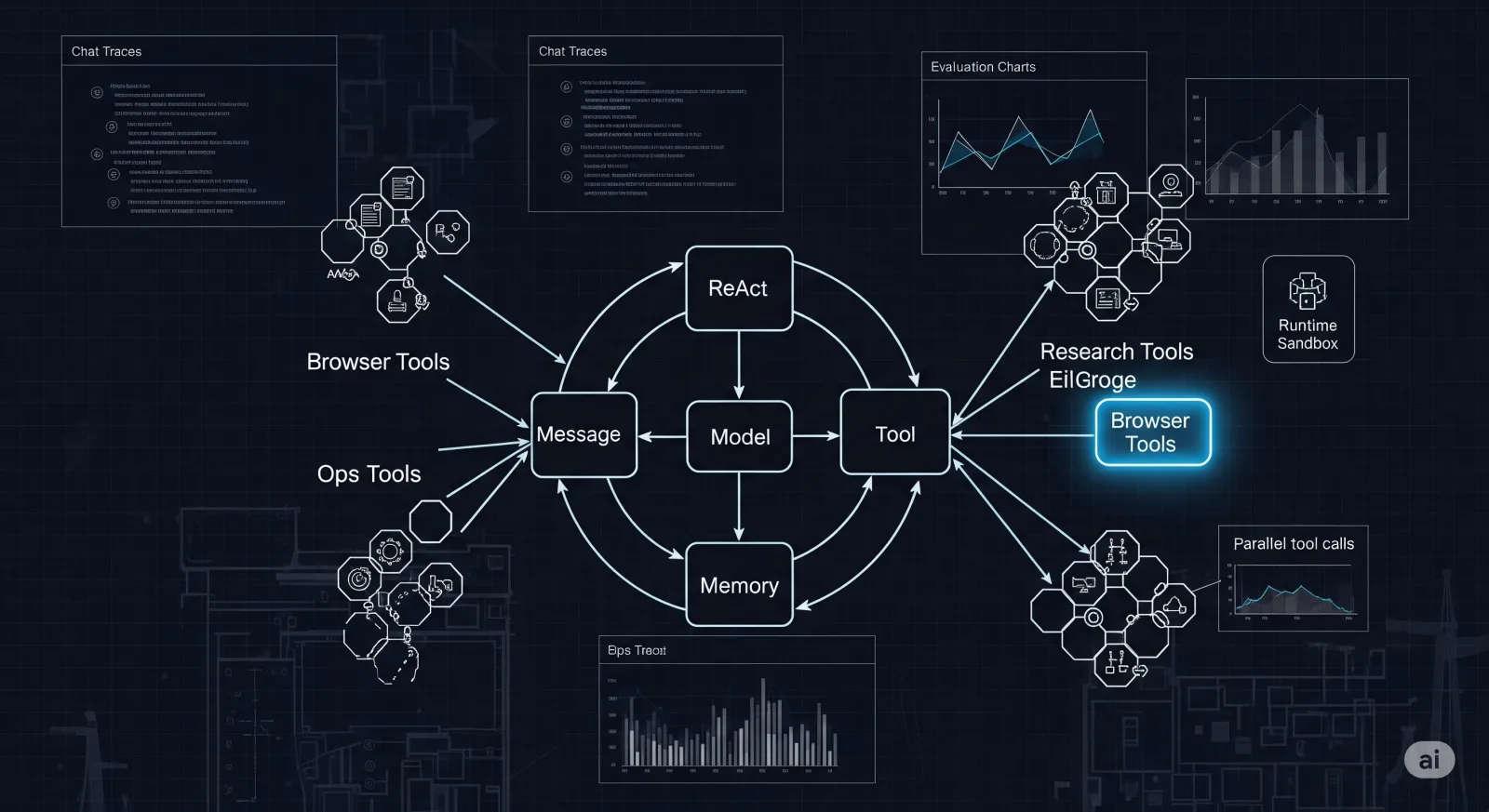
Thesis: AgentScope 1.0 is less a toolkit and more a discipline for agentic software. By pinning everything to ReAct loops, unifying “message–model–memory–tool,” and adding group-wise tool provisioning, it addresses the real failure mode of agents in production: tool sprawl without control. The evaluation/Studio/runtime trio then turns prototypes into shippable services. What’s actually new (and why it matters) 1) A crisp core: Message → Model → Memory → Tool Most frameworks blur these into ad‑hoc objects; AgentScope forces a clean, composable boundary: ...

August 25, 2025 · 4 min · Zelina
Cover image

Who Sees What, Who Pays the Cost? Teaching Agents to See Through Others’ Eyes

TL;DR A new study probes whether you can teach perspective‑taking to ReAct‑style LLM agents by feeding them structured examples distilled from a symbolic planner: optimal goal paths (G‑type), information‑seeking paths (E‑type), and local contrastive decisions (L‑type). The punchline: agents became decent at common‑ground filtering (what the other party can see) but remained brittle at imagining occluded space and pricing the cost of asking vs. exploring. In business terms, they’re good at “don’t recommend what the customer can’t see,” but still bad at “should I go find out more before I act—and is it worth it?” ...

August 23, 2025 · 5 min · Zelina
Cover image

The Memory Advantage: When AI Agents Learn from the Past

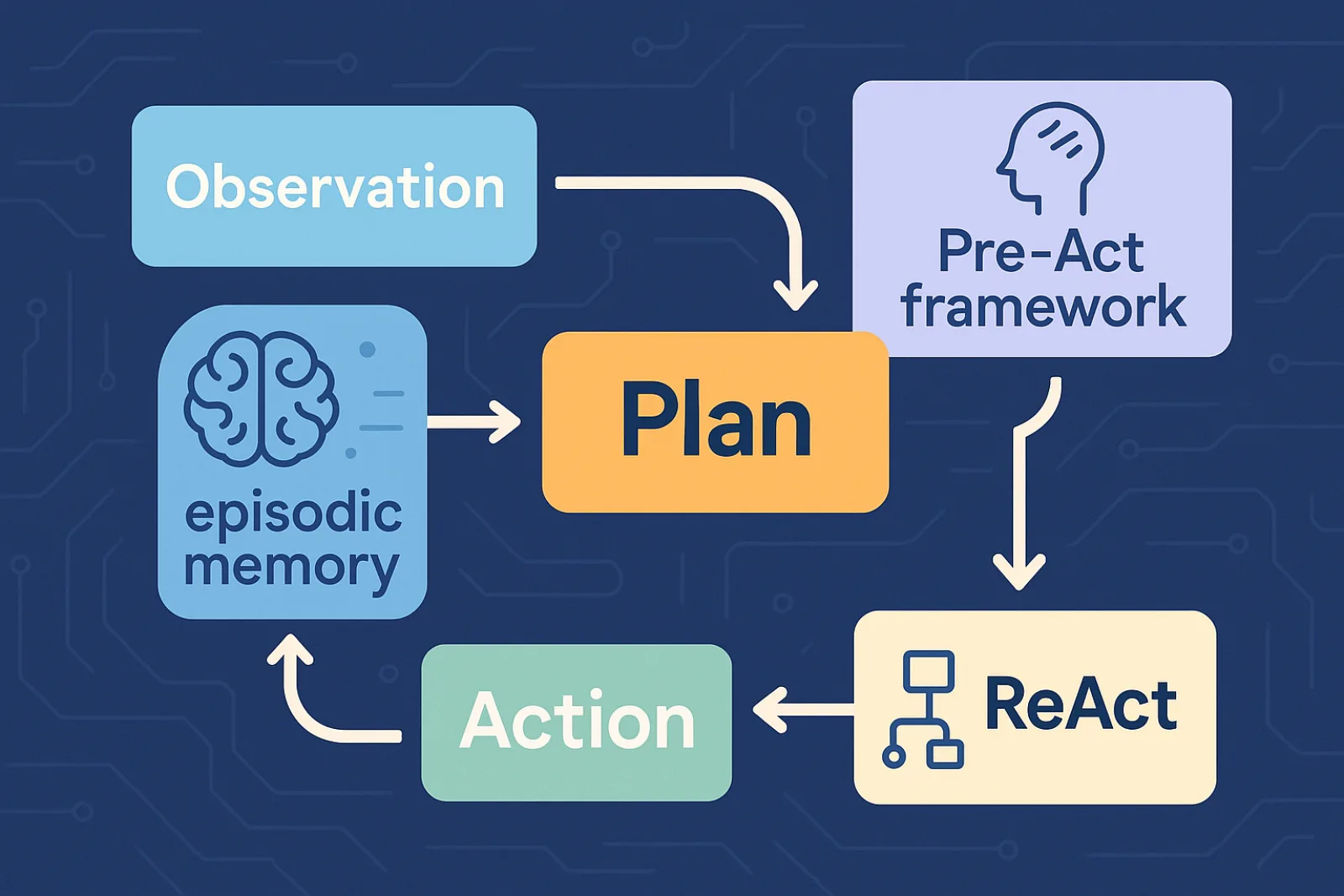
What if your AI agent could remember the last time it made a mistake—and plan better this time? From Reaction to Reflection: Why Memory Matters Most language model agents today operate like goldfish—brilliant at reasoning in the moment, but forgetful. Whether navigating virtual environments, answering complex questions, or composing multi-step strategies, they often repeat past mistakes simply because they lack a memory of past episodes. That’s where the paper “Agentic Episodic Control” by Zhihan Xiong et al. introduces a critical upgrade to today’s LLM agents: a modular episodic memory system inspired by human cognition. Instead of treating each prompt as a blank slate, this framework allows agents to recall, adapt, and refine prior reasoning paths—without retraining the underlying model. ...

June 3, 2025 · 3 min
Cover image

Plans Before Action: What XAgent Can Learn from Pre-Act's Cognitive Blueprint

If ReAct was a spark, Pre-Act is a blueprint. In the paper Pre-Act: Multi-Step Planning and Reasoning Improves Acting in LLM Agents, Mrinal Rawat et al. challenge the single-step cognitive paradigm of ReAct, offering instead a roadmap for how agents should plan, reason, and act—especially when tool use and workflow coherence matter. What Is ReAct? A Quick Primer The ReAct framework—short for Reasoning and Acting—is a prompting strategy that allows an LLM to alternate between thinking and doing in a loop. Each iteration follows this pattern: ...

May 18, 2025 · 4 min