Cover image

Graphs, Gains, and Guile: How FinKario Outruns Financial LLMs

In the world of financial AI, where speed meets complexity, most systems are either too slow to adapt or too brittle to interpret the nuanced messiness of real-world finance. Enter FinKario, a new system that combines event-enhanced financial knowledge graphs with a graph-aware retrieval strategy — and outperforms both specialized financial LLMs and institutional strategies in real-world backtests. The Retail Investor’s Dilemma While retail traders drown in information overload, professional research reports contain rich insights — but they’re long, unstructured, and hard to parse. Most LLM-based tools don’t fully exploit these reports. They either extract static attributes (e.g., stock ticker, sector, valuation) or respond to isolated queries without contextual awareness. ...

August 5, 2025 · 3 min · Zelina
Cover image

Shadow Boxing the Market: Option Pricing Without a Safe Haven

One of the most sacred assumptions in financial modeling is the existence of a traded risk-free asset. It anchors discounting, defines arbitrage boundaries, and supports the edifice of Black–Scholes. But what happens when you remove this pillar? Can we still price options, hedge risk, or extract information about funding conditions? In a striking extension of the Lindquist–Rachev (LR) framework, Ziyao Wang shows that not only is it possible — it may reveal financial dynamics that conventional models obscure. ...

August 3, 2025 · 4 min · Zelina
Cover image

The Lion Roars in Crypto: How Multi-Agent LLMs Are Taming Market Chaos

The cryptocurrency market is infamous for its volatility, fragmented data, and narrative-driven swings. While traditional deep learning systems crunch historical charts in search of patterns, they often do so blindly—ignoring the social, regulatory, and macroeconomic tides that move crypto prices. Enter MountainLion, a bold new multi-agent system that doesn’t just react to market signals—it reasons, reflects, and explains. Built on a foundation of specialized large language model (LLM) agents, MountainLion offers an interpretable, adaptive, and genuinely multimodal approach to financial trading. ...

August 3, 2025 · 3 min · Zelina
Cover image

Seeing is Retraining: How VizGenie Turns Visualization into a Self-Improving AI Loop

Scientific visualization has long been caught in a bind: the more complex the dataset, the more domain-specific the visualization, and the harder it is to automate. From MRI scans to hurricane simulations, modern scientific data is massive, high-dimensional, and notoriously messy. While dashboards and 2D plots have benefitted from LLM-driven automation, 3D volumetric visualization—especially in high-performance computing (HPC) settings—has remained stubbornly manual. VizGenie changes that. Developed at Los Alamos National Laboratory, VizGenie is a hybrid agentic system that doesn’t just automate visualization tasks—it refines itself through them. It blends traditional visualization tools (like VTK) with dynamically generated Python modules and augments this with vision-language models fine-tuned on domain-specific images. The result: a system that can answer questions like “highlight the tissue boundaries” and actually improve its answers over time. ...

August 2, 2025 · 4 min · Zelina
Cover image

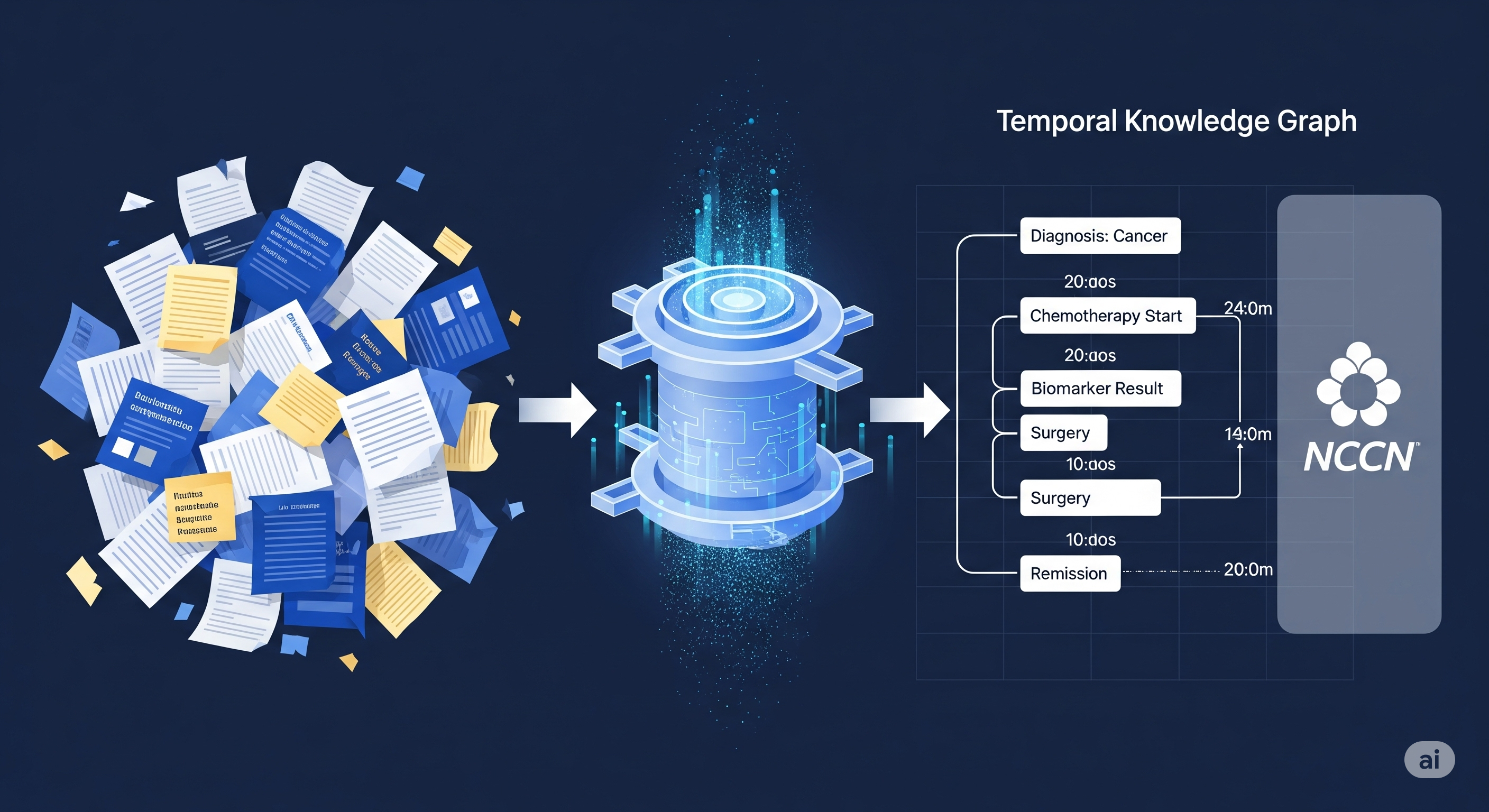
From Chaos to Care: Structuring LLMs with Clinical Guidelines

Modern oncology is an overwhelming cognitive battlefield: clinicians face decades of fragmented notes, tests, and treatment episodes, scattered across multiple languages and formats. Large Language Models (LLMs) promise relief—but without careful design, they often collapse under the weight of these chaotic Electronic Health Records (EHRs), hallucinate unsafe recommendations, or fail to reason over time. Enter CliCARE: a meticulously designed framework that not only tames this complexity but grounds the entire decision process in clinical guidelines. Rather than stuffing raw records into long-context transformers or bolting on retrieval-augmented generation (RAG), CliCARE introduces a radically more structured approach. ...

July 31, 2025 · 3 min · Zelina
Cover image

Don't Trust. Verify: Fighting Financial Hallucinations with FRED

When ChatGPT makes up a statistic or misstates a date, it’s annoying. But when a financial assistant claims the wrong interest expense or misattributes a revenue source, it could move markets or mislead clients. This is the stark reality FRED confronts head-on. FRED—short for Financial Retrieval-Enhanced Detection and Editing—is a framework fine-tuned to spot and fix factual errors in financial LLM outputs. Developed by researchers at Pegasi AI, it isn’t just another hallucination detection scheme. It’s an auditor with a domain-specific brain. ...

July 29, 2025 · 3 min · Zelina
Cover image

RAG in the Wild: When More Knowledge Hurts

Retrieval-Augmented Generation (RAG) is often hailed as a cure-all for domain adaptation and factual accuracy in large language models (LLMs). By injecting external context at inference time, RAG systems promise to boost performance on knowledge-intensive tasks. But a new paper, RAG in the Wild (Xu et al., 2025), reveals that this promise is brittle when we leave the sanitized lab environment and enter the real world of messy, multi-source knowledge. ...

July 29, 2025 · 4 min · Zelina
Cover image

Think Twice, Then Speak: Deliberative Searcher and the Future of Reliable LLMs

When a large language model (LLM) answers your question with a high degree of confidence, do you trust it? What if it’s wrong—but still confident? The stakes are high in real-world applications, from legal guidance to enterprise decision support. Yet today’s LLMs remain notoriously unreliable in aligning their confidence with correctness. The paper Deliberative Searcher: Improving LLM Reliability via Reinforcement Learning with Constraints (Yin et al., 2025) offers a bold response: rewire LLMs to be reasoning-primary and information-secondary. Instead of front-loading search and passively absorbing evidence, Deliberative Searcher acts more like a prudent investigator: it thinks, self-assesses, retrieves external information only when needed, and calibrates its confidence step-by-step. Crucially, it learns this behavior through a custom constrained reinforcement learning regime. ...

July 23, 2025 · 3 min · Zelina
Cover image

Beyond Search: RAG’s Awakening to Enterprise Spreadsheets

Retrieval-Augmented Generation (RAG) systems are fast becoming the connective tissue between Large Language Models (LLMs) and real-world business data. But while RAG systems excel at fetching relevant passages from documents, they often stumble when the data isn’t narrative but numerical. In enterprise environments, where structured formats like HR tables, policy records, or financial reports dominate, this mismatch has become a bottleneck. The paper “Advancing Retrieval-Augmented Generation for Structured Enterprise and Internal Data” by Chandana Cheerla proposes a much-needed upgrade: a RAG system that treats structured and tabular data as first-class citizens. It doesn’t just flatten tables into linear strings or hope LLMs can reason through semi-garbled inputs. It restructures the entire RAG pipeline to respect and preserve the meaning of tables, rows, and metadata. ...

July 17, 2025 · 4 min · Zelina
Cover image

The Retrieval-Reasoning Tango: Charting the Rise of Agentic RAG

In the AI race to make large language models both factual and reasoned, two camps have emerged: one focused on retrieval-augmented generation (RAG) to fight hallucination, the other on long-chain reasoning to mimic logic. But neither wins alone. This week’s survey by Li et al. (2025), Towards Agentic RAG with Deep Reasoning, delivers the most comprehensive synthesis yet of the field’s convergence point: synergized RAG–Reasoning. It’s no longer a question of whether retrieval helps generation or reasoning helps retrieval—but how tightly the two can co-evolve, often under the coordination of autonomous agents. ...

July 15, 2025 · 3 min · Zelina