TL;DR for operators
VizGenie is not another “type a prompt, get a chart” system. It is a research prototype for scientific visualization where the hard problem is not drawing a bar chart, but helping users explore complex volumetric datasets without manually tuning every slice, isovalue, opacity map, colour map, and feature query like it is a sacred ritual.
The paper’s practical lesson is architectural. VizGenie combines reliable pre-existing tools for common tasks with LLM-generated VTK modules for new tasks, then validates and caches successful modules so the system can reuse them later.1 It also builds a visual knowledge base from generated screenshots, uses fine-tuned Llama-Vision models for domain-aware feature recognition, adds lightweight retrieval-augmented generation for context, and logs provenance so the workflow is not merely clever but traceable.
For business readers, the point is not that every enterprise needs an AI visualization toy. The point is that AI copilots for high-cost scientific, engineering, medical, simulation, and industrial workflows will need this kind of scaffolding: trusted routines for the ordinary cases, generation for the awkward edge cases, validation before reuse, and domain-specific perception where generic models hallucinate nonsense with admirable confidence.
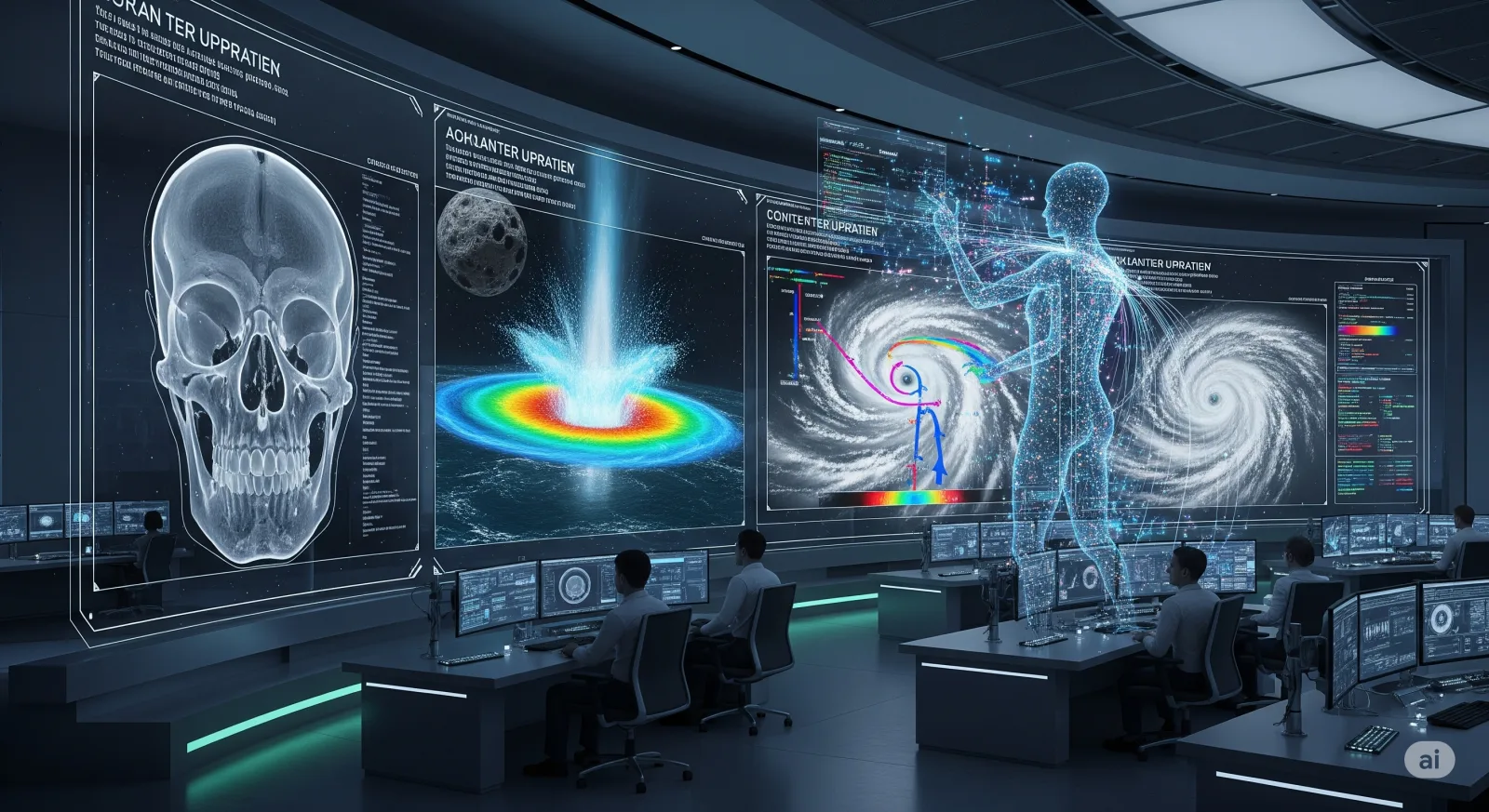
The evidence is promising but narrow. VizGenie is demonstrated on four volumetric datasets: CT scan, Hurricane Isabel, astrophysics turbulence, and deep-water asteroid impact. The system shows measurable improvements when its visual database expands, better isovalue recommendations for anatomical features, and improved domain-specific captioning after fine-tuning. But the prototype is still early, mostly VTK-based, dependent on multiple LLMs, manually fine-tuned for domain vision, and not yet validated through broad external deployment. In other words: useful direction, not procurement gospel.
The familiar pain is not making a picture; it is knowing which picture to make
Scientific visualization is often presented as a rendering problem. Give the system data, choose a method, adjust parameters, and eventually a usable visual representation emerges. That description is technically correct in the way a recipe for surgery might begin with “make an incision.”
The expensive part is not only rendering. It is knowing which variable to inspect, which scalar range matters, which isovalue exposes the feature, which viewpoint makes the phenomenon visible, and whether the resulting image actually corresponds to the thing the scientist asked for. In complex 3D or HPC-derived datasets, the feature of interest is often not a neat object with a label. It may be amorphous, multi-variable, time-dependent, view-dependent, and described using domain-specific language that generic AI models did not exactly encounter between cat photos and product reviews.
That is where VizGenie positions itself. The paper argues that current LLM visualization systems are often too close to one-shot code generation or dashboard automation. They can help produce scripts, plots, or standard charts, but they are not designed to maintain a growing, validated, domain-aware visualization workflow for scientific data. VizGenie’s contribution is to treat visualization assistance as an evolving system rather than a prompt-response transaction.
This matters because the obvious story is also the wrong one. The tempting headline is: “LLMs now generate scientific visualizations.” Fine. They do. Sometimes. The more interesting headline is: “LLM generation is only useful when surrounded by validation, memory, domain perception, and reuse.” A little less glamorous, unfortunately more correct.
VizGenie starts by admitting pure dynamic generation is unreliable
The paper’s mechanism-first logic begins with a failure mode. The authors initially experimented with a fully automated multi-agent workflow in which LLM-based agents generated and executed code from natural-language instructions. That design included an orchestrator-planner, a code generator-executor, and a security sentinel. The setup was not naïve: the authors used isolation and policy filtering to reduce risk, and the workflow could generate just-in-time visualization code.
The problem was consistency. The authors report that relying exclusively on dynamically generated software was computationally inefficient and inconsistent, with roughly half of trials producing successful outcomes, meaning code that executed properly and produced the requested visualizations. That number is doing useful editorial work. It explains why VizGenie is not designed as a pure code-generation engine. If half the time your autonomous assistant gets the job right, you do not have automation. You have a junior intern with excellent branding.
VizGenie’s architecture is therefore hybrid. It keeps stable pre-existing tools for known tasks and uses dynamic LLM-generated modules only when the user’s request exceeds the baseline capability set. Common actions such as filtering runs, visualizing histograms, slicing data, or analysing datasets can be handled by predefined modules. More specialised requests can trigger dynamic VTK Python code generation.
This is the first serious business lesson in the paper: the value of AI workflow systems is not maximising generation. It is deciding when generation should be avoided.
| System choice | What the paper shows | Operational meaning | Boundary |
|---|---|---|---|
| Pre-existing tools | Fast, reliable execution for routine tasks such as slicing and histograms | Use conventional software where the task is known | Coverage is limited to anticipated operations |
| Dynamic modules | LLMs generate new VTK scripts for tasks outside the baseline toolset | Extend capability without waiting for manual engineering | More latency, variability, and validation burden |
| Validation and caching | Generated modules are tested, corrected, logged, and reused | Turn one-off generation into institutional capability | Validation still depends on task design and test coverage |
| Incremental updates | Minor edits modify existing code instead of regenerating everything | Reduce avoidable errors and computational waste | Works best when the existing module is already correct |
This is a more sober picture of AI automation than the usual prompt magic. VizGenie is not impressive because it lets an LLM write code. It is impressive because it tries to prevent the LLM from being the only adult in the room.
The cache is where generation becomes capability
A generated script is not yet an organisational asset. It is an incident. To become useful, it must be saved, validated, described, and made available for later reuse. VizGenie does this by logging dynamically generated modules into a SQLite database after validation. The agent can later search this cache before deciding whether to generate fresh code.
That detail is easy to overlook, but it is central. Many enterprise AI pilots fail because every interaction is treated as disposable. The model solves a task, maybe. Then the next user starts again from scratch, also maybe. No compounding occurs. No workflow memory forms. The organisation pays repeatedly for improvisation.
VizGenie’s cache changes the economic unit. The first generated module may be expensive, slow, or fragile. But if it passes validation and becomes reusable, the system’s capability expands. The next similar request can draw from the validated repertoire instead of asking the model to improvise again.
This is why the paper’s “self-improving” language should not be read as mystical model evolution. VizGenie is not claiming that the core LLM wakes up wiser after lunch. It improves through workflow accretion: more validated modules, more visual examples, more domain captions, more retrieved context, and more recorded interaction history.
That distinction matters for buyers and builders. A self-improving enterprise system does not need to secretly retrain its foundation model every night. Often, it needs to build better task memory around it.
Feature-based queries move the challenge from language to perception
The paper’s second major mechanism is domain-aware feature querying. Users do not always ask for low-level visualization operations. They may ask to “visualize the skull,” “highlight tissue boundaries,” or find a domain-specific phenomenon in simulation data. That request cannot be solved by keyword matching alone. It requires mapping language to visual structures inside a dataset.
VizGenie approaches this by generating collections of screenshots across camera angles and visualization parameters such as isovalues. A vision model captions these images. Captions, isovalues, dataset identifiers, and other metadata are stored in a structured visual knowledge base. When a user asks for a feature, the system retrieves relevant captions and uses an LLM to select the best matching isovalue.
The CT example makes the mechanism intuitive. The system compares smaller and larger visual databases for the headsq dataset. Expanding from 150 images to 300 images increases vocabulary size from 1,606 to 2,946 unique words and raises mean pairwise semantic similarity from 0.585 to 0.717. The paper interprets this as richer feature representation and more consistent semantic coverage.
The more concrete result is isovalue alignment. When the image database expands, predicted optimal isovalues move closer to expert-judged ideal ranges:
| Feature | Predicted isovalue with 150 images | Predicted isovalue with 300 images | Expert-judged ideal range | Interpretation |
|---|---|---|---|---|
| Nose | 455 | 585 | 650–700 | Better, but still below the ideal range |
| Skull | 1365 | 1587 | 1550–1600 | Strong alignment after expansion |
| Teeth | 2730 | 2925 | 2800–2900 | Better feature targeting, slightly above range |
This is not a universal benchmark result. It is a targeted demonstration on one dataset. But it clarifies what “self-improvement” means in practice: the system can generate a broader visual vocabulary and improve feature-to-parameter mapping by expanding its visual database.
For operators, this is directly relevant. In domains where the task is to identify features in complex visual or simulation data, a generic model is rarely enough. The system needs local examples, domain labels, and parameter-linked visual memory. Otherwise, it may produce a plausible answer with no operational connection to the actual feature.
Fine-tuning helps, but the asteroid case keeps everyone honest
The deep-water asteroid impact dataset is the paper’s most useful reality check. Out-of-the-box vision models can describe ordinary visual objects tolerably well. They are less dependable when faced with domain-specific scientific renderings. In one example, the out-of-the-box model interprets an asteroid impact visualization as a cartoon-style gorilla. A bold reading, certainly. Also useless.
The authors fine-tune a Llama-3.2-Vision 11B model using LoRA on domain-specific images and captions. Their training material includes 50 isosurface images for the deep-water impact dataset, curated images from dataset documentation, and additional ParaView-generated visualizations. A visualization scientist with relevant domain experience reviews and refines the image-caption pairs.
The results improve meaningfully. Before fine-tuning, the model’s captions guessed contexts such as shockwaves, dolphins, flowers, and generic underwater projectiles. After fine-tuning, captions become more domain-specific. Vocabulary becomes more focused: total vocabulary size decreases from 4,135 words before fine-tuning to 2,287 words after. Domain terms increase sharply: “crater” rises from 1 to 348 occurrences, “asteroid” from 0 to 1,112, and “impact” from 38 to 1,616. Caption stability also improves, with mean inter-caption semantic similarity rising from 0.432 to 0.654.
An LLM-as-judge analysis also favours the fine-tuned model. GPT-4o rates fine-tuned captions at a mean of 65% versus 1.7% for the out-of-the-box model. A more conservative o4-mini-high judge gives 38% for the fine-tuned model versus 20% for the out-of-the-box model.
Then comes the important part: human qualitative analysis rates the fine-tuned model’s statements at only 39% accurate, compared with effectively 0% before tuning. That is both an improvement and a warning label.
The model still confuses domain-specific terms such as water jet, water plume, and water vapor plume. It sometimes misidentifies colour maps, invents log scales where none exist, appends incorrect terms such as “basin” after “transient crater,” and struggles with multi-variable images where one physical phenomenon may obscure another.
This is the paper at its best, because it does not let improvement masquerade as solved science. Fine-tuning moves the system from absurd to useful-ish, not from absurd to oracle. For business adoption, that difference is everything.
| Evidence item | Likely purpose in the paper | What it supports | What it does not prove |
|---|---|---|---|
| Out-of-the-box vs fine-tuned asteroid captions | Main evidence for domain-specific vision adaptation | Generic VLMs can fail badly on scientific renderings; fine-tuning improves relevance | That the fine-tuned model is accurate enough for unsupervised scientific conclusions |
| Caption stability increase from 0.432 to 0.654 | Quantitative support for consistency | Fine-tuning improves cross-view semantic stability | That captions are scientifically correct in every detail |
| 39% human-rated accuracy after tuning | Boundary-setting evidence | Domain tuning helps but remains imperfect | Production readiness without expert review |
| LLM-as-judge scores | Supplementary quantitative comparison | Fine-tuned outputs are preferred to OOTB outputs | Full replacement for domain expert evaluation |
The business reading is straightforward: domain-specific AI perception is valuable precisely because generic perception fails. But domain-specific does not mean expert-level. It means the system has become worth supervising.
RAG is useful here because the questions are grounded in dataset context
VizGenie also uses lightweight retrieval-augmented generation. The turbulence case study shows why. The authors add contextual materials, including SciVis contest documentation and a relevant publication, then compare direct LLM answers with RAG-supported answers. For a question about fields associated with the IEEE VIS 2008 contest data, the direct LLM answer lists inaccurate fields. The RAG-supported answer correctly identifies scalar fields including temperature, mass density, and chemical species, plus the velocity vector field.
This is not the most glamorous part of the paper, but it is operationally important. In scientific workflows, the answer often lives in nearby documentation: README files, contest descriptions, simulation notes, variable dictionaries, methodology PDFs, and prior publications. A generic model may know the shape of a plausible answer. The local document knows the answer.
The RAG component in VizGenie is described as lightweight, and the authors acknowledge its current limitations. That restraint is appropriate. RAG is not being sold as a magic truth machine. It is a contextual support layer that improves answers when user guidance is minimal and relevant documents exist.
The enterprise implication is almost boring, which is usually where the money is. A domain copilot should not rely only on model memory. It should read the project folder.
Timing results expose the cost of flexibility
The performance table is less about leaderboard bragging and more about workflow economics. The authors average results over five executions of the same prompts and check both executability and whether user specifications are incorporated. Pre-existing tools are much faster than generated code. Slicing and histogram operations complete in about 2 to 4 seconds with suitable models, while code generation tasks such as VTK volume rendering or isosurface creation take roughly 15 to 23 seconds.
The model comparisons are also task-dependent. GPT-4o and o3-mini generally produce valid outputs, with validity scores close to 1 in several generated-code tasks. GPT-4o-mini can be faster in some cases but occasionally compromises validity. For pre-existing tool use through agentic reasoning, GPT-4o performs best in the authors’ setup.
The important lesson is not “use model X.” Model names and prices will age faster than a startup pitch deck. The durable lesson is that interactive AI systems need task routing. Routine operations should go through fast, stable tools. Generation should be reserved for tasks where flexibility justifies latency and validation cost. Modification should be incremental when possible. Expensive reasoning should be used where ambiguity is high.
This is how AI workflows become usable: not by selecting one impressive model, but by assigning different kinds of work to different reliability and latency regimes.
The interface matters because trust is partly a visibility problem
VizGenie’s interface includes a chat panel, an agent reasoning panel, a 2D image display area, and a 3D VTK rendering panel. The interface supports interactive callbacks, follow-up suggestions, and validation feedback. This is not cosmetic.
For scientific visualization, users need to see not only the output but also how the system interpreted the request. If a user asks to highlight a feature, the system’s reasoning, selected tool, generated module, parameter choice, and visual result all matter. A silent assistant that produces a beautiful wrong image is a liability with anti-aliased edges.
The paper’s early user feedback reinforces this. Users liked natural-language feature exploration, interface simplicity, query suggestions, and VQA functionality. They were less satisfied when VQA failed to return exact answers or when prompts were misinterpreted. One cause was vocabulary mismatch across domains: words such as “show,” “explore,” or “visualize” can imply different operations depending on the user’s background.
That point deserves more attention than it usually gets. Natural language is not automatically natural in specialised environments. It is full of local dialects. A surgeon, fluid dynamicist, materials scientist, and visualization engineer may use the same verb and intend different computational actions. Domain-aware AI systems must learn not just terminology but operational meaning.
What Cognaptus infers for business use
The paper directly shows a research prototype that integrates pre-existing visualization tools, dynamic VTK module generation, validation, caching, domain-tuned vision, visual knowledge bases, lightweight RAG, and provenance-oriented interaction logging. It demonstrates this architecture on four volumetric datasets and reports improvements in feature vocabulary, semantic consistency, isovalue selection, caption relevance, and response-time trade-offs.
The business inference is broader but should remain disciplined. VizGenie points toward a class of enterprise AI copilots for expert workflows where the value is not “make content faster” but “reduce expert configuration burden without losing traceability.” Candidate domains include scientific computing, industrial simulation, medical imaging workflows, digital twins, geospatial analysis, materials discovery, computational fluid dynamics, and other environments where data is visual, high-dimensional, and expensive to interpret.
In those settings, the copilot’s value proposition has four layers:
| Technical contribution | Operational consequence | ROI relevance |
|---|---|---|
| Stable pre-existing tools | Common tasks execute quickly and reliably | Saves expert time without increasing risk |
| Dynamic validated modules | Edge cases become supported over time | Converts repeated bespoke work into reusable capability |
| Domain-aware visual knowledge base | Natural-language feature queries become parameter-linked | Reduces manual tuning and search cost |
| RAG and provenance | Answers remain tied to local context and interaction history | Supports auditability, reproducibility, and trust |
The strongest business opportunity is not replacing experts. It is compressing the loop between question, visualization, correction, and reuse. In high-cost expert environments, shaving that loop matters. A scientist who can explore ten plausible visualizations in the time previously required for two may find better hypotheses. An engineering team that validates and reuses generated modules may reduce repeated scripting labour. A medical or industrial analysis workflow may benefit from feature-aware retrieval and traceability, provided governance is strict enough to prevent “looks right” from becoming “is right.”
There is also an organisational design implication. VizGenie suggests that AI adoption should be measured less by how many prompts users send and more by how much validated workflow memory accumulates. The important asset is not the chat transcript. It is the growing library of trusted modules, domain examples, parameter mappings, and provenance records.
Where the current evidence stops
VizGenie is a strong architectural argument, but it is not yet a mature product benchmark.
First, the case studies are limited. The four datasets are useful and varied, but they do not prove broad generalisation across scientific domains, institutions, data formats, or user populations. The authors themselves call for extensive user studies and more rigorous quantitative evaluation across diverse real-world datasets.
Second, the current pipeline is largely constrained to VTK for reading and visualizing data. That is a sensible early design choice because it keeps the prototype lightweight, but it also limits the system’s immediate applicability. The authors mention future integration with tools such as ParaView or VisIt, which would be important for real-world adoption.
Third, latency remains material. Multiple LLMs, code generation, validation, VQA, and retrieval all add overhead. In exploratory workflows, a 20-second generation step may be acceptable for a complex visualization but irritating for repeated interaction. The paper’s own timing table makes clear that routing between pre-existing tools and generated modules is essential.
Fourth, fine-tuning is still manually initiated and domain-specific. The asteroid results show improvement, but also reveal persistent errors in scientific terminology, variable identification, and physical interpretation. That limits autonomy. For now, the system looks more like a supervised expert accelerator than an independent scientific analyst.
Finally, RAG and provenance are present but still lightweight. The architecture points in the right direction, but production scientific environments would require stronger retrieval pipelines, permissioning, versioning, audit logs, validation suites, and integration with existing data management systems. Slightly less glamorous than a demo. Much more likely to survive contact with procurement.
The real shift is from visual output to visual operations
VizGenie’s most important move is conceptual. It reframes AI visualization from output generation to operational learning. The system does not merely answer a request. It tries to improve the conditions under which future requests are answered.
That is why the paper matters beyond scientific visualization. Many enterprise AI systems are still stuck in the prompt-response phase. A user asks. A model answers. Maybe the answer is good. Maybe someone copies it into a document, script, dashboard, or ticket. Then the system forgets the operational lesson.
VizGenie points to a different pattern:
- Use stable tools when the task is known.
- Generate code when the task is new.
- Validate before trusting.
- Cache what works.
- Build domain-specific perception from examples.
- Retrieve local context before guessing.
- Log the path so results can be reproduced.
- Improve asynchronously rather than forcing every user interaction to carry the full learning burden.
That pattern is not limited to VTK or volumetric data. It is a blueprint for AI systems in any specialised workflow where novelty and reliability must coexist. The future of enterprise AI is unlikely to be a single genius model sitting behind a chat box. It will look more like a managed workshop: some trusted tools, some generative improvisation, some inspection, some memory, and a careful record of who did what before the machine got creative.
VizGenie is early. It is imperfect. Its domain-tuned model still makes mistakes that a human expert would catch quickly. Its RAG is lightweight. Its user evidence is preliminary. But the architecture has the right kind of seriousness. It recognises that in expert work, the question is not whether AI can produce something visually plausible. It is whether the system can help users reach a useful visual interpretation faster, with fewer dead ends, and with enough traceability to trust the path.
That is the difference between seeing and retraining. One produces an image. The other turns the act of producing images into a compounding workflow.
Cognaptus: Automate the Present, Incubate the Future.
-
Ayan Biswas et al., “VizGenie: Toward Self-Refining, Domain-Aware Workflows for Next-Generation Scientific Visualization,” arXiv:2507.21124, 2025. https://arxiv.org/abs/2507.21124 ↩︎