Cover image

Can You Spot the Bot? Why Detectability, Not Deception, Is the New AI Frontier

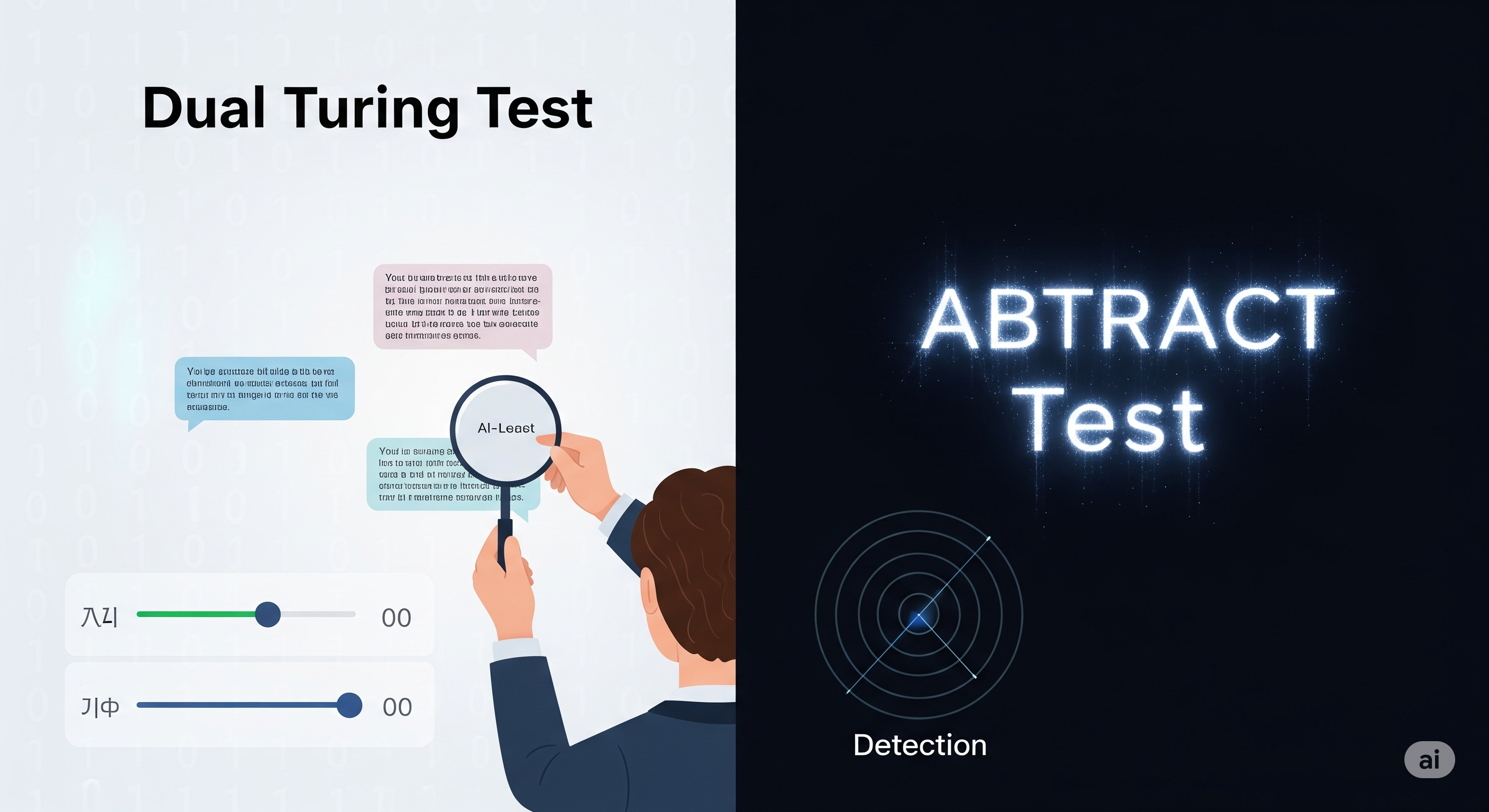
TL;DR for operators The paper behind this article proposes a useful shift in AI safety thinking: stop asking only whether AI can pass as human, and start asking whether high-quality AI output remains detectable when it is trying not to be.1 That sounds like a small inversion. It is not. It changes the operational question from “Can the model impress us?” to “Can our systems still identify it under adversarial conditions?” For any organisation deploying generative AI into customer support, content moderation, financial advice, political communication, recruitment, education, or regulated workflows, that difference matters. ...


July 26, 2025 · 17 min · Zelina
Cover image

The Two Minds of Finance: Testing LLMs for Divergence and Discipline

TL;DR for operators Finance teams do not ask AI systems to do one kind of thinking. They ask them to imagine plausible futures, extract investable implications, choose between similar explanations, and avoid being seduced by the prettiest narrative. Those are not the same task. A model can be fluent, plausible, and still strategically dull. Finance has a long tradition of rewarding that, but we do not need to automate the habit. ...

July 25, 2025 · 17 min · Zelina
Cover image

Homo Silicus Goes to Wall Street

TL;DR for operators An AI financial assistant may sound balanced, prudent, and numerate. That is not the same thing as being suitable. The paper behind this article tests leading LLMs on 14 financial decision questions and compares their answers with human responses from a cross-national dataset covering 53 nations.1 The models mostly behave like expected-value machines on lottery-style questions. Give them a risky payoff with clear probabilities, and they often land near the mathematically neutral answer. Very tidy. Very spreadsheet. Very unlike the way many actual clients think when money is uncertain and losses feel personal. ...

July 16, 2025 · 14 min · Zelina
Cover image

Thoughts, Exposed: Why Chain-of-Thought Monitoring Might Be AI Safety’s Best Fragile Hope

TL;DR for operators Chain-of-thought monitoring is not “AI explaining itself.” That would be too convenient, and convenience is not usually how safety engineering works. The paper argues something narrower and more useful: when reasoning models solve hard tasks, some of their intermediate cognition may pass through human-readable language. That creates a rare oversight opportunity. A separate monitor can inspect the reasoning trace and flag signs of reward hacking, prompt-injection obedience, sabotage, manipulation, or evaluation artefacts before the final action is trusted. ...

July 16, 2025 · 16 min · Zelina
Cover image

Memory Games: The Data Contamination Crisis in Reinforcement Learning

TL;DR for operators A model that improves after training on random rewards has not necessarily discovered a secret route to reasoning. It may simply be remembering the exam. The paper behind this article investigates a strange result in reinforcement learning for large language models: Qwen2.5 models appeared to improve on public math benchmarks even when the reward signal was random, inverted, or based on wrong majority-voted answers.1 That sounds exciting, in the same way that a finance team “beating forecast” after seeing next quarter’s numbers is exciting. Technically impressive, commercially dangerous, and not something one should build governance around. ...

July 15, 2025 · 15 min · Zelina
Cover image

Tables Turned: Why LLM-Based Table Agents Are the Next Big Leap in Business AI

TL;DR for operators Most business data does not live in pristine chatbot-friendly prose. It lives in spreadsheets, ledgers, CSV exports, relational databases, dashboards, compliance reports, and those heroic Excel files with merged cells, colour-coded warnings, unexplained abbreviations, and one column called misc. The paper behind this article, Toward Real-World Table Agents, argues that LLM-based table agents should not be judged as smarter versions of Text-to-SQL alone.1 Real-world table work requires an end-to-end workflow: reading table structure, cleaning noisy semantics, retrieving only the relevant parts, executing traceable reasoning steps, and adapting to domains such as finance, healthcare, public administration, and industrial operations. ...

July 15, 2025 · 21 min · Zelina
Cover image

Bias, Baked In: Why Pretraining, Not Fine-Tuning, Shapes LLM Behavior

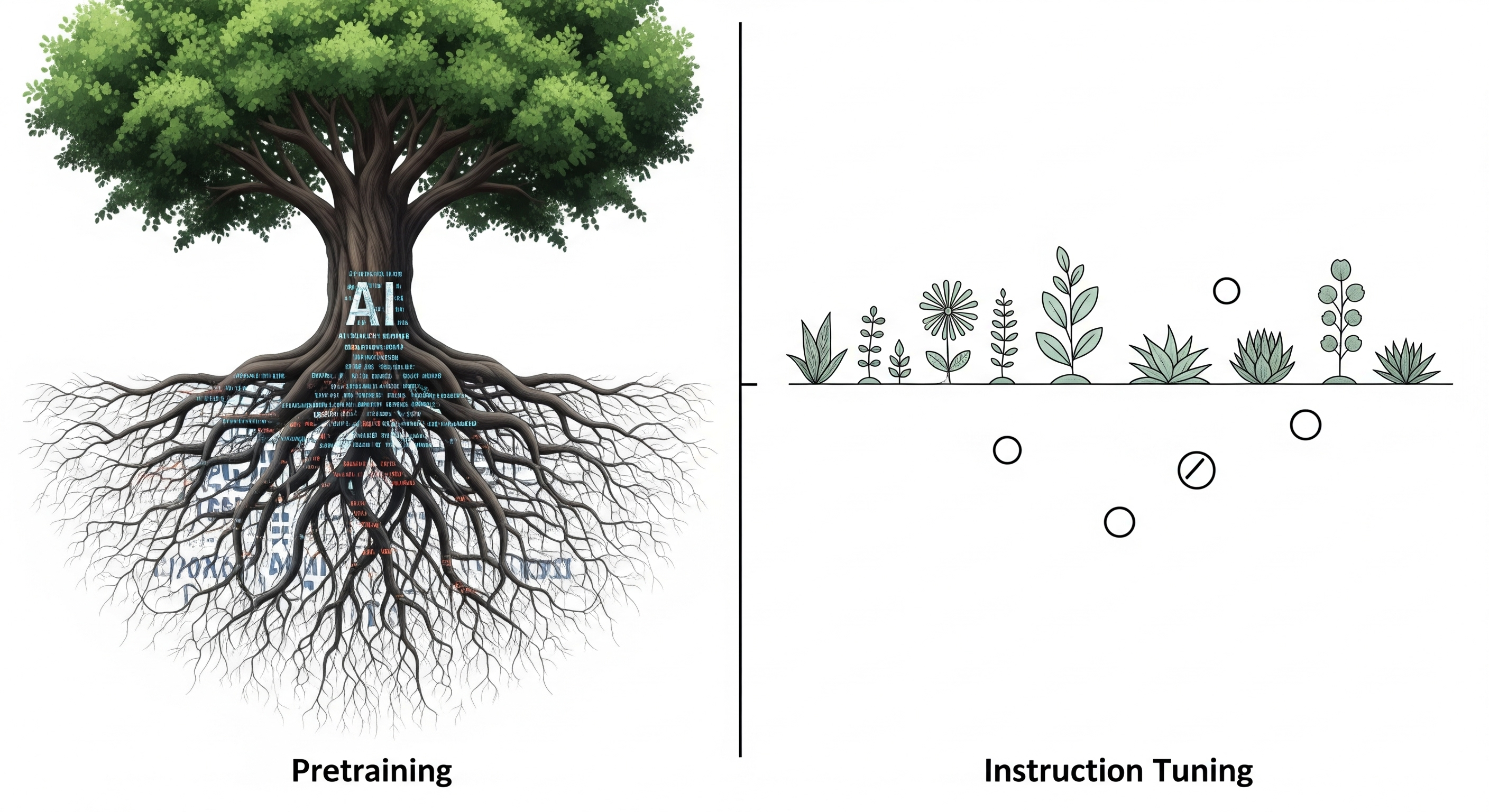
TL;DR for operators Fine-tuning is not a washing machine. It may polish, redirect, or occasionally muffle a model’s behavioural tendencies, but this paper suggests that many cognitive-bias patterns are already substantially shaped before instruction tuning begins. The study separates three possible sources of observed bias in large language models: the pretrained backbone, the instruction dataset, and random variation during fine-tuning. Its main finding is that models’ bias profiles cluster more strongly by pretrained model identity than by the instruction data used later. In plainer operational language: the base model carries a behavioural signature that survives downstream training. ...

July 13, 2025 · 16 min · Zelina
Cover image

The Meek Shall Compute It

TL;DR for operators The usual AI strategy story is simple: whoever spends the most on compute owns the future. The paper behind this article makes a more awkward claim: under current language-model scaling assumptions, massive compute advantage may be a temporary lead, not a permanent moat.1 The mechanism is not magic. It is diminishing returns. Chinchilla-like scaling laws imply that each additional unit of training compute buys a smaller reduction in loss. Meanwhile, hardware improvement and algorithmic progress are shared forces. They do not only help the largest labs. They also make yesterday’s “small” budget more capable. The result is a curve where frontier models pull ahead, peak in relative advantage, and then become less distinguishable from cheaper models. ...

July 12, 2025 · 18 min · Zelina
Cover image

Echo Chamber in a Prompt: How Survey Bias Creeps into LLMs

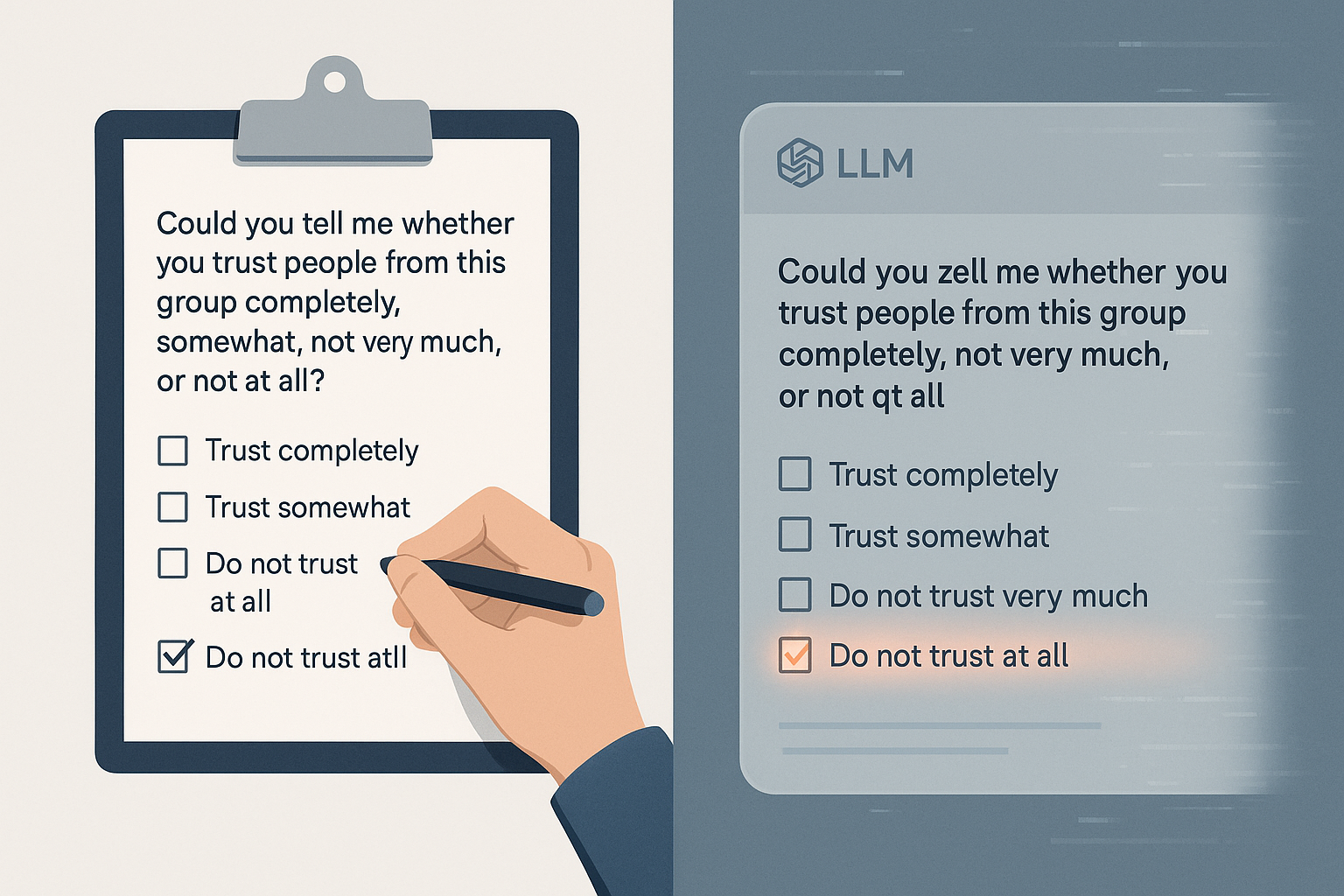
TL;DR for operators LLM survey panels are cheap, fast, and extremely willing to give you numbers. That is exactly why they are dangerous. A recent paper by Jens Rupprecht, Georg Ahnert, and Markus Strohmaier stress-tests nine instruction-tuned LLMs on World Values Survey-style questions and finds that small prompt changes can materially alter synthetic survey responses.1 The study runs 167,400 simulated interviews across 62 normative survey questions, 25 repeated runs per model-question-condition, and a battery of perturbations covering answer-order reversal, refusal-option removal, odd/even scale changes, priming text, typos, synonyms, paraphrases, and a combined paraphrase-plus-reversal condition. ...

July 11, 2025 · 18 min · Zelina
Cover image

The Bullshit Dilemma: Why Smarter AI Isn't Always More Truthful

TL;DR for operators Most AI quality programmes still treat truthfulness as a factual accuracy problem: did the model get the answer right, cite the source, or hallucinate a feature that does not exist? That is necessary. It is not sufficient. The paper behind this article argues for a nastier category: “machine bullshit,” meaning model output produced with indifference to truth rather than simple ignorance or random hallucination.1 The key point is not that models become stupid. It is that, under some incentives, their outward claims stop tracking what they appear to know. ...

July 11, 2025 · 17 min · Zelina