Executive Snapshot
- Client type: Mid-sized independent publisher producing 80–120 new titles per year
- Industry: Trade, illustrated, and professional publishing
- Core problem: Each title crossed many specialist teams, but its true status had to be reconstructed from spreadsheets, email, folders, portals, and individual memory
- Why agentic AI: The work required persistent state, cross-system observation, dependency propagation, exception routing, and repeated human review rather than a single prediction or chatbot response
- Deployment stage: Prototype design with a planned controlled pilot
- Primary result: A target operating model in which agents continuously maintain evidence and dependencies while accountable professionals retain every material publishing decision
1. Business Context
The publisher acquired and produced dozens of books concurrently across several imprints. Each title moved from manuscript intake and contracting through developmental editing, copy-editing, fact-checking, permissions, design, typesetting, proofing, metadata, printing, distribution, and launch. These activities did not form a clean sequence: cover work could start before final text, metadata went to retailers while titles and dates were still changing, and image permissions could remain open after pages entered proof. The operating record was scattered across a title database, spreadsheets, email threads, shared folders, annotated documents, retailer portals, and printer systems. A missed dependency mattered because it could create an unauthorized use, an expensive late correction, a lost printer slot, inconsistent retailer data, or a launch campaign tied to a date the production team could no longer meet.
2. Why Simpler Automation Was Not Enough
A dashboard could display fields already entered, but it could not determine whether the same photograph in a manuscript, image list, proof, and permission email represented one obligation or four. Fixed rules could test whether a field was blank, but not whether a licence covered the intended format and territory. A chatbot could summarize an email thread, yet it would not maintain the title’s state after a new proof, author answer, price change, or print delay arrived. The workflow also branched around judgment: an editor could accept an unusual manuscript package, a rights specialist could interpret an ambiguous clause, and a publishing director could accept a controlled release risk. The required system therefore had to combine narrow agent roles, structured records, dependency-aware actions, and explicit human gates.
3. Pre-Agent Workflow
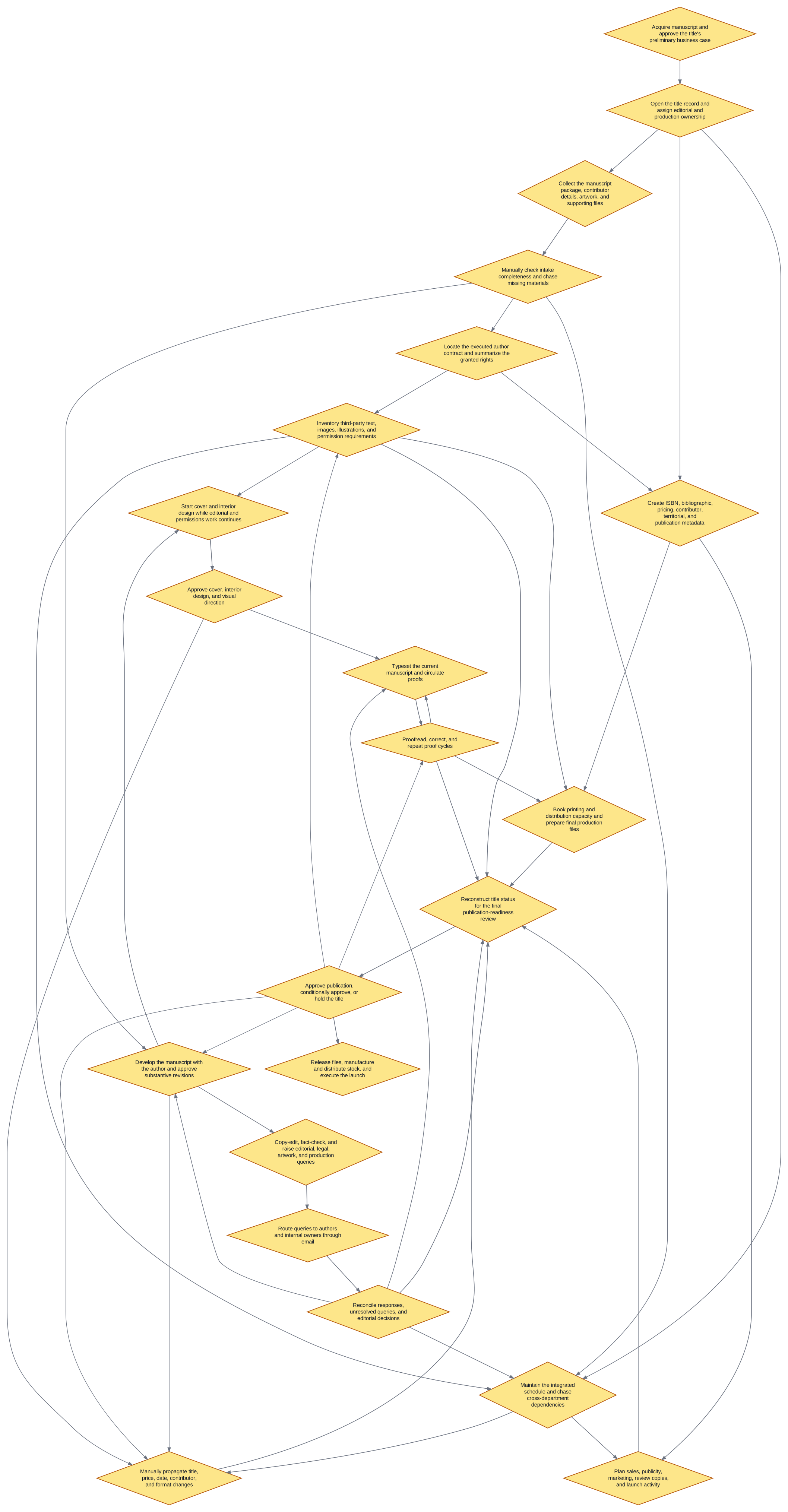
- Acquisition and intake: An acquiring editor secured preliminary approval, opened title records, collected manuscript files, contributor details, artwork lists, and declarations, then manually checked completeness. Missing items were chased through email, often from a checklist held by one editor.
- Rights and editorial work: Rights staff located the author contract and built permission spreadsheets while editors developed the manuscript. Copy-editors, fact-checkers, designers, and production staff raised queries in documents, proofs, and separate messages. A managing editor manually consolidated and routed them.
- Parallel design and production: Designers began cover and interior work before all editorial and permissions issues were settled. Production controllers maintained an integrated schedule in spreadsheets, repeatedly asking specialists whether inputs were final enough for typesetting, proofing, printing, or distribution setup.
- Metadata and launch preparation: Metadata staff entered ISBNs, titles, contributors, prices, territories, formats, and dates into internal and external systems. When an approved fact changed, separate teams had to update cover copy, copyright pages, retailer feeds, catalogues, sales material, and campaign schedules.
- Readiness reconstruction: Before release, editorial and production owners assembled status from emails, folders, spreadsheets, proofs, permissions records, printer updates, and colleagues’ recollections. A publishing director or release committee then approved, conditionally approved, or held the title.
Key pain points:
- A specialist could complete their own task while remaining unaware that a related change had invalidated another team’s work.
- “Requested,” “received,” “reviewed,” and “approved” were easily confused across permissions, editorial queries, designs, proofs, and metadata.
- Senior editors and production controllers became human integration layers, spending time locating status instead of resolving exceptions.
- Final readiness was a late reporting exercise rather than a continuously maintained operational state.
4. Agent Design and Guardrails
- Inputs: Manuscripts, artwork schedules, contracts, permission correspondence, editorial queries, proofs, design files, title records, retailer feeds, printer milestones, and launch schedules
- Understanding: Document extraction, asset and version identification, field normalization, query classification, source linking, and conflict detection
- Reasoning: Completeness rules, dependency checks, source precedence, confidence thresholds, exception classification, and readiness criteria
- Actions: Create or update structured records, route queries, reopen affected tasks, notify owners, propose synchronized corrections, and assemble decision packages
- Memory/state: A canonical title workspace containing stable identifiers, current versions, obligations, owners, events, approvals, dependencies, evidence links, and exception history
- Human review points: Manuscript acquisition, intake exceptions, contract interpretation, substantive author text, factual or legal disputes, design approval, material schedule or budget changes, metadata conflicts, waivers, and final publication approval
- Out-of-scope actions: Autonomous acquisition, silent contract interpretation, rewriting author text, approving creative work, accepting legal or commercial risk, or declaring a book ready for publication
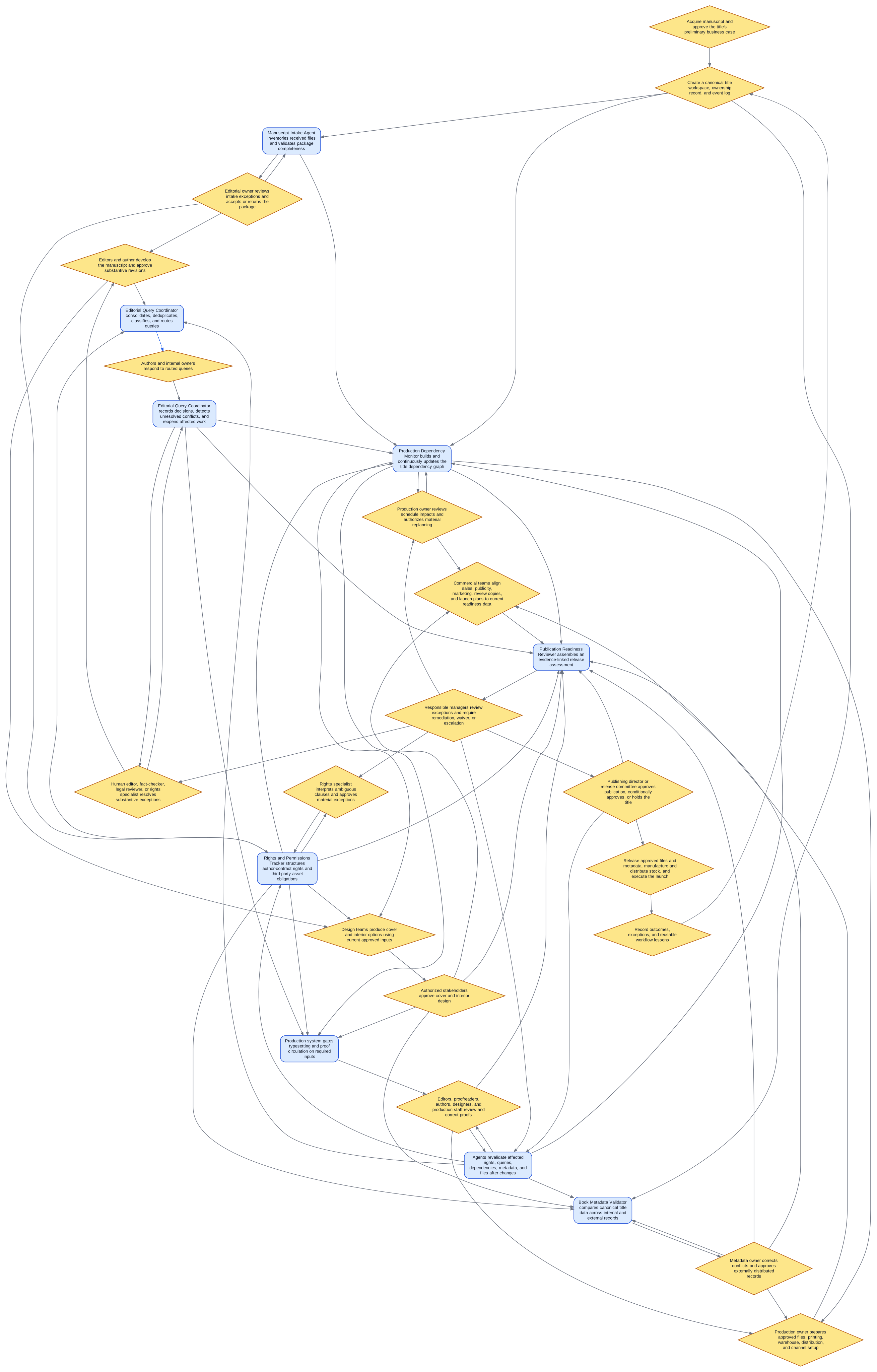
The target design used six bounded agents. The Manuscript Intake Agent inventoried files and raised completeness exceptions. The Rights and Permissions Tracker maintained contract facts and asset-level permissions but escalated ambiguous language. The Editorial Query Coordinator deduplicated questions, assigned owners, tracked answers, and reopened issues when later changes invalidated them. The Production Dependency Monitor maintained the graph connecting manuscript versions, artwork, rights, design, proofs, metadata, printing, distribution, and launch commitments. The Book Metadata Validator compared authoritative title facts across internal and external records. The Publication Readiness Reviewer assembled a signed evidence snapshot but could not issue the release decision.
The analytical point drawn from the selected research is that value does not come from maximizing agent autonomy. It comes from converting each handoff into an evidence-bearing state transition. ReAct shows why reasoning should alternate with observations and bounded actions against an external environment.1 MetaGPT and ChatDev show the importance of role specialization, structured intermediate outputs, prerequisite-aware handoffs, and review dialogue.23 AutoGen demonstrates that agent interactions can be programmed around different combinations of models, tools, and human input.4 Reflexion adds the correction loop: failed checks should create feedback and revised attempts, but its authors also note that self-evaluation has no formal guarantee of success.5 In this publishing workflow, an agent may update a permission state, open a query, propagate a schedule impact, or assemble evidence. It may not convert uncertainty into approval.
5. One Workflow Walkthrough
An illustrated nonfiction title entered proof after the author supplied a replacement archival photograph. The Manuscript Intake Agent detected a new asset identifier and linked it to the revised image schedule. The Rights and Permissions Tracker found no matching licence and marked the asset as “unverified,” not “uncleared”: the evidence was incomplete rather than definitively invalid. The Editorial Query Coordinator opened one consolidated query for the editor, picture researcher, and rights specialist instead of sending duplicate requests from three departments. The Production Dependency Monitor then identified the affected interior page, print proof, ebook package, credit line, final-file milestone, and launch review-copy date.
The rights specialist reviewed the source correspondence and determined that the proposed use required a new licence. The editor approved a temporary return to the previous image while the picture researcher sought permission. After the replacement was licensed, the rights record changed to “approved,” triggering targeted revalidation of the proof, credit line, ebook rights, and metadata—not a restart of the whole title. The design approver accepted the corrected page, the production owner confirmed the printer milestone, and the Publication Readiness Reviewer included the licence, approved proof version, and closed query in the release package. The publishing director made the final decision, with the entire exception path retained for audit.
6. Results
- Baseline period: Proposed retrospective analysis of the previous 12 months
- Evaluation period: Planned 12-week pilot
- Workflow scope/sample: Proposed pilot of 10–15 active titles in one imprint, including illustrated and text-led books
- Process change: Replace periodic status reconstruction with continuous intake, obligation, query, dependency, metadata, and readiness state
- Decision/model change: Present managers with source-linked exceptions and explicit approval requirements rather than a generic readiness score
- Business effect: Expected reduction in duplicate queries, late rights discoveries, avoidable proof cycles, inconsistent metadata, manual status chasing, and launch work based on stale dates
- Evidence status: Planned; no production outcome or financial benefit has yet been measured
The pilot should measure time spent chasing status, unresolved dependencies found at final review, query response time, permission clearance before typesetting, post-submission metadata discrepancies, late publication-date changes, proof cycles caused by coordination errors, overrides, false alerts, and rework cost. A successful pilot would not be defined by the number of autonomous actions. It would be defined by earlier exception discovery, cleaner handoffs, more complete decision evidence, and fewer cases in which managers must reconstruct what happened.
7. What Failed First and What Changed
A tabletop review of the initial design exposed two weaknesses. First, the agents treated every occurrence of a changed title fact as a separate problem, producing duplicate alerts from the manuscript, cover, metadata feed, and marketing copy. Second, a recent file could be mistaken for an authoritative file even when it lacked approval. The design was changed to use stable identifiers, source precedence, explicit version and approval states, deduplication, and role-specific subscriptions. Agents now distinguish factual, inferred, forecast, and approved state. The remaining limitation is substantive ambiguity: a contract clause, disputed fact, nuanced author response, or creative choice cannot be made safe merely by adding more agent dialogue. Those issues still require qualified human judgment.
8. Transferable Lesson
- Automate state maintenance before automating judgment. The highest-value work was detecting, connecting, and propagating changes across specialist workstreams.
- Design agents around accountable handoffs. Every output needs an owner, source, status, downstream consequence, and rule for escalation or review.
- Treat correction as part of the workflow. New evidence should reopen only the affected obligations and approvals, while a material change should invalidate any stale readiness decision.
This case shows that agentic AI works best in high-coordination environments when it makes dependencies and exceptions continuously visible without dissolving human accountability.
-
Shunyu Yao et al., “ReAct: Synergizing Reasoning and Acting in Language Models,” arXiv:2210.03629, https://arxiv.org/abs/2210.03629. ↩︎
-
Sirui Hong et al., “MetaGPT: Meta Programming for a Multi-Agent Collaborative Framework,” arXiv:2308.00352, https://arxiv.org/abs/2308.00352. ↩︎
-
Chen Qian et al., “ChatDev: Communicative Agents for Software Development,” arXiv:2307.07924, https://arxiv.org/abs/2307.07924. ↩︎
-
Qingyun Wu et al., “AutoGen: Enabling Next-Gen LLM Applications via Multi-Agent Conversation,” arXiv:2308.08155, https://arxiv.org/abs/2308.08155. ↩︎
-
Noah Shinn et al., “Reflexion: Language Agents with Verbal Reinforcement Learning,” arXiv:2303.11366, https://arxiv.org/abs/2303.11366. ↩︎