Executive Snapshot
- Client type: Composite mid-table professional football club
- Industry: Professional sport and performance operations
- Core problem: Training, medical, scouting, video, player-feedback, and travel information reached decision-makers through separate reports that became difficult to reconcile before each match.
- Why agentic AI: The preparation cycle required several specialist workers to retrieve evidence, maintain a shared state, detect exceptions, and reopen only the decisions affected by late changes.
- Deployment stage: Design-stage prototype
- Primary result: A proposed shift from batch-style departmental reporting to a traceable, role-specific preparation brief with explicit approval gates and dependency-aware revision.
1. Business Context
Northbridge United FC is a fictional composite top-division football club with a 28-player first-team squad. Between the final whistle of one match and the start of the next, coaches, sports scientists, medical staff, analysts, and operations personnel must turn GPS and conditioning data, rehabilitation notes, wellness questionnaires, match video, scouting observations, and travel schedules into one preparation brief. The cycle occurs every fixture and can compress to less than 72 hours during congested periods. Information sits across dashboards, spreadsheets, electronic medical records, video platforms, presentations, email, and messaging channels. A stale availability label, missed load warning, unsupported scouting claim, or changed arrival time can alter training, recovery, selection, or match preparation.
2. Why Simpler Automation Was Not Enough
The bottleneck was not data collection alone. A dashboard could display load, but it could not determine whether a high value reflected normal positional demand, recent match minutes, rehabilitation restrictions, or an itinerary that reduced recovery time. A fixed script could merge fields, but not reconcile “modified training” in a medical update with “available” in a coaching sheet. A chatbot could summarize documents, but without state, provenance, access controls, and approval status it could turn provisional information into an authoritative-looking brief. The workflow therefore needed specialized agents with bounded roles, a shared preparation state, deterministic policy checks, and escalation paths for ambiguous or consequential cases.
3. Pre-Agent Workflow
Before the redesign, the club operated through parallel departmental work followed by manual convergence:
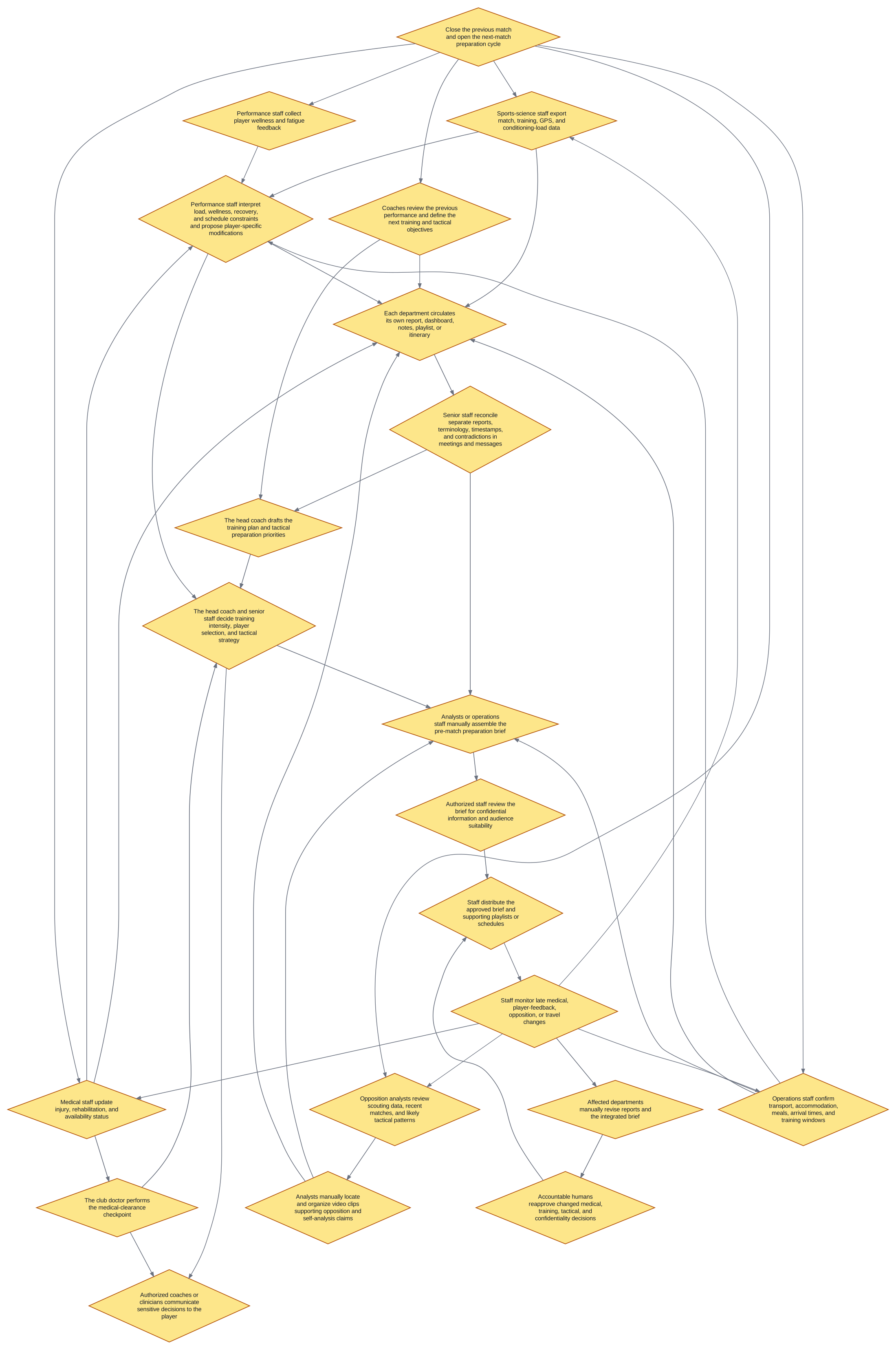
- Departments collected and interpreted their own inputs. Sports-science staff exported match, training, GPS, and conditioning data. Medical staff updated rehabilitation and availability. Performance staff gathered player wellness feedback. Coaches reviewed the previous match, analysts studied the opponent, and operations staff confirmed transport, hotels, meals, and training windows.
- Each function produced a separate artifact. The outputs arrived as dashboards, spreadsheets, medical status notes, tactical presentations, video playlists, coaching notes, and travel itineraries.
- Senior staff reconciled the differences. Meetings and message threads were used to check timestamps, translate terminology, identify missing information, and ask which version was current.
- Humans made the protected decisions. The club doctor decided medical clearance. The head coach and senior staff decided training intensity, player selection, and tactical strategy.
- A brief was assembled and repeatedly repaired. Analysts or operations staff manually combined the approved material, checked confidentiality, and distributed it. A late medical update, player complaint, opposition change, or travel disruption could reopen several reports and force a broad rewrite.
Key pain points
- The same player status was recreated in several formats, increasing inconsistency and version risk.
- Evidence and claims were separated: a scouting conclusion might be in a slide while its supporting clips remained inside a long playlist.
- Late changes propagated through people rather than dependencies, so staff often rebuilt more of the brief than the change required.
4. Agent Design and Guardrails
The redesign introduced six coordinated capabilities rather than one autonomous “head coach” agent.
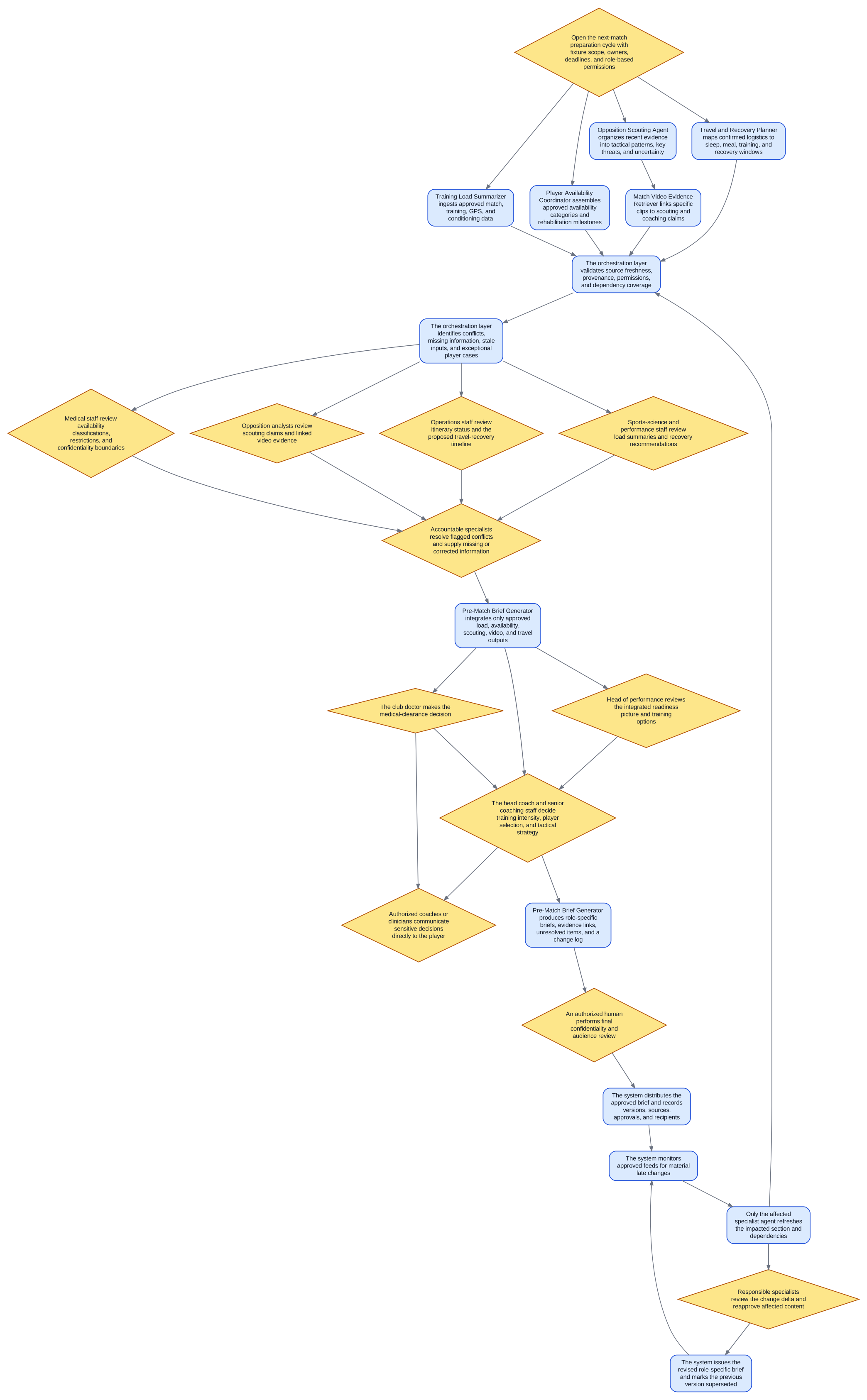
- Inputs: Approved GPS and conditioning feeds, player-status classifications, rehabilitation milestones, wellness inputs, scouting notes, match and tracking data, indexed video, and confirmed itinerary events.
- Understanding: The Training Load Summarizer structures recent and baseline load; the Player Availability Coordinator assembles authorized status categories; the Opposition Scouting Agent separates observations from interpretations; the Match Video Evidence Retriever links claims to clips; and the Travel and Recovery Planner maps logistics to available sleep, meal, training, and recovery windows.
- Reasoning: An orchestration layer checks timestamps, permissions, provenance, required fields, and dependencies. It identifies contradictions, stale inputs, missing approvals, and exceptional player cases. It routes each exception to the accountable specialist instead of resolving it through model confidence.
- Actions: The Pre-Match Brief Generator integrates only approved inputs, creates role-specific views, links claims to sources, lists unresolved items, and records a change log.
- Memory/state: One fixture-scoped preparation state stores source versions, owners, approvals, open exceptions, affected decisions, and the active brief version.
- Human review points: Performance staff approve load and recovery interpretations; medical staff approve availability and restrictions; analysts approve tactical claims and clips; operations staff confirm itinerary facts; the head of performance reviews readiness options; the club doctor clears players; the head coach decides intensity, selection, and tactics; and an authorized human approves confidential distribution.
- Out-of-scope actions: Medical diagnosis, medical clearance, player selection, tactical strategy, final training intensity, and confidential communication with players.
Analytical point: coordinate exceptions, do not automate authority
The five selected papers point toward the same design conclusion. Sports prediction is useful only when outputs are interpretable enough to support practitioners and when false alarms are understood in operational context.1 Retrieval-augmented generation makes external evidence inspectable and updateable rather than relying only on model memory.2 ReAct shows why reasoning should alternate with actions against external sources, especially when plans must change after new observations.3 AutoGen demonstrates how role-specific agents, tools, and configurable human participation can form an explicit control flow.4 ReSpAct adds the missing organizational behavior: when information is ambiguous, the system should ask, clarify, and incorporate human guidance rather than make a convenient assumption.5
For Northbridge, the central benefit is therefore not an AI-generated recommendation about who should play. It is a current operational picture in which every important claim has an owner, source, timestamp, approval state, and known downstream effect.
5. One Workflow Walkthrough
Forty-eight hours before an away match, a starting midfielder reports unusual hamstring tightness after completing a high-load session. The Training Load Summarizer flags a sharp change against the player’s recent baseline. The Player Availability Coordinator finds that the current coaching view still says “full training,” while the latest medical entry is “assessment pending.” At the same time, the Travel and Recovery Planner shows an earlier departure that removes part of the planned recovery window.
The orchestrator does not decide that the player is injured or unavailable. It opens an exception linking the three inputs and routes it to sports science, medical staff, and operations. The performance specialist reviews the load trace and proposes modified training. The clinician examines the player and records a provisional restriction with a reassessment time. Operations confirms the new departure. The brief generator updates only player readiness, the session plan, and the travel-recovery section. The club doctor later makes the clearance decision; the head coach then makes the selection and intensity decisions. A confidentiality reviewer verifies that the coaching brief contains only the approved availability category, not the diagnosis. The revised version is issued, the earlier one is marked superseded, and the decision trail remains auditable.
6. Results
This is a design-stage case, so no production outcome is claimed.
- Baseline period: To be measured across four fixtures using the existing manual process
- Evaluation period: Planned four-to-six-fixture controlled pilot
- Workflow scope/sample: First-team preparation from the preceding final whistle to the next kickoff
- Process change: Replace full-document reconciliation with source-grounded specialist outputs, an exception queue, and partial refresh of affected sections
- Decision/model change: Increase the proportion of brief claims carrying a source, timestamp, owner, and approval state; keep all protected decisions human
- Business effect: Expected reduction in preparation latency, clarification traffic, stale-status exposure, duplicate reporting, and unnecessary whole-brief rework
- Evidence status: Planned
The pilot should measure median time to first approved brief, staff minutes spent assembling it, number of cross-department clarification messages, percentage of material claims with traceable evidence, time from a late change to a revised brief, number of superseded versions still circulating, and the rate at which specialists reject or correct agent outputs. Sporting outcomes should not be attributed to the system without a longer and more carefully controlled evaluation.
7. What Failed First and What Changed
The first design review exposed a structural failure: the draft architecture allowed retrieved information to flow directly into the narrative brief. That made a provisional travel change, an analyst hypothesis, and an unapproved medical status look equally authoritative. The workflow was revised around typed states—observed, interpreted, provisional, approved, restricted, and decided—and the brief generator was blocked from presenting unresolved information as settled fact. Material changes now create a delta for the relevant specialist and repeat the original approval gate. The remaining limitation is upstream quality: an agent can preserve the provenance of an incorrect or late human entry, but it cannot make that source true.
8. Transferable Lesson
- Design the system around handoffs and exceptions, not around a generic assistant that summarizes everything.
- Keep evidence, interpretation, recommendation, and human decision as separate data objects with separate owners.
- Make late-change handling a first-class workflow: refresh dependencies, show the delta, and repeat only the approvals that the change affects.
This case shows that agentic AI works best in high-tempo professional operations when it synchronizes evidence and review without confusing coordination power with decision authority.
-
Alessio Rossi et al., “Effective Injury Forecasting in Soccer with GPS Training Data and Machine Learning,” arXiv:1705.08079, 2017. https://arxiv.org/abs/1705.08079 ↩︎
-
Patrick Lewis et al., “Retrieval-Augmented Generation for Knowledge-Intensive NLP Tasks,” arXiv:2005.11401, 2020. https://arxiv.org/abs/2005.11401 ↩︎
-
Shunyu Yao et al., “ReAct: Synergizing Reasoning and Acting in Language Models,” arXiv:2210.03629, 2022. https://arxiv.org/abs/2210.03629 ↩︎
-
Qingyun Wu et al., “AutoGen: Enabling Next-Gen LLM Applications via Multi-Agent Conversation,” arXiv:2308.08155, 2023. https://arxiv.org/abs/2308.08155 ↩︎
-
Vardhan Dongre et al., “ReSpAct: Harmonizing Reasoning, Speaking, and Acting Towards Building Large Language Model-Based Conversational AI Agents,” arXiv:2411.00927, 2024. https://arxiv.org/abs/2411.00927 ↩︎