Executive Snapshot
- Client type: Regional industrial laundry and textile-rental operator serving hospitals, hotels, gyms, factories, and food-processing sites
- Industry: Commercial laundry, managed textiles, and route-based business services
- Core problem: Demand, circulating inventory, wash capacity, contamination controls, routes, and customer commitments were managed through separate systems and repeated human reconciliation
- Why agentic AI: The workflow required several specialized planners to share changing operational state, replan after exceptions, and stop at defined human authority gates
- Deployment stage: Pre-pilot workflow design
- Primary result: A designed shift from late, department-by-department problem discovery to continuous, exception-driven coordination; production results have not yet been measured
1. Business Context
The operator processes roughly 70–90 tonnes of linen, towels, uniforms, and protective garments each week for about 110 customer sites. Across three shifts, receiving teams, sorters, production planners, hygiene managers, inventory controllers, drivers, customer-service staff, and account managers coordinate 25–30 wash batches and 18 collection or delivery routes per operating day. Their evidence is scattered across contracts, route manifests, barcode or RFID records, machine-control logs, contamination declarations, email, telephone notes, shift logs, and spreadsheets. Errors matter because textile stock is distributed across customers, vehicles, quarantine areas, production lines, repair stations, and clean stores. A late discrepancy can therefore become a missed hospital delivery, an unsafe batch, an emergency route, or a disputed replacement charge.
2. Why Simpler Automation Was Not Enough
A dashboard could display counts but could not determine whether a shortage represented delayed returns, route errors, quarantined stock, damaged items, or genuine demand. A scheduling script could fill washer capacity but could not safely mix incompatible fabrics, customer-specific garments, or loads subject to different hygiene procedures. A chatbot could summarize messages but would not maintain authoritative state across a collection, wash, inspection, allocation, and delivery cycle. The workflow branches whenever actual arrivals differ from forecasts, a load appears contaminated, equipment goes offline, output fails inspection, or scarce stock must be divided among customers. The required mechanism was therefore not one model making every decision. It was a set of specialized agents exchanging structured outputs, observing execution, and invoking people under explicit conditions.123
3. Pre-Agent Workflow
Before the redesign, the organization operated through a sequence of human-maintained handoffs:
- Customer service assembled demand. Staff interpreted contract schedules, recurring orders, emails, calls, complaints, and emergency requests, then consolidated them into daily order spreadsheets.
- Transport and receiving established what had returned. Coordinators prepared route manifests; drivers collected soiled textiles and declarations; receiving staff weighed and scanned loads; sorters separated them by customer, item, fabric, wash specification, and apparent contamination risk.
- Inventory control reconstructed availability. Staff combined scans, bundle counts, weights, route records, quarantine notes, production logs, repair records, and spreadsheets to estimate what was customer-held, in transit, soiled, clean, damaged, missing, or unavailable.
- Production and dispatch negotiated a feasible day. Planners created wash and finishing batches from incomplete arrival information. Dispatch staff repeatedly called production supervisors to learn whether allocated orders would be ready, then manually resequenced routes.
- Managers resolved consequential exceptions. Hygiene managers decided whether suspicious loads could be released, alternatively processed, retained, or disposed of. Plant leaders prioritized customers during shortages. Account managers investigated losses and approved replacement charges. Account teams later rebuilt SLA reports from separate operational records.
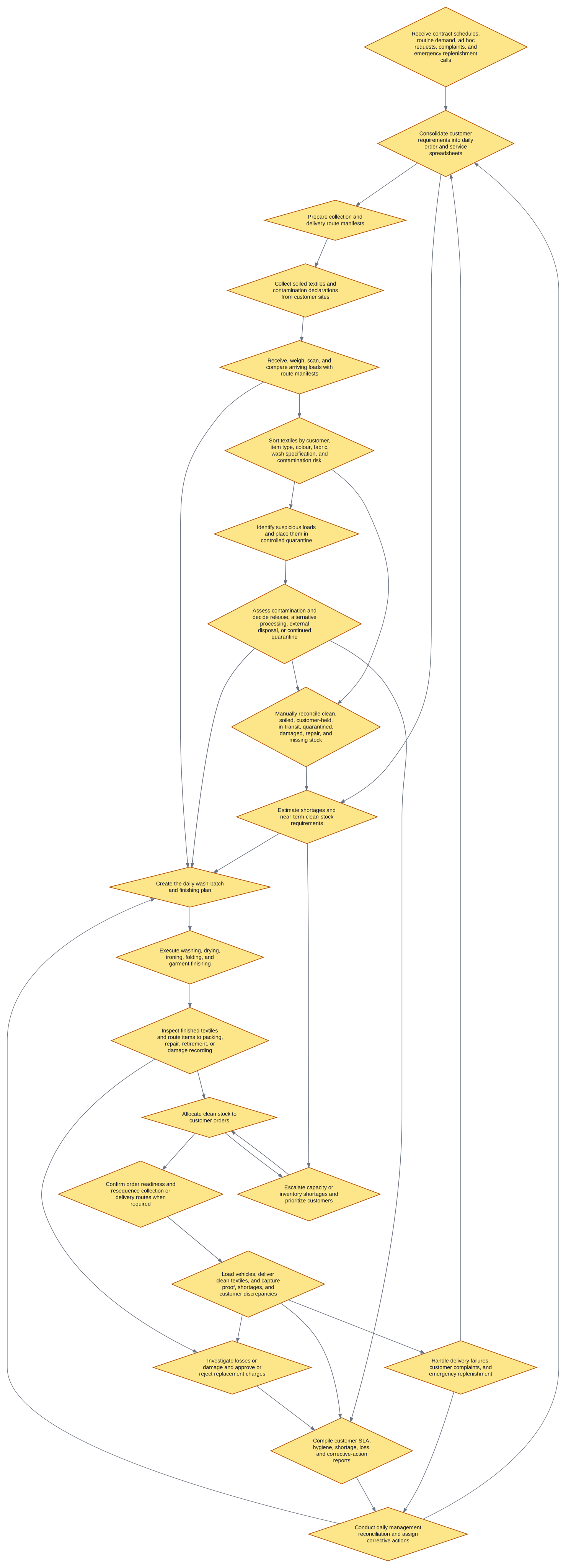
The principal bottleneck was not any single task. It was the delay between a change in one department and its operational consequences elsewhere. Quarantining a hospital load altered usable inventory, batch eligibility, clean-stock allocation, route readiness, and SLA exposure, but each effect had to be communicated and recalculated separately.
Key pain points:
- Production plans were created before all returns, machine conditions, and contamination outcomes were visible.
- Inventory reconciliation mixed genuine loss with timing differences and incomplete scans.
- Managers spent time locating and reconciling information before they could judge exceptions.
- Customer risk was often discovered during staging or loading, when recovery options were already narrow.
4. Agent Design and Guardrails
The new design creates a shared operational state from contract, customer, route, scan, weight, production, maintenance, inspection, contamination, and delivery events. Records are not silently overwritten: each event retains its source, time, item or batch identity, confidence, and reconciliation status.
- Inputs: Contract schedules, order changes, historical consumption, route events, RFID or barcode scans, bulk counts and weights, machine status, approved wash formulas, contamination declarations, inspection results, maintenance records, and delivery evidence
- Understanding: Event normalization, customer and item classification, discrepancy detection, contamination-rule matching, and provenance tracking
- Reasoning: Demand forecasting, distributed inventory reconciliation, compatible batch planning, route coordination, readiness prediction, shortage-scenario generation, and deterministic policy validation
- Actions: Update provisional operating state, propose batches and routes, hold suspicious loads, create exception cases, trigger replanning, draft charge candidates, and generate SLA reports
- Memory/state: Customer-held, in-transit, receiving, sorted, quarantined, in-process, clean, allocated, repair, damaged, retired, and missing textile states, plus approved lessons from prior exceptions
- Human review points: Low-confidence demand changes; material inventory discrepancies; abnormal routes; contamination disposition; wash-process changes; operational overrides; scarce-capacity prioritization; replacement charges; and consequential customer reports
- Out-of-scope actions: Clearing contamination, altering validated hygiene procedures, choosing winners during severe shortages, or posting disputed charges without named human approval
The six agents are organized around the existing workflow rather than around an open-ended conversation. The Demand Forecasting Agent produces an item-by-customer forecast. The Inventory Reconciliation Agent publishes a usable-stock position and discrepancy queue. The Contamination Exception Agent can identify and quarantine a suspect load, but only the hygiene manager can decide its disposition. The Wash-Batch Planning Agent proposes compatible machine and finishing sequences, which pass through a deterministic rule validator before execution. The Collection and Delivery Coordinator aligns expected returns, production readiness, allocations, vehicle capacity, and customer windows. The SLA Report Generator assembles traceable customer evidence.
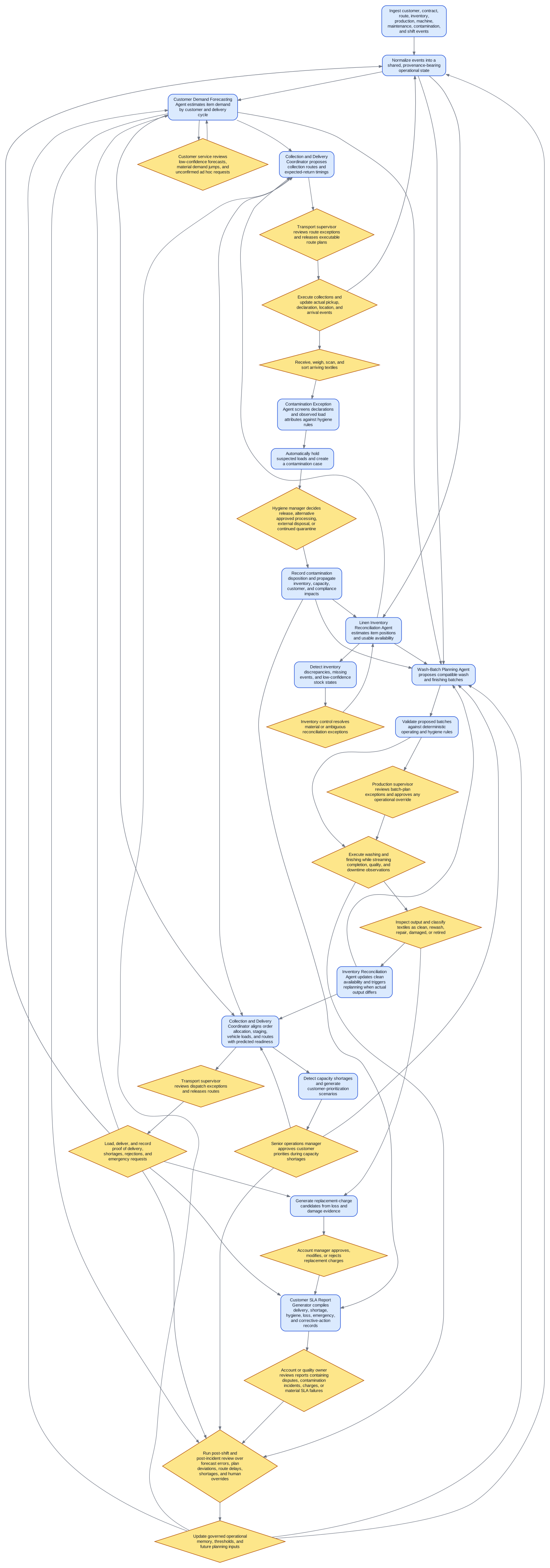
Analytical point: govern the transitions, not the conversation
The selected research suggests that agentic value appears when organizational handoffs become explicit artifacts and controlled state changes. Role specialization and standardized intermediate outputs reduce ambiguity between agents.1 Configurable agent, tool, and human participation allows different escalation patterns for routine and consequential work.2 Interleaving plans with external observations supports replanning when arrivals, output, or routes diverge from expectation.3 Feedback can be retained as operational memory, but it remains fallible and should not update policy without review.4 Human oversight is therefore layered across preventive controls, joint planning, execution monitoring, and post-event review rather than concentrated in one final approval.5
5. One Workflow Walkthrough
A hospital collection arrives above forecast while one cage is flagged during sorting for a contamination condition inconsistent with its declaration. The receiving and sorting events immediately update the shared state. The Contamination Exception Agent matches the discrepancy to the hygiene rules, places the cage in quarantine, blocks it from batch eligibility, and opens an evidence-bearing case. The hygiene manager reviews the declaration, observations, affected items, and approved procedures, then decides that the cage must remain isolated pending a defined alternative process.
That decision reduces the usable linen position. The Inventory Reconciliation Agent recalculates clean and expected stock; the Batch Planning Agent proposes a revised sequence using only released loads and approved formulas; and the rule validator checks textile compatibility, machine limits, traceability, and expected completion. Because the revised output cannot meet every commitment, the system generates prioritization scenarios showing clinical risk, contractual exposure, route effects, and emergency-stock options. A senior operations manager approves the allocation. The route coordinator then revises staging and delivery plans, while customer service receives the affected commitments and proposed communication. The incident, approval, route changes, and final delivery outcome flow into the SLA record and post-shift review.
6. Results
- Baseline period: Not supplied; the baseline is reconstructed from the recurring pre-agent operating cycle
- Evaluation period: Not yet conducted
- Workflow scope/sample: End-to-end demand, collection, receiving, sorting, inventory, contamination, batching, finishing, allocation, delivery, charging, and SLA reporting
- Process change: Planned replacement of manual cross-system reconciliation with shared-state updates, structured agent handoffs, and event-triggered replanning
- Decision/model change: Planned separation of probabilistic recommendations from deterministic operating rules and named human decisions
- Business effect: Expected reduction in late shortage discovery, emergency deliveries, reconciliation effort, avoidable route changes, and unsupported SLA reporting
- Evidence status: Planned; no production or pilot effect size is claimed
The pilot should measure forecast error by customer and item, the age and value of unresolved inventory discrepancies, quarantine-to-disposition time, batch-plan adherence, rewash and damage rates, route departure reliability, emergency deliveries, SLA misses, and the proportion of cases requiring human review. The central test is not whether agents produce plausible plans. It is whether actual inspected output, delivery evidence, and human decisions remain synchronized with those plans throughout the operating cycle.
7. What Failed First and What Changed
No deployment history was supplied, so the first weakness is a design-stage failure mode rather than an observed production incident. A naïve implementation would let agents exchange free-form summaries and ask humans to review every output. That recreates the original coordination burden in digital form and makes it difficult to determine which record is authoritative. The design therefore changes the unit of coordination from messages to typed artifacts and state transitions: forecast, stock position, contamination case, batch proposal, route release, charge candidate, and SLA record. Hard rules validate executable plans, while humans see only material exceptions and the evidence needed for their authority. The remaining limitation is data quality: bulk textiles that are counted by weight or bundle will still carry more uncertainty than individually tagged garments.
8. Transferable Lesson
- Model the physical state before adding autonomy. Agents cannot coordinate reliably when inventory, quarantine, production, and delivery statuses have no shared definitions.
- Use agents for synthesis and replanning; use deterministic controls for hard constraints. Hygiene, compatibility, traceability, ownership, and approval rules should not depend on persuasive model output.
- Place human authority at consequence boundaries. Review contamination, process changes, disputed charges, and scarcity decisions—not every routine forecast or batch.
This case shows that agentic AI works best where several specialized functions must continually revise a shared plan, while consequential exceptions remain governed by accountable people.
-
Sirui Hong et al., “MetaGPT: Meta Programming for a Multi-Agent Collaborative Framework,” arXiv:2308.00352, 2023. https://arxiv.org/abs/2308.00352 ↩︎ ↩︎
-
Qingyun Wu et al., “AutoGen: Enabling Next-Gen LLM Applications via Multi-Agent Conversation,” arXiv:2308.08155, 2023. https://arxiv.org/abs/2308.08155 ↩︎ ↩︎
-
Shunyu Yao et al., “ReAct: Synergizing Reasoning and Acting in Language Models,” arXiv:2210.03629, 2022. https://arxiv.org/abs/2210.03629 ↩︎ ↩︎
-
Noah Shinn et al., “Reflexion: Language Agents with Verbal Reinforcement Learning,” arXiv:2303.11366, 2023. https://arxiv.org/abs/2303.11366 ↩︎
-
Shipi Dhanorkar, Samir Passi, and Mihaela Vorvoreanu, “Human Oversight of Agentic Systems in Practice: Examining the Oversight Work, Challenges, and Heuristics of Developers Using Software Agents,” arXiv:2606.05391, 2026. https://arxiv.org/abs/2606.05391 ↩︎