Executive Snapshot
- Client type: Independent medium-sized ship agency serving international cargo-vessel owners and operators
- Industry: Maritime services and commercial port operations
- Core problem: Each port call depended on coordinators manually reconciling changing information across email, messaging apps, telephone calls, spreadsheets, PDFs, and port portals
- Why agentic AI: The work required persistent state, parallel specialist checks, dependency tracking, and repeated replanning rather than a single prediction or fixed automation
- Deployment stage: Pilot design for approximately 30 container-vessel and bulk-carrier calls at one port
- Primary result: A governed target workflow in which agents maintain operational state and prepare actions, while humans retain authority over regulated submissions, service-provider changes, expenses, claims, safety exceptions, and departure
1. Business Context
HarborLink Marine Services coordinated roughly 70–90 port calls each month, with 8–15 vessels active at once and operations running across rotating shifts. A call began with the agency appointment and preliminary vessel, cargo, crew, arrival, and service information. It ended only after cargo work was complete, departure clearance was obtained, the vessel sailed, and the preliminary port-cost file was assembled. Between those points, coordinators worked across shared and personal inboxes, WhatsApp or WeChat groups, telephone calls, terminal and authority portals, spreadsheets, PDFs, and internal records. A changed estimated time of arrival could invalidate a berth plan, tug and pilot bookings, surveyor attendance, document deadlines, and cost assumptions. Missing one dependency could create cancellation charges, departure delay, demurrage exposure, regulatory escalation, or a disputed final account.
2. Why Simpler Automation Was Not Enough
The workflow was repetitive but not stable. A fixed script could copy a field from an email, yet it could not reliably decide whether a new arrival time was preliminary or confirmed, identify every downstream booking it affected, or distinguish a routine reschedule from a safety-critical exception. A dashboard could display data but would not chase missing documents, compare conflicting sources, draft revised instructions, or return to an earlier step after a failed check. A chatbot would answer questions without maintaining the full port-call state.
Five relevant arXiv studies suggest a stronger design. Role-specialized agents work better when they follow explicit procedures and exchange structured intermediate outputs; recurring action patterns can be retained as workflow memory; SOP-oriented agents need execution state and retry paths; human feedback should be inserted at consequential stages; and reviewed failures should feed an explicit improvement loop.12345 The analytical point for HarborLink was therefore not to automate the port call end to end, but to convert a fragmented human process into a governed workflow operating system: agents maintain state and prepare decisions, while humans control commitments and exceptions.
3. Pre-Agent Workflow
Before the agent system, the assigned port-call coordinator acted as the organization’s integration layer.
- The coordinator received the agency appointment, opened a vessel spreadsheet and folders, and manually copied preliminary vessel, cargo, crew, ETA, and service information into the working record.
- The coordinator collected updates from email, messages, calls, portals, PDFs, and spreadsheets, then reconciled contradictory berth, cargo, documentation, and service information using personal judgment and local knowledge.
- Based on the latest understood schedule, the coordinator booked pilots, tugboats, surveyors, suppliers, and inspections while documentation specialists separately checked customs and immigration files.
- Every material change triggered another manual dependency review: affected stakeholders were contacted, bookings were revised, deadlines were recalculated, and the spreadsheet was updated. At shift change, the outgoing coordinator reconstructed the live situation through notes, selected message threads, and a verbal handover.
- Finance staff later assembled quotations, tariffs, invoices, and evidence of service delivery; operations staff reconstructed delay chronologies; and authorized humans chased the final departure prerequisites.
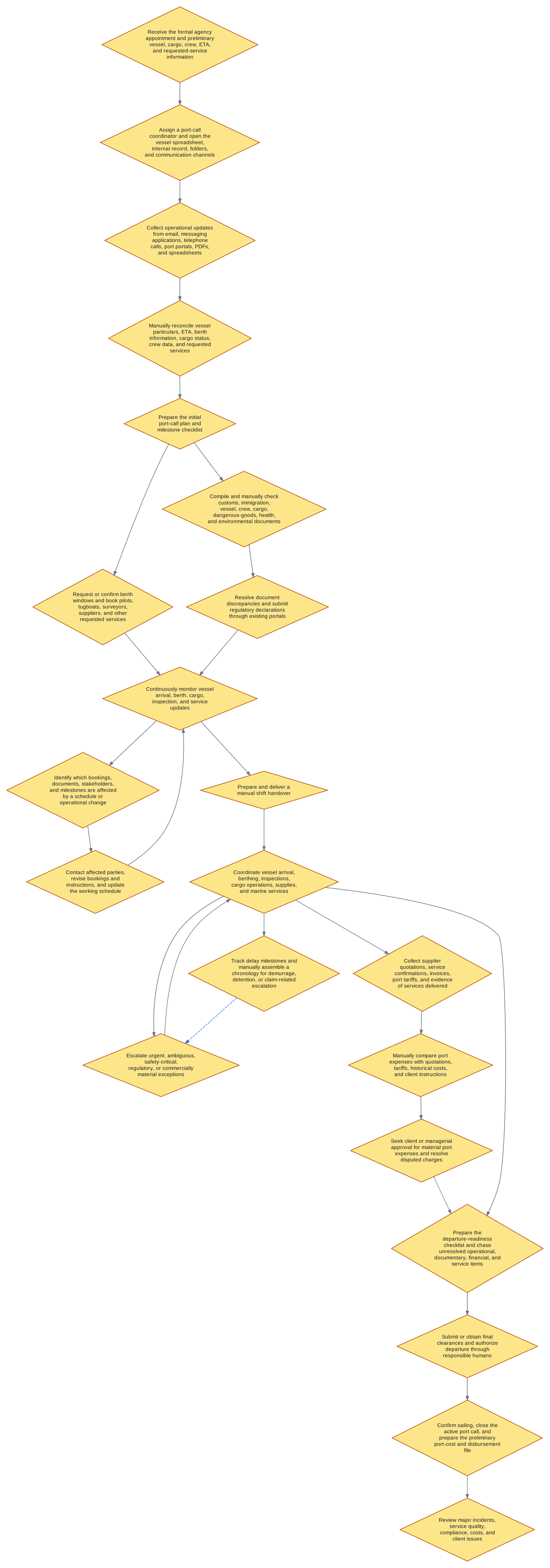
Figure 1. Before agentic AI, the workflow depended on repeated human collection, reconciliation, forwarding, and reconstruction across fragmented channels.
Key pain points:
- The spreadsheet was only as current as the last manual update, while critical information could remain inside an email thread, chat group, or telephone call.
- A schedule change required the coordinator to remember every affected booking, document, deadline, and stakeholder.
- Documentation, expense, delay, and departure reviews were performed from separately assembled evidence, producing duplicated work and late exceptions.
4. Agent Design and Guardrails
- Inputs: Designated operational inboxes, spreadsheets, PDFs, standard forms, portal exports, internal port-call records, vessel-position and approved weather feeds, plus manually recorded phone and messaging updates
- Understanding: Document classification, field extraction, entity matching, deadline tagging, source comparison, and provisional-versus-confirmed status
- Reasoning: Workflow-state transitions, dependency checks, deterministic regulatory and financial rules, threshold-based escalation, evidence retrieval, and role-specific planning
- Actions: Update the shared case state, create alerts, draft coordination messages, generate checklists, assemble evidence chronologies, and route approval tasks
- Memory/state: One case-level evidence store, timestamped event timeline, task graph, approvals, overrides, superseded values, and unresolved-item list
- Human review points: Critical baseline facts; provider changes; material operational commitments; customs, immigration, safety, and regulatory submissions; supplier quotations and port expenses; delay responsibility and claims; safety exceptions; and final departure authorization
- Out-of-scope actions: Navigation, emergency command, autonomous regulatory submission, final payment approval, autonomous claim initiation, cargo-stowage decisions, and legal or safety clearance
The six agents divided the existing work rather than inventing a separate process. The Vessel Arrival Monitor watched for changes. The Berth and Service Coordinator translated confirmed changes into a revised timeline and draft messages. The Customs Document Checker tested completeness and cross-document consistency. The Port Expense Reviewer matched charges with tariffs, quotations, ordered work, and delivery evidence. The Delay and Demurrage Risk Agent tracked missed milestones and built an evidence-linked chronology without assigning legal responsibility. The Departure Clearance Assistant evaluated readiness without authorizing sailing.
The coordinator remained accountable for the case. Agents could recommend, draft, flag, and recheck; they could not bind the vessel owner, change a provider, submit a declaration, approve an expense, or issue a safety-relevant instruction. Rejected proposals returned to the responsible agent for revision, creating a controlled review loop rather than an autonomous chain.
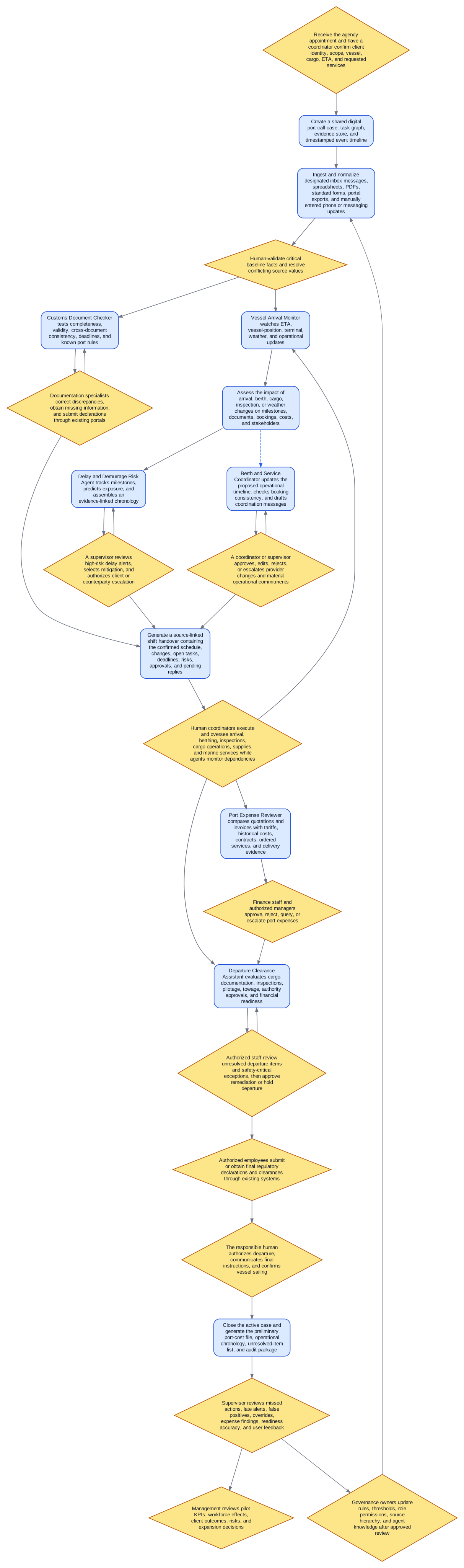
Figure 2. After implementation, specialist agents operate over one shared case state, with explicit human gates for controlled decisions and exceptions.
5. One Workflow Walkthrough
Two days before arrival, a terminal email moved the provisional berth window six hours later while the vessel’s latest position report still supported the earlier ETA. The Vessel Arrival Monitor recorded both values rather than overwriting the schedule and asked the coordinator to confirm which source governed the operational plan. After confirmation, the impact check identified four dependencies: the pilot and tug bookings, a surveyor attendance window, a customs-document deadline, and possible additional anchorage exposure.
The Berth and Service Coordinator drafted revised booking messages and showed the cost implications. Because one tug provider could not support the new time, the system proposed an alternative but routed the provider change and revised quotation to the supervisor. In parallel, the Customs Document Checker found that the arrival declaration still contained the old berth time, while the Delay and Demurrage Risk Agent added the terminal change to the chronology and estimated the exposure range. The supervisor approved the provider change; the documentation specialist corrected and submitted the declaration; and the agents rechecked the updated case. The final actions, evidence, approvals, and superseded schedule remained in the event timeline for handover and audit.
6. Results
- Baseline period: To be established from a comparable set of completed calls before the pilot
- Evaluation period: Approximately 30 pilot port calls
- Workflow scope/sample: Container vessels and bulk carriers at one commercial port, from formal appointment through sailing and preliminary cost-file preparation
- Process change: Planned transition from manual channel checking and spreadsheet reconciliation to continuous ingestion, shared state, source-linked handovers, and event-triggered specialist checks
- Decision/model change: Planned shift from coordinators independently remembering dependencies to agents proposing evidence-backed actions with confidence, rule status, and explicit approval requirements
- Business effect: Expected earlier detection of missing documents and schedule impacts, fewer avoidable cancellation or standby charges, stronger expense review, more complete audit trails, and lower coordinator time per call
- Evidence status: Planned pilot; no production benefit is claimed
The pilot should measure change-detection timeliness, missing-document findings before deadlines, manual data-entry time, questionable expenses detected, cancellation and standby charges, readiness accuracy, missed actions, supervisor overrides, user trust, client satisfaction, and audit completeness. Results should be reported against the baseline rather than inferred from agent accuracy alone. A technically correct alert that arrives too late, cannot be verified, or causes staff to ignore later warnings is not an operational success.
7. What Failed First and What Changed
The first prototype logic treated the newest timestamp as the current truth. That was unsafe in a workflow where a recent chat message might be provisional while an older terminal notice remained authoritative. It produced unnecessary rebooking alerts and made the shared record look more certain than the evidence justified. HarborLink changed the state model so that updates were stored as provisional, confirmed, superseded, or disputed. Critical values displayed their sources side by side, and the coordinator had to validate vessel identity, dangerous-goods status, crew data, confirmed ETA, berth instructions, and regulatory deadlines before downstream commitments. The remaining limitation is physical-world visibility: calls, informal messages, and unexpected quay-side conditions still depend on prompt human recording.
8. Transferable Lesson
- Automate state maintenance before decision authority. The largest workflow gain comes from preserving current evidence, dependencies, and unresolved work—not from letting an agent make every decision.
- Put human gates at commitments, not everywhere. Routine monitoring and checking can run continuously, while provider changes, regulated submissions, material costs, claims, and safety decisions receive explicit approval.
- Turn overrides into governed workflow knowledge. Rejections, corrections, missed alerts, and false positives should improve versioned rules and reusable routines, but production behavior should never self-modify without review and testing.
This case shows that agentic AI works best when it makes a changing operational process observable, coordinated, and reviewable—while leaving consequential authority with the people accountable for the vessel call.
-
Sirui Hong et al., “MetaGPT: Meta Programming for A Multi-Agent Collaborative Framework,” arXiv:2308.00352, revised 2024. https://arxiv.org/abs/2308.00352 ↩︎
-
Zora Zhiruo Wang, Jiayuan Mao, Daniel Fried, and Graham Neubig, “Agent Workflow Memory,” arXiv:2409.07429, 2024. https://arxiv.org/abs/2409.07429 ↩︎
-
Wannita Takerngsaksiri et al., “Human-In-the-Loop Software Development Agents,” arXiv:2411.12924, 2024. https://arxiv.org/abs/2411.12924 ↩︎
-
M. Kulkarni et al., “Agent-S: LLM Agentic Workflow to Automate Standard Operating Procedures,” arXiv:2503.15520, 2025. https://arxiv.org/abs/2503.15520 ↩︎
-
Noah Shinn et al., “Reflexion: Language Agents with Verbal Reinforcement Learning,” arXiv:2303.11366, 2023. https://arxiv.org/abs/2303.11366 ↩︎