Executive Snapshot
- Client type: Mid-sized water, electricity, or municipal utility provider
- Industry: Public utilities and infrastructure maintenance
- Core problem: Urgent outages, routine maintenance, field inspections, public notices, and reliability reports were coordinated through fragmented human handoffs.
- Why agentic AI: The work required stateful coordination across messy reports, asset records, crew constraints, field evidence, and public communication—not just a chatbot or fixed dashboard.
- Deployment stage: Prototype design for pilot deployment
- Primary result: A redesigned workflow where agents prepare triage, dispatch, inspection, notice, and reporting outputs, while supervisors keep approval authority over safety-critical, public-facing, and budget-impacting decisions.
1. Business Context
The utility provider operates a daily workflow around service complaints, outage reports, meter-reading anomalies, field observations, work orders, asset inspections, crew schedules, and public notices. Reports arrive from call centers, emails, municipal apps, sensor alerts, and field teams. Field crews investigate leaks, outages, equipment faults, and maintenance requests, while office teams prepare dispatch instructions, public updates, and reliability reports. Delays matter because a small incident can affect households, critical facilities, traffic systems, businesses, or public trust. The same team must handle emergency response while preserving routine preventive maintenance that protects long-term service reliability.
2. Analytical Point: Workflow Compression Must Be Governed
The selected analytical point from the arXiv references is this: agentic AI creates value in utilities not by removing human authority, but by compressing fragmented coordination into a shared, auditable incident state.
Agent workflow research emphasizes structured orchestration, tool use, memory, and multi-agent coordination as the control layer for complex tasks.1 Human-agent systems research also shows why full autonomy is risky in real-world environments where reliability, safety, and accountability matter.2 Evidence from production-agent studies points in the same direction: deployed agents are often deliberately scoped, constrained, and paired with human verification rather than allowed to act freely.3 For utility restoration specifically, the operational challenge is not just classification; it is multi-crew coordination under uncertainty, routing, infrastructure dependencies, and sequencing constraints.4 Evaluation-driven agent operations further suggest that monitoring, audit logs, feedback loops, and hybrid oversight should be treated as part of the operating model, not after-the-fact quality checks.5
For this case, the implication is clear: the AI system should not be designed as an autonomous repair manager. It should be designed as a governed coordination layer that shortens handoffs, makes evidence visible, generates drafts, flags uncertainty, and routes high-impact decisions to humans.
3. Why Simpler Automation Was Not Enough
A rules engine could classify obvious incidents, but many reports are incomplete, duplicated, or ambiguous. A dashboard could display tickets, but it would not reconcile a cluster of customer complaints with asset history, crew capability, equipment availability, field photos, and public-notice requirements. A chatbot could answer questions, but it would not maintain incident state across triage, dispatch, inspection, communication, reporting, and governance review.
The workflow branches whenever a report affects a critical facility, has uncertain location data, requires scarce equipment, involves safety risk, displaces planned maintenance, or needs public communication. These branches require both machine assistance and human judgment. The correct design is therefore not one general assistant, but a set of specialized agents with explicit checkpoints.
4. Pre-Agent Workflow
Before AI agents, the organization operated through a sequential and human-coordination-heavy workflow.
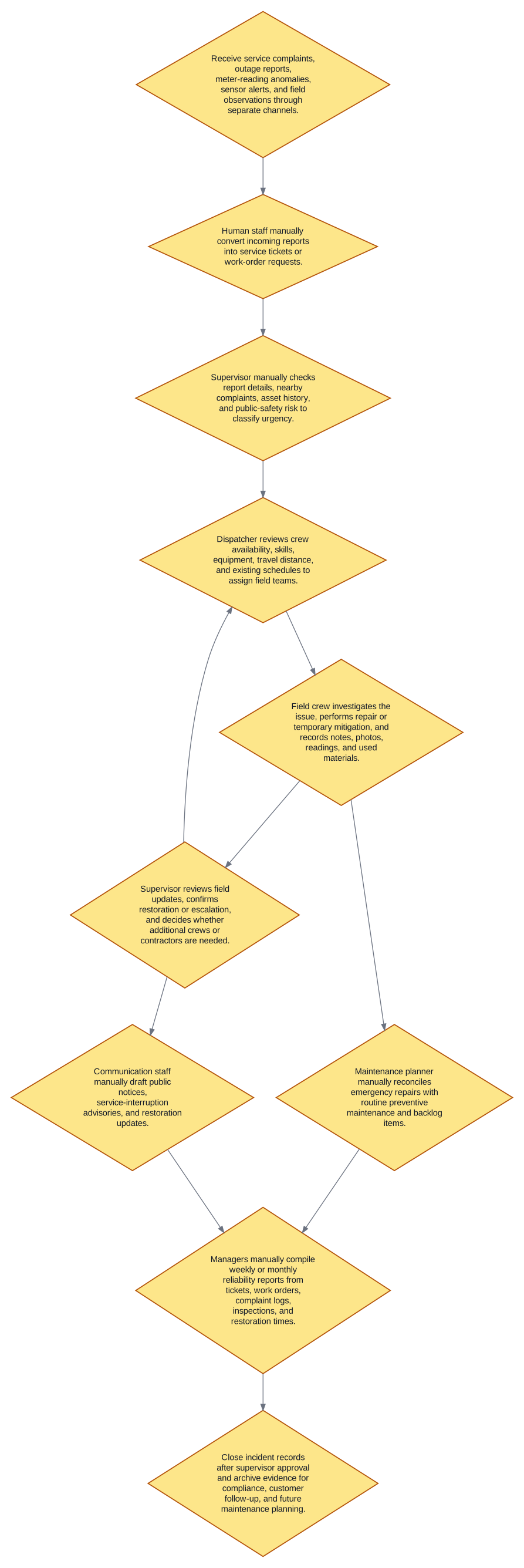
- Intake staff received reports through separate channels. Complaints, outage reports, meter anomalies, sensor alerts, and field observations arrived through call center logs, email inboxes, municipal apps, sensor lists, and field messages.
- Service staff manually converted reports into tickets or work-order requests. They had to capture location, affected service, reporter contact, issue type, and time received. Duplicate or incomplete reports were often logged separately.
- Supervisors manually classified urgency. They checked the report details, nearby complaints, asset history, and public-safety risk. Critical facilities, large affected areas, hazards, or regulatory incidents were escalated before routine jobs.
- Dispatchers manually assigned field teams. They reviewed crew availability, skills, equipment, travel distance, and existing schedules. A crew could not be dispatched without the right safety clearance, tools, and asset-specific capability.
- Field crews investigated and updated the case. They repaired or mitigated the issue, then recorded notes, photos, readings, materials used, and restoration status.
- Supervisors decided closure or escalation. If the repair exceeded the expected time, affected critical users, required road closure, or revealed asset deterioration, the case had to be escalated.
- Communication staff manually drafted public updates. Notices had to include affected areas, time windows, safety instructions, and contact channels, while avoiding unsupported restoration promises.
- Maintenance planners reconciled emergencies with routine work. Emergency repairs often displaced preventive maintenance, creating backlog risk.
- Managers compiled reliability reports after the fact. Weekly or monthly reports were assembled from tickets, work orders, inspection records, complaint logs, and restoration times.
- Incidents closed only after supervisor approval. Closure required operational status, evidence, customer communication status, and follow-up ownership.
Key pain points:
- Incident context had to be reconstructed manually across channels and systems.
- Dispatch decisions depended heavily on individual experience and informal communication.
- Routine maintenance could be silently postponed when urgent incidents consumed attention.
- Public notices were slow to draft and inconsistent across cases.
- Reliability reporting was retrospective, manual, and weak as a feedback loop for prevention.
5. Agent Design and Guardrails
The redesigned system uses five specialized agents: Outage Triage Agent, Maintenance Dispatch Agent, Asset Inspection Summarizer, Customer Notice Drafter, and Service Reliability Report Agent.
- Inputs: Complaints, outage reports, meter anomalies, sensor alerts, asset records, crew schedules, inspection logs, work orders, field notes, photos, restoration status, and public-notice templates.
- Understanding: The system groups related reports, extracts locations and affected services, links likely assets, summarizes unstructured text, and separates observed facts from inferred risks.
- Reasoning: Agents rank urgency, detect critical-facility or public-safety flags, check dispatch constraints, identify repeated incidents, and recommend follow-up maintenance actions.
- Actions: Agents create triage summaries, dispatch recommendations, crew briefing notes, inspection summaries, draft notices, call-center scripts, reliability dashboards, and recurring-failure lists.
- Memory/state: Each incident keeps a shared context with source records, timestamps, locations, confidence scores, assigned crews, field evidence, notice status, restoration status, and follow-up actions.
- Human review points: Operations supervisors approve triage for high-impact cases; dispatch coordinators approve crew assignment; field crews execute the actual work; asset managers approve preventive or capital follow-ups; public-affairs reviewers approve high-impact notices; utility managers review reliability reports and tune rules.
- Out-of-scope actions: The AI system cannot independently authorize safety-critical dispatch, issue regulatory notifications, approve public release for high-impact incidents, close an incident without evidence, create budget-impacting capital work, or decommission assets.
6. Post-Agent Workflow
After AI agents are introduced, the workflow becomes a shared-state coordination process rather than a chain of manual reconstruction.
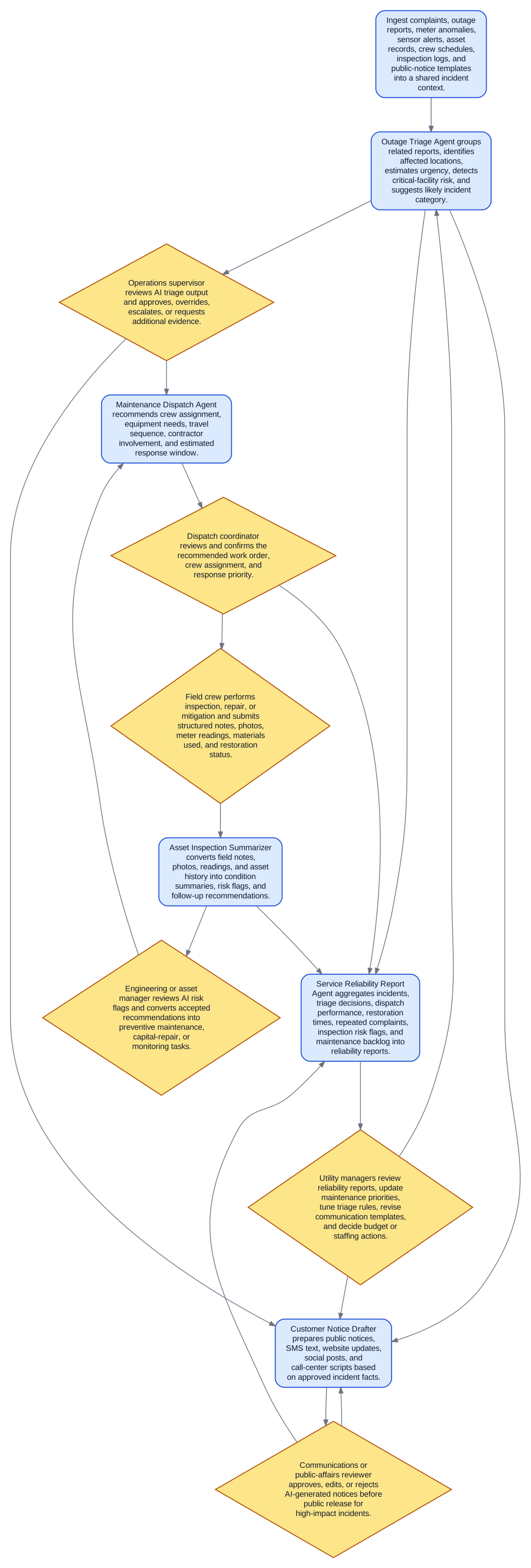
- Shared incident context is created. The system ingests complaints, outage reports, meter anomalies, sensor alerts, asset records, crew schedules, inspection logs, and notice templates. Source records are preserved with timestamps, channel, location, and original text.
- The Outage Triage Agent groups and classifies reports. It clusters related complaints, identifies affected locations, estimates urgency, checks critical-facility risk, and suggests likely incident categories. Low-confidence, high-impact, repeated unresolved, or regulatory-threshold cases are routed to a supervisor.
- The operations supervisor reviews triage. The supervisor approves, overrides, escalates, or requests more evidence. Human approval is mandatory for safety hazards, critical facilities, uncertain geolocation, and cross-agency incidents.
- The Maintenance Dispatch Agent recommends assignment. It proposes crews, equipment, contractor involvement, travel sequence, and response windows while respecting skills, certifications, route feasibility, and ongoing emergency commitments.
- The dispatch coordinator confirms the work order. Low-risk jobs may receive fast approval, while safety, overtime, contractor cost, or planned-work displacement requires explicit human confirmation and reason codes.
- Field crews inspect, repair, or mitigate. The human crew remains responsible for physical work and submits structured notes, photos, readings, materials used, unresolved risks, and restoration status.
- The Asset Inspection Summarizer creates structured evidence. It converts field notes and asset history into condition summaries, risk flags, likely follow-up needs, and linked evidence.
- The asset manager reviews follow-up recommendations. Accepted recommendations become preventive maintenance, monitoring tasks, or capital-repair requests. Budget-impacting or safety-critical asset decisions remain human-owned.
- The Customer Notice Drafter prepares communications. It drafts SMS text, website updates, social posts, email notices, and call-center scripts using approved incident facts and templates.
- Public-affairs staff approve high-impact notices. Emergency outages, politically sensitive cases, regulatory disclosures, critical-facility impacts, and uncertain restoration times require human review before release.
- The Service Reliability Report Agent aggregates performance. It produces weekly and monthly views of incidents, triage decisions, dispatch performance, restoration times, repeated complaints, risk flags, and backlog.
- Managers close the learning loop. Utility managers review reliability reports, update maintenance priorities, tune triage thresholds, revise communication templates, and decide staffing or budget actions.
The operating model changes from “humans search, decide, write, reconcile, and report” to “agents prepare structured options and evidence while humans govern high-consequence decisions.”
7. One Workflow Walkthrough
A cluster of low-water-pressure complaints arrives from three nearby streets within forty minutes. The system first links the complaints by location, time, and service type. The Outage Triage Agent checks nearby asset history and identifies a prior repair on the same distribution line. Because the location cluster is strong but the likely cause is still uncertain, the case receives an elevated priority and is sent to the operations supervisor with supporting evidence.
The supervisor approves triage and asks dispatch to verify crew availability. The Maintenance Dispatch Agent recommends a crew with pipe-repair capability, the correct safety clearance, and nearby equipment. The dispatcher confirms the assignment and creates the work order. After inspection, the field crew uploads photos, readings, materials used, and temporary mitigation status. The Asset Inspection Summarizer flags possible recurring pipe deterioration. The Customer Notice Drafter prepares an SMS and website notice stating the affected streets, expected service window, and contact channel. A public-affairs reviewer approves the notice before release. The case remains open until restoration is confirmed and the follow-up asset review is assigned.
8. Results
- Baseline period: Reconstructed from the pre-agent workflow; not a measured production baseline.
- Evaluation period: Planned 8–12 week pilot.
- Workflow scope/sample: Outage and service-interruption cases, inspection summaries, public notices, and weekly reliability reports.
- Process change: Target reduction in manual incident-context preparation from 20–40 minutes per complex case to under 10 minutes, with low-risk triage summaries generated automatically for supervisor review.
- Decision/model change: Triage, dispatch, and notice drafting become evidence-linked recommendations rather than unstructured human judgment. High-impact or uncertain cases remain human-approved.
- Business effect: Expected improvement in dispatch consistency, notice speed, backlog visibility, repeated-incident detection, and management review quality.
- Evidence status: Estimated and planned for pilot validation, not claimed as observed production impact.
The first pilot should track triage time, dispatch time, restoration time, repeated-incident rate, notice drafting time, preventive-maintenance deferral, maintenance backlog size, and supervisor override rate. The override rate is especially important: it shows where the AI workflow is useful, where rules are too aggressive, and where human expertise still carries the decision.
9. What Failed First and What Changed
The first version failed by treating outage triage as a simple ticket-classification problem. It grouped complaints and assigned priority, but it did not always expose why a cluster mattered, which asset history was relevant, or whether the location confidence was weak. This created a trust problem: supervisors still had to reconstruct the evidence.
The revised version changed the unit of work from a ticket to a shared incident context. Each recommendation now includes the evidence cluster, affected area, source records, asset links, confidence level, escalation reason, and missing information. The limitation remains that AI can improve coordination quality only when source data is timely and structured enough to be linked.
10. Transferable Lesson
- Do not automate the decision before structuring the handoff. The largest gain comes from making the incident state visible, not from letting AI make final operational decisions.
- Use specialized agents around existing responsibilities. Triage, dispatch, inspection, communication, and reporting should map to real organizational handoffs.
- Keep governance inside the workflow. Human approval, audit logs, override reasons, confidence thresholds, and post-incident reviews should be part of the operating model from the first pilot.
This case shows that agentic AI works best in utility maintenance when it acts as a governed coordination layer: fast enough to compress fragmented work, but constrained enough to preserve safety, accountability, and public trust.
References
-
Chaojia Yu et al., “A Survey on Agent Workflow – Status and Future,” arXiv:2508.01186, https://arxiv.org/pdf/2508.01186. ↩︎
-
Henry Peng Zou et al., “LLM-Based Human-Agent Collaboration and Interaction Systems: A Survey,” arXiv:2505.00753, https://arxiv.org/abs/2505.00753. ↩︎
-
“Measuring Agents in Production,” arXiv:2512.04123, https://arxiv.org/abs/2512.04123. ↩︎
-
H. D. Kaushik et al., “Multi-agent Power Grid Restoration Under Uncertainty Considering Coupled Transportation-Power Networks,” arXiv:2510.10399, https://arxiv.org/abs/2510.10399. ↩︎
-
“Evaluation-Driven Development and Operations of LLM Agents: A Process Model and Reference Architecture,” arXiv:2411.13768, https://arxiv.org/abs/2411.13768. ↩︎