Executive Snapshot
- Client type: Regional airline or airport ground-handling company
- Industry: Aviation operations / airline ground handling
- Core problem: Aircraft turnaround delays compounded because gate teams, ramp teams, baggage handlers, cleaning crews, fueling, catering, and customer-service staff depended on fragmented real-time updates.
- Why agentic AI: The workflow required live state tracking, exception detection, task-priority recommendations, and human-reviewed communication rather than a single dashboard or chatbot.
- Deployment stage: Prototype design for station-level pilot
- Primary result: A shift from supervisor-led manual consolidation to a human-reviewed agentic coordination layer that makes the turnaround state visible before small delays become larger operational disruptions.
1. Business Context
A regional airline or ground-handling company manages aircraft turnarounds at busy domestic and regional stations. Each arriving aircraft triggers a chain of dependent work: aircraft parking, passenger disembarkation, baggage unloading and loading, cabin cleaning, fueling, catering, boarding preparation, gate announcements, and delay communication. The workflow repeats many times per day, often under narrow turnaround windows. Teams rely on flight schedules, gate or stand assignments, departure control systems, baggage updates, supervisor notes, paper or mobile checklists, radio calls, and chat messages. Errors matter because a missed fueling update, late baggage status, or unclear gate change can delay boarding, affect the next sector, disrupt crew utilization, and damage passenger trust.
2. Why Simpler Automation Was Not Enough
The selected research angle is that ground operations are not a single-document automation problem; they are a live dependency-state problem. Agentic AI contributes when it continuously maintains the operational state of a workflow, detects exceptions against task dependencies, proposes constrained actions, and routes high-impact decisions to humans for approval. Recent agent-workflow research emphasizes orchestration across roles, tools, memory, and workflow graphs rather than isolated LLM responses.1 Human-agent system research also supports keeping human feedback and control inside the process when reliability, safety, and accountability matter.2 Airline disruption-management research reinforces the same point from the aviation side: disruption recovery spans aircraft, crew, passenger, and ground-operation dimensions, while human specialists face information overload during day-of-operation disruptions.34 Turnaround forecasting work further shows that ground operations are uncertain, data-constrained, and sensitive to operational context, which makes a stateful decision-support layer more suitable than fixed scripts alone.5
A dashboard could show status, but it would not explain which task was blocking departure. A fixed-rule alert could flag “fueling late,” but it would not connect that delay to baggage loading, boarding readiness, and passenger messaging. A chatbot could answer a question, but it would not maintain a rolling turnaround state. The required mechanism was therefore a controlled agentic workflow: agents observe, structure, infer, recommend, draft, and log; humans approve decisions that affect safety-sensitive sequencing, staff allocation, delay codes, and passenger-facing communication.
3. Pre-Agent Workflow
Before AI agents were introduced, the station operated through a human-coordination-heavy workflow.
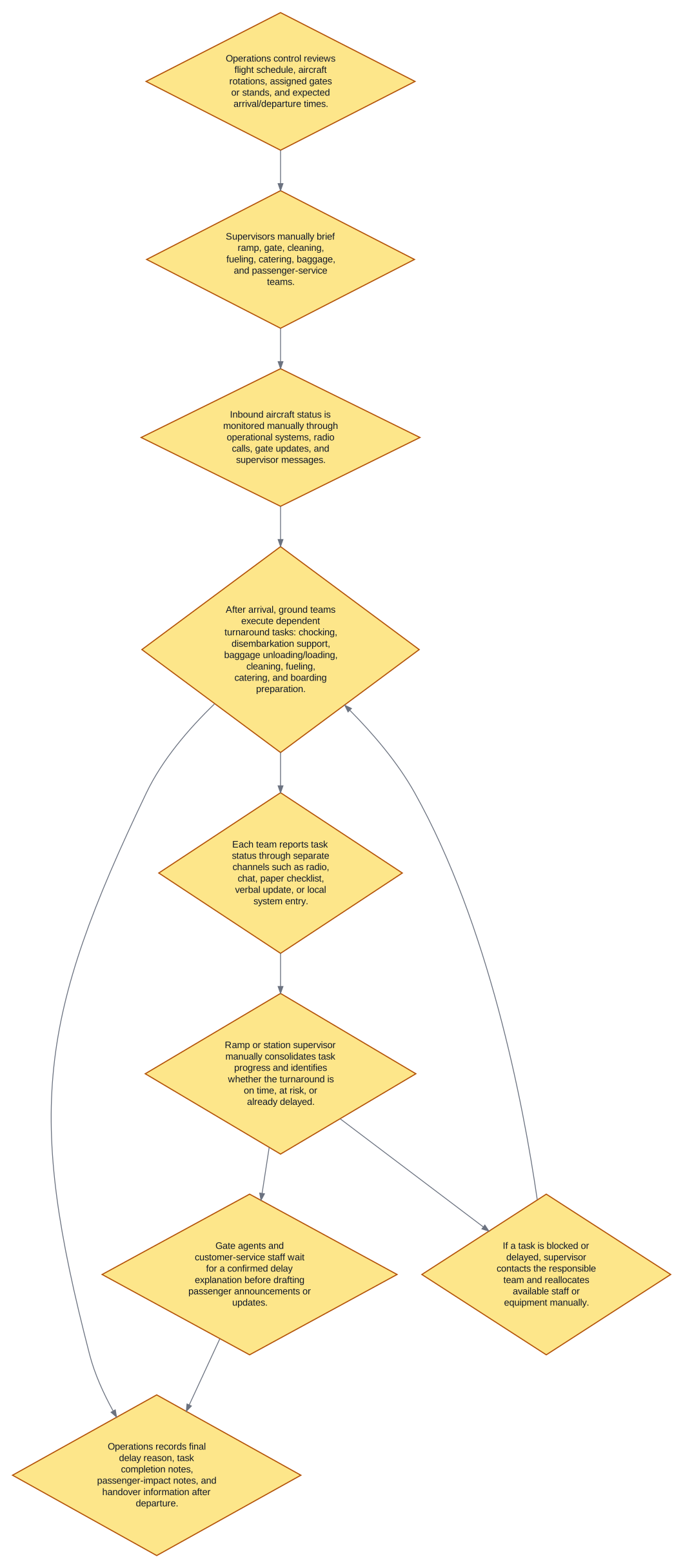
- Operations control reviewed the schedule. Controllers checked flight rotations, arrival estimates, assigned gates or stands, and planned departure times before the shift or before a flight wave.
- Supervisors briefed ground teams manually. Ramp, gate, cleaning, baggage, fueling, catering, and passenger-service teams received task expectations through briefings, radio calls, group chats, and local checklists.
- Inbound status was monitored through scattered channels. A late inbound aircraft might be visible in the schedule system, but the practical implications for cleaning, fueling, baggage, and boarding were interpreted manually.
- Teams executed dependent turnaround tasks. After arrival, each team worked on its own task sequence and reported status separately: started, waiting, blocked, complete, or unclear.
- The supervisor reconstructed the operational picture. The ramp or station supervisor manually consolidated updates, identified whether the turnaround was on time or at risk, contacted delayed teams, and escalated issues.
- Passenger communication came late. Gate agents and customer-service staff often waited for a confirmed explanation before drafting announcements, SMS updates, app messages, or counter talking points.
- Records were completed after departure. Delay reasons, task notes, passenger-impact notes, and handover details were finalized after the aircraft left, limiting immediate learning.
Key pain points:
- Fragmented visibility: Ground teams had local knowledge, but no shared live state of the aircraft turnaround.
- Late exception detection: A task could be blocked for several minutes before the right supervisor recognized the downstream impact.
- Manual causality reconstruction: Supervisors had to decide whether the real problem was late arrival, cleaning, baggage, fueling, catering, crew, or gate readiness.
- Inconsistent passenger updates: Gate agents could only communicate clearly after the operational explanation had been manually confirmed.
- Weak post-event learning: The final report captured what happened, but not always the sequence of missed signals, rejected options, and human decisions.
4. Agent Design and Guardrails
The AI system was designed as a coordination layer, not as an autonomous ramp controller.
- Inputs: Flight schedule, aircraft rotation, expected arrival time, assigned gate or stand, turnaround checklist, baggage status, fueling status, catering status, cleaning status, service-team messages, gate-change notes, boarding status, and summarized chat or radio updates.
- Understanding: The system extracts and normalizes updates into a shared event stream keyed by flight, aircraft, gate, task type, source team, timestamp, and confidence.
- Reasoning: The Turnaround Coordination Agent maintains a live dependency graph for each aircraft. The Ground Service Exception Monitor detects missing, late, conflicting, or abnormal updates. The Crew Task Dispatcher ranks possible reallocation or priority actions, while the Delay Explanation Agent separates observed facts, inferred causes, operational impact, and uncertainty.
- Actions: The system creates internal alerts, dispatch recommendations, delay-code candidates, passenger-message drafts, and post-turnaround reports. It does not directly command staff or publish passenger messages without review.
- Memory/state: Each flight has a rolling state: planned milestones, actual milestones, task owner, task status, blocker, estimated departure risk, prior alerts, human approvals, rejected recommendations, released passenger messages, and final outcome.
- Human review points: Station managers or ramp supervisors approve task-priority changes and staff/resource reallocation. Operations controllers confirm delay reasons and whether explanations can be used externally. Gate agents or customer-service leads review and release passenger-facing messages.
- Out-of-scope actions: The agents do not authorize safety-sensitive ramp actions, replace licensed operational judgment, change aircraft dispatch decisions, bypass airline or airport operating procedures, or make compensation promises to passengers.
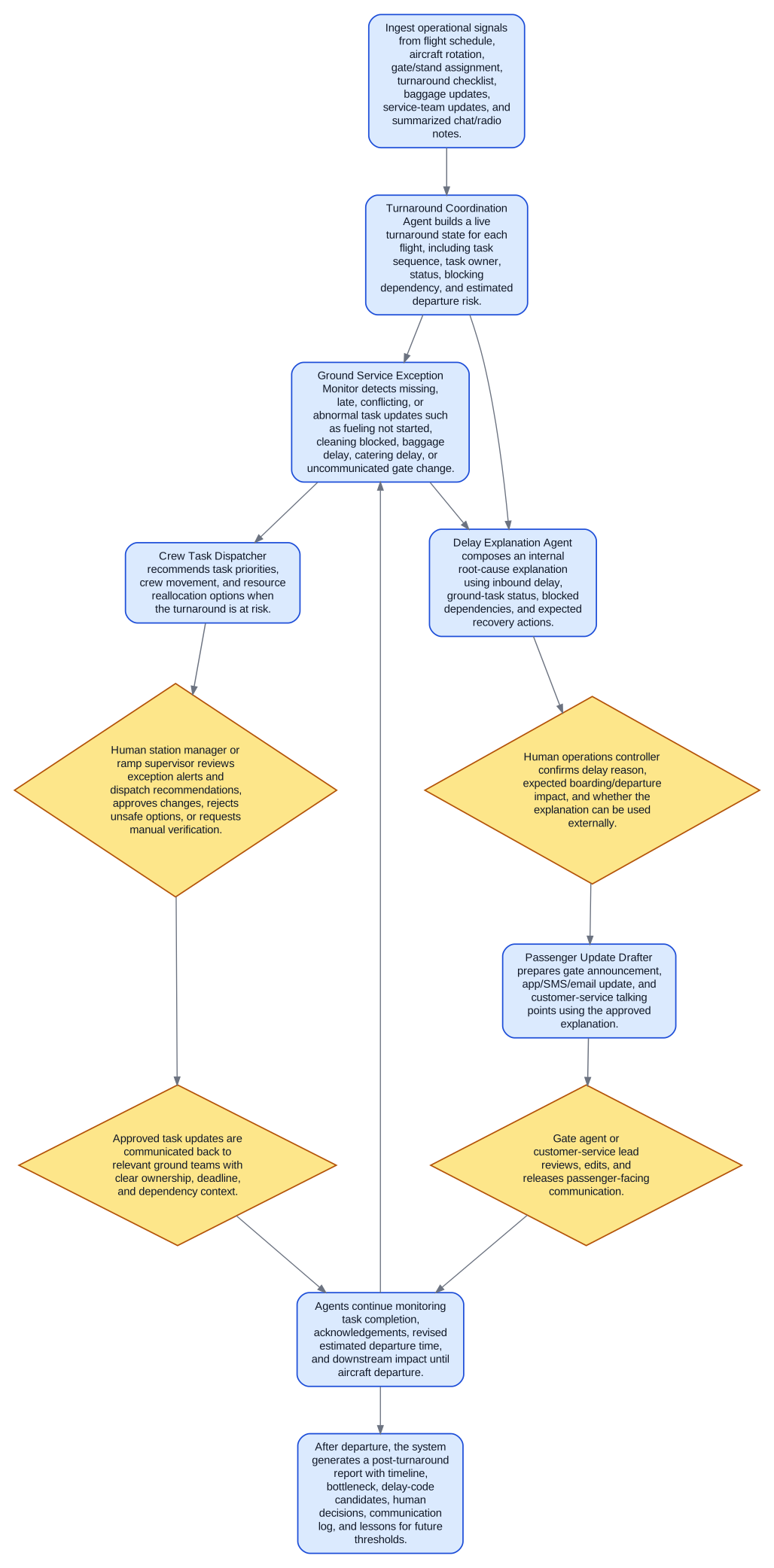
The guardrail logic is simple: agents may structure, infer, recommend, draft, and log; accountable humans approve operational actions and public communication.
5. One Workflow Walkthrough
At 14:05, an inbound aircraft for Flight RX214 arrived 20 minutes late. In the old workflow, the gate team would wait for a supervisor to explain whether boarding should be delayed, while ramp and cleaning teams exchanged separate updates. In the agent-enabled workflow, the ingestion layer registered the late arrival, updated the aircraft’s turnaround state, and marked the flight as at risk. The Turnaround Coordination Agent observed that passenger disembarkation finished at 14:12, cleaning began at 14:15, baggage loading was still pending, and fueling had not started. The Ground Service Exception Monitor flagged fueling as the critical blocker because it was approaching the station’s pre-departure threshold.
The Crew Task Dispatcher recommended prioritizing fueling and confirming whether cleaning access constraints were cleared. The ramp supervisor reviewed the recommendation, approved the fueling escalation, and requested manual verification from the fueling team. The Delay Explanation Agent then produced an internal explanation: late inbound aircraft, delayed disembarkation, cleaning in progress, fueling pending, boarding expected to move by approximately 15 minutes. The operations controller approved the delay reason for external use. The Passenger Update Drafter generated a gate announcement and SMS version, and the gate agent edited and released the message. After departure, the system logged the timeline, alert, human approval, message release, and final delay code for post-shift review.
6. Results
- Baseline period: Pre-pilot workflow observation design; manual status consolidation was treated as the baseline.
- Evaluation period: Planned 8-week station pilot.
- Workflow scope/sample: One regional station, selected high-frequency routes, approximately 20–40 turnarounds per operating day.
- Process change: Status moved from fragmented radio/chat/checklist reports to a flight-level event stream and live dependency graph.
- Decision/model change: The organization moved from supervisor memory and manual escalation to exception-driven recommendations with human approval.
- Business effect: Target outcomes include faster identification of at-risk turnarounds, shorter time from confirmed delay reason to passenger update, fewer repeated clarification calls to supervisors, and same-shift post-turnaround reporting.
- Evidence status: Planned pilot / estimated impact, not measured production results.
For the pilot, success should be measured through operational timestamps rather than broad satisfaction claims. Suggested metrics include: time from aircraft-on-block to first complete turnaround state, time from exception occurrence to supervisor acknowledgment, number of conflicting task statuses per flight, time from approved delay reason to passenger update, percentage of recommendations accepted or modified by supervisors, and completeness of post-turnaround audit logs. A reasonable pilot target is a 30–50% reduction in time to identify at-risk turnarounds and a passenger-update draft within two minutes after the delay reason is approved. These are evaluation targets, not claimed historical results.
7. What Failed First and What Changed
The first prototype over-alerted supervisors. It treated every missing or late update as equally urgent, so normal reporting lag created unnecessary alerts. This weakened trust because the station manager still had to judge which warnings mattered. The fix was to separate missing data, late task, blocked dependency, and departure-risk exception into different severity levels. The system also added source confidence, acknowledgement status, and station-specific thresholds by task and aircraft type. A remaining limitation is that radio or chat summaries can still be ambiguous; safety-sensitive status must therefore come from authorized operational sources or direct human confirmation.
8. Transferable Lesson
- Model the workflow before adding agents. In time-sensitive operations, the most valuable AI object is often the live dependency graph, not the generated text.
- Separate recommendations from authority. Agents can rank options and explain trade-offs, but humans must approve safety-sensitive task changes and public messages.
- Separate internal truth from external communication. Internal root-cause explanations can contain uncertainty and operational detail; passenger messages need approved facts, concise wording, and consistent channel formatting.
This case shows that agentic AI works best where delays arise not from one missing tool, but from many teams trying to coordinate under time pressure with incomplete, fast-changing information.
-
Chaojia Yu et al., “A Survey on Agent Workflow – Status and Future,” arXiv:2508.01186, 2025. https://arxiv.org/abs/2508.01186 ↩︎
-
Henry Peng Zou et al., “LLM-Based Human-Agent Collaboration and Interaction Systems: A Survey,” arXiv:2505.00753, 2025. https://arxiv.org/abs/2505.00753 ↩︎
-
Kolawole Ogunsina, Ilias Bilionis, and Daniel DeLaurentis, “Exploratory Data Analysis for Airline Disruption Management,” arXiv:2102.03711, 2021. https://arxiv.org/abs/2102.03711 ↩︎
-
Kolawole Ogunsina and Daniel DeLaurentis, “Enabling Integration and Interaction for Decentralized Artificial Intelligence in Airline Disruption Management,” arXiv:2104.03349, 2021. https://arxiv.org/abs/2104.03349 ↩︎
-
Abdulmajid Murad and Massimiliano Ruocco, “Pre-Tactical Flight-Delay and Turnaround Forecasting with Synthetic Aviation Data,” arXiv:2508.02294, 2025. https://arxiv.org/abs/2508.02294 ↩︎