Executive Snapshot
- Client type: Mid-sized mining operator with several remote extraction sites
- Industry: Mining, heavy equipment operations, environmental compliance
- Core problem: Safety inspections, equipment checks, environmental records, contractor logs, and incident evidence were fragmented across paper forms, photos, supervisor notes, spreadsheets, and regulatory templates.
- Why agentic AI: The work required more than document summarization: records had to be classified, cross-checked, routed to specialist reviewers, converted into draft reports, and returned for clarification when evidence was incomplete.
- Deployment stage: Prototype design / pilot-ready workflow
- Primary result: A workflow design that converts scattered field evidence into structured safety intelligence while keeping incident classification, regulatory filing, and high-risk equipment decisions under accountable human review.
1. Business Context
The company operates remote extraction sites where supervisors, operators, contractors, maintenance teams, and environmental officers generate daily evidence: safety walkaround notes, equipment pre-start checks, inspection photos, contractor activity logs, environmental readings, incident records, and corrective-action updates. The workflow occurs every shift, with additional reporting at weekly, monthly, incident-triggered, and regulatory deadlines. Before AI agents, the same site event could appear as a photo in a chat group, a handwritten note in a supervisor log, a fault comment in an equipment checklist, and a rewritten line in a compliance template. Delays mattered because mining safety depends on timely hazard recognition, equipment risk escalation, complete incident documentation, and auditable environmental records.
The analytical point behind the redesign is simple: in safety-critical operations, agentic AI should act as a stateful coordination layer, not as an autonomous safety authority. Research on reasoning-and-acting agents supports the value of systems that retrieve context, update plans, and take structured actions; research on human-agent systems and oversight shows why high-stakes workflows still need explicit human checkpoints, transparent traces, and non-bypassable approval gates.1234 Mining-specific work adds another constraint: real mine environments suffer from dust, poor illumination, occlusion, irregular topologies, intermittent connectivity, and sensor blind spots, so safety workflows must be designed around imperfect evidence rather than ideal data streams.5
2. Why Simpler Automation Was Not Enough
A fixed dashboard could count submitted reports, but it could not reliably connect a blurry crusher-area photo, a contractor note, a repeated truck fault, and an environmental observation into one reviewable safety case. A chatbot could answer questions, but it would not maintain workflow state across open hazards, missing attachments, reviewer comments, equipment histories, and filing deadlines. A script could populate a template, but it would not know when an incident timeline was incomplete or when a regulatory draft should be blocked until a human officer approved the evidence. The workflow branched whenever evidence was missing, risk severity was uncertain, equipment status was safety-critical, or a report had external compliance consequences. That made the problem better suited to an agentic workflow with classification, routing, memory, review loops, and governed action boundaries.
3. Pre-Agent Workflow
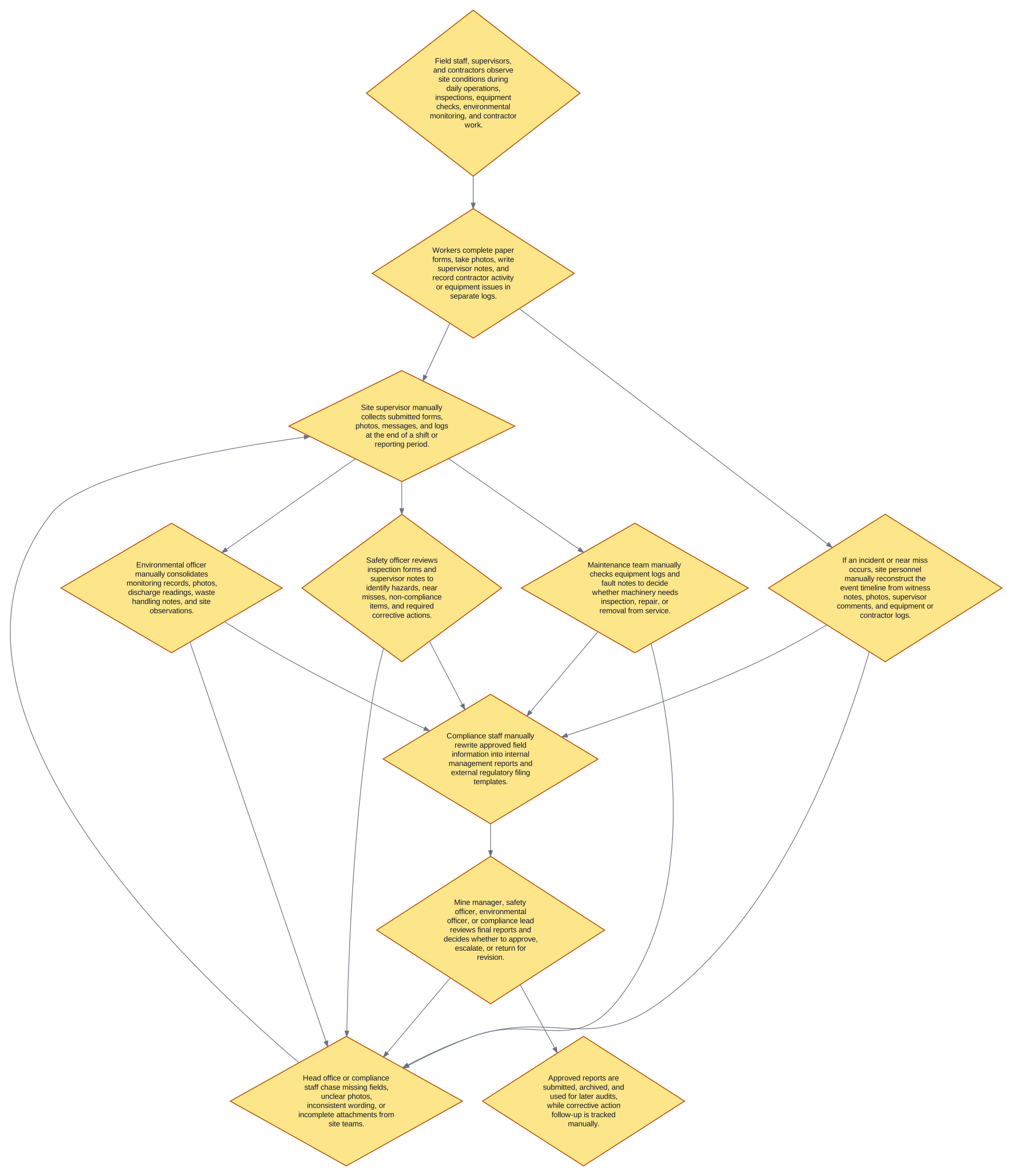
Before the AI agent system, the organization operated through a human-coordination-heavy workflow.
- Field staff and contractors observed site conditions during daily operations, safety inspections, equipment checks, environmental monitoring, and contractor work.
- Workers created scattered evidence through paper forms, photos, handwritten notes, spreadsheets, chat messages, and separate equipment or contractor logs.
- Site supervisors manually collected records at the end of a shift or reporting period and checked whether required forms had been submitted.
- Safety, maintenance, and environmental officers reviewed their own record streams separately, identifying hazards, near misses, equipment issues, missing environmental evidence, or possible non-compliance.
- Compliance staff chased missing fields and rewrote approved information into internal management reports or regulatory templates, often returning to site teams for clarification before final approval.
Key pain points:
- Fragmented evidence: One operational issue could be split across photos, checklists, chat messages, and supervisor comments.
- Slow review loops: Head office or compliance staff had to ask site teams repeatedly for missing fields, clearer photos, or corrected wording.
- Weak pattern detection: Repeated equipment faults or recurring hazards could remain buried in separate daily logs.
- Late escalation: Incidents and near misses were often reconstructed after the fact rather than structured at intake.
- Manual compliance burden: Regulatory templates were filled by rewriting field records instead of generating controlled drafts from validated evidence.
4. Agent Design and Guardrails
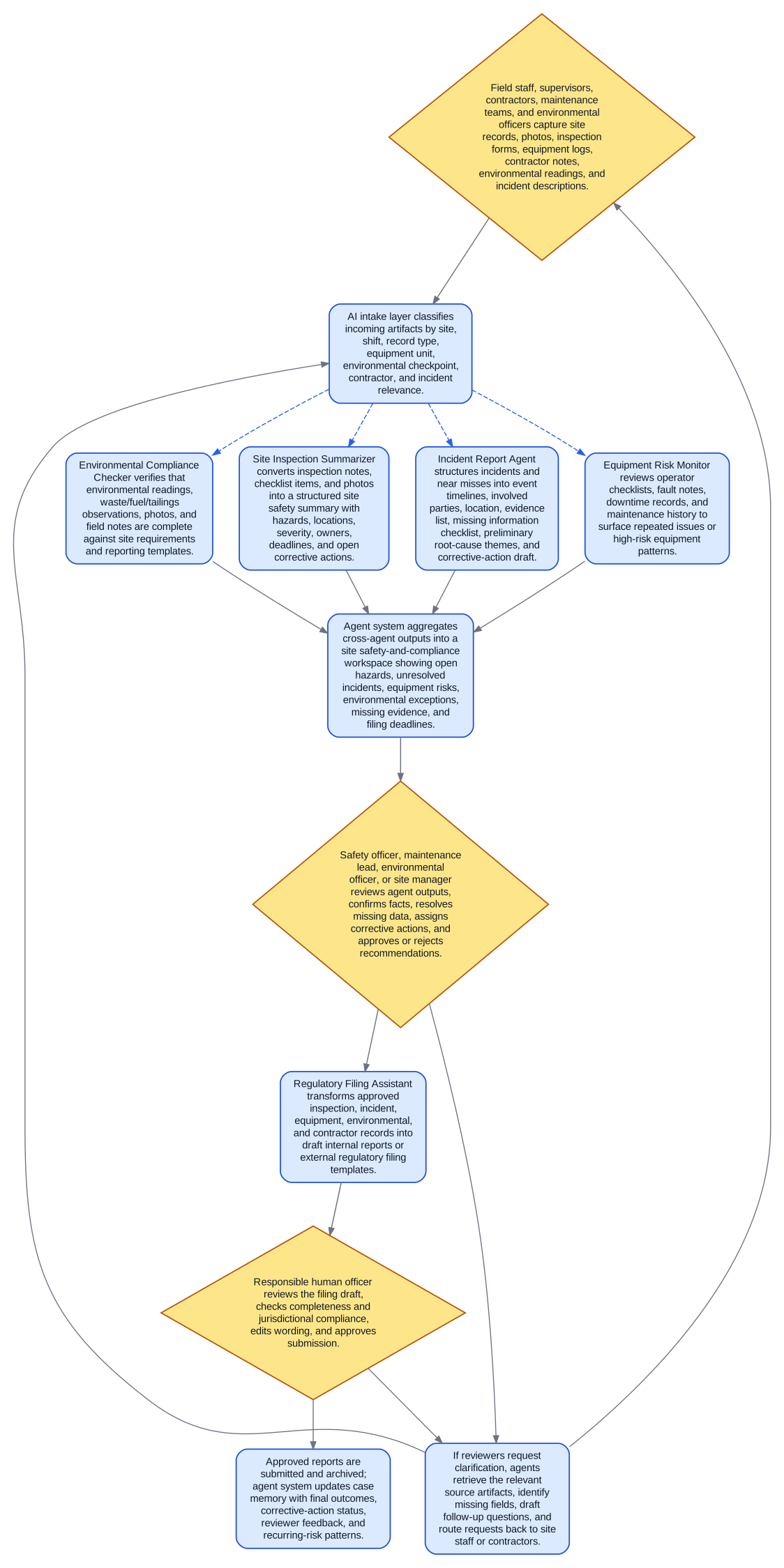
The AI Mining Site Safety & Reporting Agent was designed as a multi-agent workflow layer around the existing operating process.
- Inputs: Paper forms converted to text, mobile photos, inspection checklists, supervisor notes, contractor logs, equipment fault reports, maintenance history, environmental readings, incident descriptions, corrective-action records, and regulatory templates.
- Understanding: OCR, artifact classification, record tagging by site / shift / area / equipment / contractor / incident relevance, evidence extraction, and retrieval of related historical records.
- Reasoning: The system compares evidence against inspection rules, equipment-risk patterns, environmental checklist requirements, open corrective actions, missing-field rules, and filing deadlines.
- Actions: Agents generate structured safety summaries, incident timelines, equipment-risk alerts, environmental completeness checks, missing-information questions, draft corrective actions, and draft regulatory or internal reports.
- Memory/state: The workspace tracks open hazards, unresolved incidents, repeated equipment issues, missing evidence, assigned action owners, reviewer decisions, final report versions, and recurring-risk patterns.
- Human review points: Safety officers approve hazard interpretation and incident classification; maintenance leads approve equipment-removal or repair decisions; environmental officers validate compliance exceptions; responsible officers approve regulatory filings.
- Out-of-scope actions: The system does not autonomously shut down equipment, discipline workers, submit regulatory reports, classify legally reportable incidents, or override site safety officers.
The five operating agents have distinct responsibilities. The Site Inspection Summarizer converts inspection notes, checklist items, and photos into structured hazards, locations, severity, action owners, deadlines, and open corrective actions. The Incident Report Agent structures near misses and incidents into timelines, evidence lists, missing-information checklists, preliminary root-cause themes, and corrective-action drafts. The Equipment Risk Monitor reviews operator checklists, fault notes, downtime records, and maintenance history to surface repeated issues. The Environmental Compliance Checker verifies whether readings, photos, waste/fuel/tailings observations, and field notes are complete against required evidence fields. The Regulatory Filing Assistant transforms approved records into controlled drafts for internal reports or external filing templates.
5. One Workflow Walkthrough
During a night shift, a haul truck operator noted delayed brake response on Truck HT-07. The operator added a checklist comment and the supervisor uploaded a photo of the vehicle tag and the shift log. In the old workflow, this might have waited until a maintenance clerk manually compared several daily logs. In the new workflow, the intake layer classified the record as an equipment safety issue, linked it to the truck ID, and sent it to the Equipment Risk Monitor. The agent found two similar pre-start comments from the previous ten days and flagged the issue as a repeated safety pattern. It did not remove the truck from service by itself. Instead, it created a review item for the maintenance lead and site safety officer, attached the source records, and drafted a follow-up question to confirm brake inspection status. Because the risk involved equipment assignment, the human reviewers approved the escalation before the case entered the compliance workspace. The final record was logged with the reviewer decision, maintenance action, and equipment-risk history for later audit.
6. Results
- Baseline period: Current manual workflow reconstructed from the pre-agent operating model
- Evaluation period: Proposed 8–12 week pilot across one mining site before multi-site rollout
- Workflow scope/sample: Daily inspections, incident and near-miss records, equipment fault logs, environmental evidence checks, contractor logs, and draft reporting for one site
- Process change: Field records move from scattered collection to classified intake, specialist agent processing, human review, controlled drafting, and archived organizational memory.
- Decision/model change: Reviewers receive structured evidence packets and repeated-risk alerts instead of manually searching through forms, photos, and notes.
- Business effect: Expected benefits include faster report preparation, fewer missing-field follow-ups, earlier detection of repeated equipment risks, clearer corrective-action ownership, and stronger audit readiness.
- Evidence status: Estimated / planned pilot. No production measurement is claimed at this stage.
For the pilot, the recommended measurement design is to compare four baseline indicators against the agent-assisted period: average time from field submission to management-ready summary, percentage of reports returned for missing evidence, number of repeated equipment issues detected before breakdown or escalation, and time required to prepare approved regulatory filing drafts. The strongest expected value is not a fully automated report; it is a shorter path from raw field evidence to reviewed, accountable safety action.
7. What Failed First and What Changed
The first version failed by treating the workflow too much like document summarization. It generated readable safety summaries, but it did not reliably preserve the operational state of each issue: whether evidence was missing, who owned the corrective action, whether the maintenance lead had approved an equipment recommendation, or whether a regulatory draft was safe to prepare. The design was changed to separate agent output from human approval state. Each generated item now carries a review status, source evidence links, confidence notes, missing-field flags, and an explicit owner. The remaining limitation is field data quality: blurry photos, incomplete handwritten notes, and delayed uploads can still weaken the agent’s confidence and force manual follow-up.
8. Transferable Lesson
- Do not start with “automate the report.” Start with the evidence chain. In high-risk operations, the most valuable workflow improvement is often connecting raw observations to accountable decisions.
- Use agents for routing, memory, and preparation; keep humans responsible for judgment. The system can classify, summarize, detect patterns, and draft reports, but safety-critical decisions need named human approval.
- Design review loops as first-class workflow objects. Missing evidence, unclear photos, conflicting notes, and regulatory ambiguity should trigger structured clarification loops, not informal chat chasing.
This case shows that agentic AI works best when it turns fragmented operational records into a governed workflow: evidence is captured, interpreted, reviewed, approved, reported, and remembered.
Reference Logic
The case uses one analytical point from the selected arXiv literature: agentic AI creates organizational value when it interleaves reasoning, retrieval, action, memory, and specialist handoffs, but safety-critical domains require human-in-the-loop control gates and transparent oversight rather than full autonomy. This is why the post-agent mining workflow gives agents responsibility for classification, summarization, risk surfacing, draft preparation, and memory updates, while reserving incident classification, equipment removal, legal/regulatory filing, and final approval for accountable human officers.
-
Shunyu Yao et al., “ReAct: Synergizing Reasoning and Acting in Language Models,” arXiv:2210.03629, 2022. https://arxiv.org/abs/2210.03629 ↩︎
-
Qingyun Wu et al., “AutoGen: Enabling Next-Gen LLM Applications via Multi-Agent Conversation,” arXiv:2308.08155, 2023. https://arxiv.org/abs/2308.08155 ↩︎
-
Hussein Mozannar et al., “Magentic-UI: Towards Human-in-the-loop Agentic Systems,” arXiv:2507.22358, 2025. https://arxiv.org/abs/2507.22358 ↩︎
-
“Overseeing Agents Without Constant Oversight: Challenges and Opportunities,” arXiv:2602.16844, 2026. https://arxiv.org/abs/2602.16844 ↩︎
-
Md Sazedur Rahman, Mizanur Rahman Jewel, and Sanjay Madria, “Future Mining: Learning for Safety and Security,” arXiv:2602.11472, 2026. https://arxiv.org/abs/2602.11472 ↩︎