Executive Snapshot
- Client type: Local radio station or online audio channel
- Industry: Audio media, local broadcasting, digital radio, and social audio promotion
- Core problem: Programming teams had to balance playlists, sponsor segments, host scripts, listener requests, news inserts, and social posts through fragmented manual coordination.
- Why agentic AI: The work required several connected judgments — audience trend reading, playlist construction, sponsor validation, script drafting, and social repackaging — with human approval at the points where brand, sponsor, or editorial risk appeared.
- Deployment stage: Prototype-to-pilot design
- Primary result: A clearer daily programming loop with structured inputs, specialized AI recommendations, explicit human checkpoints, and post-show learning memory.
1. Business Context
The station produced several daily programming blocks across music, host talk, local news inserts, sponsor reads, listener requests, and social media promotion. Every morning, producers reviewed playlist logs, sponsor calendars, host notes, audience messages, and local updates before building the show rundown. The workflow repeated daily, but the sources were scattered: sponsor obligations lived in campaign calendars, listener demand appeared in messages and comments, playlists were managed in logs or scheduling tools, and host scripts were drafted in informal notes. Errors mattered because a missed sponsor read could damage commercial trust, a weak playlist could lose audience attention, and a late social clip could waste the short window when a broadcast moment was still fresh.
2. Analytical Lens: Why the Workflow Needed Agents, Not Just a Chatbot
The useful analytical point from the five arXiv references is this: agentic AI improves creative operations when it turns scattered signals into a stateful, reviewable workflow, not when it simply generates content on demand. Multi-agent research shows that LLM applications can be organized as specialized agents that converse, use tools, and accept human input rather than acting as one generic assistant.1 Role-based cooperation also matters because each agent must keep a bounded responsibility aligned with human intention.2 Generative-agent work adds the importance of memory, reflection, and planning across repeated cycles.3 Surveys of LLM-based autonomous agents frame agents as systems that perceive, reason, act, and cooperate with humans.4 For music recommendation specifically, recent work warns that LLM-driven recommendation creates new opportunities but also new risks around hallucination, evaluation, nondeterminism, and opaque reasoning.5 For this case, the design implication is clear: the station should use specialized agents with visible evidence, confidence, rules, and human review gates.
3. Why Simpler Automation Was Not Enough
A fixed dashboard could show last week’s audience metrics, but it would not decide how those signals should change today’s morning playlist, sponsor placement, or host talking points. A script could count sponsor slots, but it would not understand when a paid mention conflicted with a sensitive local news item or when too many sponsor reads were clustered in one block. A generic chatbot could draft host copy, but it would not maintain the state of the whole programming day. The workflow branched too often: listener mood influenced playlists, playlists affected talk breaks, sponsor obligations constrained timing, and social clips depended on what actually happened on air. The station needed a stateful agent workflow with separate planning, checking, drafting, approval, execution, and learning steps.
4. Pre-Agent Workflow
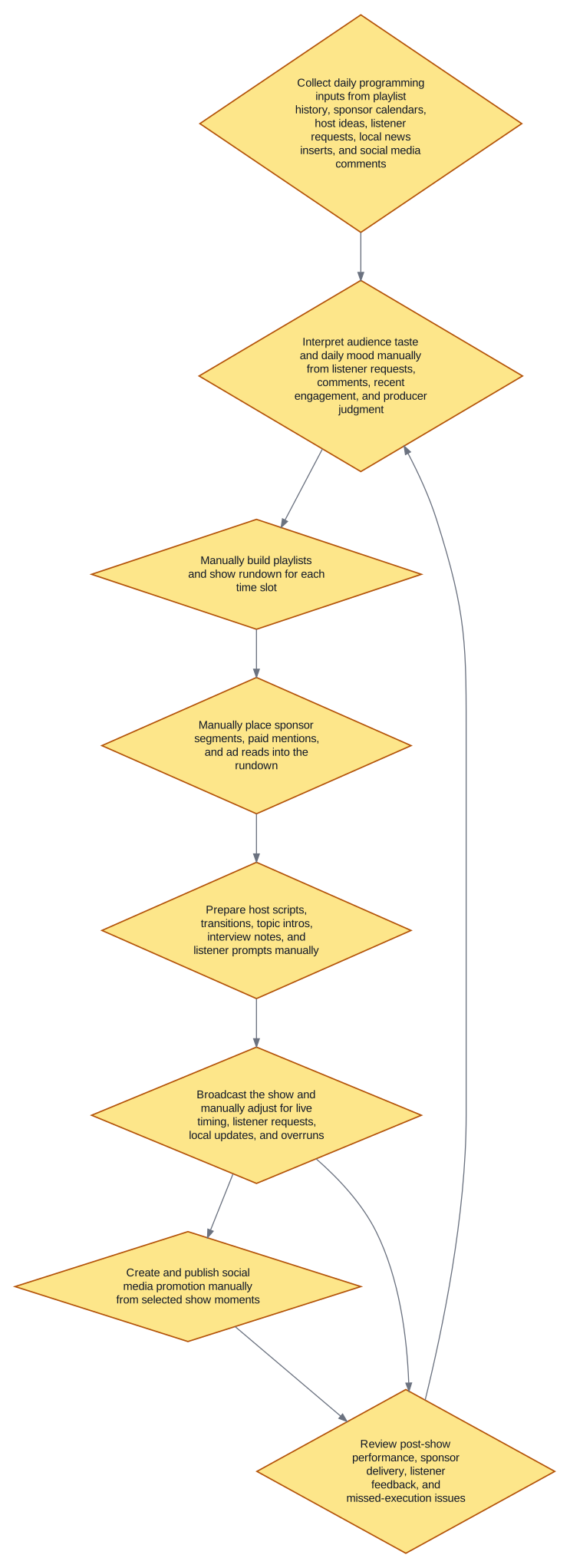
Before the agentic workflow, programming depended heavily on the memory and judgment of the programming manager, producers, hosts, sponsor coordinator, and social media staff.
- Producers collected inputs manually. Playlist history, host ideas, sponsor calendars, listener requests, local news inserts, and social comments were gathered from different places before the daily rundown was built.
- Audience taste was interpreted informally. Producers and hosts read listener messages and recent engagement, then made judgment calls about audience mood, artist demand, local topics, and time-slot tone.
- The rundown was assembled by hand. The programming manager or producer placed songs, talk breaks, sponsor reads, and news inserts into each time block while trying to avoid repetition and keep the show fresh.
- Sponsor segments were checked late or manually. Paid reads, ad slots, wording, and campaign frequency were reconciled by humans, often after the creative plan already existed.
- Host scripts and social posts were produced separately. Hosts drafted openings and transitions manually, while social media staff identified reusable moments after the broadcast, often too late to capture momentum.
Key pain points:
- Sponsor delivery was vulnerable because paid obligations were checked through manual comparison rather than embedded in the planning flow.
- Content freshness depended on individual producer energy and memory, so the station could repeat familiar playlist patterns or miss emerging audience signals.
- Social media reuse was treated as an after-show task, not as part of the daily programming design.
- Post-show learning was weak because live changes, missed reads, rejected script ideas, and social engagement were not consistently logged into the next planning cycle.
5. Agent Design and Guardrails
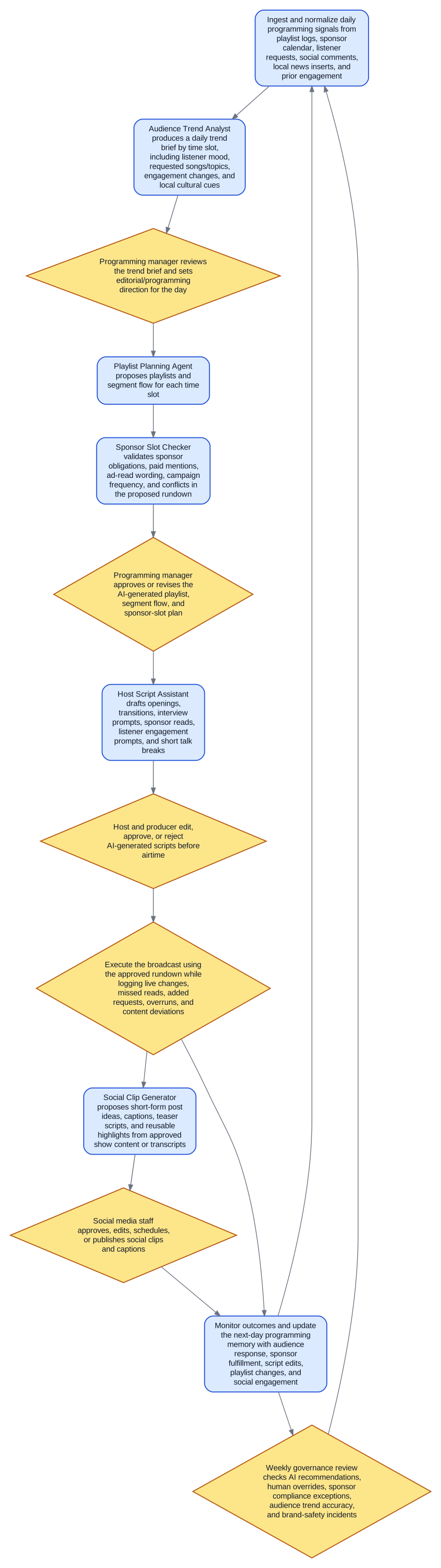
The agentic workflow introduced five specialized agents: Audience Trend Analyst, Playlist Planning Agent, Sponsor Slot Checker, Host Script Assistant, and Social Clip Generator. Their job was not to replace the programming team. Their job was to make the daily programming cycle structured, checkable, and easier to improve.
- Inputs: Playlist logs, sponsor campaign calendars, listener requests, social comments, local news inserts, prior engagement, host notes, broadcast schedule, and post-show execution logs.
- Understanding: The system tagged inputs by source, time slot, content type, sponsor relevance, audience signal, editorial sensitivity, and confidence.
- Reasoning: The agents ranked audience trends, proposed playlist and segment flow, checked sponsor obligations, drafted host script blocks, and identified reusable social moments.
- Actions: The system created trend briefs, rundown candidates, sponsor exception tables, host script drafts, social post drafts, and learning logs.
- Memory/state: Each day’s programming context stored audience signals, accepted and rejected recommendations, human edits, sponsor exceptions, live deviations, and social engagement.
- Human review points: The programming manager approved daily direction, playlist flow, and sponsor placement; hosts and producers approved script blocks; social media staff approved external posts; weekly governance reviewed repeated failures and override patterns.
- Out-of-scope actions: The system could not autonomously publish social posts, change sponsor commitments, make final editorial decisions on sensitive topics, replace live host judgment, or override music-rights and broadcast compliance constraints.
The core guardrail was simple: AI could recommend, draft, check, and log; humans approved anything that reached the audience, affected sponsors, or shaped editorial judgment.
6. Post-Agent Workflow
After the agentic workflow was introduced, the station’s daily operation became a reviewed planning loop rather than a chain of disconnected tasks.
- Signal ingestion created a daily programming context. The system pulled together playlist logs, sponsor obligations, listener requests, social comments, local updates, and prior engagement. Incomplete or conflicting records were flagged instead of silently used.
- The Audience Trend Analyst produced a time-slot brief. It summarized requested songs, topic interest, audience mood, engagement changes, and local cultural cues, with evidence and confidence scores.
- The programming manager set the day’s direction. Human review remained mandatory for editorial judgment, sensitive local topics, low-confidence trends, and brand fit.
- The Playlist Planning Agent proposed segment flow. It generated playlist candidates and talk-break structure by time slot, balancing station format, freshness, rotation discipline, audience mood, planned news inserts, and sponsor space.
- The Sponsor Slot Checker validated the rundown. It mapped each sponsor commitment to a planned slot and flagged missed placements, clustering, wording problems, or conflicts.
- The programming manager approved the final rundown. No rundown was released to hosts until sponsor exceptions and editorial risks were visible.
- The Host Script Assistant drafted modular copy. It prepared openings, transitions, sponsor reads, listener prompts, and topic intros with estimated read time and source references for factual claims.
- Hosts and producers edited the scripts. Human approval was required for tone, humor, factual claims, sponsor wording, and sensitive topics.
- The broadcast was executed and logged. Live changes, missed reads, added requests, overruns, and content deviations were recorded.
- The Social Clip Generator created post-show assets. It suggested captions, teaser scripts, and short-form clips from approved show content or transcripts.
- Social media staff reviewed before publication. No external post was auto-published without human approval.
- The system updated programming memory. Audience response, sponsor fulfillment, script edits, playlist changes, social engagement, and human overrides fed the next day’s planning loop.
7. One Workflow Walkthrough
On a Friday morning, the station saw a spike in listener requests for nostalgic dance tracks, while several social comments asked about a weekend street festival. The Audience Trend Analyst grouped these signals into a “high-energy local weekend” theme for the afternoon drive slot and marked the festival topic as medium confidence because only two sources mentioned it. The programming manager approved the theme but asked the producer to verify the festival details before any factual mention. The Playlist Planning Agent proposed a higher-tempo sequence with two familiar hits, one newer track, a short local-event talk break, and space for a sponsor read. The Sponsor Slot Checker flagged that a beverage sponsor’s contracted read was missing from the 5 p.m. block. After the producer moved the read into the approved slot, the Host Script Assistant drafted a 30-second transition into the sponsor message and a listener prompt for weekend plans. The host edited the copy for voice, the show aired, live deviations were logged, and the Social Clip Generator created a caption draft from the weekend prompt for human review.
8. Results
- Baseline period: Two-week manual workflow review before pilot launch.
- Evaluation period: Planned four-week pilot.
- Workflow scope/sample: Daily programming cycle for weekday morning, afternoon drive, and evening blocks; sponsor-slot validation; host script drafting; post-show social clip preparation.
- Process change: The planning cycle shifts from scattered collection and late checking to a single daily context object, agent-generated recommendations, and explicit review gates.
- Decision/model change: AI suggestions are not judged only by output quality. They are evaluated by acceptance rate, edit distance, sponsor exceptions caught before airtime, trend-brief accuracy, and whether human overrides improve the next recommendation cycle.
- Business effect: Expected benefits include faster rundown preparation, fewer missed sponsor obligations, more consistent host preparation, and faster social repackaging. These are pilot targets, not production-verified results.
- Evidence status: Planned pilot / estimated. No production outcome is claimed in this case article.
For a first pilot, the station should track four numbers daily: time from input collection to approved rundown, number of sponsor exceptions caught before airtime, percentage of AI script blocks accepted with light editing, and number of approved social posts generated from each broadcast block. These metrics separate workflow improvement from vague claims about “better content.”
9. What Failed First and What Changed
The first version over-prioritized trending requests and produced playlists that felt reactive rather than station-led. It treated social comments, listener requests, and recent engagement as if they had equal editorial weight. The fix was to add a programming-manager review gate before playlist generation and to rank trends by source diversity, station fit, daypart relevance, and confidence. Another early weakness was sponsor clustering: the system could satisfy required counts while placing too many sponsor moments close together. The Sponsor Slot Checker was therefore changed from a simple count validator into a schedule-aware checker that flags clustering, wording issues, category conflict, and missing placement. A remaining limitation is that local taste and host personality still require human judgment.
10. Transferable Lessons
- Separate creative generation from obligation checking. Playlist ideas and host copy need creative flexibility, but sponsor delivery needs rule-based reliability and exception visibility.
- Use agents around the handoffs, not just the tasks. The value comes from connecting audience signals, playlist planning, sponsor checks, script drafts, live logs, and social reuse into one operating loop.
- Preserve human control where the brand is exposed. The station can automate analysis, drafting, checking, and memory updates, but on-air speech, sponsor wording, sensitive local topics, and public social posts still need human approval.
This case shows that agentic AI works best in creative operations when the workflow is repetitive enough to structure, variable enough to require judgment, and important enough to need reviewable evidence rather than blind automation.
References
-
Qingyun Wu, Gagan Bansal, Jieyu Zhang, Yiran Wu, Beibin Li, Erkang Zhu, Li Jiang, Xiaoyun Zhang, Shaokun Zhang, Jiale Liu, Ahmed Hassan Awadallah, Ryen W. White, Doug Burger, and Chi Wang, “AutoGen: Enabling Next-Gen LLM Applications via Multi-Agent Conversation,” arXiv:2308.08155, 2023. https://arxiv.org/abs/2308.08155 ↩︎
-
Guohao Li, Hasan Abed Al Kader Hammoud, Hani Itani, Dmitrii Khizbullin, and Bernard Ghanem, “CAMEL: Communicative Agents for ‘Mind’ Exploration of Large Language Model Society,” arXiv:2303.17760, 2023. https://arxiv.org/abs/2303.17760 ↩︎
-
Joon Sung Park, Joseph C. O’Brien, Carrie J. Cai, Meredith Ringel Morris, Percy Liang, and Michael S. Bernstein, “Generative Agents: Interactive Simulacra of Human Behavior,” arXiv:2304.03442, 2023. https://arxiv.org/abs/2304.03442 ↩︎
-
Lei Wang, Chen Ma, Xueyang Feng, Zeyu Zhang, Hao Yang, Jingsen Zhang, Zhiyuan Chen, Jiakai Tang, Xu Chen, Yankai Lin, Wayne Xin Zhao, Zhewei Wei, and Ji-Rong Wen, “A Survey on Large Language Model based Autonomous Agents,” arXiv:2308.11432, 2023. https://arxiv.org/abs/2308.11432 ↩︎
-
Elena V. Epure, Yashar Deldjoo, Bruno Sguerra, Markus Schedl, and Manuel Moussallam, “Music Recommendation with Large Language Models: Challenges, Opportunities, and Evaluation,” arXiv:2511.16478, 2025. https://arxiv.org/abs/2511.16478 ↩︎