Executive Snapshot
- Client type: Commercial building operator / property management firm
- Industry: Office real estate and facilities operations
- Core problem: Energy-saving decisions were reactive, fragmented across floors and tenants, and often discovered only after high bills, complaints, or maintenance incidents.
- Why agentic AI: The workflow required continuous monitoring, cross-source interpretation, comfort-aware judgment, maintenance routing, and human approval—not just a dashboard or fixed-rule alert.
- Deployment stage: Prototype design for pilot implementation
- Primary result: A human-coordination-heavy monthly workflow is redesigned into a continuous sense–explain–approve–act–audit loop.
1. Business Context
A commercial building operator manages multiple office buildings with shared electricity infrastructure, HVAC systems, lighting schedules, elevator operations, tenant requests, maintenance tickets, and monthly utility bills. Before the agentic AI redesign, the operating rhythm was mostly monthly: teams collected bills, checked meter readings, reviewed tenant complaints, discussed suspected causes in operations meetings, and asked engineers or contractors to inspect possible problems. Errors and delays mattered because a small scheduling issue, equipment drift, or after-hours usage pattern could remain hidden until the next bill cycle. At the same time, aggressive energy-saving action could create tenant discomfort, lease-service complaints, or reputational damage.
2. Why Simpler Automation Was Not Enough
A dashboard could show electricity consumption, but it would not explain whether a spike came from HVAC drift, after-hours tenant activity, elevator traffic, weather, lighting schedules, or a meter anomaly. A fixed-rule script could flag unusually high usage, but it would not decide whether the case required a tenant reminder, a contractor inspection, a schedule adjustment, or manager approval. A chatbot could answer questions, but it would not maintain operational state across anomalies, comfort complaints, maintenance outcomes, and monthly owner reporting.
The selected arXiv literature points to one practical design lesson: building energy AI should be treated as a governed feedback workflow, not a standalone optimizer. BEMS research emphasizes IoT/data integration and predictive intelligence; LLM-based BEMS agents formalize a perception–control–action feedback loop; HVAC control research shows the value of optimizing energy while preserving comfort; anomaly-detection work shows why raw smart-meter data must be cleaned and interpreted before decisions; and override/audit research argues that automated building-control systems need reviewable authority boundaries.12345
3. Pre-Agent Workflow
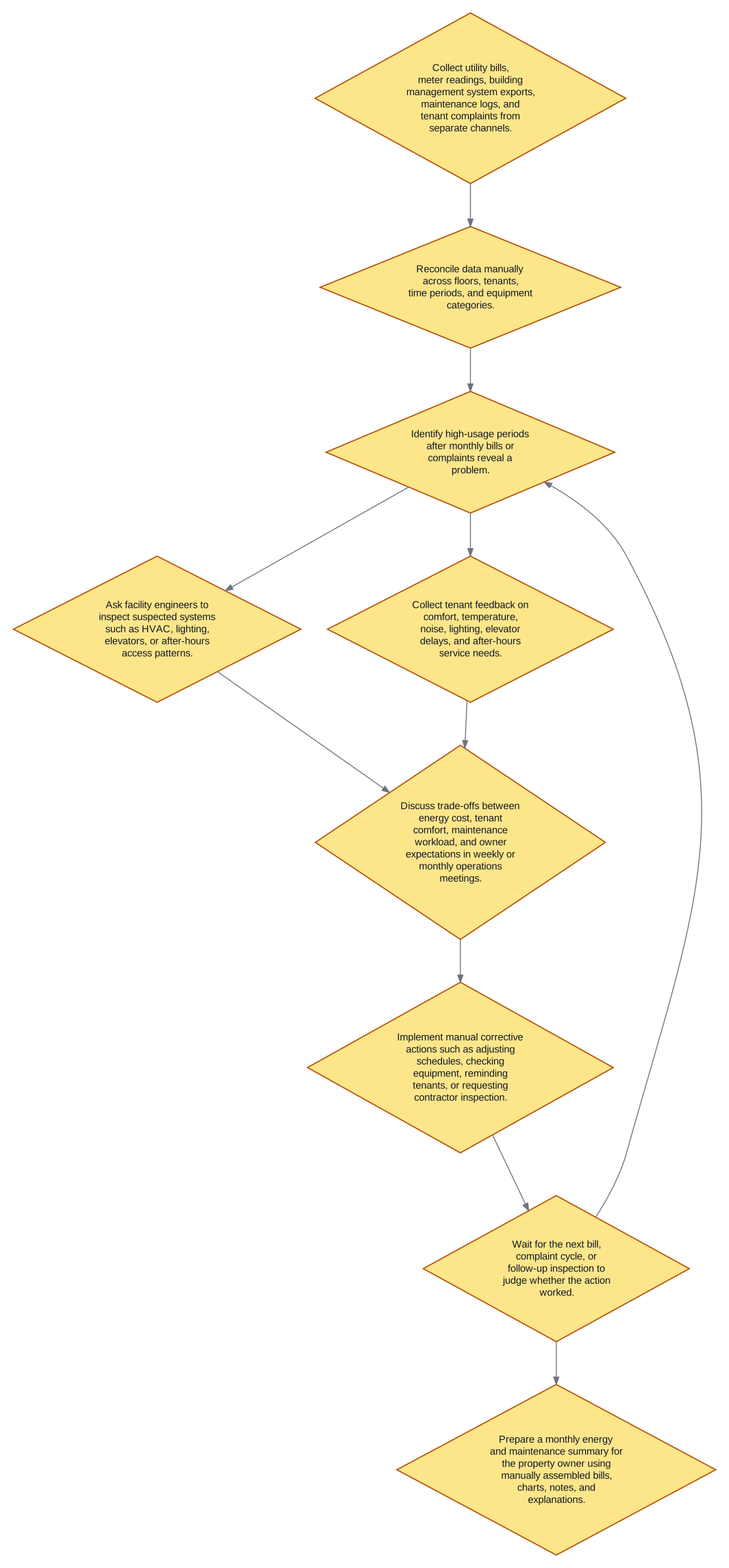
Before AI agents, the organization operated through a slow human-coordination loop:
- Collect scattered records. The building management team gathered utility bills, meter readings, BMS exports, maintenance logs, and tenant complaints from separate channels.
- Manually reconcile context. Facility staff compared floors, tenants, equipment categories, time periods, and service notes in spreadsheets or email threads.
- Identify problems late. High-usage periods were usually noticed after a monthly bill, a tenant complaint, or an obvious maintenance issue.
- Request inspection. Managers asked engineers to inspect suspected systems such as HVAC, lighting, elevators, or after-hours access patterns.
- Discuss trade-offs and act. Energy cost, tenant comfort, maintenance workload, and owner expectations were reviewed in weekly or monthly meetings before manual corrective actions were made.
Key pain points:
- Root-cause analysis depended heavily on human memory and cross-checking.
- Energy waste could continue for weeks before being noticed.
- Comfort risk and maintenance risk were discussed late, not monitored continuously.
- Monthly owner reporting required manual assembly of bills, charts, notes, and explanations.
- The organization learned slowly because each case was not consistently logged as reusable operating knowledge.
4. Agent Design and Guardrails
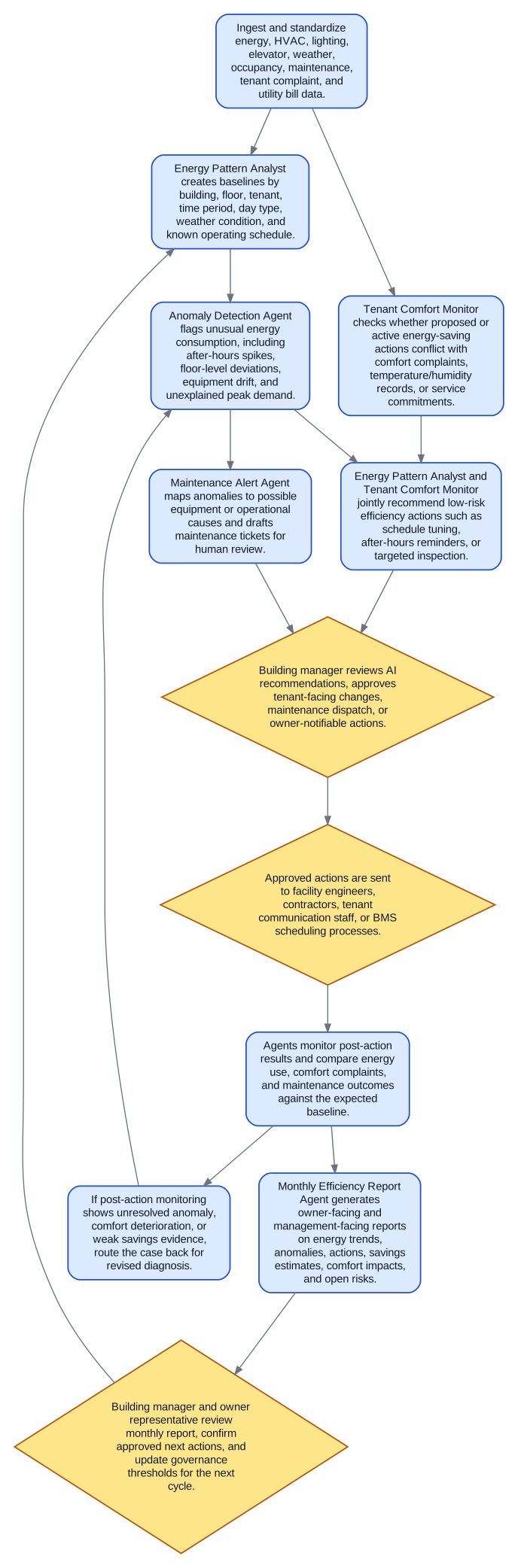
The redesigned system uses five coordinated agents: Energy Pattern Analyst, Tenant Comfort Monitor, Anomaly Detection Agent, Maintenance Alert Agent, and Monthly Efficiency Report Agent.
- Inputs: Energy readings, HVAC logs, lighting schedules, elevator usage, weather, occupancy schedules, after-hours access, maintenance tickets, tenant complaints, and utility bills.
- Understanding: Data standardization, baseline creation, floor/tenant/time-period tagging, anomaly classification, and comfort-context matching.
- Reasoning: Baseline comparison, threshold logic, confidence scoring, operational-cause mapping, comfort-risk screening, and escalation routing.
- Actions: Draft alerts, draft maintenance tickets, recommend schedule changes, prepare tenant-facing reminders, and generate monthly efficiency reports.
- Memory/state: Each anomaly is stored with baseline context, suspected cause, confidence level, approved action, comfort impact, maintenance outcome, and reporting status.
- Human review points: Building managers approve tenant-facing changes, BMS schedule changes, contractor dispatches, owner-notifiable actions, and monthly efficiency reports.
- Out-of-scope actions: The system does not independently change tenant service levels, override comfort constraints, dispatch contractors, or modify building-control settings without authorized approval.
This design makes the AI system operationally useful without making it operationally reckless. The agents can observe, interpret, draft, compare, and recommend; humans still control actions that affect comfort, safety, tenant commitments, contractor cost, and owner communication.
5. One Workflow Walkthrough
On a Tuesday morning, the Anomaly Detection Agent flags that Floor 18 used 34% more electricity than its weather-adjusted baseline between 9:30 p.m. and 2:00 a.m. The Energy Pattern Analyst compares the pattern with historical after-hours usage and finds that the spike does not match normal tenant overtime. The Tenant Comfort Monitor checks the same period and finds no comfort complaints, but the Maintenance Alert Agent notices that the floor’s HVAC unit also showed longer compressor runtime than similar floors.
Because the confidence is moderate rather than high, the system does not directly trigger a contractor dispatch. It drafts a maintenance ticket with evidence: abnormal after-hours load, HVAC runtime drift, no matching occupancy signal, and no comfort complaint. The building manager reviews the draft, approves an engineer inspection, and asks the tenant communication staff not to send any reminder yet. After inspection, the engineer finds a schedule override left active after a previous event. The action is logged, the baseline is updated, and the next monthly report records the anomaly, cause, response time, and avoided repeat risk.
6. Results
- Baseline period: Pre-pilot workflow reconstructed from the monthly bill-review and maintenance-response process.
- Evaluation period: Prototype target for a 6–8 week pilot across one office building before expansion.
- Workflow scope/sample: Energy monitoring, anomaly routing, comfort-risk checking, maintenance ticket drafting, and monthly owner reporting.
- Process change: Problem detection moves from “after bill or complaint” to daily or near-real-time anomaly review.
- Decision/model change: Energy recommendations are screened against comfort data, maintenance history, occupancy context, and manager approval rules.
- Business effect: Expected benefits include faster anomaly diagnosis, fewer repeated manual reconciliations, clearer maintenance prioritization, and more consistent owner reporting.
- Evidence status: Planned / estimated. No production savings claim is made at this stage.
The most concrete early metric is not “percentage energy saved,” because that requires pilot data. The better first-stage metrics are operational: median time from anomaly to review, percentage of alerts with clear suspected cause, number of unresolved repeat anomalies, manual hours spent on monthly reporting, and number of comfort-related escalations after energy-saving actions.
7. What Failed First and What Changed
The first version over-flagged evening electricity spikes because it treated all after-hours usage as suspicious. That created noisy alerts for legitimate tenant overtime, cleaning activity, and scheduled events. The improvement was to add context before escalation: after-hours access records, known tenant schedules, elevator activity, maintenance calendars, and recent comfort complaints. The system also added a confidence field and a “manager review required” state instead of forcing every alert into the same maintenance queue. A remaining limitation is data completeness: if floor-level meters, access logs, or BMS records are missing, the agent must lower confidence and route the case as an investigation rather than a diagnosis.
8. Transferable Lesson
- Agentic AI is strongest when the problem is not one decision but a recurring operational loop with data, judgment, handoffs, approvals, and feedback.
- In building operations, energy optimization must be comfort-constrained; otherwise, savings can become tenant-service risk.
- The first useful deployment should focus on evidence trails and reviewable recommendations before autonomous control.
This case shows that agentic AI works best when it turns fragmented human coordination into a governed workflow where machines handle monitoring and explanation, while people retain authority over comfort, cost, and operational commitments.
References
-
Haizum Hanim Ab Halim, Dalila Alias, Akmal Zaini Arsad, Lewis Tee Jen Looi, Rosdiadee Nordin, and Denny Ng Kok Sum, “IoT-Driven Building Energy Management Systems (BEMS) for Net Zero Energy Buildings: Concept, Integration and Future Directions,” arXiv:2602.20453, 2026. https://arxiv.org/abs/2602.20453 ↩︎
-
Tianzhi He and Farrokh Jazizadeh, “Context-aware LLM-based AI Agents for Human-centered Energy Management Systems in Smart Buildings,” arXiv:2512.25055, 2025. https://arxiv.org/abs/2512.25055 ↩︎
-
Xianzhong Ding, Alberto Cerpa, and Wan Du, “Multi-zone HVAC Control with Model-Based Deep Reinforcement Learning,” arXiv:2302.00725, 2023. https://arxiv.org/abs/2302.00725 ↩︎
-
Sangkeum Lee, Sarvar Hussain Nengroo, Hojun Jin, Yoonmee Doh, Chungho Lee, Taewook Heo, and Dongsoo Har, “Anomaly Detection of Smart Metering System for Power Management with Battery Storage System/Electric Vehicle,” arXiv:2207.09784, 2022. https://arxiv.org/abs/2207.09784 ↩︎
-
Rashid Mushkani, “Right-to-Override for Critical Urban Control Systems: A Deliberative Audit Method for Buildings, Power, and Transport,” arXiv:2509.13369, 2025. https://arxiv.org/abs/2509.13369 ↩︎