Executive Snapshot
- Client type: Mid-sized recruitment agency serving corporate hiring clients
- Industry: Recruitment and talent advisory services
- Core problem: Recruiters spent too much time reading resumes, comparing candidates with job descriptions, writing shortlist notes, and preparing client briefings.
- Why agentic AI: The workflow required extraction, role-specific judgment support, explanation drafting, exception handling, and human approval, not just keyword search or a generic chatbot.
- Deployment stage: Prototype-to-pilot design
- Primary result: The agency moved from scattered recruiter coordination to a structured human-agent workflow where AI prepares evidence, comparisons, questions, and briefing drafts, while recruiters retain final accountability.
1. Business Context
The agency screens hundreds of resumes and LinkedIn profiles for client companies across sales, operations, finance, IT, marketing, and managerial roles. Each mandate begins with a client job description, then expands into resumes from job boards, referrals, LinkedIn searches, email applications, and the agency’s internal candidate database. The work occurs continuously across multiple open roles, often under 24-to-72-hour shortlist expectations. Before AI agents, recruiters used a mix of applicant tracking system records, spreadsheets, resume PDFs, LinkedIn notes, call notes, and email threads. Delays mattered because clients compared the agency against competing recruiters, while weak or poorly explained shortlists damaged trust.
2. Analytical Point from the Research
The useful analytical point is this: AI creates value in recruitment when it decomposes screening into auditable workflow stages, not when it simply produces a final candidate score. Recent arXiv work on LLM-based recruitment repeatedly separates resume extraction, evaluation, summarization, and structured scoring into different components or agents.12 At the same time, work on bias in job-resume matching shows that even capable LLMs can retain implicit biases, especially around educational background.3 Fairness reviews of AI recruitment systems also emphasize continuous auditing, job-specific criteria, transparency, and bias mitigation rather than one-time deployment.4 Research on human oversight for agents adds a practical design lesson: oversight works better when risky decision points are made legible at the right time, not when humans are asked to monitor everything passively.5
For this case, the implication is clear. The AI Talent Screening Agent should not be framed as an automated hiring decision-maker. It should be designed as a workflow layer that structures evidence, highlights fit and uncertainty, drafts recruiter materials, and routes high-risk or low-confidence cases to human review.
3. Why Simpler Automation Was Not Enough
A script could count keywords, but it could not judge whether “regional account expansion” was evidence of enterprise sales capability. A dashboard could show candidate counts, but it could not explain why a candidate with a non-linear career path might still fit a client’s role. A chatbot could summarize a resume, but without workflow state it would not know whether the client’s salary ceiling had changed, whether the recruiter had already clarified availability, or whether a candidate’s education signal should be treated cautiously. The agency needed a stateful agentic workflow: one that could preserve the client rubric, attach evidence to candidate claims, flag uncertain judgments, draft outputs, and pause for recruiter approval before client-facing delivery.
4. Pre-Agent Workflow
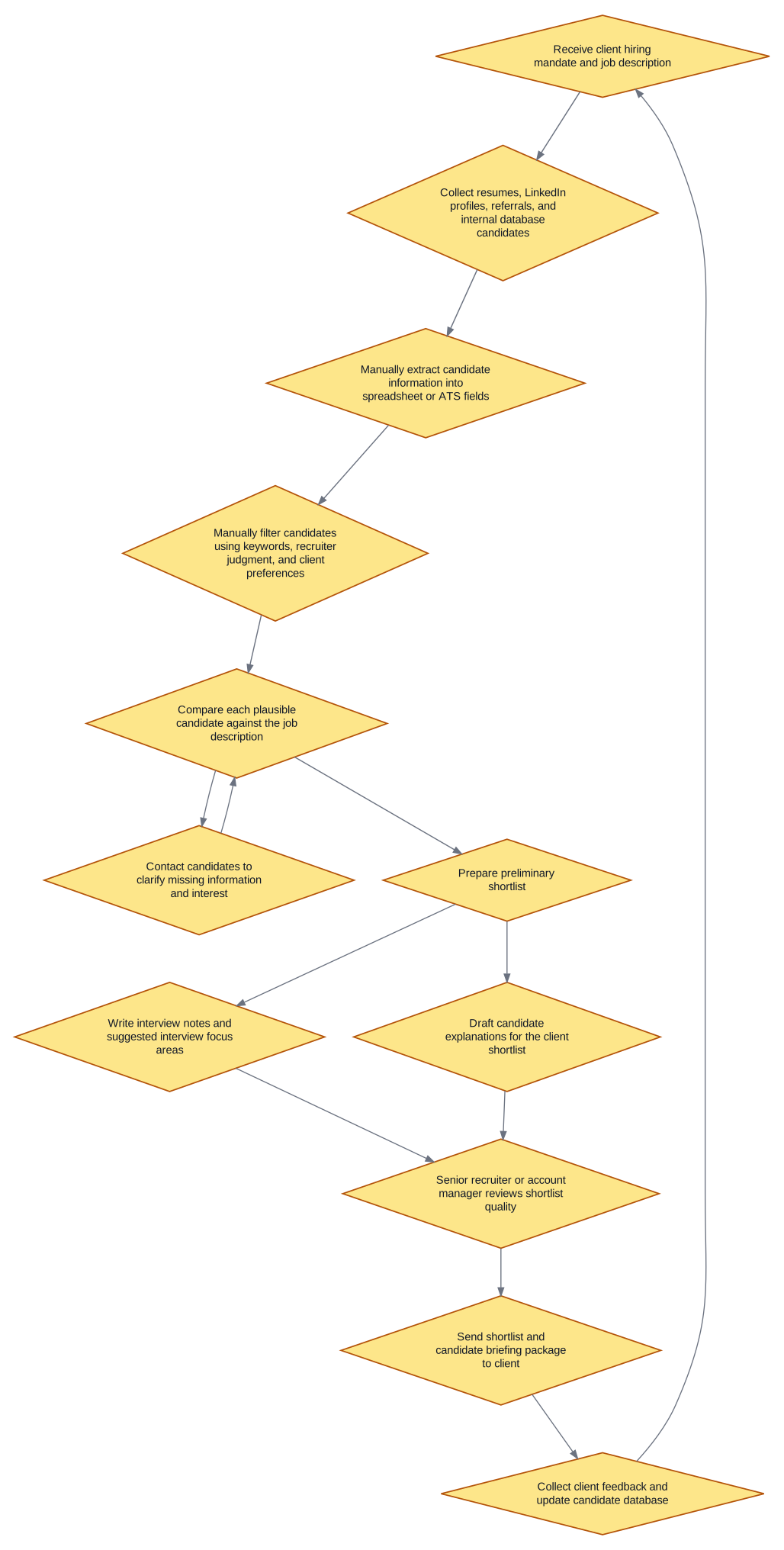
Before the AI-agent workflow, the recruitment process was mostly human-coordination-heavy.
- The account manager received the client mandate and job description. The recruiter confirmed the role title, must-have requirements, preferred requirements, salary range, location, work mode, urgency, and client-specific preferences.
- Recruiters collected candidate materials from several channels. Resumes, LinkedIn profiles, referrals, internal database records, and email applications were gathered into spreadsheets or ATS records.
- Recruiters manually extracted candidate information. Experience, skills, education, certifications, location, salary expectations, availability, and source notes were copied or summarized by hand.
- Recruiters manually compared candidates with the job description. They filtered candidates through keywords, memory, prior client experience, and subjective judgment. Missing information triggered calls or messages to candidates, then the recruiter returned to the comparison step.
- The shortlist was written and reviewed. Recruiters prepared interview notes, candidate explanations, and a client briefing package. A senior recruiter or account manager reviewed the shortlist before it was sent to the client. Client feedback was later recorded, often inconsistently, into the agency’s database.
Key pain points:
- Throughput bottleneck: Recruiters lost time reading and re-reading resumes before they could reach higher-value judgment.
- Inconsistent comparison: Candidate fit depended heavily on each recruiter’s note-taking style, memory, and interpretation of the job description.
- Weak explainability under pressure: Client-facing shortlist notes were sometimes written after the decision, rather than built from structured evidence during the workflow.
- Feedback loss: Client reactions and rejection reasons were not always converted into reusable screening knowledge.
5. Agent Design and Guardrails
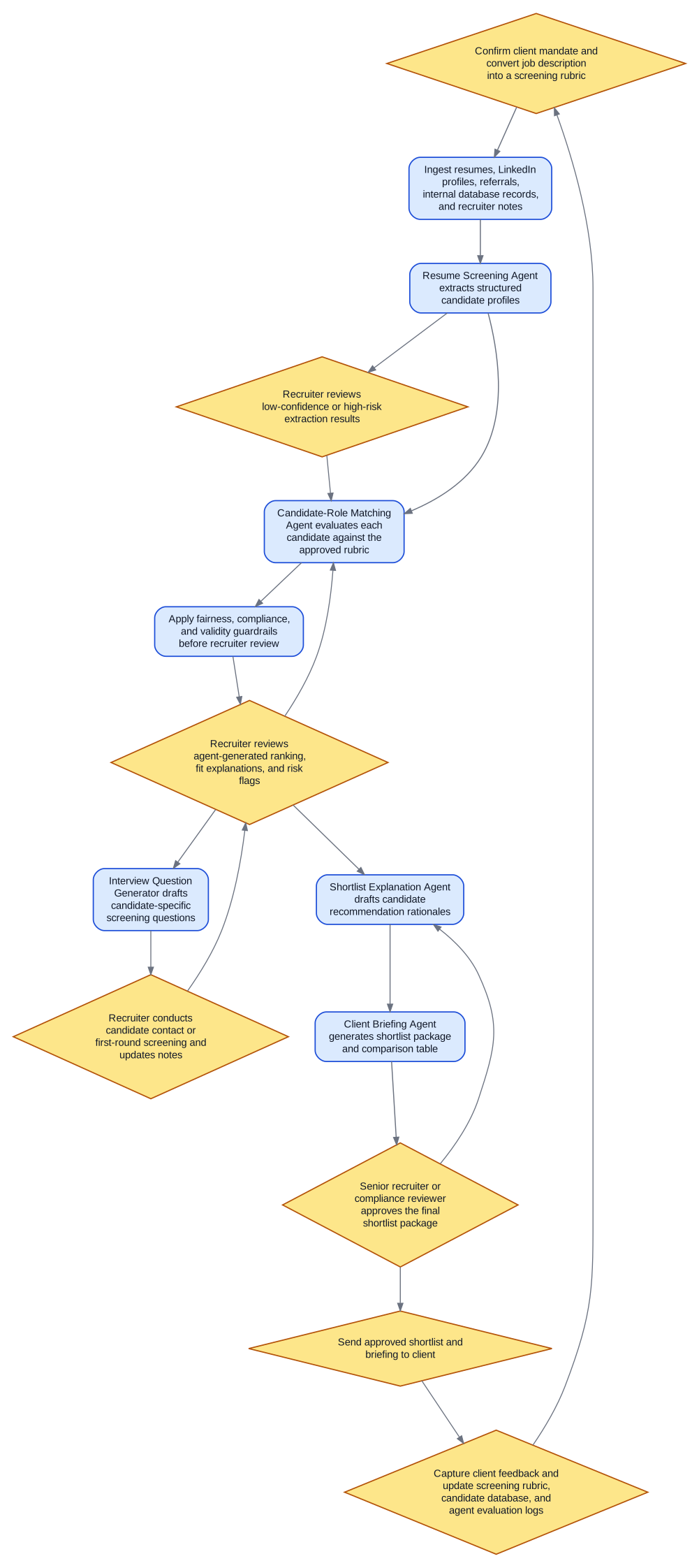
The AI Talent Screening Agent was designed as a set of specialized agents around the existing recruiter workflow.
- Inputs: Client job descriptions, approved screening rubric, resumes, LinkedIn profiles, referrals, internal candidate records, recruiter notes, candidate clarification notes, and client feedback.
- Understanding: The Resume Screening Agent extracts structured candidate profiles from unstructured resumes and LinkedIn-style text. It separates facts from inferred skills and marks missing information.
- Reasoning: The Candidate-Role Matching Agent evaluates each candidate against the approved role rubric, with separate fields for required skills, preferred skills, seniority, industry relevance, compensation fit, availability, risks, and uncertainty.
- Actions: The Interview Question Generator drafts candidate-specific screening questions. The Shortlist Explanation Agent writes evidence-based recommendation rationales. The Client Briefing Agent creates comparison tables and a client-ready shortlist package.
- Memory/state: The system stores each mandate, rubric version, candidate profile, matching rationale, recruiter override, client feedback, and final outcome as structured workflow state.
- Human review points: Recruiters approve the screening rubric, review low-confidence extraction results, inspect rankings and fit explanations, conduct candidate contact, approve shortlist rationales, and sign off before anything is sent to the client.
- Out-of-scope actions: The agent does not make final hiring decisions, reject candidates without human review, message clients without approval, infer protected characteristics, or use informal client preferences that are not job-related.
The design therefore changes the recruiter’s role. Recruiters no longer begin by manually reading every document from zero. They begin by reviewing structured evidence, correcting uncertainty, deciding whether the agent’s comparison is valid, and owning the final recommendation.
6. One Workflow Walkthrough
A client sent the agency a mandate for a mid-level B2B Sales Manager. The account manager converted the job description into a screening rubric: enterprise sales experience, CRM discipline, pipeline ownership, regional market exposure, English communication, salary range, and start-date availability. The Resume Screening Agent ingested 180 resumes and LinkedIn profiles, extracted structured fields, and flagged 22 profiles with incomplete salary or availability information. The Candidate-Role Matching Agent compared each candidate with the approved rubric and produced fit, gap, risk, and evidence fields.
One candidate ranked highly for enterprise sales and regional client exposure, but the agent marked a low-confidence leadership inference because the resume used phrases like “supported team targets” without clear management responsibility. The recruiter reviewed the source evidence, contacted the candidate, and confirmed that the candidate had led two junior account executives informally but did not hold a formal manager title. The recruiter adjusted the fit note, kept the candidate on the shortlist as a strong commercial fit with a leadership-validation question, and approved the Interview Question Generator’s proposed screening questions. The Client Briefing Agent then produced a comparison table and candidate narrative, which the senior recruiter reviewed before delivery. The case was logged with the recruiter override and client feedback for future mandates.
7. Results
- Baseline period: Manual workflow observed during previous comparable hiring mandates.
- Evaluation period: Prototype-to-pilot workflow design for one recruitment-agency use case.
- Workflow scope/sample: High-volume resume screening, candidate-role comparison, interview-note drafting, shortlist explanation, and client briefing preparation.
- Process change: The workflow shifted extraction, initial comparison, question drafting, shortlist explanation, and briefing assembly from manual recruiter production to AI-prepared drafts with human review gates.
- Decision/model change: Candidate evaluation became more component-level: required skills, preferred skills, industry fit, seniority, compensation, availability, uncertainty, and risk were separated instead of being compressed into an informal “good fit” judgment.
- Business effect: Expected benefits include faster shortlist preparation, more consistent candidate comparison, stronger client-facing explanations, and better reuse of client feedback.
- Evidence status: Estimated for case-study design. The workflow should be validated in pilot by measuring time-to-shortlist, recruiter override rate, client interview acceptance rate, candidate false-positive rate, candidate false-negative review samples, and fairness audit indicators.
The most important result is not “AI screens resumes faster.” The more defensible result is that the agency can convert a messy expert-service workflow into a traceable decision-support process.
8. What Failed First and What Changed
The first version over-relied on a single fit score. Recruiters found that the score was easy to sort but hard to trust. A candidate could receive a high score because of keyword overlap while still being weak on the client’s real priority, or receive a lower score despite having transferable experience described in different language. The design was changed so the agent produced component-level evidence: must-have fit, preferred-skill fit, seniority fit, compensation fit, availability, uncertainty, and specific source snippets. Low-confidence or high-impact claims were routed to recruiter review. The remaining limitation is that structured evidence improves review quality, but it does not remove the need for recruiter judgment or ongoing fairness checks.
9. Management Responsibilities
The new workflow requires operational ownership, not just model deployment.
- Account manager: Confirms the mandate, approves the screening rubric, and checks that client preferences are job-related.
- Recruiter: Reviews agent outputs, contacts candidates, corrects uncertain claims, approves candidate-specific interview questions, and owns the shortlist judgment.
- Senior recruiter or compliance reviewer: Reviews final shortlist quality, fairness concerns, unsupported claims, and client-facing wording.
- Operations lead: Monitors turnaround time, override rates, rejected-candidate review samples, and whether client feedback is being converted into reusable rubric updates.
- Data/process owner: Maintains candidate data provenance, role rubric versions, audit logs, and retention rules.
This division of responsibility prevents the AI system from becoming an unaccountable ranking machine. The agents accelerate preparation, but the organization remains responsible for the recommendation.
10. Transferable Lessons
- Do not automate the final judgment first. Start by automating evidence extraction, structured comparison, and explanation drafting.
- Turn human review into a designed checkpoint. Recruiters should review uncertainty, source evidence, fairness risks, and business fit, not merely approve a ranked list.
- Keep learning loops governed. Client feedback should improve future screening only when it is job-related, documented, and compliant with fairness rules.
This case shows that agentic AI works best when the organization can decompose expert work into observable steps, assign preparation tasks to agents, and preserve human accountability at the moments where judgment, fairness, and client trust matter most.
References
-
Frank P.-W. Lo et al., “AI Hiring with LLMs: A Context-Aware and Explainable Multi-Agent Framework for Resume Screening,” arXiv:2504.02870, 2025. https://arxiv.org/abs/2504.02870 ↩︎
-
Chengguang Gan, Qinghao Zhang, and Tatsunori Mori, “Application of LLM Agents in Recruitment: A Novel Framework for Resume Screening,” arXiv:2401.08315, 2024. https://arxiv.org/abs/2401.08315 ↩︎
-
Hayate Iso et al., “Evaluating Bias in LLMs for Job-Resume Matching: Gender, Race, and Education,” arXiv:2503.19182, 2025. https://arxiv.org/abs/2503.19182 ↩︎
-
Dena F. Mujtaba and Nihar R. Mahapatra, “Fairness in AI-Driven Recruitment: Challenges, Metrics, Methods, and Future Directions,” arXiv:2405.19699, 2024. https://arxiv.org/abs/2405.19699 ↩︎
-
Chaoran Chen et al., “Comparing Human Oversight Strategies for Computer-Use Agents,” arXiv:2604.04918, 2026. https://arxiv.org/abs/2604.04918 ↩︎