Executive Snapshot
- Client type: Mid-sized event planning agency
- Industry: Weddings, corporate conferences, exhibitions, retreats, and product launches
- Core problem: Event teams coordinated vendors, venues, budgets, guest lists, contracts, run-of-show documents, and last-minute changes through scattered chats and spreadsheets.
- Why agentic AI: The workflow required stateful coordination across messy inputs, multiple specialist roles, human approvals, and live exception handling rather than a single script or chatbot.
- Deployment stage: Prototype case design / pilot-ready workflow
- Primary result: A proposed shift from manual coordination to an AI-supported event control board where agents prepare, monitor, and flag issues while human event leads approve commitments, spending, client messages, and escalation decisions.
1. Business Context
The agency manages weddings, conferences, exhibitions, corporate retreats, and product launches, often with 10–30 active events in different planning stages. Each event generates a moving set of client briefs, vendor quotations, venue agreements, contracts, guest lists, RSVP records, budget sheets, floor plans, run-of-show documents, chat threads, email updates, and post-event reports. The old operating model depended on experienced event managers manually checking these sources and translating them into action. This mattered because a missed vendor confirmation, outdated guest count, unapproved budget change, or wrong setup time could quickly become a visible client-facing failure on event day.
2. Why Simpler Automation Was Not Enough
A fixed dashboard could show budget numbers, but it would not understand that a catering change affects guest communication, seating, staff allocation, and the run-of-show. A chatbot could answer isolated questions, but it would not maintain a reliable event state across vendor contracts, guest updates, schedule versions, risk notes, and approval history. Simple scripts also struggle when inputs arrive as partial messages, revised quotes, scanned contracts, informal client instructions, or last-minute vendor updates.
The analytical point from the agent-workflow literature is that the transformation unit is not the model prompt; it is the workflow graph. Useful agentic systems combine specialist agents, explicit information dependencies, memory, verification, human checkpoints, and execution traces.1 For this case, the goal is not to make the event manager disappear. The goal is to convert scattered coordination into a controllable operations workflow where AI agents keep state, surface exceptions, and route decisions to humans when authority, money, safety, or client trust is involved.2
3. Pre-Agent Workflow
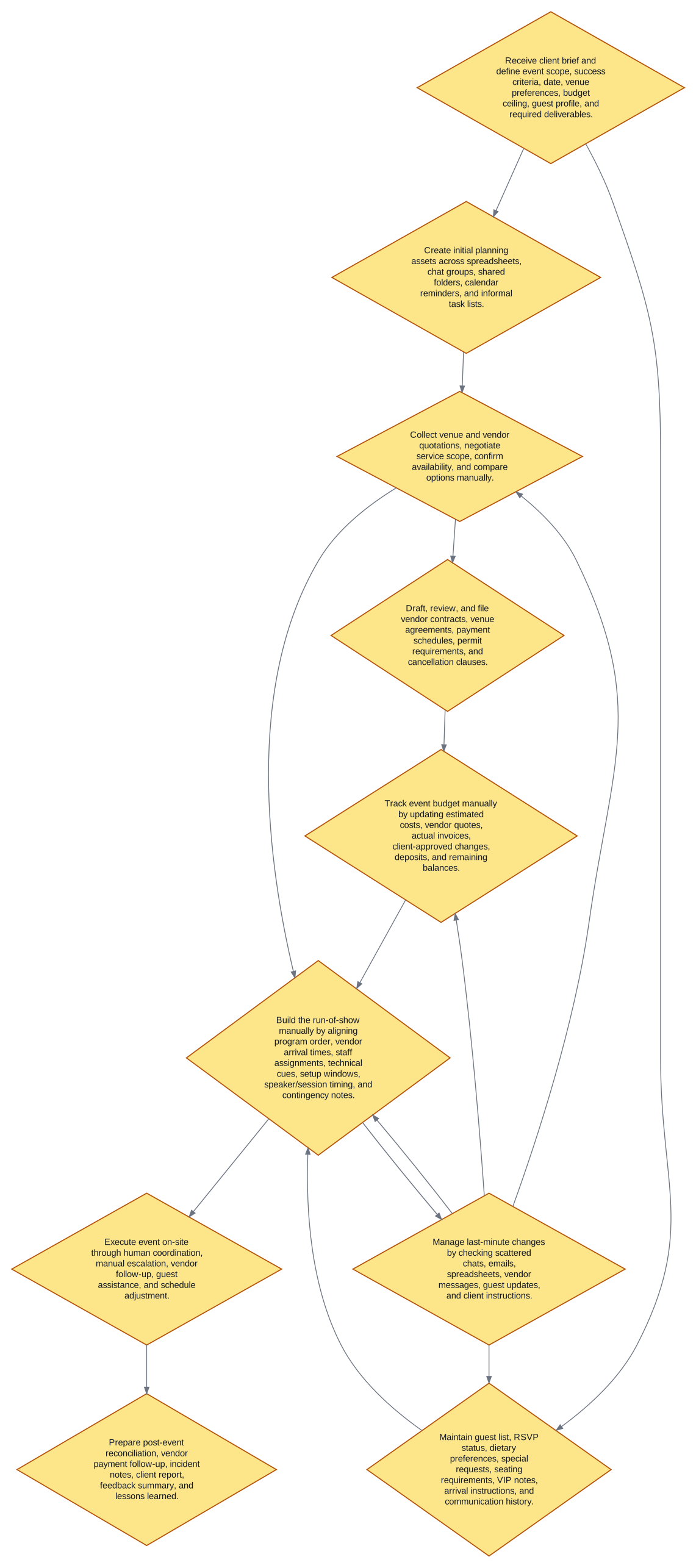
- The account lead receives the client brief and manually defines event scope, success criteria, date, venue preferences, budget ceiling, guest profile, and deliverables.
- The event manager creates planning assets across spreadsheets, chat groups, shared folders, calendar reminders, and informal task lists.
- The vendor coordinator collects quotations, checks availability, negotiates service scope, and sends contract or payment details back to the event manager.
- Finance or the event manager manually updates the budget sheet with estimates, invoices, deposits, balances, and client-approved changes.
- Guest communication, RSVP tracking, dietary preferences, VIP notes, and arrival instructions are maintained separately from vendor and budget records.
- The run-of-show is built manually by combining program order, vendor arrival times, setup windows, staff assignments, technical cues, and contingency notes.
- When last-minute changes arrive, the event manager searches emails, chats, spreadsheets, vendor messages, guest updates, and client instructions, then decides what must be revised.
- On event day, the team executes through human follow-up, manual escalation, vendor calls, guest assistance, and real-time schedule adjustment.
- After the event, staff reconstruct what happened through payment records, incident notes, feedback, and lessons learned.
Key pain points:
- The same event fact existed in several places, so the team could not easily know which version was current.
- Budget, guest, vendor, and schedule changes were connected in practice but reviewed in separate documents.
- Last-minute changes created cascading work because each update had to be manually reflected across the run-of-show, vendor call sheet, guest messages, and contingency plan.
- Management visibility depended on status meetings and personal memory rather than a structured control layer.
4. Agent Design and Guardrails
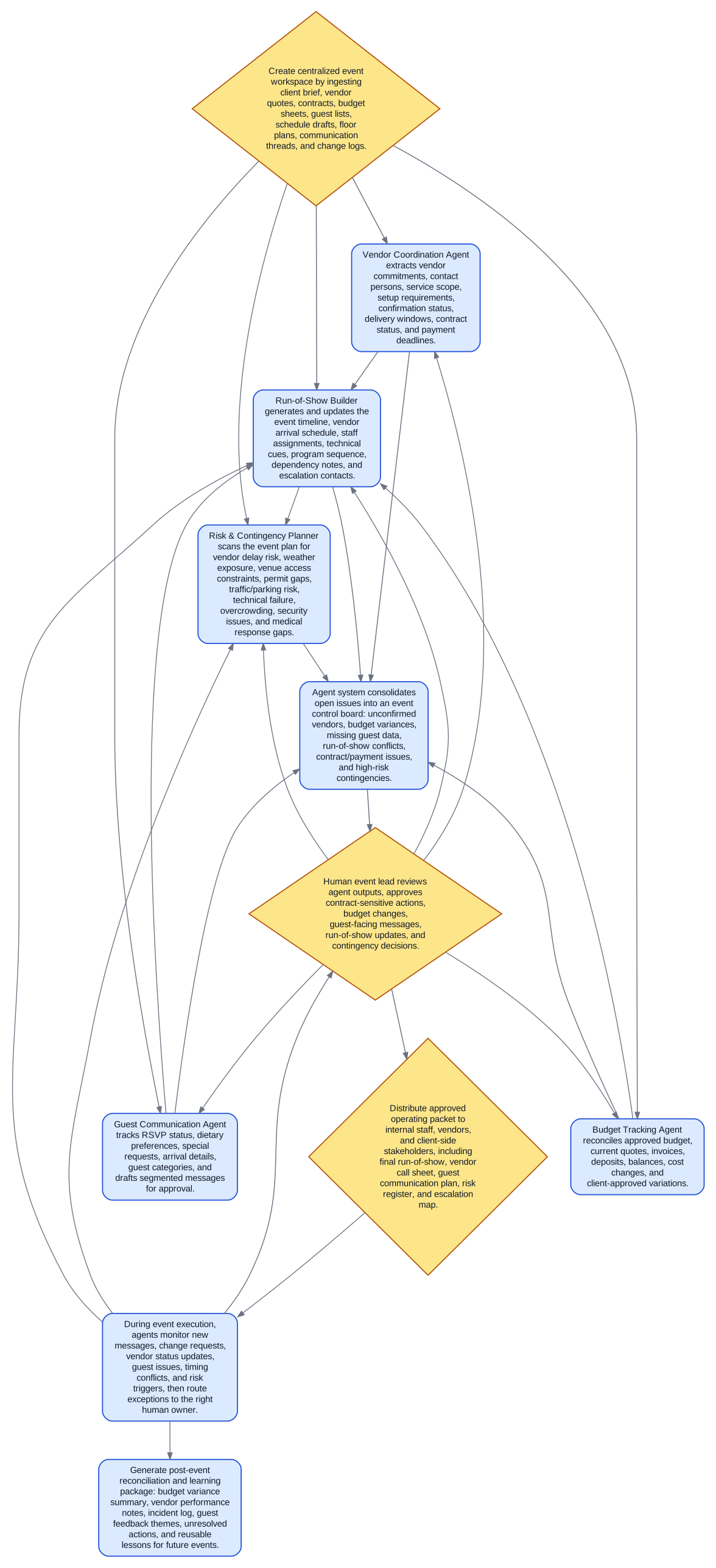
The redesigned system uses five specialist agents connected through a centralized event workspace. The Vendor Coordination Agent extracts vendor commitments, contact persons, service scope, setup requirements, confirmation status, delivery windows, contract status, and payment deadlines. The Budget Tracking Agent reconciles approved budget, quotes, invoices, deposits, balances, cost changes, and client-approved variations. The Guest Communication Agent tracks RSVP status, dietary preferences, special requests, arrival details, guest categories, and drafts segmented messages. The Run-of-Show Builder generates and updates the event timeline, vendor arrival schedule, staff assignments, technical cues, dependency notes, and escalation contacts. The Risk & Contingency Planner scans for vendor delay risk, weather exposure, venue access constraints, permit gaps, traffic problems, technical failure, overcrowding, security issues, and medical response gaps.
- Inputs: Client brief, vendor quotes, contracts, budget sheets, guest lists, RSVP records, schedule drafts, floor plans, communication exports, and change logs.
- Understanding: Document extraction, message classification, entity linking, version comparison, dependency mapping, and exception tagging.
- Reasoning: Planning, dependency checks, variance thresholds, risk ranking, approval-state tracking, and uncertainty-sensitive escalation.
- Actions: Update internal records, create issue flags, draft guest messages, generate run-of-show versions, produce risk registers, and prepare operating packets.
- Memory/state: One event workspace stores current facts, source references, approval status, unresolved issues, decision history, and post-event lessons.
- Human review points: Contract-sensitive actions, final vendor selection, budget changes, guest-facing messages, run-of-show approval, contingency choices, and event-day escalations.
- Out-of-scope actions: The agents do not sign contracts, approve spending, send sensitive VIP messages, make safety-critical decisions, or commit the client to new terms without human approval.
This design follows a role-based multi-agent pattern: agents specialize by operational domain, then report to a shared coordination layer rather than acting independently.3 The event control board is the key operational object. It consolidates unconfirmed vendors, budget variances, missing guest data, schedule conflicts, contract/payment issues, and high-risk contingencies into one reviewable queue. The human event lead remains the decision owner.
5. One Workflow Walkthrough
Two days before a 500-guest product launch, the audiovisual vendor sends a message saying the stage setup crew can only arrive at 10:00 a.m., three hours later than planned. At the same time, the client adds 18 VIP guests and asks whether the front-row seating plan can be revised.
The Vendor Coordination Agent extracts the new setup window and marks it as a vendor-change request, not yet an approved schedule update. The Run-of-Show Builder checks the current timeline and finds that the new setup time conflicts with rehearsal, booth inspection, and livestream testing. The Budget Tracking Agent checks whether overtime or additional crew cost is likely. The Guest Communication Agent identifies affected VIP seating and catering counts. The Risk & Contingency Planner flags technical-delay risk and crowd-flow risk.
The event control board groups these issues into one escalation. The event lead reviews the evidence, calls the vendor, approves a revised setup sequence, asks finance to confirm the overtime cost, and approves a revised VIP seating plan. Only after approval does the system generate the updated operating packet: revised run-of-show, vendor call sheet, VIP seating notes, and risk register. The change is logged for post-event review.
6. Results
- Baseline period: Proposed audit of the last 10 comparable events before deployment.
- Evaluation period: Planned 8-week pilot across 3–5 active events.
- Workflow scope/sample: Vendor coordination, budget tracking, guest updates, run-of-show management, risk planning, event-day exception routing, and post-event reconciliation.
- Process change: Target reduction in manual status-compilation time from several hours per major update cycle to under one hour, because vendor, budget, guest, schedule, and risk exceptions are pre-grouped on the event control board.
- Decision/model change: Event leads shift from searching for information to reviewing structured exceptions, approving sensitive actions, and resolving conflicts.
- Business effect: Expected improvement in schedule reliability, budget visibility, guest communication consistency, and management control during peak seasons.
- Evidence status: Estimated / planned pilot. These are not production measurements; they are evaluation targets to be validated through before/after logs, issue-resolution time, rework counts, budget-variance latency, and post-event incident reviews.
7. What Failed First and What Changed
The first version treated too many chat messages as confirmed facts. A casual vendor reply such as “should be okay” could be misread as a confirmed commitment, and a client question could be converted into a schedule change before approval. The fix was to add an approval-state model: request, proposed change, confirmed by source, approved by event lead, and distributed. Only approved items could update the final run-of-show or operating packet. This made the system less “automatic,” but much safer. The remaining limitation is that agents still depend on clean access to source documents and communication exports; missing channels weaken the event state.
8. Transferable Lesson
- Treat agentic AI as an operations-control layer, not merely as a content generator.
- Separate extraction, reasoning, approval, distribution, and live monitoring into visible workflow nodes.
- Use human checkpoints where the decision changes money, contracts, safety, client commitments, or external communication.
This case shows that agentic AI works best when the business problem is not one isolated task, but a moving coordination system where many small updates can create large operational consequences.
-
Chaojia Yu et al., “A Survey on Agent Workflow — Status and Future,” arXiv:2508.01186, https://arxiv.org/abs/2508.01186; Ling Yue et al., “From Static Templates to Dynamic Runtime Graphs: A Survey of Workflow Optimization for LLM Agents,” arXiv:2603.22386, https://arxiv.org/abs/2603.22386. ↩︎
-
Henry Peng Zou et al., “LLM-Based Human-Agent Collaboration and Interaction Systems: A Survey,” arXiv:2505.00753, https://arxiv.org/abs/2505.00753. ↩︎
-
Khanh-Tung Tran et al., “Multi-Agent Collaboration Mechanisms: A Survey of LLMs,” arXiv:2501.06322, https://arxiv.org/abs/2501.06322. ↩︎