Executive Snapshot
- Client type: Mid-sized customer service outsourcing company
- Industry: BPO / contact center operations serving telecom, utilities, banking, and online-service clients
- Core problem: Supervisors could manually review only a small fraction of calls, so poor service quality, compliance risks, and training gaps were discovered late.
- Why agentic AI: The workflow required transcript understanding, risk ranking, client-specific rule checks, coaching preparation, and human review routing rather than a simple dashboard or chatbot.
- Deployment stage: Prototype-to-pilot workflow design
- Primary result: A redesigned QA operating model that expands review coverage, prioritizes supervisor attention, and converts call evidence into coaching, compliance, and management reporting.
1. Business Context
The company operates multiple client accounts, each with its own call scripts, verification requirements, escalation rules, service-level expectations, and QA scorecards. Every day, frontline agents handle high-volume inbound and outbound calls for billing issues, service interruptions, account changes, complaints, and product questions. Calls are recorded, basic metadata is stored, and QA reviewers manually select a small sample for evaluation. This process creates an operational blind spot: a call can contain a missed disclosure, a frustrated customer, or a repeated agent mistake, but the issue may not appear in the sampled set until weeks later, often after a complaint or client escalation.
2. Analytical Point: Agentic AI as Governed Triage, Not Autonomous Judgment
The strongest analytical point from recent arXiv work is that the value of agentic AI in contact-center QA comes from coverage expansion plus governed triage, not from replacing supervisors. LLM-based contact-center analytics can turn messy transcripts into call drivers, topic clusters, trends, and summaries that administrators can use operationally.1 However, contact-center planning work shows that production systems must explicitly manage dependencies between structured tools, transcript retrieval, and synthesis steps; otherwise multi-step plans can silently fail through wrong tool choice, missing inputs, or incorrect dependency wiring.2 Auto-QA fairness research also warns that LLM-based workforce evaluation can produce score shifts and judgment reversals across counterfactual agent identities, behavioral styles, and contextual cues.3 ASR reliability research adds another dependency risk: downstream QA decisions may be unsafe when transcript quality is poor under realistic acoustic, demographic, or linguistic conditions.4 Therefore, the case design treats AI as an evidence-producing, risk-routing, coaching-drafting layer, with human checkpoints for compliance findings, client-facing reports, and personnel-impacting decisions. This is consistent with agentic BPM guidance that agent adoption needs clear goals, legal and ethical guardrails, human-agent collaboration, risk management, and fallback options.5
3. Why Simpler Automation Was Not Enough
A fixed dashboard could show call volume, average handle time, or customer satisfaction scores, but it could not explain why quality was slipping inside actual conversations. A rule-based script checker could detect a few required phrases, but it would miss context: whether identity verification happened before account disclosure, whether the agent made an unsupported promise, or whether the customer’s frustration increased after an unclear explanation. A chatbot alone would also be misplaced because the problem was not customer self-service; it was managerial visibility across thousands of agent-customer interactions. The workflow needed a stateful agent system that could ingest transcripts, apply client-specific rules, score escalation risk, preserve evidence spans, route exceptions to reviewers, and learn from supervisor overrides.
4. Pre-Agent Workflow
Before the AI agents were introduced, the QA workflow was human-coordination-heavy and sample-constrained.
- Agents handled calls for multiple client accounts. Each agent was expected to follow the relevant client script, verification sequence, disclosure language, escalation rules, and closing procedure.
- Calls were recorded and stored with basic metadata. The operations system captured call ID, agent ID, client account, queue, duration, disposition, and recording link.
- QA reviewers selected a small random or supervisor-nominated sample. Sampling was shaped by quotas, complaints, agent tenure, client risk level, and supervisor judgment.
- QA reviewers listened to sampled calls and completed manual scorecards. They checked greeting, verification, empathy, issue resolution, script adherence, escalation handling, and prohibited language.
- Supervisors decided whether to coach, escalate, or report. Confirmed findings were passed to team leaders for coaching, to compliance owners for serious issues, or to account managers for client reporting.
- Weekly or monthly summaries were manually compiled. Reports aggregated only the reviewed calls, leaving managers uncertain whether visible problems represented isolated cases or broader patterns.
- Scripts and training were updated slowly. Recurring issues had to become visible through sampled calls, complaints, or client feedback before process changes were approved.
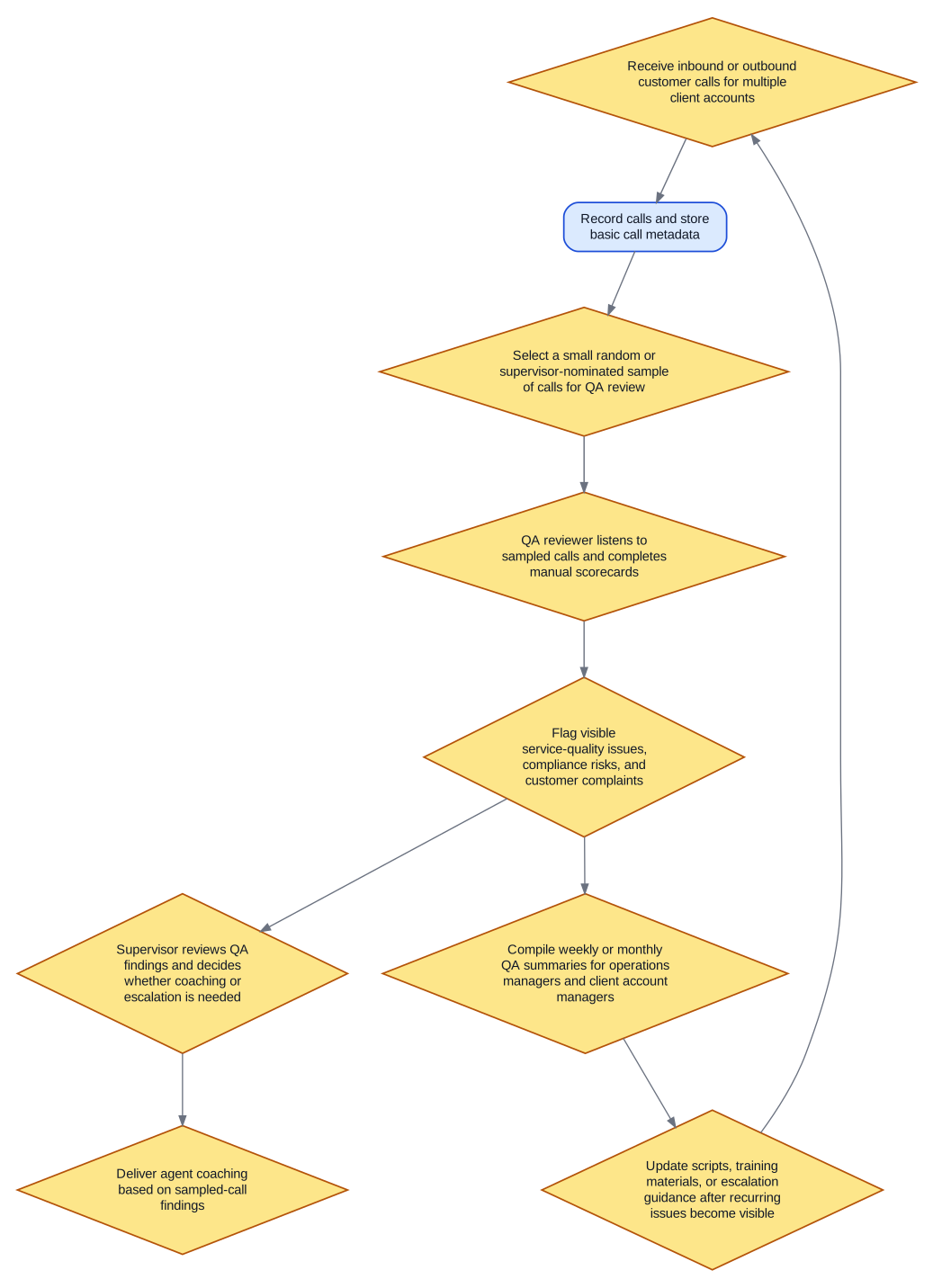
Key pain points:
- QA coverage was too narrow to detect repeated failures early.
- Compliance risks were discovered late because only sampled calls received detailed review.
- Coaching was evidence-based but incomplete, often tied to a few reviewed calls rather than patterns across many interactions.
- Reports could overstate certainty because sample limits were not always visible to clients or account managers.
- Supervisors spent their time searching for problems rather than validating and acting on prioritized evidence.
5. Agent Design and Guardrails
The AI Call Center Quality Assurance Agent system was designed as a governed workflow layer over recordings, transcripts, CRM notes, QA rubrics, and client-specific rule packs.
- Inputs: Call recordings, speech-to-text transcripts, call metadata, CRM notes, agent metadata, client scripts, QA scorecards, disclosure rules, escalation policies, and prior coaching records.
- Understanding: The Call Transcript Reviewer extracts the call reason, customer issue, agent actions, resolution status, follow-up needs, and supporting transcript spans.
- Reasoning: The Sentiment & Escalation Detector scores frustration, cancellation risk, repeated-complaint signals, and supervisor-request indicators. The Compliance Checker compares transcript events with identity verification rules, mandatory disclosures, prohibited promises, and client-approved scripts.
- Actions: The risk triage engine ranks calls by severity, model confidence, client risk tier, customer impact, agent history, and transcript quality. The Agent Coaching Assistant drafts coaching notes and recommended training modules. The QA Report Generator creates daily, weekly, monthly, and client-specific summaries.
- Memory/state: The system stores call-level findings, evidence spans, reviewer accept/edit/reject decisions, coaching status, rule-pack version, prompt/model version, and known transcript-quality issues.
- Human review points: Supervisors validate high-impact findings; QA leads confirm critical compliance labels; team leaders approve coaching notes before delivery; account managers approve client-facing reports; compliance owners approve changes to regulated scripts or disclosures.
- Out-of-scope actions: The AI system does not discipline agents, send regulatory notices, change client-approved scripts, promise customer remediation, or issue client-facing incident reports without human approval.
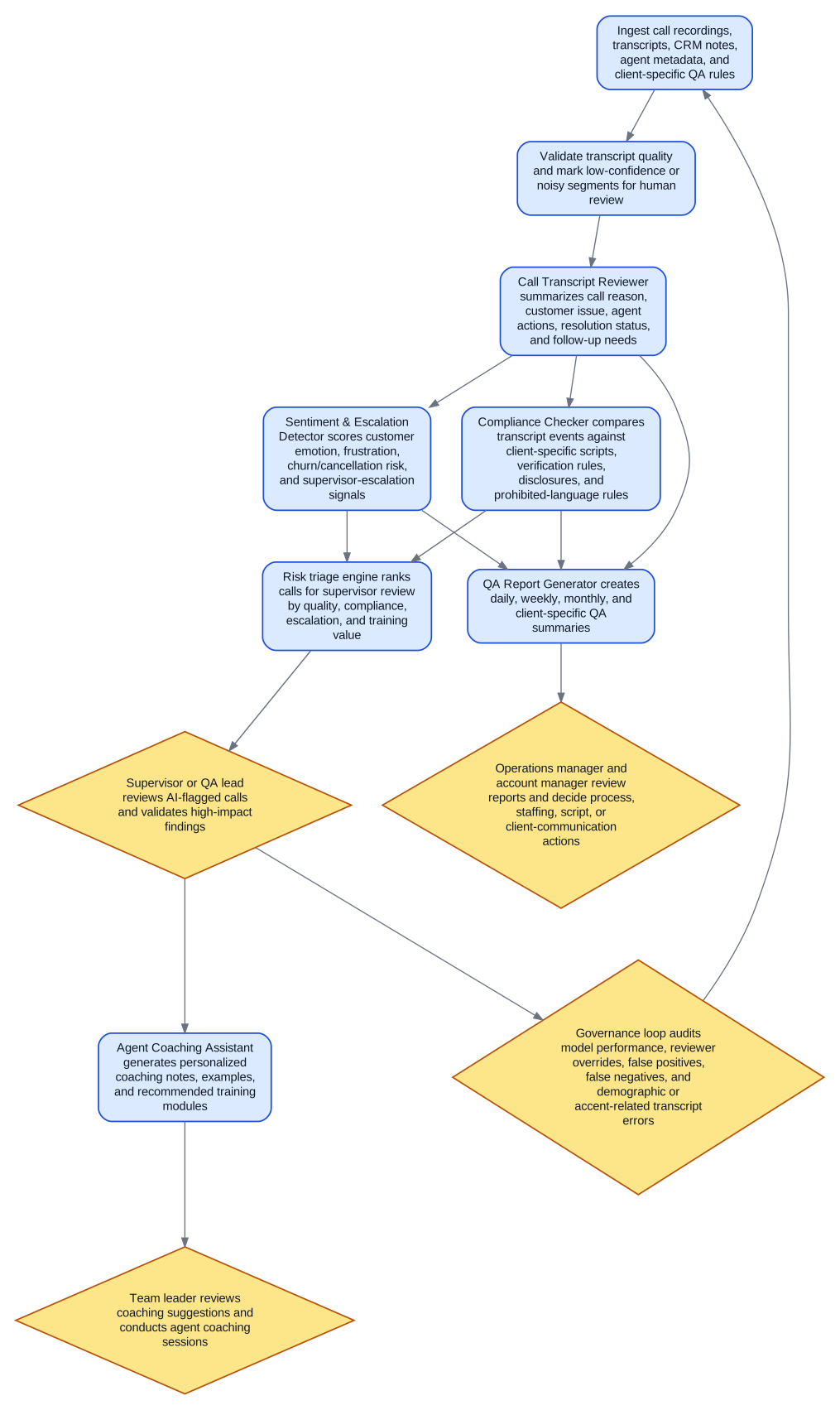
6. Post-Agent Workflow
After the agentic AI workflow is introduced, the organization changes from random inspection to continuous review and prioritized human validation.
- The system ingests call recordings, transcripts, CRM notes, agent metadata, and rule packs. Each call is mapped to the correct client account and QA rubric.
- Transcript quality is checked before scoring. Low-confidence audio, noisy segments, speaker-diarization problems, and unclear timestamps are marked for playback review instead of being treated as final evidence.
- The Call Transcript Reviewer structures the conversation. It produces a concise record of the call reason, customer issue, agent steps, resolution status, follow-up needs, and evidence spans.
- The Sentiment & Escalation Detector identifies risk signals. It flags anger, confusion, repeated complaints, cancellation threats, unresolved prior issues, and requests for supervisors.
- The Compliance Checker applies client-specific rules. It tests whether identity verification, disclosures, privacy requirements, documentation steps, and escalation obligations were followed.
- The risk triage engine ranks calls for supervisor review. It separates severity from confidence, so a low-confidence but high-severity case still enters the review queue.
- Supervisors validate high-impact findings. Reviewers see transcript snippets, audio timestamps, AI rationale, rule references, and accept/edit/reject actions.
- The Agent Coaching Assistant drafts coaching guidance. It proposes skill gaps, example language, policy references, practice tasks, and follow-up dates.
- Team leaders approve and deliver coaching. Coaching remains developmental by default; disciplinary use requires a separate HR or compliance path.
- The QA Report Generator produces management and client summaries. Reports distinguish AI-detected signals, human-confirmed findings, unresolved cases, and sample limitations.
- Operations and account managers decide process actions. Trends can trigger script updates, training refreshes, escalation-rule changes, staffing review, or client issue briefs.
- A governance loop audits the system. Model performance, reviewer overrides, false positives, false negatives, transcript errors, prompt versions, and rule-pack changes are reviewed regularly.
7. One Workflow Walkthrough
A banking client’s customer called about a disputed fee and became frustrated after the agent explained the adjustment policy. The transcript was ingested with the call ID, agent ID, account queue, CRM disposition, and the bank’s QA rule pack. The Call Transcript Reviewer summarized the issue as a billing dispute with partial resolution. The Sentiment & Escalation Detector flagged rising frustration because the customer repeated that the problem had occurred before and asked for a supervisor. The Compliance Checker then detected a possible sequencing problem: account details may have been discussed before the full verification script was completed. Because the compliance flag was serious but the transcript confidence around the verification segment was imperfect, the case was routed to a QA lead for playback review. The QA lead confirmed the missed verification step, edited the AI note to clarify the exact timestamp, and approved a coaching draft for the team leader. The final record was logged as a human-confirmed compliance issue, a coaching action, and an input to the weekly banking-client QA report.
8. Results and Measurement Plan
- Baseline period: Last 30 days before pilot launch.
- Evaluation period: First 6–8 weeks of pilot operation.
- Workflow scope/sample: One banking client account, one telecom client account, and a selected group of frontline agents across normal and high-risk queues.
- Process change: Manual QA remains, but the first pass shifts from human sampling to automated transcript structuring, risk scoring, and queue routing.
- Decision/model change: Supervisors review prioritized calls with evidence spans and rule references, while low-confidence transcript segments trigger audio playback review.
- Business effect: The expected benefit is earlier detection of compliance risks, more targeted coaching, clearer reporting, and reduced dependence on random sampling.
- Evidence status: Planned pilot measurement. No production improvement percentage is claimed yet.
The pilot should track five practical metrics: reviewed-call coverage, time from call completion to risk flag, human override rate, false-positive/false-negative rate from calibration samples, and coaching completion-to-improvement trend. The management report should separate measured outcomes from estimates, and it should explicitly label whether a finding is AI-detected, human-confirmed, or unresolved.
9. What Failed First and What Changed
The first version over-treated AI scores as QA conclusions. It produced useful summaries, but some compliance flags were too brittle when transcripts had noisy audio, overlapping speech, or unclear speaker labels. The fix was to add a transcript-quality gate before QA scoring and to require evidence spans, timestamps, rule references, and confidence labels for every material finding. The workflow also separated three outcomes: AI-detected, human-confirmed, and unresolved. This reduced the risk that supervisors would treat a model output as a final judgment. A remaining limitation is that fairness and ASR reliability cannot be solved only through prompting; they require periodic audit samples, reviewer calibration, and careful decisions about what employee or demographic data can legally and ethically be used for monitoring.
10. Transferable Lessons
- Use AI to widen visibility, not to remove accountability. The most valuable shift is from low-coverage sampling to high-coverage triage, with humans still responsible for high-impact decisions.
- Separate detection, confirmation, and action. A transcript flag should not automatically become a compliance incident, coaching record, or client report.
- Make governance operational. Store rule versions, model versions, evidence spans, reviewer overrides, and transcript-quality flags as part of the workflow, not as an afterthought.
This case shows that agentic AI works best when it turns messy operational evidence into structured queues, decisions, and feedback loops while preserving human authority where judgment, fairness, and accountability matter most.
Cognaptus: Automate the Present, Incubate the Future
-
Sourabh Zanwar, Ali Ben Hamza, and Tarun Kumar, “LLM-Based Insight Extraction for Contact Center Analytics and Cost-Efficient Deployment,” arXiv:2503.19090, 2025. https://arxiv.org/abs/2503.19090 ↩︎
-
Varun Nathan, Shreyas Guha, and Ayush Kumar, “Tool-Aware Planning in Contact Center AI: Evaluating LLMs through Lineage-Guided Query Decomposition,” arXiv:2602.14955, 2026. https://arxiv.org/abs/2602.14955 ↩︎
-
Kawin Mayilvaghanan, Siddhant Gupta, and Ayush Kumar, “Counterfactual Fairness Evaluation of LLM-Based Contact Center Agent Quality Assurance System,” arXiv:2602.14970, 2026. https://arxiv.org/abs/2602.14970 ↩︎
-
“Back to Basics: Revisiting ASR in the Age of Voice Agents,” arXiv:2603.25727, 2026. https://arxiv.org/abs/2603.25727 ↩︎
-
“Agentic Business Process Management: Practitioner Perspectives on Agent Governance in Business Processes,” arXiv:2504.03693, 2025. https://arxiv.org/abs/2504.03693 ↩︎