TL;DR for operators
Hospital AI systems rarely receive a standardized bundle of ECGs, echocardiograms, and chest X-rays. One patient may have ECG and CXR, another ECG and Echo, while each modality contains its own leads, views, frames, or images. The architectural question is whether these sources should remain in largely separate representation pipelines until downstream fusion, or whether they should learn from one another earlier.
A self-supervised model can learn by hiding parts of an input and training itself to reconstruct what was removed. Agostini and colleagues extend that idea with Latent-Attention Masked Autoencoders, or LAMAE.1 Against an otherwise matched Independent MAE trained on the same multimodal data for the same duration, LAMAE improves AUROC on all six evaluated hospital-stay tasks. Because the baseline sees the same multimodal data but lacks the interaction mechanism, the comparison indicates that exposure to multiple modalities is not equivalent to letting their representations exchange information during pretraining.
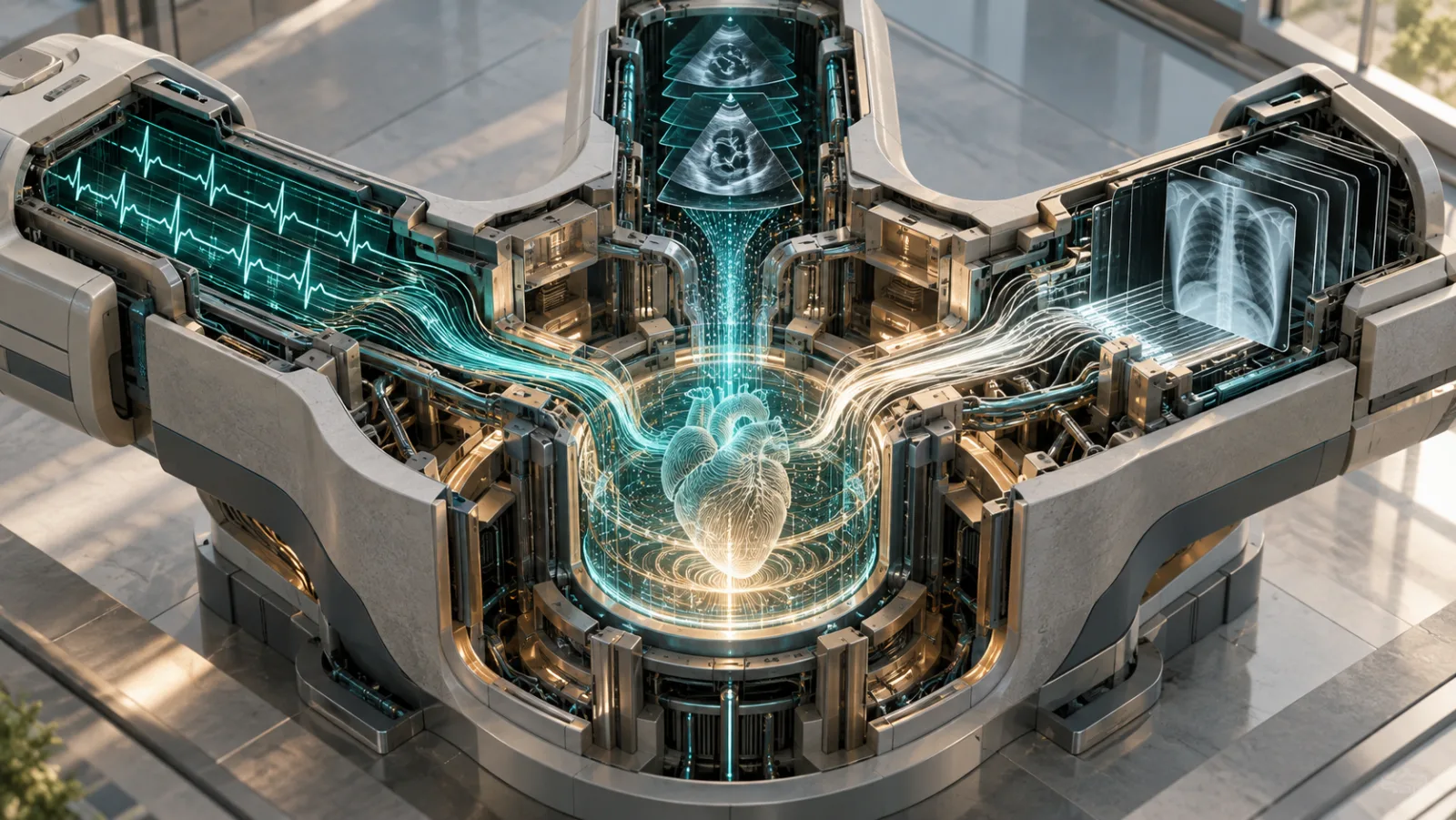
LAMAE first converts each modality into compact internal representations and then lets those representations attend to one another. It also preserves structure within modalities—such as leads, views, and frames—and can remove complete structured units during reconstruction rather than hiding only scattered patches.
For a clinical AI platform, the result supports evaluating modality-specific front ends connected to a shared latent representation layer rather than assuming that modality isolation is the safest default. It does not show that multimodal pretraining universally improves models later given only one modality: Echo and most ECG probes improve, while the CXR difference from independent pretraining is within seed variance. All reported evidence also comes from the MIMIC-IV ecosystem.
The same patient rarely produces the same input bundle
A hospital stay does not arrive as a fixed tensor with one ECG, one Echo study, and one chest X-ray. Some stays contain ECG and CXR but no Echo. Others contain different combinations. Inside each modality, the structure varies again: ECGs have multiple leads, Echo studies contain frames and views, and CXR studies can contain multiple images.
A common architecture can accommodate this operational mess by encoding each source separately and combining the representations only when a downstream task requires them. That keeps modality pipelines modular, but it leaves a question unresolved: if two observations describe the same patient state, should their representations learn from one another before labeled downstream training begins?
LAMAE is designed around that question. A masked autoencoder learns without labels by hiding portions of an input and reconstructing what was removed. LAMAE extends that setup across ECG, Echo, and CXR while preserving the internal structure of each modality.
The matched baseline makes interaction the main result
The cleanest evidence is the comparison with the paper’s Independent MAE. Both models see the same multimodal pretraining data and train for the same duration. The Independent MAE removes the shared latent-attention interaction, so modality-specific encoders learn without exchanging latent information.
LAMAE performs better on all six hospital-stay tasks:
| Task | Independent MAE AUROC | LAMAE AUROC | Difference |
|---|---|---|---|
| In-hospital mortality | 90.51 | 91.59 | +1.08 |
| ICD-10 Chapter IX | 81.66 | 83.02 | +1.36 |
| DRG code | 57.46 | 58.92 | +1.46 |
| DRG severity | 69.08 | 70.29 | +1.21 |
| DRG mortality risk | 71.14 | 72.21 | +1.07 |
| Length of stay | 80.87 | 81.70 | +0.83 |
These are benchmark gains rather than evidence of clinical outcome improvement. Still, the comparison changes an architectural assumption: exposing separate encoders to the same multimodal dataset does not recover everything that is gained by allowing their representations to interact during pretraining.
Against the broader baselines MedSigLip and ProbMED, LAMAE records the best reported result on five of six tasks. DRG-code prediction is the exception, where MedSigLip and ProbMED are slightly higher. That makes the matched Independent MAE comparison more informative than declaring universal benchmark dominance.
Latent attention moves integration away from raw inputs
LAMAE does not concatenate every raw ECG, Echo, and CXR token into one enormous sequence. Modality-specific encoders first convert visible content into latent representations. A shared latent-attention module then processes the representations from whatever modalities are present and produces both updated latent tokens and a multimodal summary representation.
The model organizes observations through a study–view–entity hierarchy. This matters because a modality is not treated as one indivisible object. Leads, frames, views, and images remain identifiable structured units while information can still move between them.
The reconstruction loss is calculated only over observed modalities. A hospital stay without an Echo study does not require a synthetic Echo input merely to satisfy the training objective. Architecturally, this gives the model a direct way to accommodate incomplete modality combinations.
Masking whole entities changes what reconstruction can teach
Standard masked reconstruction can often rely on nearby visible patches. LAMAE adds full-entity masking: an entire lead, frame, view, or comparable structured unit can be removed while the remaining entities are patch-masked at an adjusted rate to preserve the intended overall masking ratio.
The learning pressure is different. Reconstruction can require information from another entity within the same modality and, when complementary observations are available, from another modality.
The Echo appendix tests this mechanism and related temporal settings as ablations rather than as a second central claim. Dropping frames during pretraining generally improves LVEF regression relative to using no entity dropping, but performance does not change monotonically with the number of dropped frames. Separate tests of temporal patch size and clip length also produce mixed results. These experiments support sensitivity to structural masking choices; they do not establish one universally optimal configuration.
Multimodal strength does not guarantee unimodal strength
A stronger joint model might seem likely to produce a stronger encoder when only one modality is later available. The paper’s results are more selective.
For Echo LVEF regression, modality-specific LAMAE improves MAE from 8.97 to 8.29 percentage points and raises reported $R^2$ from 0.306 to 0.412 relative to Independent MAE. For ECG interval regression, LAMAE improves five of six targets, including sizeable MAE reductions for QT and QTc. QRS is the exception and remains within seed variation.
CXR provides the counterexample. Modality-specific LAMAE reaches 82.01 macro AUROC versus 81.87 for Independent MAE, but the authors state that this difference lies within seed variance. Multimodal-pretrained LAMAE finetuned on CXR alone reaches 81.85.
The supported claim is thus narrower: structured interaction can strengthen unimodal representations in some modalities, but multimodal pretraining is not a general-purpose upgrade for every single-modality deployment.
The platform implication is architectural, not clinical
Cognaptus’ inference is that clinical AI platform teams have a concrete architecture worth testing: modality-specific front ends feeding a shared latent representation layer rather than fully isolated representation stacks maintained through the entire model lifecycle.
The potential operational gain is consolidation. A shared pretrained layer could support patient-level tasks that consume varying modality combinations while also supplying modality-specific downstream models. If transfer remains adequate, that may reduce duplicated pretraining infrastructure and make incomplete diagnostic workflows a native training condition rather than an exception handled downstream.
The evidence does not establish the economics of that consolidation, nor does it show improved patient outcomes. Those depend on deployment workload, retraining requirements, institutional data distributions, and validation outside the research environment.
External validation is the next gating condition
Every reported pretraining and evaluation result comes from the MIMIC-IV ecosystem. Cross-institutional transfer is untested, and the restricted-modality hospital-stay experiments require additional care: when an accepted modality is absent, the evaluation substitutes the training-set mode. Those scores therefore reflect both representation capability and how often the chosen modality is actually available.
The available preprint also leaves its modality-specific architecture appendix marked “TBD,” which limits reproducibility from the document alone. One Echo-only DRG-code value is internally inconsistent as well: the prose reports 17.60 AUROC while Table 2 reports 42.36. The discrepancy does not affect the matched LAMAE-versus-Independent-MAE result, but it is a reason not to overinterpret the restricted-modality table.
LAMAE’s strongest contribution is narrower and more actionable: when multimodal observations describe the same clinical episode, interaction during self-supervised pretraining can add information that separate encoders trained on the same data do not capture. The next decision for a platform team is not whether to replace existing clinical models wholesale. It is whether a shared latent layer deserves validation as common infrastructure—and whether its gains survive the institution, modality mix, and downstream tasks where it would actually operate.
Cognaptus: Automate the Present, Incubate the Future.
-
Andrea Agostini and Simon Böhi and Moritz Vandenhirtz and Samuel Ruiperez-Campillo and Max Krähenmann and Silke Mühlstedt and Irene Cannistraci and Ece Özkan Elsen and Julia E. Vogt and Thomas M. Sutter (2026). Reading the Whole Heart: Latent-Attention Masked Autoencoders for Multimodal Cardiac Representation Learning. arXiv:2609.12035. https://arxiv.org/abs/2609.12035 ↩︎